
Cape Town Airbnb owners brace for rates shake-up
Cape Town's new short-term rental rules (starting 2027) will reclassify properties, hiking rates & impacting investor yields. Learn how the city, hosts, & banks are adapting.
Cape Town is shaking up its short-term rental rules starting July 1, 2027. If you rent your place out often, it'll be seen as a business, not a home, meaning much higher taxes and fees. This change aims to balance the booming holiday rental market with the need for long-term housing. Property owners are now looking for clever ways to adapt, like limiting rental nights or converting units, to avoid the steep new costs. It's a big shift, making many wonder if they should keep renting short-term or switch to long-term leases.
What are the new rules for short-term accommodation in Cape Town?
Cape Town's new by-law, effective July 1, 2027, reclassifies short-term lets from "Residential" to "Commercial" for property rates if a unit is advertised/rented for over 180 nights, listed for over 210 nights, or not used as a primary residence. This significantly increases rates and other service charges.
Get Cape Town news in your inbox
Stay updated with the latest stories from the Mother City.
The Numbers You Need to Know
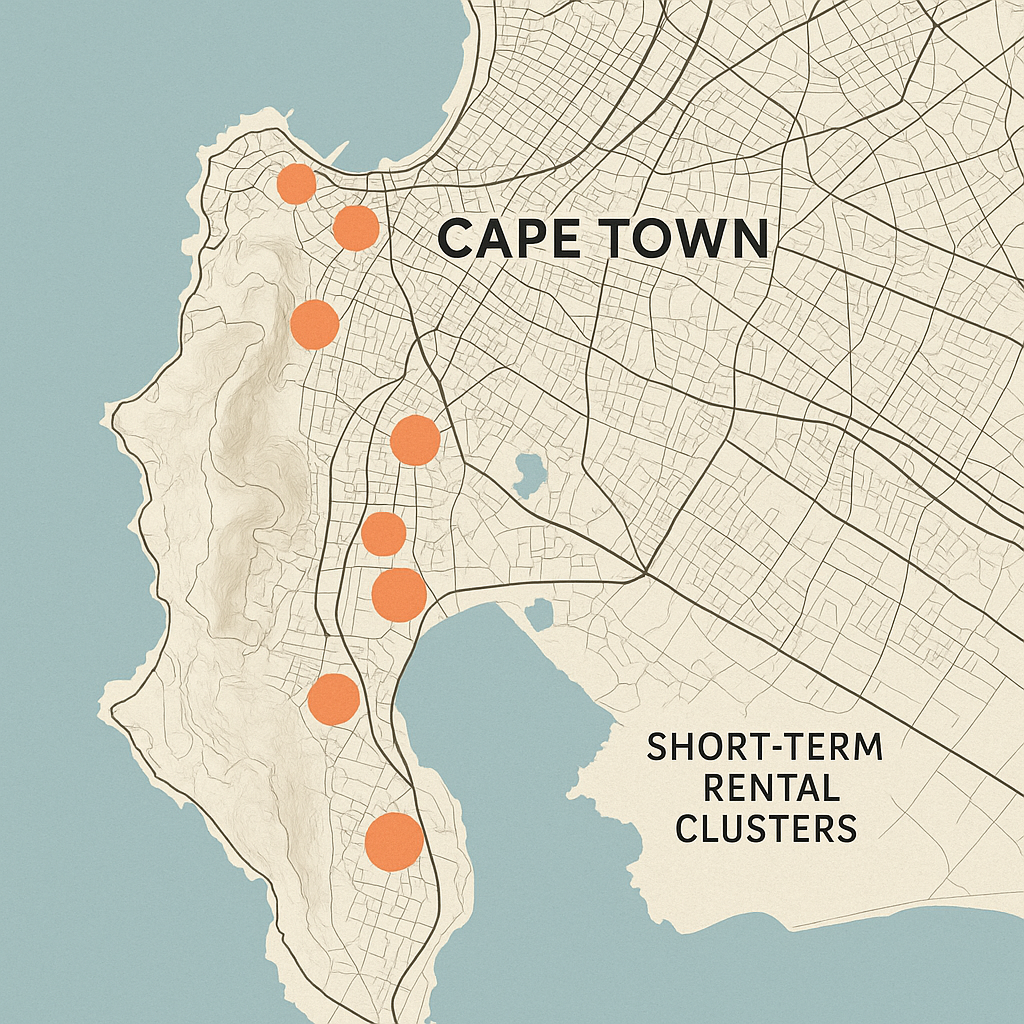
Signal Hill, Sea Point and the City Bowl have become one sprawling digital hotel. On any given night more than seven thousand short-stay listings are live, and their geographic fingerprints are surprisingly tight: just under half lie inside a five-kilometre halo around the CBD, the Atlantic Seaboard claims another one in five, and the V&A Waterfront precinct corners roughly one in eight.
AirDNA, an independent scraping service that polls the big platforms every day, says hosts in the metro banked R4.3 billion in 2023. Once you fold in tips to cleaners, restaurant tabs late at night, Uber rides from the airport and the odd guided township tour, the City’s own economists reckon the broader spend tops R860 million – about three percentage points of Cape Town’s annual tourism GDP.
The concentration matters. So does the scale. Together these listings deliver almost as much revenue as the province’s entire wine-route tasting-room spend, yet they sit in ordinary sectional-title blocks once designed for full-time residents. Which is why the municipality’s new by-law, due to kick in on 1 July 2027, has investors, analysts and neighbouring municipalities glued to their screens.
The New Rates Regime Explained
The Municipal Property Rates Amendment Draft slipped quietly onto the municipal website in March 2024. It coins a fresh label – “Short-Term Accommodation Use” – and sets three simple tripwires for reclassification. Meet any one of them during a calendar year and the property snaps from “Residential” (0.5–0.7 cents in the rand) to “Commercial” (around 1.9 cents).
The first trigger is straightforward: advertise or rent out the unit for more than 180 nights. The second is more brutal: the calendar only has to be open for 210 nights, even if actual bookings are lower. The third is residency: if no natural person keeps the address as their ordinary home, the property is automatically re-zoned.
The difference for an average two-bed sectional title on the Atlantic Seaboard valued at R4.5 million is sobering: rates leap from about R31 500 a year to R85 500. Add the jump to commercial refuse, sewerage and electricity block tariffs and another ±R1 200 a month lands on the levy statement. The City has deliberately left a 36-month runway – valuations, objections and tariff implementation – so landlords can decide whether to pivot, sell or grin and bear it.
The Profit Picture Before and After 2027
Picture a one-bedroom Green Point loft advertised at R1 850 a night. At 70 % occupancy over 255 nights the gross haul is R472 750. After platform commission, cleaning, fibre and insurance the owner pockets about R315 000. Strip out residential rates (R21 000) and body-corporate levies (R42 000) and the net drops to R252 000 – a respectable 8 % yield on a R3.2 million purchase price.
Now run the same numbers under the new tariff. Revenue stays identical, but rates now demand R57 000 and additional commercial service levies nibble another R12 000. Net cash flow shrinks to R204 000 – a 6.4 % gross yield. For anyone who levered up two years ago at prime plus one percent, the interest-service-cover ratio slides from 1.9× to 1.5×, tripping covenants at most banks.
The arithmetic is even harsher for owners who bought on 10 %–12 % cash-on-cash assumptions. Some have already quietly listed their units, convinced that today’s prices still cap the “old yield” rather than the lower post-2027 reality.
Long-Term Rentals: The Quiet Counterplay
While short-stay returns compress, long-term leases are surging. Lightstone pins City Bowl two-bed average rents at R18 700 in the first quarter of 2024, up 9.3 % year-on-year and 28 % over three years. TPN Credit Bureau has vacancy at an all-time low of 1.4 %. A furnished unit leased unfurnished for R19 000 a month grosses R228 000 annually. After levies, agent fees and modest maintenance the landlord keeps around R140 000 – a 4.4 % return – but the income is stable, the tenant pays for lights and there is no frantic midnight call about a broken kettle.
The switch is already visible in sectional-title meetings: some blocks report that up to 15 % of apartments that once had key safes now have permanent residents with dogs and pot plants. The irony, say property managers, is that the same owners who thrived on nightly bookings are now competing with themselves for stable tenants. Rents could cool slightly in 2027 but most analysts expect population growth and student demand to mop up the excess.
Smart Landlords Write New Game Plans
Sophisticated operators are not waiting for 2027. Three work-arounds are spreading through investor WhatsApp groups at light speed.
The “179-Night Club” simply caps calendar availability and switches to six- or nine-month corporate leases between May and August. Media crews, Formula-E mechanics and NGO consultants will pay hotel-level tariffs yet keep the unit under the threshold.
Dual-key conversions are another favourite. Lofts in heritage blocks along Bree and Harrington are being sliced into a lock-off suite (commercial tariff from day one) and a main flat (still residential). The City’s building-plan portal shows a 250 % spike in minor-alteration applications since July 2023.
Further up the technology ladder, a De Waterkant block is tokenising studios into blockchain fractions. Algorithms decide in real time how many nights are sold short-stay versus bundled into long-term leases, ensuring the 180-night ceiling is never breached. Early investors receive dividends proportionate to their slice, minus a 7 % platform fee.
How the Municipality Plans to Police 7 000 Homes
Enforcement will not rely on neighbour complaints. The Spatial Planning & Urban Design Department has quietly built a data cell that scrapes and photographs every listing nightly. AI then marries the photo set with GIS cadastral polygons to identify the exact sectional-title unit behind a bland complex name. A March 2024 pilot correctly flagged 576 dwellings above the 180-night threshold with 94 % accuracy.
Once singled out, owners will receive a provisional classification and 30 days to object with booking invoices, sworn affidavits or proof of principal residence. Appeals land before an independent Rates Tribunal whose rulings carry the same legal weight as valuation-court decisions. No new legislation is required because property-rates law already lets the City split tariffs once a property’s “primary use” changes.
What Investors, Banks and Neighbouring Towns Are Doing
Absa and Standard Bank quietly added a 50-basis-point risk premium to any mortgage flagged on the City’s commercial-rates list. Stress tests now assume a debt-service-cover ratio of 1.3× rather than 1.1×. Valuers expect the 2026 municipal roll to carve out a separate class for short-stay stock; capitalisation rates should compress because of higher embedded income, but buyers will need fatter deposits to offset thinner liquidity.
George, Mossel Bay and the Drakensberg uThukela District have all circulated discussion papers that copy Cape Town’s wording, pointing out that no provincial statute change is required. Internationally, Lisbon froze new licences and slapped a 25 % income-tax surcharge on non-primary hosts, while Vancouver went for a 3 % “empty-home” tax that automatically snares Airbnbs after 90 nights. Cape Town’s choice – tweak the rates base rather than cap licences – aims to rebalance the cost curve without triggering a tourism-lobby revolt.
Where the Next Returns Are Hiding
Investors priced out of Green Point and Sea Point are turning north and east. The Tygerberg waterfront corridor, eight kilometres from the CBD via the N1, is zoned for 24-hour mixed use with short-stay rights baked in. Off-plan one-beds from R1.45 million still promise 11 % gross yields before the new tariff even matters.
District Six’s 1 400 leasehold sectional-title units, due for handover from 2026, already assume 15 % of inventory will be holiday lets. Commercial rates were locked in from day one, so early ballot entrants can secure five-year fixed lev and completely avoid the 2027 cliff.
Finally, bigger blocks of more than ten units can apply for a Hotel Overlay Zone. Rates stay commercial, but owners qualify for section-12B tourism-incentive depreciation – new structures can be written off in year one. At least four buildings between Green Point and Sea Point are preparing applications.
Tactical Short-Cuts, Insurance Shifts and Student Beds
Investor chats are buzzing with bite-sized rules of thumb. One favourite is the “Cape-Ratio”: divide annual gross nightly revenue by 28. If the result beats conventional rent, keep the short-stay flag; if not, pivot. After 2027 the divisor moves to 34 to account for the higher cost base.
FlatClub Africa, a digital platform, now pre-vets consular staff and NGO project managers, guaranteeing rent for furnished six-month leases at 15 %–20 % above market. No 180-night cap is breached, and void risk all but disappears.
Insurance is evolving too. Once a property is reclassified, cover migrates from a standard SASRIA-backed homeowner policy to commercial hospitality under the Tourism Grading Council’s “Limited-Service Self-Catering” label. Premiums rise from ±0.35 % of replacement cost to 0.55 %–0.7 %, but policies now include public-liability extensions for guest injuries and even liquor liability if owners leave a welcome bottle of wine.
Student housing markets are also feeling the ripple. Curiosa Student Spaces is signing five-year master-leases on former Airbnbs near UCT’s medical campus and Stellenbosch University. Units become “micro-dorms” with two single beds, pocket-Wi-Fi and weekly cleaning at R8 200 per bed. Landlords’ gross yield drops to 4.5 %, but vacancy is under 1 % and rent is paid quarterly in advance via bursary schemes.
Countdown to 1 July 2027
The calendar is fixed. Public comment closes 1 May 2024, Council promulgates by August, and the first batch of provisional commercial-rates notices ships in March 2025. Owners can appeal until July 2025, valuations for the 2026 roll close in July 2026, and the new tariff clicks in at midnight on 1 July 2027.
Blackstone’s BREIT offshore feeder and several Dubai family offices have already ring-fenced R3.5 billion for Cape Town multifamily stock. Their models assume that 35 % of holiday lets will convert to long-term leases, pushing institutional-grade vacancy to barely 1 % and compressing long-term yields from 4.4 % to 3.7 %. Whether that capital arrives in time to cushion the transition, or floods in too late to prevent a 2027 rental supply spike, will decide who wins the next chapter of Cape Town’s accommodation game.
What are the new rules for short-term accommodation in Cape Town?
Cape Town's new by-law, effective July 1, 2027, reclassifies short-term lets from "Residential" to "Commercial" for property rates if a unit is advertised/rented for over 180 nights, listed for over 210 nights, or not used as a primary residence. This reclassification leads to significantly higher taxes and fees, including property rates, refuse, sewerage, and electricity block tariffs.
Why is Cape Town implementing these new rules?
The changes are aimed at balancing the booming holiday rental market with the pressing need for long-term housing. The municipality wants to address the concentration of short-term rentals in residential areas, which has impacted housing availability and affordability for full-time residents. By reclassifying frequent short-term rentals as commercial, the City seeks to ensure fair taxation reflective of their business operation.
What are the financial implications for property owners?
For an average R4.5 million two-bedroom sectional title on the Atlantic Seaboard, annual rates could jump from approximately R31,500 to R85,500. Additionally, commercial refuse, sewerage, and electricity block tariffs could add an extra ±R1,200 per month. This increase in operational costs will significantly reduce net profits for short-term rental owners, potentially impacting their yield and debt-service-cover ratios.
How can property owners adapt to these new regulations?
Sophisticated owners are exploring several strategies: joining the "179-Night Club" by limiting short-term rentals to under 180 nights and filling the remaining time with corporate leases; converting units into dual-key properties where one section is commercial and the other residential; or utilizing advanced algorithms to manage rental nights through tokenization, ensuring the 180-night cap is never breached. Many are also considering a pivot to long-term leases.
What are the benefits of switching to long-term rentals?
While long-term rentals may offer a lower gross yield (around 4.4% compared to 6.4% under new short-term rates), they provide stable income, fewer operational demands (tenants often pay for utilities), and eliminate the frantic management associated with short-term guests. Rental vacancy rates in Cape Town are at an all-time low, and rents have been steadily increasing, making it a viable and less volatile option.
How will the municipality enforce these new rules?
The Spatial Planning & Urban Design Department has developed a data cell that scrapes and photographs every listing nightly. Using AI and GIS cadastral polygons, they can accurately identify properties exceeding the 180-night threshold. Owners will receive provisional classifications and have 30 days to object with proof of principal residence or booking invoices. Appeals will be heard by an independent Rates Tribunal.

Kagiso Petersen is a Cape Town journalist who reports on the city’s evolving food culture—tracking everything from township braai innovators to Sea Point bistros signed up to the Ocean Wise pledge. Raised in Bo-Kaap and now cycling daily along the Atlantic Seaboard, he brings a palpable love for the city’s layered flavours and even more layered stories to every assignment.
View all articles →