
Cape Town retains title of South Africa’s highly financially sustainable metro
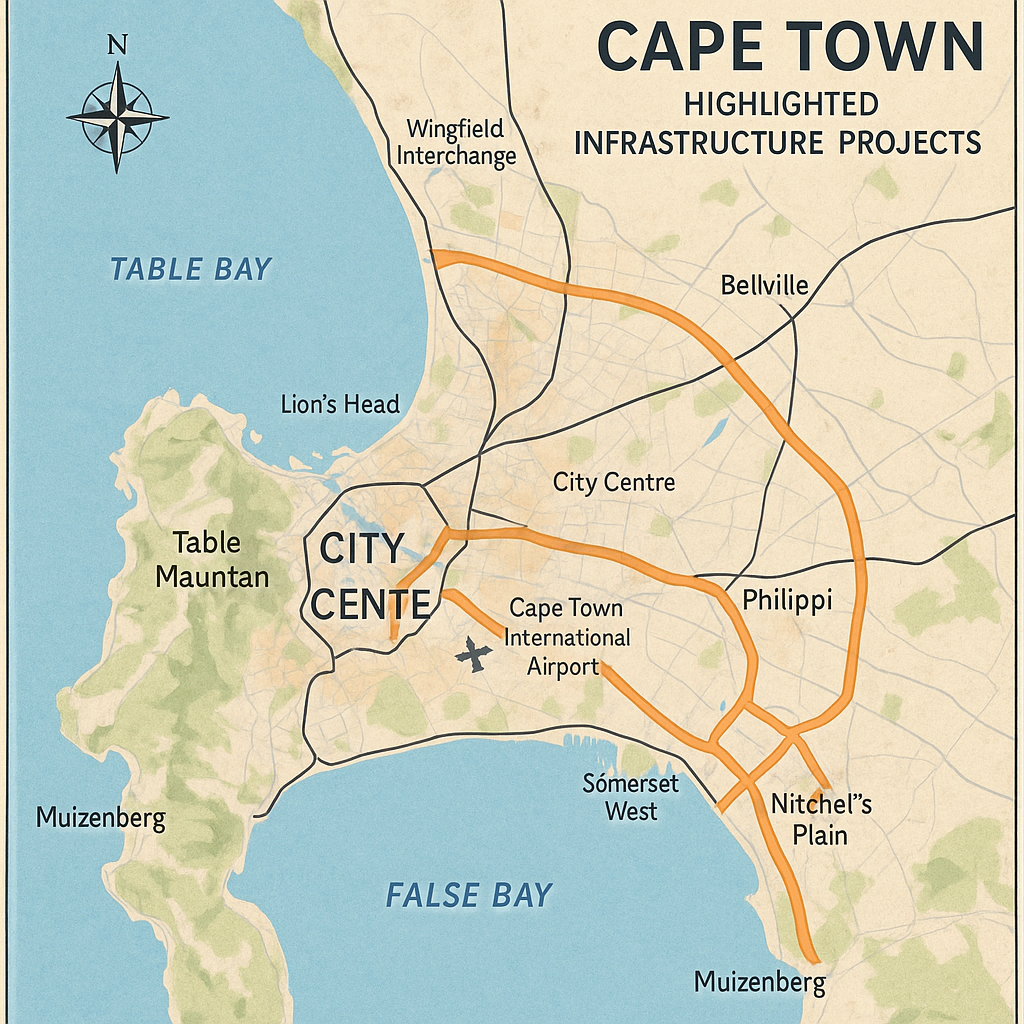
Cape Town's unprecedented R40bn infrastructure plan, funded by its robust financial sustainability, targets water, power, and mobility.
Cape Town is a financial superstar! They save money, borrow smart, and make their own cash for big projects. They learned from a water crisis and are now leaders in water, power, and travel. They make sure their projects help poor people get jobs and support them with free services. Even with a small hiccup, investors still trust them, proving that being financially smart and helping people can go hand-in-hand.
What makes Cape Town financially resilient?
Cape Town's financial resilience stems from robust liquidity, disciplined debt management, and substantial internally generated revenue. The city prioritizes capital investment through internal cash, minimizing reliance on external borrowing. Strategic reforms, including diversified water supply, independent energy procurement, and innovative urban mobility projects, further underpin its sustainable infrastructure economics.
Get Cape Town news in your inbox
Stay updated with the latest stories from the Mother City.
The Anatomy of Fiscal Strength
Cape Town has secured an unusual distinction that extends far beyond ceremonial recognition. Ratings Afrika's 2024 Municipal Financial Sustainability Index, unveiled on July 9, positions the city alone at the summit of South Africa's 32 metropolitan municipalities, distinguished by metrics that matter: robust liquidity reserves, genuine budgetary flexibility, disciplined debt management, and substantial internally generated revenue. While peer cities grapple with cash flow crises, surging unpaid accounts, and deteriorating physical assets, Cape Town maintains the capacity to meet obligations punctually, access capital markets on favourable terms, and simultaneously pursue ambitious expansion of its infrastructure backbone without jeopardising its investment-grade standing.
This achievement stems from deliberate structural reforms implemented across nearly ten years. The municipality abandoned reliance on short-term commercial borrowing in favour of longer-dated bond instruments. Fleet operations and property portfolios underwent centralised consolidation, unlocking value from previously underutilised holdings. Strategic divestment of non-essential land holdings redirected proceeds into revenue-generating infrastructure rather than operational consumption. These measures produced an outcome virtually unknown among contemporary South African cities: capital investment funded predominantly through internal cash generation rather than external indebtedness or intergovernmental transfers. Consequently, a R40 billion three-year capital programme - representing approximately 28% of current fixed asset replacement value - proceeds without triggering the customary warnings of debt unsustainability or imminent rating deterioration.
Three Strategic Battlegrounds: Water, Energy, and Movement
- Securing Water Independence*
The trauma of 2018, when reservoir levels approached single digits and Day Zero loomed as genuine possibility, fundamentally reshaped Cape Town's risk appetite. The municipality has since constructed a diversified supply architecture worthy of sophisticated resource management: four substantial groundwater extraction fields, Africa's first urban direct potable water reuse facility at scale, a 98 megalitre daily seawater desalination plant at the V&A Waterfront, and comprehensive pressure management reducing pipe ruptures by 60% in vulnerable areas. The forthcoming phase addresses legacy vulnerability directly - 2,400 kilometres of asbestos-cement piping laid during the 1950s will yield to advanced fusible PVC infrastructure incorporating embedded fibre-optic leak detection. German KfW Development Bank partnership enables this R16.7 billion water and sanitation commitment, comprising 40% of total capital expenditure, with projected non-revenue water reduction from 39% to below 25% within seven years - performance rivalling global utility benchmarks.
- Escaping the National Grid Trap*
Eskom's structural decline - escalating tariffs driving major consumers off-network, forcing remaining customers to absorb disproportionate fixed costs - demonstrated the futility of awaiting national solutions. Cape Town's response unfolds across three interconnected initiatives. First, embedded generation capacity reaching 1,200 MW, primarily rooftop solar photovoltaic systems enrolled under 2022 small-scale embedded generation feed-in arrangements. Second, 120 kilometres of 132 kilovolt cable forming a municipal "ring main," enabling lateral power distribution among substations when national transmission experiences disruption. Third, and most significantly, establishment of a NERSA-licensed municipal procurement entity capable of direct power purchase from independent producers, projected to bypass Eskom for 35% of municipal demand by 2028. The R6 billion Medium-Term Revenue and Expenditure Framework allocation merely initiates this transition; complementary financing will emerge through a green bond programme already indicated to Fitch, whose AA+ (za) national scale rating for the city exceeds sovereign assessment by three full notches.
- Reimagining Urban Mobility*
Visible transformation characterises Cape Town's transportation investment. MyCiTi, once derided as exclusive amenity, now facilitates 52 million annual passenger journeys - surpassing combined Gautrain and Rea Vaya ridership. The R3.2 billion Cape Flats extension will extend trunk corridors through Mitchells Plain, Khayelitsha, and Philippi, areas historically underserved by mass transit where 62% of households allocate over one-fifth of income to commuting costs. This expansion employs availability-based public-private partnership architecture: private consortia assume financing, construction, and maintenance responsibility for depots, stations, and rolling stock, with municipal obligation limited to payment for verified "available vehicle-kilometres." This off-balance-sheet mechanism preserves debt ratios beneath National Treasury's 30% threshold while maintaining municipal authority over routing, pricing, and fleet specifications - including transition to 70% electric buses by 2032.
Delivering Inclusion Through Procurement Design
Infrastructure investment achieves social legitimacy only through equitable distribution of benefits. Cape Town's 75% poverty-targeting ratio for the R40 billion programme carries enforceable weight through procurement architecture. Contracts exceeding R10 million must direct minimum 30% of value to enterprises meeting 51% black, women, or youth ownership criteria, with preference enhancement doubling for bidders domiciled in designated "red" wards - areas falling within the lowest two poverty quintiles. The supplier development unit complements these requirements with bridging finance, tender documentation assistance, and construction management training, preventing common phenomena where smaller firms merely provide front for established contractors. Initial phase results indicate 4,700 micro-enterprises accessing R1.4 billion in contract opportunities, median project value R280,000 - sufficiently modest to circumvent cartel capture that has plagued infrastructure expenditure elsewhere.
Employment generation follows equally intentional design. Construction labour intensity standards specify 12 positions per R1 million road expenditure, 8 positions per R1 million water reticulation, and 5 positions per R1 million electrical installation. Incorporating indirect and induced employment multipliers modelled by University of Cape Town's Development Policy Research Unit yields 130,000 job-years - approximately 43,000 full-time equivalent positions sustained across the three-year implementation horizon. Mandatory local hiring requires 55% of person-hours from residents within 25 kilometres of project sites, monitored through biometric systems integrated with the Expanded Public Works Programme database. This arrangement constitutes geographically targeted economic stimulus: neighbourhood reconstruction financed through wages earned by neighbourhood residents.
Revenue Excellence and Social Protection
Exceptional fiscal performance rests upon exceptional revenue administration. Cape Town's 98% bill collection ratio stands in stark contrast to municipal peers struggling below 70%. Achievement derives not primarily from service disconnection but from predictive analytics: a behavioural insights unit analyses prepaid meter patterns to identify households with 90-day default probability, then deploys targeted SMS interventions tripling payment likelihood. Simultaneously, the municipality maintains South Africa's most generous indigent support package - complete property rate exemption for households earning below two state pension equivalents, 50 kilowatt-hours monthly free electricity, 12 kilolitres free water, and sanitation tariffs effectively eliminating charges below 8 kilolitre consumption. Biennial recertification through real-time South African Revenue Service and Home Affairs National Identification System interfaces eliminates phantom beneficiaries that drain other municipal finances. The poorest quintile receives net municipal subsidy of R1.3 billion annually, yet the city preserves operational surplus because the wealthiest quintile face marginal rates 40% below the next most affordable metro, discouraging the asset relocation that has eroded Durban and Johannesburg rate bases.
Navigating Accountability Challenges
Clean audit loss immediately preceding the MFSI announcement represents operational friction rather than fundamental governance failure. Auditor-General concerns addressed three transactions: R1.8 billion emergency water-pressure valve procurement during 2023 drought conditions, R420 million variation on N2 express busway construction, and incomplete supply chain documentation for R67 million central business district CCTV deployment. Each transaction satisfied value-for-money assessment - valves acquired 12% below municipal cost database, busway 8% beneath benchmark - but procedural compliance lapsed as emergency delegations awaited council ratification beyond 30-day Municipal Finance Management Act requirements. Opposition political formations characterised this as exposure of claimed fiscal virtue, yet capital market response contradicted such interpretation: the city's most recent 12-year note auction attracted 2.1 times oversubscription at merely 135 basis points above R203 government bond yield, indicating investor confidence in underlying control systems. Corrective action followed: deviations exceeding R50 million now require concurrent city manager and Section 79 oversight committee pre-approval, with mandatory five-day public filing on the e-Tender portal.
Scale, Ambition, and National Implications
By 2027, Cape Town will have executed greater capital investment within a single mayoral administration than across the entire decade spanning 2006 through 2016. Infrastructure register replacement value will advance from R146 billion to R182 billion - effectively adding Namibia's entire gross fixed capital formation to national economic statistics. Whether this model - municipal green bonds, direct power procurement, data-informed revenue management - replicates nationally remains uncertain. For present purposes, Cape Town demonstrates that financial sustainability and redistributive objectives coexist productively when balance sheet integrity receives recognition as intrinsic public value.
What makes Cape Town financially resilient?
Cape Town's financial resilience is built on strong liquidity, disciplined debt management, and significant internally generated revenue. They prioritize funding capital investments with their own cash, reducing reliance on external borrowing. Strategic reforms in water, energy, and urban mobility also play a crucial role in their sustainable infrastructure economics.
How does Cape Town fund its capital projects?
Cape Town primarily funds its capital projects through internally generated cash, a distinction from many other South African cities that often rely on external debt or intergovernmental transfers. This approach is supported by strategic measures like abandoning short-term commercial borrowing for longer-dated bond instruments, consolidating fleet operations and property portfolios, and divesting non-essential land to reinvest proceeds into revenue-generating infrastructure. This allows them to undertake a substantial capital program without jeopardizing their financial stability.
How is Cape Town addressing its water challenges?
Learning from the 2018 water crisis, Cape Town has diversified its water supply. This includes developing groundwater extraction fields, constructing a direct potable water reuse facility, and operating a seawater desalination plant. They are also investing in advanced infrastructure to replace old piping and reduce water loss, with a significant R16.7 billion commitment to water and sanitation, partly funded by the German KfW Development Bank.
What is Cape Town doing to secure its energy supply?
To reduce reliance on the national grid, Cape Town is pursuing three main initiatives: increasing embedded generation capacity, particularly rooftop solar (1,200 MW target); building a municipal "ring main" for lateral power distribution; and establishing a NERSA-licensed entity to directly purchase power from independent producers, aiming to bypass Eskom for 35% of demand by 2028. This transition is supported by a R6 billion allocation and potential green bond programs.
How does Cape Town ensure its infrastructure projects benefit the community?
Cape Town's infrastructure investment is designed for social inclusion, with a 75% poverty-targeting ratio for its capital program. Contracts over R10 million require a minimum of 30% of their value to go to enterprises owned by black individuals, women, or youth, with enhanced preference for businesses in designated high-poverty areas. A supplier development unit provides support to smaller firms, fostering job creation through specific labor intensity standards and mandatory local hiring requirements, ensuring that wages benefit residents near project sites.
How does Cape Town maintain high revenue collection and support vulnerable residents?
Cape Town boasts a 98% bill collection ratio, achieved through predictive analytics and targeted interventions. They use behavioral insights to identify and support households at risk of default. Simultaneously, the city offers a generous indigent support package, including property rate exemptions, free electricity, and free water for the poorest households. This balance of efficient revenue administration and social protection ensures both fiscal health and support for its most vulnerable citizens, while still attracting new residents with competitive rates for wealthier quintiles.

Lerato Mokena is a Cape Town-based journalist who covers the city’s vibrant arts and culture scene with a focus on emerging voices from Khayelitsha to the Bo-Kaap. Born and raised at the foot of Table Mountain, she brings an insider’s eye to how creativity shapes—and is shaped by—South Africa’s complex social landscape. When she’s not chasing stories, Lerato can be found surfing Muizenberg’s gentle waves or debating politics over rooibos in her grandmother’s Gugulethu kitchen.
View all articles →