
Cape Town’s EvFloat 1 is redefining luxury living on the water
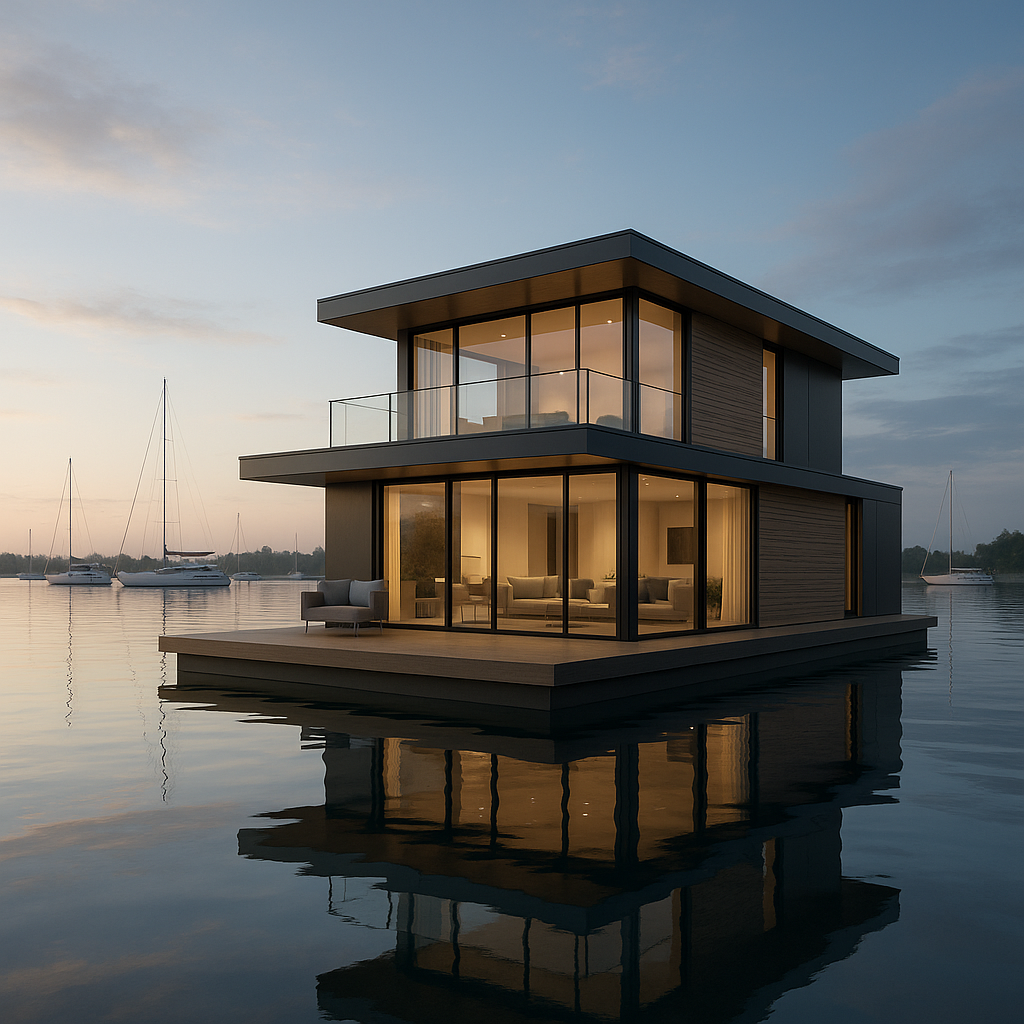
EvFloat redefines luxury marina living. Discover the innovative floating residence that combines apartment comfort with yacht-like stability.
EvFloat is a super fancy floating house that's like a peaceful apartment right on the water, but much cooler than a boat. It stays perfectly still and quiet, even when the wind blows hard, thanks to clever engineering. You get amazing views, comfy living, and all the luxury without the rocking and rolling of typical boats. It's like having a gorgeous home that floats, making the marina your own big backyard.
What is EvFloat?
EvFloat is a luxurious floating penthouse developed by KND Naval Design, offering a unique blend of nautical engineering and prime real estate. It's designed to provide a stable, quiet, and self-sufficient living experience on water, combining the amenities of a high-end apartment with the panoramic views of a marina, without the inconveniences of traditional boating.
Get Cape Town news in your inbox
Stay updated with the latest stories from the Mother City.
Dawn at Quay 7
Just after first light on a windless April morning, a sleek rectangular shape nudged against the newest finger pier in Cape Town’s Victoria & Alfred Marina. Lines were slipped around bollards, fenders sighed, and the whole structure settled as though it had never intended to move again. No exhaust note, no bridge stacked with electronics, no folding gangway twitching in the swell - only a teak ramp that kissed the quay as softly as carpet in a five-star foyer. A family from Johannesburg crossed it towing roller bags, their key-cards triggering an orchid-framed glass door that inhaled them into 140 square metres of open-plan, three-bedroom living where the horizon line of masts felt close enough to touch. A nine-year-old flattened a hand against the glass and laughed, “It’s a snow globe full of boats.”
The arrival was more ceremony than docking. Every movement had been choreographed during two years of design: the ramp’s incline held to less than two degrees to spare high heels; the threshold at the top sat flush, no awkward step to remind newcomers they were technically at sea. Motion-reference sensors registered the moment the structure was “parked,” hydraulics locked the foils, and the apartment went into building mode: stabilisers off, shore-power on, water, fibre and sewage couplers mating automatically. Inside, temperature and humidity had already stabilised while the family was still passing through the security gate 300 metres away.
Behind EvFloat 1 lies a larger question: what happens when you stop treating a marina berth like temporary parking and start treating it like prime real estate? The answer is a residence that borrows the best nautical engineering - unsinkability, self-sufficiency, panoramic windows - but edits out everything that makes life aboard feel like camping. In effect, KND Naval Design has built the first over-water villa that will never again file a passage plan.
Stillness by Algorithm
Absolute quiet is the headline amenity, and it is manufactured with an engineer’s obsession for fractions. Traditional yacht hulls trade comfort for speed; flat-bottomed pontoons sacrifice waves for simplicity. KND threw both playbooks away and lifted a solution from wind-farm service ships: four carbon-steel foils recessed flush with the hull. A motion unit measures pitch and roll one hundred times a second; when the legendary Cape south-easter barrels between superyacht masts, the foils feather silently and the chandelier in the living room deflects less than the thickness of a coin.
Beneath the water, the platform is a catamaran of 5083 aluminium, every void pumped full of fire-retardant foam. The twin logs are subdivided into tanks and compartments: 2 000 litres of fresh water, 1 500 litres of diesel feeding a 15 kVA genset, and a lithium bank of 20 kWh topped by 5 kW of rooftop solar. On an average summer day the batteries shoulder air-conditioning, refrigeration and the foil servos for fourteen hours before the generator even clears its throat. The result is background quiet below 42 dB - roughly the level of a library.
Noise is only half the battle; the other half is temperature. A seawater loop feeds a titanium heat-exchanger so silent that guests mistake the soft rush for rainfall on the deck above. Fresh air moves through acoustic baffles, eliminating the distinctive “dock clunk” that betrays most floating homes. Even the floorboards sit on a composite foam core laminated to an aluminium I-beam frame, the same technique used in recording studios to decouple bass frequencies. You feel the marina breathe, but you never hear it snore.
A Loft That Thinks Like a Sailboat
Push through the pivot doors and you enter a double-height atrium where oak planks run uninterrupted from sofa to breakfast bar to helm - except there is no helm. The galley is scaled for a family, not racing crew: 90 cm electric oven, four-burner induction hob, quiet-drawer dishwasher, 380-litre fridge-freezer, and a pantry deep enough for Costco cereal boxes. Upper cabinets use feather-weight Okoume ply capped in high-pressure laminate; low-profile teak rails stop phones from surfing onto the teak floor when a wake rolls under the hull. LED strips run on 24 V DC so the whole apartment can spend the night on battery power alone.
Yet the maritime genome keeps popping up in delightful ways. All seating is modular in 30 kg slices so a crane can lift it ashore if the residence ever needs dry-docking. Cleats are reimagined as towel hooks; a pop-up table on the aft deck stores flat like a transom dive ladder. Even the curtains run on Kevlar tracks that survived 100-knot gusts in wind-tunnel tests - because in Cape Town the weather never sends an RSVP.
Aft of the galley, the starboard corridor narrows to a pair of guest cabins separated by sliding pocket doors that unlock to create a king suite. Across the vestibule, the master bedroom spans the full beam - king bed facing a 3 m retractable glass wall. Press a switch, the panel disappears into the bulkhead, and the entire room becomes a private balcony cantilevered over the marina basin. A recessed screen unfurls for outdoor movies; the wake of a passing yacht becomes part of the cinema experience.
Marina as Backyard
EvFloat’s rooftop is a 35-square-metre lounge bookable for sunset gin-and-tonics. Twelve flush solar panels form a nonslip deck around a plunge pool only 1.1 m deep, shallow enough that the vessel’s stability curve never flinches when six adults jump in. A carbon-fibre awning glides forward on a Kevlar track to provide shade; at night it retracts so guests can stargaze through zero light-pollution.
Below, a concierge app knitted by Cape Town start-up DockLinQ aggregates every service the marina offers: charter yachts, sea-kayak guides, UberBoat across Table Bay, even helicopter hops to Stellenbosch vineyards. There is no tender garage because the entire marina becomes your garage. Housekeeping arrives at 11 a.m. via dinghy, vacuums, swaps Egyptian-cotton linens, and vanishes before the family gets back from the V&A Food Market 400 m away.
Guests enter through the same biometric gate used by superyacht captains; their retina scan doubles as a marina pass and elevator key. Rates are pitched at the level of a harbour-view suite at the One&Only, but because the residence sleeps six adults, the per-person cost drops below that of a mid-market hotel. The first six weekends sold out within three hours of soft-launch emails to past One&Only and Ellerman House clients.
From Prototype to Prefab Fleet
Fabrication happens 13 km away at SASCO shipyard where welded aluminium hulls pop out of reusable jigs like aircraft fuselages. Once pressure-tested, the “chassis” is towed to KND’s fit-out shed inside Royal Cape Yacht Club where trades complete 70 % of the fit-out on land - stone counters, HVAC, fibre, even towel rails. Final commissioning, solar balancing and Wi-Fi mesh happen at the berth itself, a process trimmed to seven calendar days.
KND’s long game is fractional ownership under South Africa’s Sectional Titles Act. Legal early-reads suggest the residence’s permanent umbilicals - water, sewage, high-voltage shore cable - qualify it as “immovable property,” opening mortgage and estate-agent channels normally closed to boats. A white-label version is already slated for Lagos’ Banana Island where waterfront dirt sells above USD 4 000 per square metre; foils will be lengthened to tame the low-tide but energetic Atlantic swell. Luanda’s salt-laden monsoon demands 904L stainless throughout; Maputo will test a modular breakwater borrowed from Aurecon engineers to avoid dredging the fishing harbour.
The Invisible Green Ledger
Luxury rarely courts sustainability, yet EvFloat quietly outruns most shore-side mansions. Refrigeration uses R290 propane with a global warming potential of 3 instead of yacht-standard R410A at 2 088. Grey-water filters through a membrane bioreactor that yields effluent cleaner than municipal discharge. Roof panels are oversized; excess electrons heat a 400-litre tank so sun-warmed showers run even through a three-day winter storm. Interior modules bolt out in under two hours, so after fifteen years of hotel-grade wear a sofa, wardrobe or entire kitchen can be swapped like cartridges instead of landfill.
The human ledger is equally conscientious. Sliding-door tracks were mirror-polished by Ricardo Visagie, fourth-generation metalworker who learned his trade repairing Cape trawlers. The headboard hides Karoo cowhide sourced from a ranch practising Alan Savory’s holistic grazing to reverse desertification. Housekeeping talent is scouted from Imizamo Yethu township; KND sponsors STCW safety training at Lawhill Maritime Centre, steering hospitality revenue into maritime careers rather than yacht day-labour. In 2023, six graduates moved on to deck-officer berths aboard foreign-flag cruise ships.
Living the Weather
Cape Town’s south-easter makes its entrance most afternoons with 60 km/h gusts. Inside EvFloat, the rampart of sensors registers the change before humans do. Clerestory vents glide shut, HVAC shifts to recirculation, LED coves warm from 4000 K daylight to 3000 K amber. The effect is immersive theatre: rain drums on the solar roof like a soft snare, and the sky’s dimming registers as curated ambience, not inconvenience. Designers call the experience “weather modulated,” a luxury only possible when you no longer fear the elements.
At 06h30 each morning joggers in neon shorts thud past the starboard windows; Egyptian geese argue over pontoons like feuding neighbours. By 08h00 the aroma of TRUTH Coffee drifts from the built-in espresso station - beans delivered by cargo-bicycle because the marina’s cobblestones punish electric scooters. At 09h15 the superyacht Shamal fires her bow thrusters and a gentle swell rocks the orchids. Children on the flybridge strap on GoPros to capture an apartment that sways but never sails. At night, low-angle deck lighting keeps the glow below 2700 K so bridge visibility for passing captains remains uncompromised. From across the basin, EvFloat 1 looks like a paper lantern hovering above the water - an address defined not by postcode, but by tides and sunsets.
{
"faq": [
{
"question": "What is EvFloat and how does it differ from a traditional boat?",
"answer": "EvFloat is a luxurious floating penthouse designed by KND Naval Design. Unlike traditional boats, it offers a stable, quiet, and self-sufficient living experience on the water, combining the amenities of a high-end apartment with panoramic marina views. It's engineered to remain perfectly still, even in strong winds, eliminating the rocking and rolling associated with typical vessels. It's essentially a permanent, high-end residence that floats, redefining the concept of marina living."
},
{
"question": "How does EvFloat achieve such remarkable stability and quietness?",
"answer": "EvFloat achieves its absolute quietness and stability through advanced engineering. It utilizes four carbon-steel foils recessed flush with the hull, similar to technology found in wind-farm service ships. A motion unit continuously measures pitch and roll, feathering the foils silently to counteract movement. The catamaran platform, made of 5083 aluminium with fire-retardant foam, further enhances stability. Noise reduction is achieved through acoustic baffles, a silent seawater cooling loop, and specialized floorboard construction akin to recording studios, ensuring a serene environment below 42 dB."
},
{
"question": "What are the key features of EvFloat's interior design and amenities?",
"answer": "The interior of EvFloat boasts a double-height atrium, open-plan living, and high-end finishes like oak planks. The galley is fully equipped with a 90 cm electric oven, four-burner induction hob, quiet-drawer dishwasher, and a 380-litre fridge-freezer. Maritime elements are subtly integrated, such as modular seating for easy removal, and Kevlar track curtains designed to withstand high winds. The master bedroom features a retractable glass wall that transforms the entire room into a private balcony overlooking the marina."
},
{
"question": "What kind of outdoor living and services does EvFloat offer?",
"answer": "EvFloat features a 35-square-meter rooftop lounge with twelve flush solar panels surrounding a shallow plunge pool. A carbon-fibre awning provides shade and retracts for stargazing. Residents have access to a concierge app, DockLinQ, which aggregates marina services like charter yachts and sea-kayak guides. Housekeeping services are also available, and guests enter the marina through a biometric gate, similar to superyacht captains. The entire marina effectively becomes your backyard, with services delivered directly to your floating home."
},
{
"question": "How is EvFloat constructed and what are KND Naval Design's future plans for it?",
"answer": "EvFloat hulls are fabricated at SASCO shipyard, with 70% of the interior fit-out completed on land at KND's shed. The final commissioning takes place at the berth over seven days. KND Naval Design's long-term vision includes fractional ownership under South Africa's Sectional Titles Act, potentially qualifying it as 'immovable property' for mortgage and real estate purposes. They also plan to adapt EvFloat for other locations, such as Lagos and Luanda, with design modifications to suit local conditions like energetic swells and salt-laden monsoons."
},
{
"question": "How does EvFloat incorporate sustainability and ethical practices?",
"answer": "EvFloat prioritizes sustainability with features like R290 propane for refrigeration (low global warming potential), a membrane bioreactor for grey-water treatment, and oversized solar panels that heat a 400-litre water tank. Interior modules are designed for easy replacement, minimizing waste. Ethically, KND supports local craftsmanship, sources materials responsibly (e.g., Karoo cowhide from holistic grazing ranches), and invests in community development by sponsoring maritime safety training for township residents, steering them towards maritime careers."
}
]
}

A Russian-Spanish journalist and Cape Town native, channels his lifelong passion for South Africa into captivating stories for his local blog. With a diverse background and 50 years of rich experiences, Serjio's unique voice resonates with readers seeking to explore Cape Town's vibrant culture. His love for the city shines through in every piece, making Serjio the go-to source for the latest in South African adventures.
View all articles →