
Cape Winelands Airport and Stellenbosch University unite for sustainable innovation
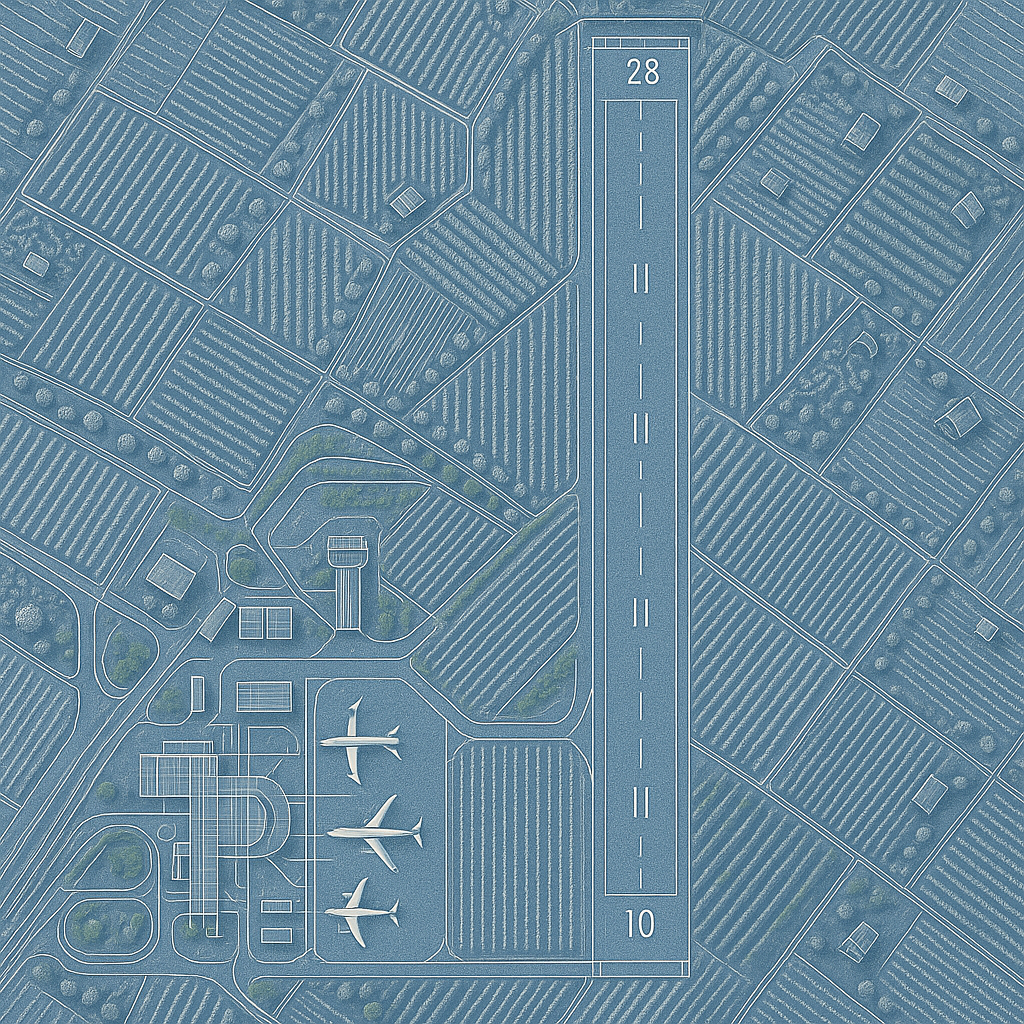
Cape Winelands Airport & Stellenbosch University: a living lab for 21st-century aerotropolis, focusing on green aviation, smart tech & skills.
Cape Winelands Airport is becoming Africa's very first aerotropolis, a city built around an airport. This isn't just a regular airport; it's a huge, living classroom where students and experts work together on new ideas. They're making the airport super green by cutting pollution, using solar power, and recycling everything. It's also a place where farming and flying work hand-in-hand, and goods move around underground really fast. This project is creating lots of new jobs and is a hub for amazing new tech, like satellites and hydrogen power, all while making sure the local community benefits greatly.
What is an aerotropolis?
An aerotropolis is an urban planning concept where a city or metropolitan area is built around an airport, serving as a multimodal transportation hub that integrates aviation, logistics, and business. It fosters economic development by attracting aviation-linked businesses and industries, creating a dynamic ecosystem.
Get Cape Town news in your inbox
Stay updated with the latest stories from the Mother City.
From Concrete to Classroom: An Airport Becomes a Living Laboratory
The R8-billion transformation of Cape Winelands Airport represents far more than typical infrastructure development. Spanning 1 500 hectares between Stellenbosch, Paarl and the Durbanville wine region, this project cultivates what planners call an "innovation biome" - a thriving ecosystem where academia, industry and public sector collaborate in real time.
In April 2024, airport leadership and Stellenbosch University formalized a decade-long partnership through a memorandum of understanding. This agreement transforms every operational element into research opportunity: taxiways become data collection pathways, warehouse roofs host solar experimentation, storm-water ponds serve as ecological study sites, and baggage systems function as automation testbeds. Graduate researchers, emerging enterprises and government agencies now share this open-air facility around the clock, developing solutions destined for broader African application once validated for safety, environmental performance and commercial viability.
The airport essentially operates as an immersive educational environment where theoretical concepts meet operational reality. Students don't merely observe from distance - they embed within functioning systems, identifying friction points and engineering improvements. This proximity to genuine challenges accelerates learning while producing immediately applicable innovations.
Smart Aviation: Three Pillars of Sustainable Operations
Every financial decision at Cape Winelands Airport defers to three unyielding performance targets: cutting net CO₂ emissions per passenger by 40 percent before 2035, generating half of all energy requirements through on-site production, and achieving complete circularity in construction waste management. These benchmarks now shape every contractor's engineering specifications across the development.
Monitoring compliance demands sophisticated oversight. The university's Centre for Renewable and Sustainable Energy Studies has constructed a comprehensive digital replica spanning 12 hectares - an intricate three-dimensional model refreshed every fifteen minutes through 1 200 interconnected sensors. This digital twin anticipates operational inefficiencies before they materialize, identifying aircraft taxiing patterns that waste fuel, detecting when photovoltaic installations fall into shadow, and simulating localized weather conditions to guide landscaping choices that eliminate irrigation-dependent grass species in favor of indigenous drought-resistant alternatives.
The technology enables proactive rather than reactive management. Rather than discovering problems through accumulated costs or environmental damage, operators receive advance warning through predictive analytics. This shift from corrective to preventive thinking distinguishes the facility from conventional airport operations worldwide.
Where Agriculture Meets Aviation: Unexpected Synergies
Cape Winelands Airport borders exceptionally productive agricultural territory - table grape vineyards, protected blueberry cultivation tunnels, and heritage tomato greenhouses supplying British retail shelves within forty-eight hours of harvest. Rather than paving over this productive landscape, designers established a 300-meter transitional zone where farming and flight operations mutually reinforce one another.
Within this buffer, university agronomists and biosystems engineers evaluate experimental technologies including low-altitude drone pollinators, hyperspectral imaging systems that identify plant stress weeks before visible symptoms appear, and innovative carbon capture from aircraft auxiliary power units redirected into hydroponic facilities to enhance photosynthetic rates. Initial trials demonstrate remarkable results: blueberry yields increased 17 percent while post-harvest fungicide applications dropped 9 percent. These outcomes attracted direct industry investment, with two international exporters now funding three additional doctoral research positions.
The arrangement benefits all parties. Farmers gain technological advantages, researchers access real-world testing environments, and the airport maintains its agricultural character while demonstrating how aviation infrastructure can coexist with rather than displace food production.
Moving Goods Smarter: The Underground Logistics Revolution
A four-kilometer automated subterranean corridor forms the backbone of Cape Winelands Airport's freight capabilities, creating seamless connection between perishable cargo facilities and the N1 highway corridor. This conveyor-driven "river" beneath the surface carries goods silently and efficiently.
The university's 2025 industrial engineering master's cohort received an extraordinary assignment: redesign this entire system to enable pallet rerouting within ninety seconds when refrigerated container temperatures deviate by merely 0.8 degrees Celsius. Students pursue multiple innovation tracks simultaneously, including ultra-wideband tracking tags that generate power from baggage trolley motion - potentially eliminating 18 000 lithium batteries discarded annually at African airports through traditional implementations.
Successful solutions will circulate freely across the continent. Under licensing terms developed by the university's Law Faculty, winning algorithms transfer without royalty obligations to Nairobi and Accra, establishing precedent for open intellectual property exchange in African aviation development.
Building Skills, Building Futures: Aviation Careers for All
South African aviation faces severe talent drainage - approximately 120 commercial pilots depart annually for Middle Eastern and Chinese carriers - while recruitment from surrounding disadvantaged communities remains stubbornly low at just 7 percent of new cadets within 50 kilometers. Cape Winelands Airport attacks this disparity through comprehensive educational intervention.
Partnering with the university's SciMathUS bridging program, the airport constructed a 600-square-meter prefabricated training facility on land contributed by the Simonsberg Rural Council. Here, first-year engineering students convert retired Airbus A320 throttle assemblies into virtual reality simulators. Local secondary students earn recognized credentials in unmanned aerial vehicle maintenance. Psychology researchers deliver spatial orientation training that lifted mathematics competency from 42 percent to 78 percent pass rates within two academic terms.
Three domestic carriers have committed bursary support ensuring each 30-student cohort accumulates 220 actual flight hours aboard electric training aircraft manufactured by Stellenbosch-derived enterprise Phiri Aviation. This pipeline transforms community connection from aspiration to guaranteed outcome.
Eyes in the Sky: Satellite Technology for Safer Skies
South Africa's Square Kilometre Array radio telescope sits 300 kilometers northeast, yet its computational heart beats within Stellenbosch University's RW Wilcocks building. Engineers recognized that the same graphics processors filtering cosmic interference could merge satellite and radar feeds into Africa's first predictive runway incursion system.
By analyzing patterns in global navigation satellite system disruption - frequent in equatorial regions - alongside aircraft autopilot telemetry, the system alerts controllers thirty seconds before potential overshoot collisions with secondary taxiways. Early deployment shows false alarm rates below 2 percent, outperforming the 8 percent standard typical of European facilities.
This adaptation of astronomical infrastructure for aviation safety exemplifies the cross-pollination possible when research institutions maintain deep involvement in regional development.
Hydrogen at Ground Level: A Micro-Hub with Macro Implications
Cape Winelands Airport's geographic advantages - 135-meter elevation, reliable southeasterly winds, and proximity to platinum catalyst suppliers 150 kilometers north - position it perfectly for national hydrogen strategy demonstration. A one-megawatt rooftop solar installation feeds a 500-kilowatt electrolyzer supplying hydrogen-compatible baggage tractors and, significantly, "green" hydrogen for forklift fleets across thirty neighboring wine cellars.
Oxygen byproducts from electrolysis enhance wastewater treatment aeration, reducing energy consumption 14 percent. The university's Hydrogen Systems Centre tracks material fatigue in 700-bar storage vessels, determining whether expansion to ten megawatts becomes feasible - sufficient capacity to refuel fifty-seat commuter aircraft by decade's end.
Reaching Orbit from the Runway: Space Technology Takes Root
Stellenbosch University's Electronic Systems Laboratory typically dispatches cube satellites from California's Mojave Desert, but currency volatility and launch expenses drive localization efforts. Cape Winelands Airport's 3 700-meter runway exceeds Lanseria's capacity, accommodating modified Boeing 747-400 aircraft releasing small payloads eastward over the Indian Ocean.
This capability spawned Winelands Launch Services, a joint venture holding preliminary agreements for three 60-kilogram atmospheric research satellites with the South African Weather Service and Botswana Academy of Sciences. Mechanical engineering students fabricate carbon fiber nosecones using campus autoclaves originally purchased for wine tank manufacturing - tangible evidence of agricultural equipment repurposed for aerospace advancement.
Building Like Nature: Construction Innovation
Conventional airport expansion consumes approximately 1.2 million cubic meters of concrete. Cape Winelands Airport pursues radical alternatives through the university's Architecture department, deploying three-dimensional printers extruding geopolymer blends of local clay, fly ash and grape stalk ash - 55 000 tons of annual agricultural residue transformed into construction feedstock.
Printing algorithms replicate termite mound internal geometries, producing naturally ventilated retaining walls that reduce climate control demands 28 percent. On-site fabrication eliminates 36 000 truck journeys compared to traditional brick and block importation, shrinking construction-phase emissions 35 percent.
Funding Tomorrow: Financial Architecture for Impact
Raising R8 billion without burdening provincial budgets or university endowments required innovative capital structuring. Regional pension funds paired with development finance institutions to create a "blue-green" bond instrument where returns correlate directly to verified outcomes: carbon avoided, water conserved, students graduated.
Standard Bank engineered the R2.3 billion vehicle; the university's School for Data Science provides independent verification algorithms. Eight weeks post-launch, subscription levels reached 1.6 times offering size, confirming investor willingness to accept 50 basis point yield reduction when social impact metrics integrate directly into financial instruments.
Planning for People: Urban Design Around Aviation
Official classifications still label Cape Winelands Airport territory as "rural-urban fringe" - planning ambiguity permitting haphazard settlement and vineyard coexistence. The university's Urban and Regional Planning programme co-authored an alternative vision organized through three concentric "twenty-minute rings."
The inner zone (0–5 kilometers) concentrates aviation core functions: runways, cargo handling, maintenance facilities. The middle band (5–12 kilometers) integrates light manufacturing, hydroponic agriculture parks and mixed-income residential development connected by 37 kilometers of new bus rapid transit infrastructure. The outer ring (12–30 kilometers) preserves greenbelt character through mountain biking trails, wine tourism, and biodiversity corridors.
Mindful of Cape Town International's history - where 140 000 households experienced displacement - the plan mandates 35 percent affordable housing in new residential construction, financed through 1 percent commercial construction upliftment levies.
Digital Defense: Cybersecurity Embedded from Inception
Johannesburg's OR Tambo baggage system hack in 2023 inflicted $34 million in damages within forty-eight hours. Cape Winelands Airport responds by embedding fifty ethical hackers - half university computer science interns - throughout procurement and installation phases. Their mandate: assume compromise, design for zero trust.
The team successfully demonstrated "ghost flight" capability, spoofing automatic dependent surveillance-broadcast signals to insert phantom aircraft into control displays. This exercise compelled quantum-safe encryption deployment between tower and approaching aircraft. The same laboratory now evaluates biometric baggage systems against deep-fake facial attacks using silicone three-dimensional printed masks - techniques borrowed from forensic anthropology research originally applied to three-century-old slave remains from the Cape.
Sound Management: Turning Noise into Neighborhood Investment
Community noise opposition frequently blocks airport expansion in affluent areas. Cape Winelands Airport's surroundings include heritage wine estates whose proprietaries command legal resources. Preemptive engagement led the university's Engineering Acoustics group to construct 64-channel microphone arrays feeding machine learning models distinguishing aircraft noise from cicadas and wind patterns.
Accuracy within 0.8 decibels enables precise noise contour mapping and "quiet hours" surcharges on overnight operations (23:00–05:00). These revenues directly fund local school music programs, transforming potential opposition into cultural patronage.
Continuous Knowledge: An Ever-Evolving Institution
Traditional doctoral research concludes with final submission. At Cape Winelands Airport, data streams from digital twins, hydrogen systems, and printed structures flow continuously into open-access repositories governed by Institute of Electrical and Electronics Engineers standards. Each annual cohort inherits existing datasets, adds new sensor layers, and publishes incremental findings.
This arrangement mirrors CERN's open data philosophy, ensuring Cape Winelands Airport remains perpetually developmental rather than fixed as 2020s engineering monument - truly a living laboratory for generations of researchers to come.
[{"question": "What is the Cape Winelands Airport project?", "answer": "The Cape Winelands Airport project is transforming the existing airport into Africa's first aerotropolis, a city built around an airport. This R8-billion initiative spans 1,500 hectares and integrates academic research, industry, and public sector collaboration to create a sustainable and innovative aviation hub. It's designed to be a 'living classroom' where cutting-edge research in areas like green energy, sustainable agriculture, advanced logistics, and space technology is applied in real-world scenarios."}, {"question": "How is Stellenbosch University involved in this project?", "answer": "Stellenbosch University is a key partner in the Cape Winelands Airport project. Through a decade-long memorandum of understanding, the university has integrated its research and educational programs directly into the airport's operations. Every aspect of the airport, from taxiways to warehouses, serves as a research opportunity for students and experts. This partnership allows for an 'innovation biome' where theoretical concepts are tested and refined in a live operational environment, accelerating learning and producing immediately applicable innovations for broader African application."}, {"question": "What are the key sustainability goals of the Cape Winelands Airport?", "answer": "The Cape Winelands Airport has ambitious sustainability goals focused on environmental performance. These include cutting net CO2 emissions per passenger by 40% before 2035, generating half of all energy requirements through on-site production (e.g., solar power), and achieving complete circularity in construction waste management. The university's Centre for Renewable and Sustainable Energy Studies uses a sophisticated digital twin, refreshed every fifteen minutes by 1,200 sensors, to monitor compliance and proactively identify inefficiencies, such as aircraft taxiing patterns that waste fuel or areas where solar installations might be shadowed."}, {"question": "How does the project integrate agriculture and aviation?", "answer": "Instead of displacing the surrounding productive agricultural land, the Cape Winelands Airport has established a 300-meter transitional zone where farming and flight operations mutually reinforce one another. University agronomists and biosystems engineers evaluate experimental technologies like low-altitude drone pollinators, hyperspectral imaging for plant stress detection, and carbon capture from aircraft auxiliary power units redirected to hydroponic facilities. This innovative approach has already shown remarkable results, such as a 17% increase in blueberry yields and a 9% drop in post-harvest fungicide applications."}, {"question": "What innovative logistics and infrastructure are being developed?", "answer": "The airport features a four-kilometer automated subterranean corridor for freight, creating a seamless connection between perishable cargo facilities and the N1 highway. This 'river' beneath the surface carries goods silently and efficiently. Additionally, the university's engineering students are redesigning this system for rapid pallet rerouting based on temperature deviations and developing ultra-wideband tracking tags that generate power from baggage trolley motion. The project also explores using 3D printers with geopolymer blends of local clay, fly ash, and grape stalk ash for construction, reducing traditional concrete use and truck journeys."}, {"question": "How is the project fostering future careers and community development?", "answer": "The Cape Winelands Airport is addressing talent drainage and low recruitment from disadvantaged communities by providing comprehensive educational interventions. In partnership with Stellenbosch University's SciMathUS bridging program, a training facility has been established where students convert retired aircraft parts into VR simulators and local secondary students earn credentials in UAV maintenance. Three domestic carriers offer bursary support for flight hours on electric training aircraft. Furthermore, the urban design plan mandates 35% affordable housing in new residential construction, financed through commercial upliftment levies, aiming to integrate the community directly into the airport's growth.", "additional_info": "An aerotropolis is an urban planning concept where a city or metropolitan area is built around an airport, serving as a multimodal transportation hub that integrates aviation, logistics, and business. It fosters economic development by attracting aviation-linked businesses and industries, creating a dynamic ecosystem."}]

Michael Jameson is a Cape Town-born journalist whose reporting on food culture traces the city’s flavours from Bo-Kaap kitchens to township braai spots. When he isn’t tracing spice routes for his weekly column, you’ll find him surfing the chilly Atlantic off Muizenberg with the same ease he navigates parliamentary press briefings.
View all articles →