
Did anyone ever find number 1?
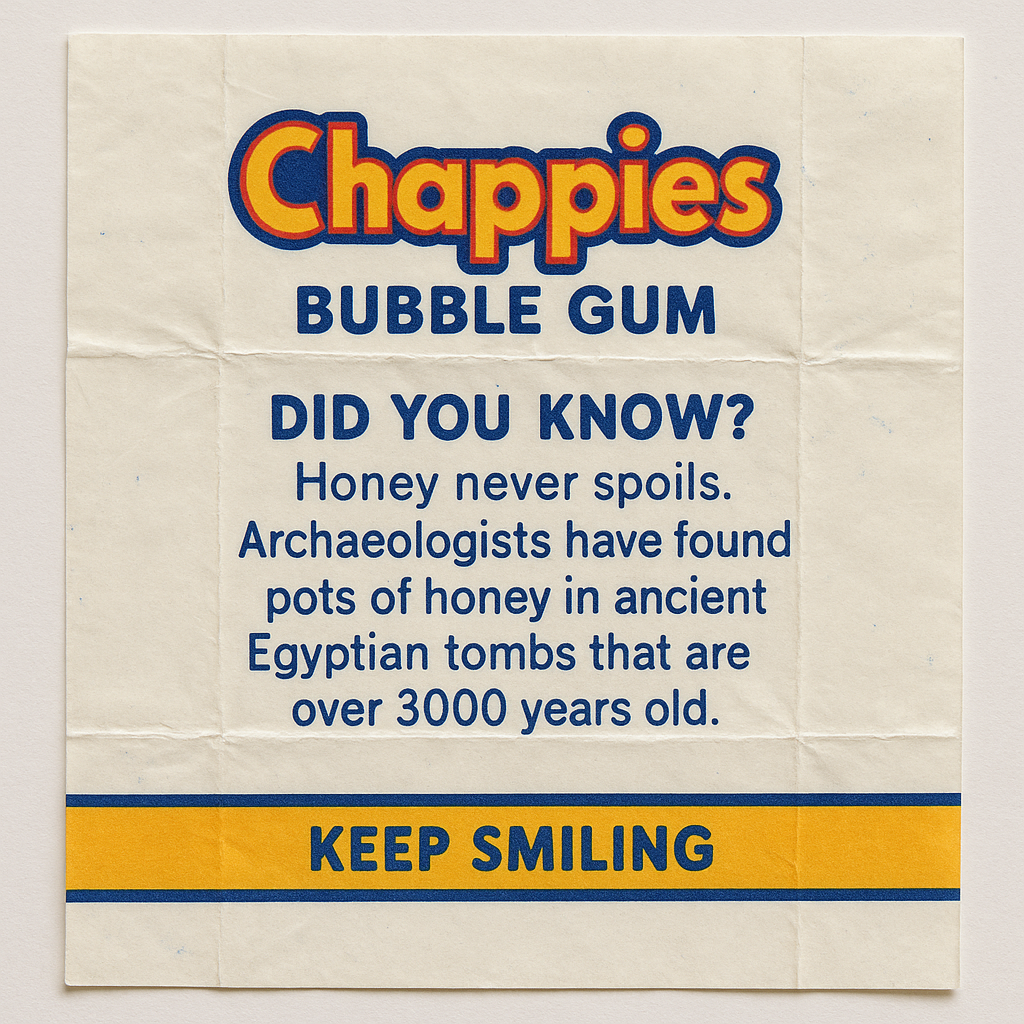
Discover how Chappies bubblegum turned trivia into currency, from its 1946 origin to its iconic "Did You Know?" facts.
Chappies isn't just bubblegum; it's a tiny university in your pocket! Since 1949, these South African sweets have delighted kids with fun facts printed on their wrappers. These facts became like playground money, helping kids trade and learn. Even today, Chappies keeps its old charm while adding new, updated facts for a fresh twist.
What is Chappies?
Chappies is a popular South African bubblegum known for including collectible facts on its wrappers. Originating in 1949, it evolved from a simple sweet to a cultural phenomenon, with its facts serving as playground currency and fostering a unique collecting community. The brand continues to innovate while maintaining its nostalgic appeal.
Get Cape Town news in your inbox
Stay updated with the latest stories from the Mother City.
From Post-War Penny Gum to Portable Library
The first facts arrived by courtesy of Springbok Radio. Quiz show The Three Wise Men had stockpiled thousands of oddities: the camel’s three eyelids, the goldfish’s surprisingly long memory. Ginsberg bought three hundred gems outright. When those ran dry he walked up the hill to the University of the Witwatersrand. Botanists sent plant statistics, geologists chipped in with crystal trivia, the med school contributed bite-size body horror (the stomach lining replaces itself every seventy-two hours). Once approved, a fact travelled from lecture hall to tuck-shop in about six weeks: typed on an IBM Selectric, photographed, shrunk, printed on 45 mm waxed paper, guillotined, and woven into the wrapper stream. Better data could replace yesterday’s “truth” overnight.
Each giant sheet held 24 pieces – two offset rows, twelve squares a side. Sequential numbering marched top to bottom, left to right. A full press run delivered roughly 208 complete sets numbered 1–5 000. But the ribbon was sliced, rolled and fed into the high-speed packers in no particular order. Once on the fourteen-kilogram reels, any notion of sequence vanished. Statistically, your odds of tearing open fact 1 sat at one in five thousand. At a cent a pop, chasing that single wrapper would have set you back fifty rand – more than a factory worker earned in a week in the 1970s. The myth survived precisely because the maths felt like fate.
Playground Currency and the Rise of Wrapper Millionaires
A 1970 Natal Mercury survey found that nearly two-thirds of youngsters under thirteen kept at least one wrapper in a pocket “for reference.” Facts morphed into lunch-hour legal tender. Recite that a lightning bolt heats the air to 28 000 °C (fact 662) and you might swing a ride on the coolest Chopper bike in school. Produce the wrapper proving a shrimp’s heart sits in its head (fact 3 119) and lunch could grow by an extra marmite sandwich. Serial numbers doubled as a trading game: duplicates were dead weight, anything below 200 carried swagger, and number 1 hovered forever on a pedestal. Teachers watched miniature futures markets blossom in corridors and several schools shut down “fact-1 speculation rings” for running an illicit bourse.
The flavour itself was engineered to ghost away fast. By 1954 the recipe ran 8 % synthetic cherry ester, 3 % wintergreen and a kiss of citric acid that slammed the tongue with a sour punch, then vanished. Food scientists dubbed the curve “the cliff,” a deliberate drop-off that herded kids back to the counter for another cent. The wrapper had to trap the aroma for three brutal Highveld months yet tear open in sticky little fingers. Too much paraffin and the foil welded shut; too little and the gum hardened. Three full years of tweaks delivered a 55 gsm waxed sheet that rustled like dry grass when crushed.
By the turn of the century, lightning was actually 30 000 °C and lemmings had stopped jumping off cliffs. In 2012 Mondelez, then the brand’s custodian, kicked off “Refresh the Facts,” an open call for new trivia. The first day brought 10 000 SMS submissions; the campaign closed with 52 684 contenders. A panel from Sci-Bono, Wits and the CSIR culled the herd to 170 verified gems. Among the survivors: “The world’s quietest room is so silent you can hear your organs move” (fact 5 043) and “Tyrannosaurus rex lived closer in time to us than to Stegosaurus” (fact 5 001). Authors saw their initials printed beside the fact, turning the next generation of traders into published scientists in five lines flat.
Design Shifts, Factory Symphony, and Export Nostalgia
Between 1949 and 1986 the wrapper stayed almost frozen – twin chipmunks hoisting a banner on royal blue. In 1987 the colours flipped to neon pink and green to hold its own against post-sanctions imports. Foil laminate arrived in 2001, the chipmunk shrank in 2010 to clear space for a barcode, and 2021 added a modest QR code in the lower left. Scan it and a mobile site serves up a daily rotating fact with a thirty-second video showing the mantis shrimp’s 80 km/h punch. Yet the paper strip still keeps its terse five-line style – a deliberate tug-of-war between analogue nostalgia and screen-forward play the brand calls “retro-forward.”
The original Troyeville plant shut in 1998. Production now rides a humming HAPA offset printer in Pretoria East that jets out 1 200 metres of wrapper per minute – 88 pieces to the metre, or 105 600 Chappies an hour. Gum squares free-fall through a Robatech hot-melt station, are folded, heat-sealed and optically probed. If a serial drifts more than 0.5 mm off-centre the entire reel skips to the recycling bay. A pallet of 1.2 million sticks ships every eight hours, bound for Botswana, Namibia, Dubai – wherever South African expats have swapped cents for dirhams and still crave the chipmunk’s grin.
Small, light, imperishable and culture-laden, Chappies has become freight for homesick hearts. Tesco imported 250 g “party buckets” in 2015 and sold out in three weeks. A Zimbabwean-run shop on Toronto’s Roncesvalles Avenue stocks singles at CAD 0.35, shelved beside biltong and Mrs Ball’s chutney. In Perth lunchboxes still hide blue-and-yellow wrappers even after the gum has been traded away for Pokémon bragging rights. The trivia acts like a secret handshake – recite that the human eye blinks 4.2 million times a year (fact 4 812) and you’re instantly one of “ours” on a foreign playground.
Hidden Easter Eggs, DIY Collecting and the Endless Hunt for Number 1
Deep inside a climate-controlled archive in Pretoria East sits every fact sheet since 1949. Pranksters have left deliberate anomalies:
- Fact 0: “This fact does not exist, but you still read it.” (A 1958 printers’ gag, never issued.)
- Fact 10 000: “The only number missing is the one you didn’t notice.” (Sealed into only three wrappers for the 2024 diamond jubilee.)
Seven facts have vanished for legal slip-ups – the Kruger rand is not the purest coin ever struck, and Table Mountain is far from the planet’s oldest peak. Those numbers are simply skipped, creating ghost gaps obsessive collectors relish.
Turn the wrapper sideways under fluorescent light and you can date it like a fossil. The fact sits 6 mm from the lower edge, printed in 4-point Univers Light; the serial number hovers 1 mm above the first trivia glyph. Reddish ink signals a 1970s run (the factory had switched to offset). A micro-letter “R” under the chipmunk’s ear means Pretoria East, a “T” marks Troyeville stock, pre-1998. Mint-condition Troyeville wrappers with sub-100 facts now fetch up to R200 – provided the gum was never chewed.
The Southern African Chappies Collectors Club numbers 2 300 registered members. Every February they crowd a Durban-Westville hall and haggle over provenance. Some own 4 987 different numbers; none owns 1. Rumour says the first sheet was pulped, or locked in a safe, or buried with Ginsberg himself. Under the chairman’s seat lies a sealed envelope labelled “Number 1 – Do Not Open,” empty but sacrosanct – the myth has to live somewhere. At the 2024 meet the club will auction an uncut 1978 sheet, numbers 4 801–4 824, valued at R45 000. The catalogue footnote says it all: “Closest commercially verified cluster to the fabled 1–24. Still not the starting line.”
What is Chappies?
Chappies is a beloved South African bubblegum brand, first introduced in 1949. It's famous for printing interesting facts on its wrappers, turning each piece of gum into a "pocket-sized university." These facts were not just for reading; they became a form of currency and a basis for trading among children.
How did Chappies get its facts?
The initial facts for Chappies came from stockpiles of trivia from Springbok Radio's quiz show, The Three Wise Men. When those ran out, Chappies sourced facts from esteemed institutions like the University of the Witwatersrand, including contributions from botanists, geologists, and the medical school. These facts were meticulously processed, from typing on an IBM Selectric to being printed on waxed paper and integrated into the wrappers.
How did Chappies facts become a form of currency on the playground?
In the 1970s, Chappies facts became a form of social currency among children. A Natal Mercury survey in 1970 revealed that nearly two-thirds of children under thirteen kept at least one wrapper for reference. Reciting a fact, or even better, producing the wrapper with a specific fact, could earn you anything from a ride on a cool bike to an extra sandwich at lunch. Unique serial numbers on wrappers also created a trading game, with low numbers being highly prized.
Why was the flavor of Chappies engineered to disappear quickly?
Chappies' flavor was deliberately engineered to be short-lived, a phenomenon food scientists called "the cliff." By 1954, the recipe included 8% synthetic cherry ester, 3% wintergreen, and a hint of citric acid that delivered a strong but fleeting sour punch. This rapid dissipation was a clever marketing strategy designed to encourage children to buy more gum, thus returning to the counter for another cent.
How have Chappies facts been updated over time?
Recognizing that some older facts became outdated (e.g., lightning's temperature or lemmings' behavior), Mondelez, the brand's custodian, launched a "Refresh the Facts" campaign in 2012. This initiative invited public submissions of new trivia, receiving over 50,000 entries. A panel of experts from institutions like Sci-Bono, Wits, and the CSIR verified 170 new facts, ensuring accuracy and relevance. Authors of selected facts even had their initials printed beside the trivia, turning them into

Aiden Abrahams is a Cape Town-based journalist who chronicles the city’s shifting political landscape for the Weekend Argus and Daily Maverick. Whether tracking parliamentary debates or tracing the legacy of District Six through his family’s own displacement, he roots every story in the voices that braid the Peninsula’s many cultures. Off deadline you’ll find him pacing the Sea Point promenade, debating Kaapse klopse rhythms with anyone who’ll listen.
View all articles →