
Franschhoek Pass closed indefinitely due to storm damage
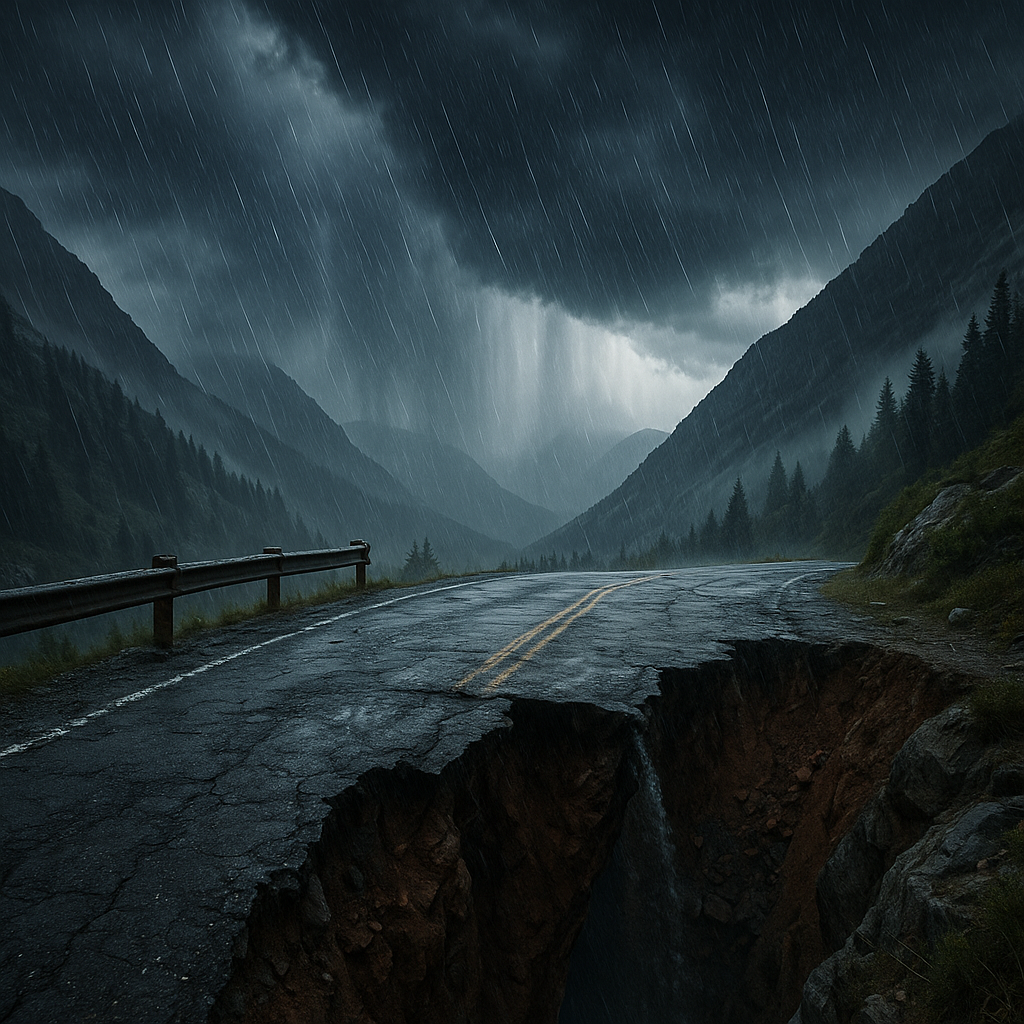
Franschhoek Pass vanishes after a mega-storm, isolating the "Valley of the Huguenots." Discover the geology, economics, and climate impact.
The Franschhoek Pass vanished overnight because crazy heavy rains, 312 mm in just 24 hours, turned the mountain into mush. This caused huge landslides and even destroyed a bridge, wiping out 12 kilometers of road. Now, locals face long detours, businesses are struggling, and the beautiful pass is a wild, quiet place again, but everyone wonders how and when it will ever be fixed.
What caused the Franschhoek Pass to collapse?
The Franschhoek Pass collapsed due to an unprecedented 312 mm of rain in 24 hours, saturating decomposed granite and creating hydrostatic wedges that destabilized the mountain. This led to multiple landslides, debris flows, and the destruction of the Blaauwklippen Bridge, effectively erasing a 12-kilometer section of the road.
Get Cape Town news in your inbox
Stay updated with the latest stories from the Mother City.
1. Sunrise Shock – The Pass Is Gone
Dawn on the final Friday of May painted the Franschhoek Ridge gold, yet the scene below looked nothing like the postcard. Where engineers once carved a 12-kilometre snake of asphalt between vineyards and Theewaterskloof Dam, raw cliff now glared back – fresh scars the colour of rusted iron. A provincial drone captured the moment: a 60-metre tongue of tar hanging in space, steel tendrils catching the light like whiskers, no louder witness than stones clattering into emptiness. Only one day earlier that same ribbon had shrugged off 4 300 cars, 200 weekend cyclists and countless wine-shuttle vans; at first light it had become a geology lesson.
The break was not a clean slice. Whole slices of mountain had walked away, taking guardrails, drainage pipes and century-old retaining walls with them. From the valley floor the damage resembled a torn theatre curtain: you could still see the outline of the stage, but the play had stopped mid-scene. Helicopter pilots radioed that the air smelled of wet granite and snapped pine, a scent usually reserved for remote kloofs no human ever visits.
By breakfast time local WhatsApp groups were flooding with clips of the void. One driver, halfway down the pass when the hillside began to hum, posted a 12-second video that ends with the headlights illuminating nothing but sky. His caption – “Road ends here” – would be retweeted 20 000 times before supper, turning a quiet farming valley into international news.
2. Cloudburst Autopsy – How 312 mm Rewrote the Rules
The assault came in three instalments, each one nastier than the last. Monday’s cold front dumped 42 mm in six hours – respectable for early winter, yet still within the comfort zone of storm-water tables. Tuesday night a cut-off low detached from the westerly flow, hurling an atmospheric fire-hose straight at the watershed. A private gauge at La Motte estate clocked 187 mm between ten at night and four in the morning, a figure statisticians expect only once every eighty-odd years. Dawn had barely cooled the rock when a train of thunderstorms marched in from False Bay, parking above the same catchment for another six hours. The final score: 312 mm in twenty-four hours, more rain than Ceres sees in an average year.
Decomposed granite behaves like sponge cake when saturated. Water filled every pore, added weight, turned friction into grease and created hydrostatic wedges able to jack entire slabs off their bedding planes. Add a 500-metre elevation drop and you have nature’s own hydraulic press; the pass never stood a chance.
South African roads are engineered for 1:50-year flood events. Climate researchers at UCT ran the numbers overnight and concluded the odds of such a downpour have already doubled since 1979. If global mean temperature edges past the two-degree mark, this kind of weather could return every dozen years. Franschhoek was not unlucky – it was early.
3. Dominoes on a Slope – When One Slide Triggers the Neighbourhood
Geologists separate “first-failure” collapses from “remobilisation” cascades where yesterday’s rubble becomes tomorrow’s skateboard. The pass delivered both, live and in colour. At kilometre 8.3 a rotational slump guillotined 15 000 cubic metres of basalt and vineyard soil across the uphill lane. Staff had barely sprayed orange paint when a translational slide higher up chewed off the berm that braced the lower carriageway. Running water excavated a four-metre trench; the downstream lane peeled away like damp cardboard.
The chain reaction continued for five kilometres: eight distinct slips, two debris rivers and a “rockfall curtain” that still fires refrigerator-sized boulders whenever the wind shifts. Early lidar flights reveal tension cracks 150 m behind the crown; if those let go during the next wet season the debris pile could triple. Engineers whisper that the mountain’s internal water balance may have been punctured, meaning the entire ridgeline is rocking itself to sleep anew each night.
provincial disaster vault lists the episode as “active/suspected propagation,” code words for keep your hard-hat handy. Contractors who once quoted a month for clean-up now refuse to give timelines; they know the slope is rewriting its own blueprint faster than any human can draft.
4. Bridge of Paper – Blaauwklippen’s 03:17 Swan Song
Half-way down the hill the R45 used the single-span Blaauwklippen Bridge to hop over a 30-metre ravine famous for wedding photographs. Design discharge: 28 cubic metres per second. Peak flow on Wednesday morning: 280 cubic metres per second. Water wedged the deck upwards 40 cm, popping hinge bearings that were never asked to levitate. Security-farm CCTV records the ballet: first a black water jet, then the parapet leans, finally the whole span pirouettes downstream like a drawbridge before snapping the eastern wing-wall and coming to rest against the opposite bank. Power lines overhead were spared; motorists were not.
Replacing the crossing means anchoring fresh abutments into bedrock now buried beneath eight metres of freshly delivered boulders. Even if the slope behaves, contractors talk of six-month lead times for castings, steel and specialised scaffolding. Every extra week funnels thousands of vehicles through the lone remaining western exit, a tortuous detour that adds 38 km and close to an hour to every wine-run.
The Blaauwklippen Stream, usually a trickle you can step across in tackies, has carved a new canyon two lanes wide. Locals joke that the river finally got planning permission for expansion, but the humour falls flat when the detour cost is tallied: an extra R1.40 per kilogram for Dalewood’s cheese, 24 % weekend-cancellation rates for tasting rooms, and rumours of seasonal lay-offs before the vines even flower.
5. Detour Economics – The Long, Expensive Way Round
Wine tourism breathes on spontaneity. Add forty-five minutes of mountain road and a booking becomes a strategy session. Online portals already show weekend traffic down a quarter; smaller cellars that rely on walk-ins have frozen hiring. The Slow Market in Stellenbosch lost three Franschhoek cheesemakers for July, their fridges still full but their profit margin gone diesel.
June is pruning season. Crews of Basotho migrants usually ride 4×4 tracks straight up the pass; now they must loop through Villiersdorp and grind up gravel switchbacks, turning a twenty-minute hop into a two-hour pilgrimage. Delayed pruning pushes bud-break later, exposing the 2025 harvest to March rains. Agronomists warn that a ten-day lag can shave four percent off yield; across 1 800 planted hectares that equals 1.1 million bottles left unsold.
Cyclists feel the void just as keenly. Strava logs 54 000 annual attempts on the climb, 5.5 km at 6.2 %, pine silhouettes straight off an Italian postcard. July’s Matroosberg Monster cancelled its century route and rerouted to the flat N2, prompting a run on indoor trainers. When the mountain says no, garage apps become the new Alps.
6. Rewilded Switchbacks – Life Without Engines
Silence has weight. With engines absent, the pass regained an older soundtrack: Cape rockjays pick grit off the centre line, a camera trap filmed a caracal padding the yellow stripe at midnight, botanists found rust-red disas blooming six weeks early where road-scrape exposed damp moss. Fire-evading seeds are sprinting from the fresh mineral soil; ecologists call it a fast-forward experiment in real time.
Baboon troops have reclaimed picnic bays, rifling through abandoned drum bins with the confidence of landlords. Pine seedlings already root in cracks where hot exhaust used to keep the surface sterile. The theatre of geology has become a pop-up wilderness, visible to anyone willing to hike the old bridle path volunteers reopened in a weekend of chainsaw labour.
Yet the experiment is temporary. Engineers must soon decide whether to tunnel inland through stable Table Mountain sandstone or abandon the upper three kilometres altogether and throw a 6-kilometre lakeside viaduct toward Villiersdorp. Budget floor: R1.8 billion, climbing faster than the baboons.
7. Politics, Insurance and the Second Exile
Jurisdictions tangle like mountain vines. The pass is a provincial road, the slopes belong to CapeNature and private farms, disaster funding awaits a national signature that has shuttled between Pretoria and Cape Town for ten days and counting. Locals revived the 1890s Franschhoek Footpath, but a 600-metre climb with groceries is no substitute for commerce. Rumours flourish: SADF engineers, Chinese contractors, December reopening maybe.
Insurers dig for daylight between “storm” and “consequential loss.” Road closure, they argue, is a civil-authority act, not direct damage, triggering exclusions farms never noticed. Lawyers now study an 1894 Dutch servitude granting “free wagon passage to Groendal church,” hoping antiquity can force the state to keep the gate open. The valley’s Huguenot heirs, once refugees, taste exile again.
Meanwhile vineyards wait, roots probing the shattered stone, stockpiling sugar for a 2025 vintage that may still become wine – if anyone can drive in to drink it.
[{"question": "What caused the Franschhoek Pass to collapse?", "answer": "The Franschhoek Pass collapsed due to an unprecedented 312 mm of rain in 24 hours, saturating decomposed granite and creating hydrostatic wedges that destabilized the mountain. This led to multiple landslides, debris flows, and the destruction of the Blaauwklippen Bridge, effectively erasing a 12-kilometer section of the road."}, {"question": "How much rain fell, and how unusual was it?", "answer": "An astonishing 312 mm of rain fell within 24 hours. This was described as more rain than Ceres typically receives in an average year, and a private gauge at La Motte estate recorded 187 mm in just six hours, an event expected only once every eighty-odd years. Climate researchers at UCT noted that the odds of such a downpour have already doubled since 1979."}, {"question": "What was the extent of the damage to the road and surrounding areas?", "answer": "The landslides wiped out 12 kilometers of the Franschhoek Pass, including the total destruction of the Blaauwklippen Bridge. Whole sections of the mountain moved, taking guardrails, drainage pipes, and century-old retaining walls with them. Geologists observed eight distinct slips, two debris rivers, and significant tension cracks behind the ridgeline, indicating potential for further collapse."}, {"question": "What happened to the Blaauwklippen Bridge?", "answer": "The Blaauwklippen Bridge, designed for a discharge of 28 cubic meters per second, was overwhelmed by a peak flow of 280 cubic meters per second. Water wedged the deck upwards by 40 cm, causing it to pivot downstream and snap before coming to rest against the opposite bank. Replacing it will require anchoring new abutments into bedrock now buried under eight meters of boulders, with lead times of six months for materials."}, {"question": "How has the closure of the pass impacted the local economy and daily life?", "answer": "The closure has caused significant disruption. Locals face long detours, adding 38 km and close to an hour to journeys. Wine tourism has seen a quarter reduction in weekend traffic, leading to frozen hiring for smaller cellars and increased costs for local businesses (e.g., R1.40 extra per kilogram for cheese). Agricultural operations, like pruning, are delayed, potentially impacting the 2025 harvest yield. Cyclists and sporting events have also been severely affected."}, {"question": "What are the future plans and challenges for repairing or replacing the pass?", "answer": "Engineers are contemplating options such as tunneling through stable Table Mountain sandstone or constructing a 6-kilometer lakeside viaduct towards Villiersdorp. The estimated budget floor is R1.8 billion, and costs are rising. Challenges include the complex geological instability of the mountain, long lead times for specialized materials, and jurisdictional disputes between provincial and national authorities regarding funding and responsibility. Insurers are also scrutinizing claims, differentiating between 'storm' damage and 'consequential loss' from road closure."}]

Tumi Makgale is a Cape Town-based journalist whose crisp reportage on the city’s booming green-tech scene is regularly featured in the Mail & Guardian and Daily Maverick. Born and raised in Gugulethu, she still spends Saturdays bargaining for snoek at the harbour with her gogo, a ritual that keeps her rooted in the rhythms of the Cape while she tracks the continent’s next clean-energy breakthroughs.
View all articles →