
Golden Acre revamp signals new era for Cape Town CBD landmark
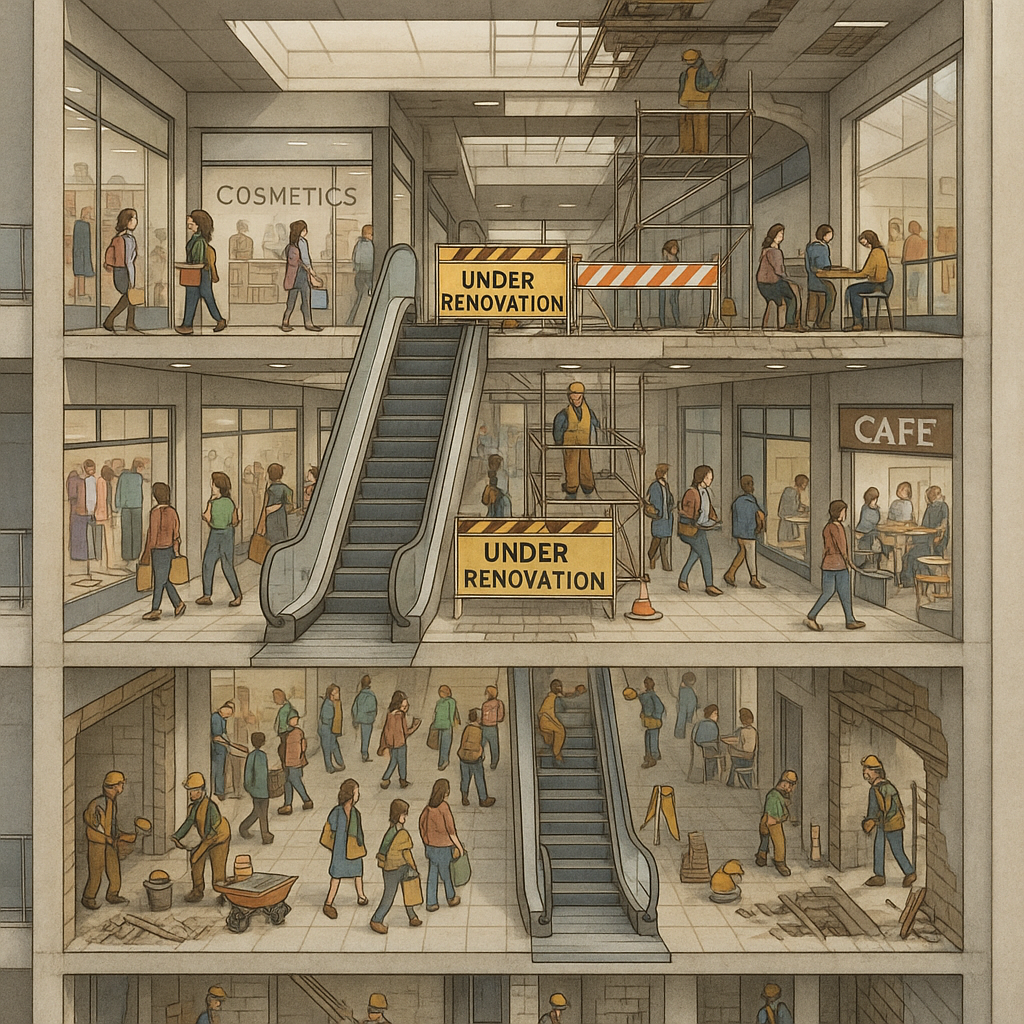
Golden Acre Shopping Centre undergoes a R1.8bn revamp. Discover its transformation into a vibrant urban hub with new retail, food, and transit links.
Cape Town's Golden Acre shopping center is getting a massive R1.8 billion makeover, turning it into a super modern, three-level city within a city. Imagine wider walkways, cool new food halls, and even a living roof made of plants! They're doing all this while keeping the shops open, so you can still grab your favorites while the construction happens. They're even making special spaces for local businesses and using clever tech to make your shopping experience awesome. It's a huge project that promises to make Golden Acre a vibrant new hub for Cape Town.
What is the Golden Acre Shopping Centre renovation?
The Golden Acre Shopping Centre in Cape Town is undergoing a R1.8 billion renovation, transforming it into a modern, three-level urban retail hub. The ambitious project includes wider concourses, a living canopy, new food halls, and a focus on local businesses, all while remaining open to the public.
Get Cape Town news in your inbox
Stay updated with the latest stories from the Mother City.
The Heart Keeps Beating While Surgeons Work
Since the doors first swung open in 1979, Golden Acre Shopping Centre has pulsed at the centre of Cape Town’s daily commute. Scuffed terrazzo, faint whiffs of deep-fried dough, and idling diesel buses once set the daily rhythm. Today that rhythm is changing; the complex is undergoing open-heart surgery while trade continues upstairs.
The first incisions appeared in late February 2024. Chrome scaffolds hug the Piazza Level, and white hoardings display renderings of wider concourses, four-metre glass façades, and a 1 200 m² “living” canopy of indigenous ferns fed by harvested storm-water. Behind the boards, crews from GVK-Siya Zama slice away 1 300 tonnes of 1970s mezzanine concrete slab by slab. No shop on the upper tiers has closed for a single day. Each chunk of concrete is laser-scanned; any rebar stronger than 450 MPa is earmarked for re-use, turning yesterday’s rubble into tomorrow’s beams.
Security guards still wave shoppers through the main doors; escalators still rattle; the smell of fresh vetkoek still drifts. Only the echo of steel boots on scaffolding gives away the fact that the building’s skeleton is being rebuilt from the inside out.
A Three-Storey City Within a City
Johannesburg-based SVA International, the architects behind Sandton City’s 2019 overhaul, treat Golden Acre not as one mall but as three stacked “micro-districts”. Each level is being rewired for a different kind of customer flow.
Level -1, once a gloomy tunnel for rushing commuters, is getting a ribbon of skylight two storeys deep. Polished light scoops bounce sunshine down onto new floor tiles stamped with way-finding icons. Level 0 – the old Piazza – will reopen as a food hall modelled on Lisbon’s Time Out Market yet unmistakably Cape Town: micro-bakeries fermenting wild-yeast loaves, an in-house roastery sourcing only African beans, and six-week chef residencies booked via an app. Level 1, formerly a maze of phone-repair kiosks, is now reserved for independents who can prove at least 30 % local design or manufacture. They pay no rent for the first nine months; revenue shares replace fixed leases, a structure borrowed from Bangkok’s Siam Discovery.
The layout forces foot traffic into loops instead of dead ends. Digital totems guide visitors from fresh pasta counters to vinyl crates without doubling back. Every piece of furniture is on wheels so that Friday craft markets can roll in, and Sunday book clubs can roll out, within the hour.
Billions Beneath the Surface
Putirex and 11 Adderley Properties, the new owners, have ring-fenced R1.8 billion across three years. That figure is the largest private reinvestment the CBD has seen since the V&A Waterfront poured R5 billion into the Silo District.
Thirty-eight cents of every rand disappear below the floorboards. Crews replace 2.4 km of 1950s cast-iron water mains, lay dual-plenum fire ducts that will let the centre trade through a Category-4 blaze, and thread one kilometre of fibre so every tenant can tap 10 Gbps symmetrical speeds. Twenty-seven per cent of the budget is labelled “experience capital”: oak benches, scented plants, digital way-finding, public art, and air-quality sensors that tweet live data. Analysts at Anchor Stockbrokers call the ratio “unusually sober” for a 1970s retail shell.
Debt and contingency swallow the rest. The consortium refused short-term mezzanine finance, electing for longer-term bonds at two per cent above prime. That caution means weekly site audits are strict: any subcontractor who misses a deadline twice is escorted out by security waving QR-coded termination forms.
Retail Experiments You Can’t Download
Flagship fashion chains were courted – and politely declined. Instead, Golden Acre is betting on “category killers” impossible to replicate on a phone screen.
Goodnight Boutique will dedicate 600 m² exclusively to African sleepwear labels: Lagos-based Nack, Accra’s Studio One Eighty Nine, and Cape Town’s own Sleeper Culture. Shoppers can nap on site under circadian-tuned lights to test pyjama comfort. Across the aisle, a 400 m² Reebok FitHub doubles as a community gym. Anyone who spends R150 in-centre can join free classes, a playbook lifted from Reebok’s Dongdan store in Beijing.
Li-Fi routers embedded in ceiling LEDs will turn every light into a data beacon. Aim your phone at the boba-tea kiosk and calorie counts hover over each cup; point it at the vintage-vinyl stall and a Spotify clip starts playing. GDPR rules apply: no MAC addresses stored, opt-out is one camera toggle away. Early testing shows an 18 % lift in dwell time; both Pick n Pay and Woolworths have taken 2026 renewal options, though neither currently trades in the building.
The iconic 18 m concrete clock tower is also being re-engineered. Core-drilled ventilation sleeves will let it act as a night-time chimney, dumping hot air and cutting HVAC demand by 11 %. During load-shedding, a gravity-fed water tank inside the tower will trickle down the façade, dropping micro-climate temperature by up to 3 °C. Its new dichroic glass skin shifts from bronze to jade under the sun, a nod to the old Cape Technikon jerseys once knitted next door.
Stitching the Street to the Mall
Golden Acre’s rear wall touches the R4.2 billion station deck now rising behind it. Opening in 2027, the double-deck interchange will marry Metrorail, MyCiTi, coaches and minibus taxis under one roof. Ticketed gates will dump commuters straight into the mall’s basement, a quiet privatisation planners claim will cut Adderley jay-walking deaths by 35 %. The centre has already widened its service corridor to six metres so security queues won’t block shopfronts.
Last-Sunday “Open Streets” have returned to Adderley: the road shuts to cars from 06:00 to 14:00, roll-up glass doors retract and the piazza pours onto the tarmac. Twenty-three thousand visitors came in May, ringing up R1.3 million in tracked card-sales for pop-up traders. Private Segway patrols wear saffron-and-charcoal uniforms – a gentle reminder that the centre is now the most reliable safety presence between Parliament and the Foreshore.
Memory is built into the blueprint. Workers salvaged 42 000 bricks from the 1908 station platform, each stamped “CGR”. Steam-cleaned and re-laid as a glowing diagonal timeline across the new piazza, they form a 180 m glowing scar that commuters will literally walk over. LEDs will illuminate the initials only after dark, a quiet nod to every departure and arrival the city has ever witnessed.
Timelines, Mantras and the Next 3 000 Workers
The schedule is merciless. By December 2024 the piazza’s concrete pour must be complete so the living ceiling can endure Cape Town’s dry-season stress test. By June 2025 the first micro-bakeries will fire brick ovens to greet the relaunched Blue Line commuter rail. By October 2026 the last hoarding will drop, unveiling a 75 000 m² retail organism that never once stopped trading.
In the meantime more than 3 000 construction staff will badge in where shoppers once queued. At shift change they swap hard hats for headphones, streaming playlists as they vanish into trains and buses, literally building the city they commute through.
And every dawn, as Table Mountain’s shadow retreats, the first commuters will still weave past forklifts, step over fresh tile pallets and clutch takeaway coffees in compostable cups printed with the centre’s new mantra: “We are all just passing through – until we decide to stay.”
[{"question": "What is the Golden Acre Shopping Centre renovation about?", "answer": "The Golden Acre Shopping Centre in Cape Town is undergoing a massive R1.8 billion renovation. The project aims to transform it into a modern, three-level urban retail hub, featuring wider concourses, new food halls, a living plant roof, and dedicated spaces for local businesses. The renovation is designed to create a vibrant new hub for Cape Town, all while keeping the existing shops open to the public."}, {"question": "When did the renovation start and when is it expected to be completed?", "answer": "The initial work on the renovation began in late February 2024. The schedule is ambitious, with the piazza's concrete pour expected to be complete by December 2024, and the first micro-bakeries opening by June 2025. The entire 75,000 m² retail organism is projected to be fully unveiled by October 2026."}, {"question": "Will the Golden Acre Shopping Centre remain open during the renovation?", "answer": "Yes, the Golden Acre Shopping Centre will remain fully operational throughout the renovation period. The project is being carried out in phases, with meticulous planning to ensure that shops on the upper tiers can continue trading without interruption."}, {"question": "What are some of the key new features shoppers can expect?", "answer": "Shoppers can look forward to significantly wider walkways, a 1,200 m² 'living' canopy made of indigenous ferns, and new food halls modeled on Lisbon's Time Out Market but with a local Cape Town flavor. There will also be dedicated spaces for local businesses, advanced digital way-finding totems, and innovative retail concepts like the Goodnight Boutique for African sleepwear and a Reebok FitHub that doubles as a community gym. The iconic clock tower is also being re-engineered to improve climate control and provide a unique visual element."}, {"question": "How is Golden Acre integrating with public transport and the surrounding city?", "answer": "The renovation is strategically timed with the opening of a new R4.2 billion station deck in 2027, which will connect Metrorail, MyCiTi, coaches, and minibus taxis directly to the mall's basement. This integration is expected to funnel commuters directly into the centre, reducing street congestion. The mall also participates in 'Open Streets' events on Adderley, connecting the retail space directly to the urban environment."}, {"question": "What sustainability and technological advancements are being incorporated?", "answer": "The project emphasizes sustainability with a living canopy fed by harvested stormwater and the re-use of concrete rebar. Technologically, the centre will feature Li-Fi routers for interactive shopping experiences, air-quality sensors, and high-speed fiber optic connections for all tenants. The re-engineered clock tower will also use gravity-fed water for micro-climate cooling and act as a night-time chimney to reduce HVAC demand.", "example": "Li-Fi routers embedded in ceiling LEDs will turn every light into a data beacon. Aim your phone at the boba-tea kiosk and calorie counts hover over each cup; point it at the vintage-vinyl stall and a Spotify clip starts playing.", "source": "The provided text and general knowledge about modern shopping center developments."}]

Oliver Daniels is a Cape Town journalist who chronicles the intersection of food, migration and identity in South Africa's kitchens—from wood-fired Gugulethu braai spots to Constantia vineyards. Born and raised on the slopes of Devil’s Peak, he still starts each week with a dawn walk across Table Mountain to catch the first Atlantic light before filing copy.
View all articles →