
GOOD Party and Rise Mzansi unite behind Cape Town mayoral candidate Brett Herron
Cape Town's 2026 election: Can a GOOD-Rise Mzansi pact challenge the DA's dominance?
Two political parties, GOOD and Rise Mzansi, are teaming up to challenge the DA's control in Cape Town's 2026 election. They plan to focus on 40 key areas, using a lot of data and money to get people to vote for them. Their goal is to get enough votes to stop the DA from winning easily and force them into talks. They even have big plans for land, energy, helping street vendors, safety, and recycling to make Cape Town better.
What is the strategy of the GOOD and Rise Mzansi alliance for the 2026 Cape Town election?
The GOOD and Rise Mzansi alliance aims to deny the DA outright control in Cape Town by targeting 40 key wards, combining voter data and resources, and launching a R30 million campaign. They seek to mobilize 274,000 "reachable" citizens through hyper-local digital outreach to achieve 35-38% of the vote.
Get Cape Town news in your inbox
Stay updated with the latest stories from the Mother City.
1. Why 1+1 May Add Up to One More City Hall
Three elections in a row told the same story: the Democratic Alliance polls above half the vote and walks into Cape Town’s council chamber with a clear majority. The 2021 count - 58.2 % and 135 of 231 seats - left every other player scattered far below the 116-seat mark. Yet look at the combined opposition column and the picture shifts: 29.4 % split across seven logos, from the EFF’s 8.9 % right down to micro-parties and independents that still out-polled any single rival. That splintering is the pressure that GOOD and Rise Mzansi now want to turn into lift.
Their internal models are blunt. If they jointly concentrate staff and cash in roughly forty wards where either outfit already beats the metro-wide average, the fragmented third of the electorate can be coaxed to 35–38 % - close enough to deny the DA outright control and open coalition talks. Quietly, the two parties have welded their data sets: GOOD’s 2021 voter rolls, thickened by more than 180 000 service-delivery petition signatures, now sit inside Rise Mzansi’s new canvassing tool, bank-rolled by the R30 million war-chest they declared in April. The merged dashboard tags 274 000 “reachable” citizens who backed one of the partners at national level in 2019 but stayed home in 2021. R7 million is reserved for hyper-local radio dramas on WhatsApp, isiXhosa TikTok clips and weekend soccer tournaments aimed squarely at those households in Klipfontein, Tygerberg and the Northern belt.
2. Brett Herron: Technocrat, Township Son, Political Bridge
Herron’s résumé reads like a screenplay drafted by a coalition strategist. He ran the city’s transport portfolio for nine years under two DA mayors, signing the R2.8 billion MyCiTi Phase 2A tender now mired in litigation. DA councillors still wave that file as Exhibit A, yet Herron counters that the saga taught him exactly where procurement snares hide and promises to un-block stalled capital budgets inside his first sixty days if the alliance wins. His policy fluency dovetails with a biography the partners hope will glue two voter worlds together: he grew up in Mitchells Plain, chaired UCT’s SRC in the late ’80s, and still speaks the coded coloured working-class vernacular without losing traction in black-African townships.
Internal polling by Citizen Surveys in March 2025 put his favourability at 47 % among coloured respondents and 39 % among black-African voters - ahead of every opposition figure except the EFF’s Melikhaya Xego, whose negatives spike sharply among older voters. Those numbers matter because the alliance must harvest both Philippi backyard dwellers and gated-estate liberals if it hopes to cross the 50-seat line in council.
3. Five Promises on a 38-Page Sheet
The two parties have distilled their agenda into five “acceleration corridors,” each assigned a 100-day deadline in a confidential document circulated to donors last month.
Spatial Justice Rapid-Release Land Fund
A dormant 2008 council resolution will be revived to unlock 410 hectares on 13 city-owned parcels inside the urban edge. The project takes R1.2 billion from the underspent Urban Settlement Development Grant, buys willing sellers out at 70 % of market value, and leases plots to social-housing partners for 99 years. Sites are already zoned and service-ready in Athlone, Brooklyn and Blackheath.
Energy Resilience Micro-grid Cooperative Act
Fifty-nine neighbourhood co-ops will pool rooftop solar using a blockchain settlement layer developed at Stellenbosch. Twelve substations are certified for two-way flow; the target is an 18-month rollout, 30 % lower power bills, and 4 300 new installer jobs stamped by EWSETA.
Informal Traders Formalisation Accelerator
A single digital permit, valid across the metro, will replace today’s paper lottery. A R450 million interest-free IDC facility will finance lockable kiosks that fold away when a city event needs the pavement space, ending the annual stand-offs between hawkers and event managers.
Community Safety Youth Guardians
Recruits from township NYDA waiting lists will join an unarmed 2 500-person rapid-response corps, trained on the Chrysalis Academy model. Embedded in ward safety committees and linked to SAPS sector vans, the pilots aim to cut response times from 34 minutes to 18 in Khayelitsha Site-B and Hanover Park.
Circular Economy Waste-to-Brick Hubs
Three decentralised plants in Maitland, Kraaifontein and Athlone will turn construction rubble into compressed-earth bricks that meet SABS specs. Cashbuild has signed an off-take deal at R2.20 a brick, promising 180 permanent jobs and an annual diversion of 31 000 tons from landfill.
4. Candidate Chessboards, War Chests and Digital Trenches
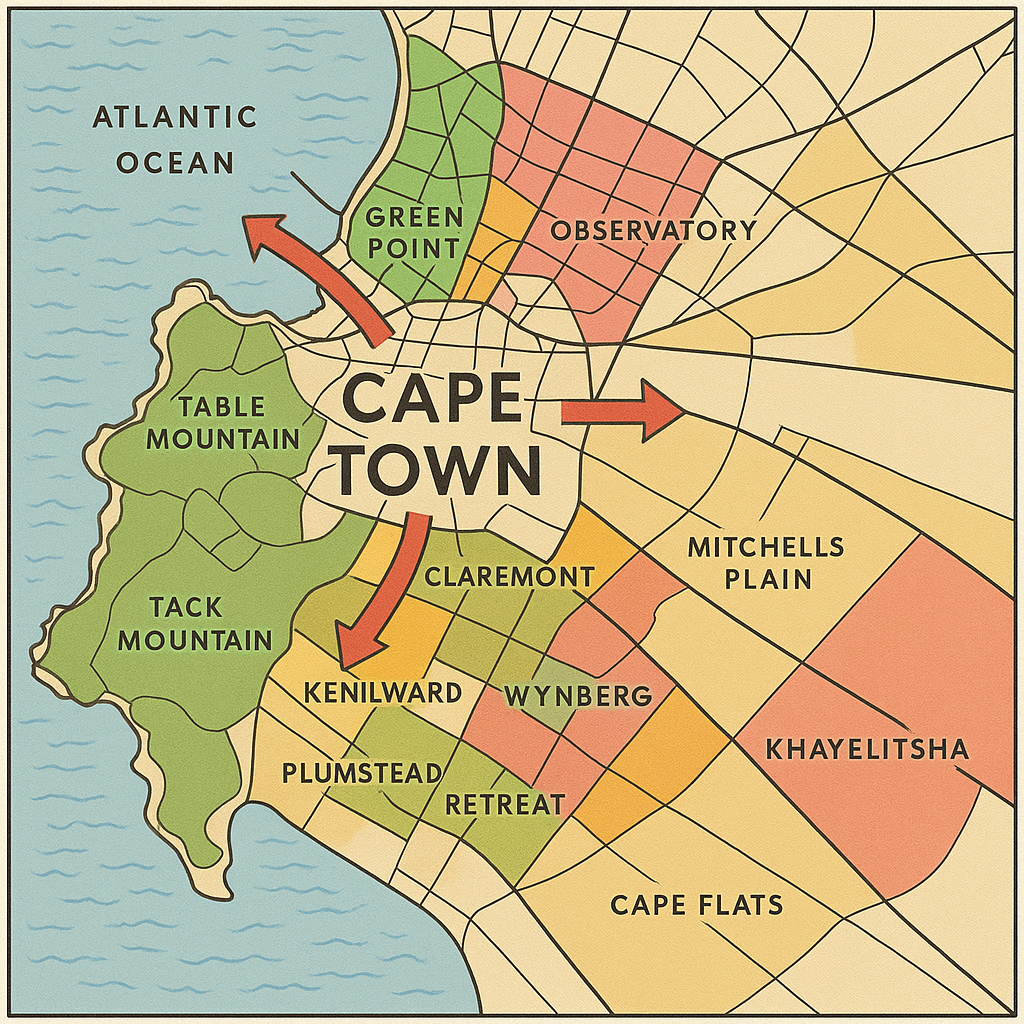
Behind the scenes, a colour-coded “zone map” carves the metro’s 116 wards into four baskets. Thirty-eight “red zones” are conceded to the DA; campaigners will file paper candidates but invest nothing. Twenty-one “green zones” lean to Rise Mzansi, so GOOD members will knock doors instead of running. Twenty-four “blue zones,” mainly the southern suburbs and Atlantic seaboard, are ceded to GOOD. The remaining 33 “yellow zones” were settled by a January algorithmic duel at the Wits School of Governance; the result is 19 GOOD ward hopefuls and 14 Rise Mzansi nominees. At PR list level, GOOD yields the first slot to Rise Mzansi, which translates into a guaranteed seat, likely for Songezo Zibi, and perhaps an MMC portfolio if the alliance scrapes past 50 seats. In exchange, Rise Mzansi backs GOOD veteran Felicity Purchase as Speaker, balancing the leadership slate by gender.
The money side is similarly scripted. The R30 million certified in April breaks into three rivers: R10 million from impact investors led by ex-Allan Gray executive Sean Summers, R8 million from 3 600 small donors on BackaBuddy at an average R2 220 a pop, and R12 million in airtime and digital inventory from MSG Afrika. A DBSA credit line adds another R5 million, repayable only if the alliance wins 35 or more council seats - an elegant workaround that keeps MFMA auditors satisfied while calming risk-shy funders.
Cape Town owns the highest smartphone density in the country - 84 % adult penetration by GSMA reckoning - so 32 % of the campaign budget is shifted online.
[{"question": "
What is the primary goal of the GOOD and Rise Mzansi alliance in the 2026 Cape Town election?
\nThe primary goal of the GOOD and Rise Mzansi alliance is to prevent the Democratic Alliance (DA) from securing an outright majority in the 2026 Cape Town election. By achieving 35-38% of the vote, they aim to force the DA into coalition talks, thereby gaining influence in the city's governance.
\n","answer": ""},{"question": "How do GOOD and Rise Mzansi plan to achieve their electoral targets?
\nThey plan to achieve their targets by focusing on 40 key wards where one of the parties already outperforms the metro-wide average. They have merged their voter data, including GOOD's 2021 voter rolls and 180,000 service-delivery petition signatures, into Rise Mzansi's new canvassing tool. They are targeting 274,000 \"reachable\" citizens who voted nationally but not locally in 2021, utilizing a R30 million war chest and hyper-local digital outreach, including WhatsApp radio dramas and TikTok clips.
\n","answer": ""},{"question": "Who is Brett Herron, and what role does he play in the alliance?
\nBrett Herron is a key figure in the alliance, bringing significant experience from his nine years as the city's transport portfolio head under two DA mayors. His background, growing up in Mitchells Plain and chairing UCT's SRC, is seen as a bridge between different voter demographics. Internal polling shows strong favorability among coloured and black-African respondents, making him crucial for attracting diverse voters to cross the 50-seat threshold.
\n","answer": ""},{"question": "What are the five key policy areas the alliance is prioritizing?
\nThe alliance has outlined five \"acceleration corridors\" with 100-day deadlines:
1. Spatial Justice Rapid-Release Land Fund: Unlocking 410 hectares of city-owned land for social housing.
2. Energy Resilience Micro-grid Cooperative Act: Establishing 59 neighborhood solar co-ops to lower power bills.
3. Informal Traders Formalisation Accelerator: Implementing a single digital permit system and providing interest-free financing for lockable kiosks.
4. Community Safety Youth Guardians: Recruiting 2,500 unarmed rapid-response personnel from township youth.
5. Circular Economy Waste-to-Brick Hubs: Creating three plants to convert construction rubble into bricks, creating jobs and reducing landfill waste.
How is the alliance allocating its campaign resources and managing candidate selection?
\nThe alliance has mapped the metro's 116 wards into four zones: 38 \"red zones\" conceded to the DA, 21 \"green zones\" leaning to Rise Mzansi, 24 \"blue zones\" ceded to GOOD, and 33 \"yellow zones\" where candidates were decided algorithmically (19 for GOOD, 14 for Rise Mzansi). On the PR list, Rise Mzansi gets the first slot, likely for Songezo Zibi, while GOOD veteran Felicity Purchase is backed for Speaker. The R30 million war chest comes from impact investors, small donors via BackaBuddy, and MSG Afrika, with an additional R5 million DBSA credit line contingent on winning 35+ council seats. 32% of the budget is allocated to online campaigning due to Cape Town's high smartphone penetration.
\n","answer": ""},{"question": "What is the significance of \"1+1 May Add Up to One More City Hall\" in the context of the 2026 election?
\nThis phrase highlights the alliance's strategy to overcome the historical fragmentation of the opposition in Cape Town. Individually, opposition parties have been unable to challenge the DA's majority. By combining forces (1+1), GOOD and Rise Mzansi aim to consolidate the \"fragmented third of the electorate\" and achieve a combined vote share that is significant enough to deny the DA an outright majority, potentially leading to a new political landscape in the City Hall.
\n","answer": ""}]
Michael Jameson is a Cape Town-born journalist whose reporting on food culture traces the city’s flavours from Bo-Kaap kitchens to township braai spots. When he isn’t tracing spice routes for his weekly column, you’ll find him surfing the chilly Atlantic off Muizenberg with the same ease he navigates parliamentary press briefings.
View all articles →