
Households hire electricity ‘fixers’ after Eskom fails them
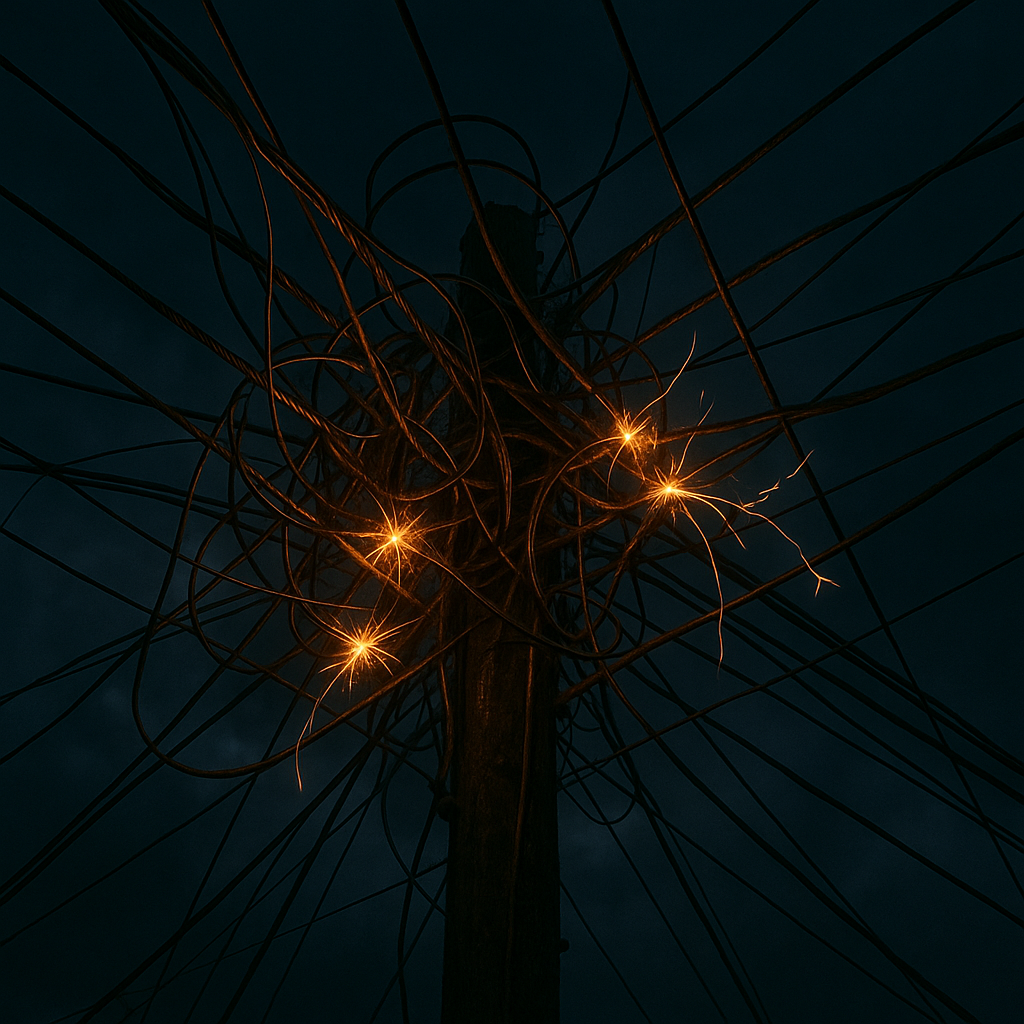
Khayelitsha residents create a "parallel grid" to cope with constant power outages, rewiring their community with informal solutions.
In Khayelitsha, frequent power outages mean residents build their own power grids. They pay informal electricians to fix broken lines, creating a hidden economy. Women, like Ntombi, even become skilled electricians, solving problems where official services fail. This community effort keeps the lights on, even if it's risky and unofficial, showing amazing resilience.
How do Khayelitsha residents cope with frequent power outages?
Khayelitsha residents cope with frequent power outages by collectively funding informal electricians to perform dangerous, temporary repairs. They also innovate with tools like solar kits, paraffin, and generators, leading to micro-economies around these solutions. Women like Ntombi Mabandla offer vital services, such as fault tracing, filling the vacuum left by inadequate official services.
Get Cape Town news in your inbox
Stay updated with the latest stories from the Mother City.
Section 1 – Grid Blow-outs: Anatomy of an Everyday Collapse
In streets such as Site C, Makhaza, Town-Two and Enkanini, dusk is often the starter pistol for black-outs. One moment the overhead supply line still hums; the next it droops like an overworked washing line, a dull clap echoes from the metal kiosk on its cement plinth, and every lamp dies in unison.
The small substation that keeps the eastern half of Khayelitsha alive was built in 1995 on an assumption: 26 000 registered houses, plus 3 000 backyard shacks, would be the ceiling. Today it shoulders roughly 64 000 homes, many rebuilt as double-storey brick blocks that shelter grandparents, parents and children. Copper aerial-bundled cable installed three decades ago was rated for 190 A, yet on chilly evenings it is routinely asked to carry twice that.
Somewhere between four and six in the morning demand finally drops low enough for the circuit-breaker to re-close. During those six lost hours joints overheat and crystallise, aluminium strands snap one by one, and the countdown to the next failure shrinks.
Section 2 – Living Without Light: Economics of a Black-out
Once the Wi-Fi box falls silent and the prepaid meter’s battery drains, the digital world disappears. Tablets die, homework halts, security lamps fade, and the corner café’s freezers start dripping. Within hours someone tapes a notice on the kiosk: “Community huddle – 6 p.m. under the big gum tree – bring ideas on power.”
Collection is swift and matter-of-fact: every home drops R137 into an ice-cream tub. Those who can’t pay are fronted by neighbours without shame. A shortlist circulates - Siya the Eskom lineman fresh from Bellville, Lefa the jobless engineering grad, Thando the self-taught electrician who once rewired a Philippi church with salvaged Telkom copper.
Chosen techies arrive after sunset, open the kiosk with an official-looking padlock key worn on a loop of fence wire, and in half an hour the breaker is manually latched shut. When drop-out fuses are blown they are replaced by snippets of 6 mm² copper “until the utility shows up.” The R2 740 collected from twenty houses pays for fuel, a bottle of whisky “for the ancestors’ blessing”, and whatever remains is split among the crew.
Section 3 – The Toolbox of Work-arounds
Electricity may be gone, but innovation is not.
- Ice becomes currency.* Spaza owners hoard working fridges and sell freezer slots by the brick. A R55 frozen chicken rises to R70 once diesel for the generator is priced in.
- Paraffin politics.* The litre that cost R18 in May retails at R24 within twenty-four hours of a black-out; kitchen fires climb in parallel.
- Barber timetables.* Clippers demand steady 220 V, so informal barbers broadcast availability on WhatsApp: “Lights on today - come get fresh lines.”
- Solar kits on hire-purchase.* Door-to-door salesmen move 200 W panels and 100 Ah batteries for R280 a month. The package drives two LEDs and a small TV for six hours, and every stretch of outages longer than four days bumps sales by 40 %.
Beneath the surface, Eskom’s own technicians try to separate “scheduled maintenance” from “forced trips,” but the second category dominates. Thermal overload, voltage collapse on 11 kV feeders, and drifting relays fooled by harmonic-rich modern loads are the usual suspects. Informal electricians often yank the earth-leakage transformer to stop nuisance trips - nice for keeping lights on, lethal for humans. Electrocution admissions at Red Cross Children’s, Karl Bremer and Groote Schuur among 10- to 24-year-olds are up 19 % year on year.
Section 4 – Parallel Professionals: Women, Side-hustles and the State Vacuum
From 2015 to 2023 Eskom shut eleven small customer-service offices in greater Cape Town; Khayelitsha is now served by one Mew Way centre that opens at 07:30 and dishes out 410 queue tickets on an ordinary day. Only 38 % of problems are fixed within seven days. Treasury cut R6.5 billion from Eskom’s budget in March 2023, so armed escorts for repair crews vanished. Technicians wait for an SAPS van whose officers finish paperwork first; meantime the township solves its own problems.
Siya, 31, holds a trade-test certificate and has spent nine years on Eskom’s 33 kV feeders in Bellville. By 17:30 he is back in civilian clothes, two rolls of rubber tape in his pocket. Fridays are busiest - salaries land and speakers thump. His tariff sheet: R500 to leapfrog a faulty meter, R750 for a temporary aerial span, R1 200 to “phase” two illegal three-phase taps so upstream fuses survive. He swears he is balancing loads better than Megawatt Park ever did, borrowing a thermal camera to keep each phase under 115 A. His greatest fear is electrocution; a friend slipped on a wet roof last winter and brushed an 11 kV line. The family still owes the undertaker R9 000.
Women are carving their own niche. Ntombi Mabandla, 42, mother of three, earned an N6 electrical diploma in 2019 but found no apprenticeship. She turned her garage into a mini-lab with a second-hand Megger and a borrowed crimp tool. She traces underground faults for R250 a house, draws “Ntombi’s Grid” in a notebook, heat-shrink sleeving every joint. Elderly customers repay R20 a week tracked in carbon-copy books. She will not compromise on earth leakage.
City Hall’s 2023 “Power Heroes” programme promises 200 free prepaid units to households that cut peak demand by 10 %. Barely anyone in Khayelitsha qualifies because consumption already sits under 450 kWh a month. The ward councillor controls R150 000 a year for “immediate outage relief,” yet the cash is released only against an Eskom job card - residents say the card never materialises.
Micro-businesses bleed when the grid fades. A 2022 UCT study of 118 tiny firms in Site B showed that beyond six hours without power 63 % simply close; 21 % pivot to paraffin, diesel or gas; 16 % scrape together solar or batteries. A spaza loses R1 840 in three dark days - equal to four months of municipal rates. Hair salons and cellphone repair shops are hit hardest. One tavern owner repurposed a telecom tower battery for 12 V lights; another rents a generator at R100 per five-hour shift and slaps a R3 “generator surcharge” on every beer.
Eskom’s smart meters in neighbouring Mitchells Plain were meant to curb tampering, but installers left the default PIN unchanged. A YouTube clip soon demonstrated how a R120 infrared dongle resets the tamper flag. Siya now carries two USB tokens: the official Eskom key and a cloned clone bought in Bellville South.
At Nolungile Clinic, 1 200 Pfizer-BioNTech doses must stay between 2 °C and 8 °C. When outages drag past four hours the nurse moves stock to a household fridge backed by an MSF-subsidised solar inverter. Chronic-care patients aren’t as lucky - diabetics skip insulin when the monthly outage schedule slips, landing later at hospital in hyperglycaemic crisis.
Mseki Primary saw Grade-6 maths marks fall 13 % in winter 2022 amid constant black-outs; homework couldn’t be done after dark. The governing body raised R18 000 for 120 rechargeable lanterns; each is borrowed at 15:30 and returned at 07:00, recharged through the principal’s inverter - now so overloaded it trips if anyone boils a kettle.
A volunteer group, Khayelitsha Energy Watch, crowdsources outages using open-source GIS and old Android handsets. WhatsApp fault reports feed a live map e-mailed daily to the ward councillor and Eskom customer service. Patterns leap out: failures cluster on Thursdays (payday) and Sundays (church PA systems). Unofficial fixes survive an average of eleven days before Eskom removes them - no fines stick because paperwork never traces back to an individual.
Every bypass is eventually undone. Eskom slaps on a R6 052 tamper fine, replaces seals, drives away, darkness returns, the ice-cream tub makes another round. Across twelve months the average Site C household spends R1 644 on these DIY reconnections - money that could have bought a brand-new 300 W panel or one-third of an inverter, yet upfront capital remains a mountain too steep. And so the second grid lives on.
A generation ago, in 1986, electricity first reached Khayelitsha as a single-phase 220 V line intended “for light bulbs only.” Elders remember the pride of snapping off paraffin lamps. Today those lamps sit on kitchen tables beside 5 000 mAh lithium packs scavenged from wrecked e-scooters. The promise of modernity once lowered from a state-owned crane; now its rungs are soldered by moonlight, one wire at a time.
How do Khayelitsha residents cope with frequent power outages?
Khayelitsha residents cope with frequent power outages by collectively funding informal electricians to perform dangerous, temporary repairs. They also innovate with tools like solar kits, paraffin, and generators, leading to micro-economies around these solutions. Women like Ntombi Mabandla offer vital services, such as fault tracing, filling the vacuum left by inadequate official services.
Why are power outages so frequent in Khayelitsha?
Power outages are frequent due to an outdated electrical infrastructure that was designed for a much smaller population. The substation built in 1995 was intended for 26,000 registered houses and 3,000 backyard shacks, but now serves approximately 64,000 homes. This overload, especially on cold evenings, causes circuit breakers to trip, joints to overheat, and cables to fail, leading to routine blackouts.
What are some of the economic impacts of these blackouts on Khayelitsha's residents and businesses?
The blackouts have significant economic impacts. Micro-businesses suffer heavily, with many closing after just six hours without power. Spaza shop owners lose an average of R1,840 in three dark days. The cost of essential goods like ice and paraffin increases during outages, and services like barber shops rely on limited power availability. Residents also collectively pay for informal repairs, spending an average of R1,644 per household annually on these DIY reconnections.
How do residents organize and pay for informal power grid repairs?
When an outage occurs, residents quickly organize community meetings to raise funds. Each home typically contributes R137 into an ice-cream tub. Neighbors often front money for those who cannot pay immediately. A shortlist of informal electricians, ranging from former utility linemen to self-taught individuals, is then consulted to perform the necessary repairs, which might include manually closing breakers or replacing blown fuses with copper snippets.
What role do women play in establishing and maintaining these informal power solutions?
Women play a crucial role in establishing and maintaining informal power solutions. For instance, Ntombi Mabandla, a 42-year-old mother of three with an N6 electrical diploma, turned her garage into a mini-lab. She now earns a living tracing underground faults for R250 per house, drawing her own grid maps, and strictly adhering to safety standards like earth leakage, in contrast to some male informal electricians.
What are the risks associated with these informal power connections?
The risks associated with informal power connections are substantial and include electrocution, which has seen a 19% year-on-year increase in hospital admissions for 10- to 24-year-olds. Informal electricians sometimes disable critical safety features like earth-leakage transformers to prevent nuisance trips, making the connections lethal for residents. Additionally, these repairs are often temporary and can lead to further damage to the grid or appliances.

Chloe de Kock is a Cape Town-born journalist who chronicles the city’s evolving food culture, from township braai joints to Constantia vineyards, for the Mail & Guardian and Eat Out. When she’s not interviewing grandmothers about secret bobotie recipes or tracking the impact of drought on winemakers, you’ll find her surfing the mellow breaks at Muizenberg—wetsuit zipped, notebook tucked into her backpack in case the next story floats by.
View all articles →