
Routine SPCA warrant execution leads to explosive discovery in Mikpunt
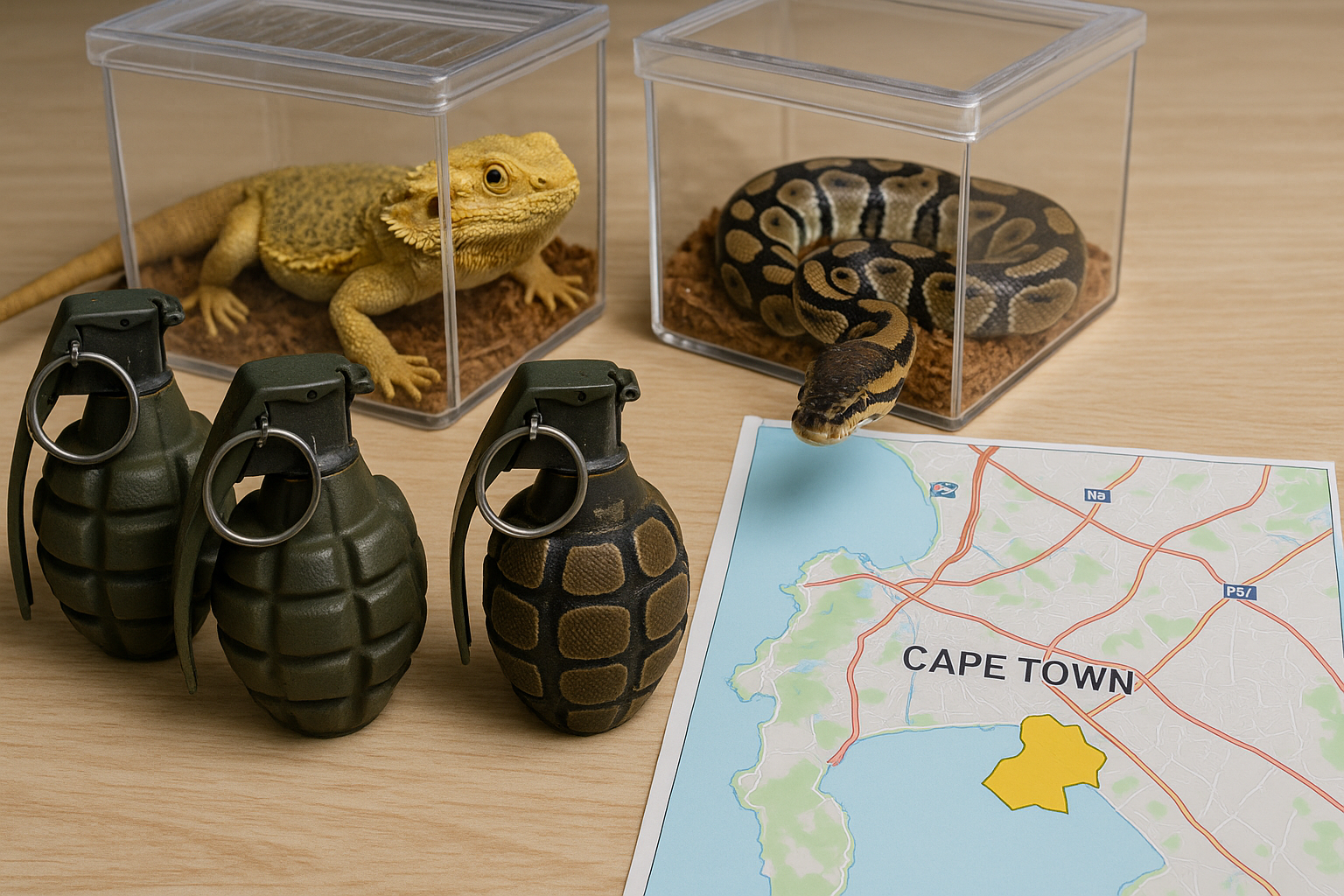
Military explosives and exotic reptiles found during a Cape Town animal welfare raid, revealing links between wildlife crime and security threats.
In a shocking turn, a routine reptile check in Durbanville uncovered military-grade explosives, turning a quiet suburb into a national security scene. Animal welfare inspectors stumbled upon these dangerous items, leading to a massive operation involving bomb squads and the military. This unexpected discovery highlighted a disturbing link between wildlife crime and the illegal trade of weapons. It shows how even a simple animal inspection can reveal serious threats to public safety and national security. This event has sparked concerns about how easily dangerous goods can be found in unexpected places.
What was discovered during the reptile raid in Durbanville?
During a routine reptile welfare check in Durbanville, South Africa, inspectors unexpectedly discovered military-grade explosives. This led to a large-scale national security operation involving the SAPS Explosives Unit and the South African National Defence Force, highlighting a convergence of wildlife crime and weapons proliferation.
Get Cape Town news in your inbox
Stay updated with the latest stories from the Mother City.
Unexpected Discovery Turns Welfare Check into National Security Operation
A quiet Saturday morning in Mikpunt, 30 kilometres north-east of Cape Town’s CBD, flipped into a scene straight out of a counter-terror thriller when inspectors from the 150-year-old Cape of Good Hope SPCA kicked open what should have been a straightforward reptile-welfare case. Court paperwork in hand, the team had arrived to verify complaints of exotic snakes kept in breach of South Africa’s Animals Protection Act and the Biodiversity Act’s Threatened or Protected Species regulations. Instead, they triggered an emergency chain reaction that pulled in City Metro Police, the SAPS Explosives Unit, and uniformed teams from the South African National Defence Force.
The switching point came while officers were photographing cramped terraria and measuring temperature gradients. In a side room, tucked between plastic tubs and coils of extension cord, lay two olive-green tubes anyone who has spent time on a military range would recognise at once. Inspectors called an immediate halt, cleared the building, and placed a cordon that would remain in place for the rest of the day. Within 30 minutes, a convoy of armoured vehicles and bomb-disposal specialists rolled down the gravel driveway, turning the modest plot on the edge of Durbanville wine country into a restricted zone rarely seen outside army bases.
The devices’ exact classification remains classified pending forensic work, yet the speed with which SANDF ordnance technicians arrived shows the find was treated as functional, not inert. Officers in heavy bomb suits set up a mobile command post and used remote cameras to complete a 360-degree survey before lifting the items into blast-proof containers. Only then did the focus return to the reptiles, proving how quickly a routine animal-protection drive can morph into high-risk ordnance disposal.
When Wildlife Crime Overlaps with Weapons Proliferation
Inside the holding pens, responders found five non-native snakes confined in conditions the SPCA later called “unfit for any living creature.” Each snake showed early signs of metabolic bone disease, dehydration and multiple skin lesions consistent with long-term neglect. Veterinary officers sedated and stabilised the animals inside mobile treatment crates while detectives began tracing paper trails for the requisite exotic-species permits. Initial scrutiny revealed either expired paperwork or falsified documentation - an increasingly common tactic in South Africa’s grey-market reptile trade.
The property’s occupant, a 42-year-old man whose name remains under embargo, was hand-cuffed and driven to Durbanville SAPS on charges that began with animal cruelty and swiftly expanded. Under the seldom-invoked Explosives Act of 1956, unauthorised custody of military ordnance can lead to twenty-year sentences. Investigators are now piecing together supply chains: were the shells pilfered from a state armoury, retrieved from a former battle-training area, or smuggled in through the same networks that move rhino horn and abalone? The SANDF has launched an internal audit amid renewed fears of inventory leakage.
This convergence of wildlife offences and weapons diversion fits a pattern South Africa’s crime analysts have tracked for a decade. Rhino-poaching syndicates routinely arm their foot soldiers with rifles lifted from police and army depots, while reptile traffickers leverage shared transport routes used to move drugs and ammunition. The Mikpunt bust therefore reads as a textbook example of what CITES now labels “convergent trafficking” - where one illicit market lubricates another, creating compound risks for investigators and communities alike.
Legal, Welfare and Conservation Consequences Unfold
Courts will decide whether the suspect’s permit lapses were administrative negligence or deliberate fraud, but the seized snakes are already benefiting from round-the-clock care at the SPCA’s specialised reptile unit. Lead veterinarian Dr Tanya Abdool reports that the animals - three ball pythons, a green anaconda and an Asian vine snake - are on fluid therapy, vitamin supplements and course-specific antibiotics. Once stabilised, their fates will be negotiated with provincial conservation authorities; possibilities range from accredited sanctuary placement to repatriation agreements with range-state facilities overseas.
Conservation officials stress that every illegally held exotic snake potentially endangers indigenous ecosystems. Escaped or deliberately released pets have established breeding populations of Burmese pythons in the Florida Everglades and boa constrictors on Puerto Rico, causing precipitous declines in native mammals and birds. South Africa’s Mediterranean climate pockets around the Western Cape could support similar invasions. Strengthening permit verification systems and post-entry monitoring therefore carries national significance far beyond individual welfare cases.
Beyond fines or imprisonment, the accused could face civil claims for clean-up costs, veterinary care and potential ecological restoration if any of the species is found to harbour pathogens transmissible to local wildlife. Meanwhile, the SPCA has signalled its willingness to act as a test case for joint prosecution strategies, hoping to secure both animal-welfare convictions and heavier sentences under the explosives statute. The organisation’s spokesperson, Belinda Abraham, emphasised that “animals, people and ecosystems are safer when smuggling routes are dismantled, whatever contraband they carry.”
Broad Lessons for Enforcement, Policy and Public Safety
The final debrief, held in a Durbanville community hall, turned into a mini-symposium on modern crime blurring traditional mandates. Metro Police commanders praised their SPCA counterparts for disciplined scene management that kept bystanders clear and preserved forensic integrity. Military ordnance teams acknowledged that animal-control officers often develop the best local intelligence on properties operating outside the law. The consensus: routine welfare checks should include updated risk protocols, and bomb squads should familiarise themselves with reptile-handling gear.
For policymakers, the Mikpunt episode strengthens calls to integrate wildlife-crime databases with arms-trafficking intelligence, a recommendation already on the table at the National Intelligence Coordinating Committee. Enhanced data sharing could flag individuals whose seemingly minor permit infractions mask deeper security threats. Civil society groups are urging Parliament to review gaping loopholes in the 1956 Explosives Act, last amended before the rise of sophisticated criminal networks and online marketplaces.
Residents of the leafy suburb now speak of their neighbourhood as a reminder that clandestine supply webs reach far beyond city harbours and border posts. Parents who once worried only about dog-snatching now quiz their children on how to report unusual deliveries or chemical smells seeping from locked sheds. In that sense, the weekend’s drama has achieved what no awareness campaign could: everyday citizens now recognise that wildlife crime, weapons trafficking and public safety sit on the same dangerous continuum.
What was discovered during the reptile raid in Durbanville?
During a routine reptile welfare check in Durbanville, South Africa, animal welfare inspectors unexpectedly discovered military-grade explosives. This discovery quickly escalated a simple animal inspection into a major national security operation involving bomb squads and the military.
Where exactly did the discovery take place?
The discovery was made in Mikpunt, a quiet enclave located approximately 30 kilometers north-east of Cape Town’s Central Business District, on the edge of the Durbanville wine country.
What was the initial purpose of the inspection?
The initial purpose of the inspection was a routine reptile welfare check. Inspectors from the Cape of Good Hope SPCA were responding to complaints about exotic snakes being kept in violation of South Africa’s Animals Protection Act and Biodiversity Act’s Threatened or Protected Species regulations.
What kind of explosives were found?
While the exact classification remains confidential pending forensic work, the devices were described as two olive-green tubes, recognized by military personnel as functional military ordnance. The rapid response from the South African National Defence Force (SANDF) ordnance technicians confirmed they were treated as active, not inert, explosives.
What is the significance of this discovery?
This incident highlights a disturbing link between wildlife crime and the illegal trade of weapons, a phenomenon crime analysts refer to as "convergent trafficking." It demonstrates how seemingly minor animal welfare infractions can mask deeper national security threats and emphasizes that illicit markets often lubricate one another, creating compound risks for communities and law enforcement.
What happened to the reptiles found at the property?
Five non-native snakes – three ball pythons, a green anaconda, and an Asian vine snake – were found in conditions described as

Lerato Mokena is a Cape Town-based journalist who covers the city’s vibrant arts and culture scene with a focus on emerging voices from Khayelitsha to the Bo-Kaap. Born and raised at the foot of Table Mountain, she brings an insider’s eye to how creativity shapes—and is shaped by—South Africa’s complex social landscape. When she’s not chasing stories, Lerato can be found surfing Muizenberg’s gentle waves or debating politics over rooibos in her grandmother’s Gugulethu kitchen.
View all articles →