
Several arrested for looting as anti-immigration protests remain largely peaceful
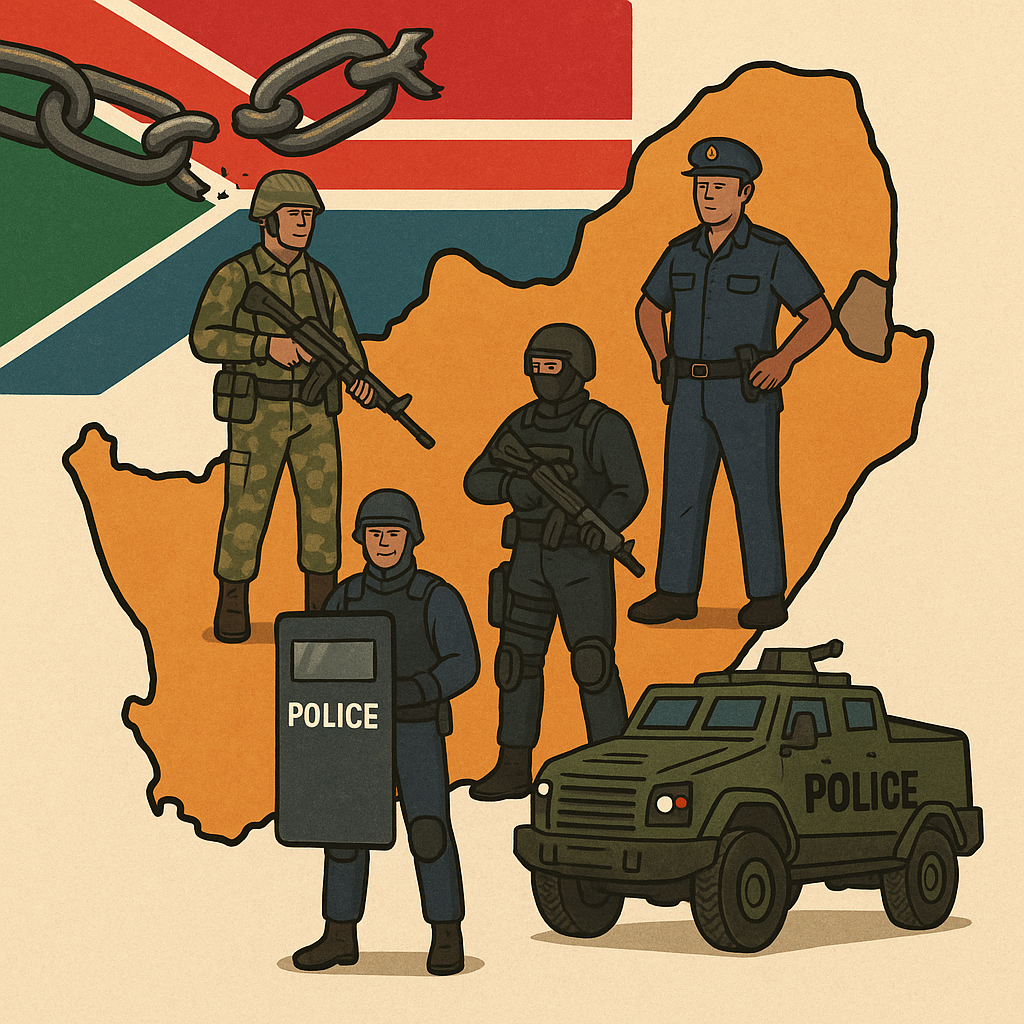
SA prevents 2021 unrest repeat as security forces maintain order during nationwide marches, balancing rights with public safety.
South African law enforcement stopped big marches from turning into chaos on June 30th. They learned from past mistakes, using a smart plan with quick-response teams and real-time information. This helped them keep things calm, letting people protest peacefully without property damage or violence. It showed how good planning can keep everyone safer and stop big problems.
How did South Africa's law enforcement manage to control the 30 June marches?
South African law enforcement controlled the 30 June marches through a meticulously planned containment strategy, drawing lessons from the 2021 unrest. This involved early activation of a national joint operational structure, cross-agency task forces, real-time intelligence fusion, rapid-response squads, and a focus on de-escalation tactics, along with clear communication to differentiate peaceful protest from criminality.
Get Cape Town news in your inbox
Stay updated with the latest stories from the Mother City.
## Meticulous Containment Strategy Thwarts History’s Echo
On 30 June, law-enforcers across South Africa implemented a tightly woven plan that kept nationwide marches from sliding into chaos. The Ministry of Police later confirmed isolated arrests for looting or attempted theft, yet the overwhelming majority of participants voiced grievances without damaging property or harming bystanders. Observers compared the outcome to the July 2021 turmoil that claimed more than three hundred and fifty lives and inflicted financial losses in the tens of billions of rand. The clear contrast demonstrated how agencies had absorbed past missteps and rebuilt operational confidence.
Acting Police Minister Firoz Cachalia addressed the nation shortly after dusk fell. He reiterated that the Constitution protects dissent so long as it remains peaceful, then drew a bright line between protest and criminality. “Cross that line and the state will respond,” he warned. By pairing affirmation of democratic rights with unequivocal deterrence, Cachalia sought to reassure communities already strained by rising living costs and persistent unemployment.
The careful choreography of the day began weeks earlier. Task teams mapped out routes, set up rapid-response squads, and placed senior commanders inside mobile command posts. Analysts watched highways, malls, and taxi ranks for signs that opportunists might hijack lawful marches. When trouble flared, officers closed in swiftly, using containment tactics rather than aggressive dispersal. The result was low injury counts and minimal disruption to business districts already battling sluggish consumer spending.
## Cross-Agency Task Force in Gauteng: From Briefing Room to Street Level
Minister of Justice and Constitutional Development Mmamoloko Kubayi - who also chairs the Inter-Ministerial Committee on Migration - called a sunrise briefing in Johannesburg. Around the table sat Gauteng Premier Panyaza Lesufi, senior South African Police Service generals, and provincial intelligence coordinators. Migration featured prominently on the agenda because march leaflets had cited undocumented foreigners as a perceived source of job-market pressure. South African cities regularly witness flare-ups where frustration over scarce opportunities turns into xenophobic scapegoating, and planners did not want a repeat.
Commissioner Tommy Mthombeni briefed colleagues on sector-by-sector deployments. Each district received clear roles: visible patrols near shopping nodes, undercover teams inside crowds, and helicopter units tracking crowd density in real time. The province’s status as the nation’s economic engine makes it a magnet for protest, so the stakes were high. Any lapse could have frozen commerce in the country’s most populous region for days, compounding revenue losses for a provincial treasury already stretched by infrastructure backlogs.
Logistics mattered just as much as strategy. Fuel tankers topped up police vans at dawn, while engineers pre-positioned mobile generators in case saboteurs cut power. Hospitals activated mass-casualty drills, and metro bus drivers rehearsed evacuation routes. These measures spoke to a deeper lesson drawn from 2021, when late deployment of reinforcements left neighbourhoods exposed to roaming looters.
## Constitutional Compass: Officials Reaffirm Rights Without Abdicating Responsibility
Kubayi’s public remarks returned again and again to the Bill of Rights. She told reporters that every person “has space to march, chant, and petition government,” language calculated to lower temperatures before the first placard appeared. At the same time she reminded listeners that rights carry reciprocal duties: “Freedom of expression stops where violence starts.” That framing resonated with citizens who still carry memories of tear-gas canisters from the apartheid era.
The minister explicitly rejected intimidation as a policing tool. “The state will not pitch up with guns blazing to silence grievance,” she said. Such declarations address a historically rooted distrust in which communities view uniformed presence as precursor to assault. By separating lawful protest from thuggery, officials hoped to isolate criminals and reduce the likelihood of pitched battles that drive media cycles.
South Africa’s approach stood out when compared with scenes from other countries where rubber bullets and stun grenades arrive early. The restrained posture bought goodwill: shopkeepers who might otherwise have shuttered premises kept doors open, and marshals within the crowds policed their own ranks. This synergy between state restraint and civil self-discipline created space for grievances to vent without tipping into mayhem.
## Institutional Memory in Action: Evading the July 2021 Trap
Minister Kubayi invoked the July 2021 unrest directly: “Citizens told us the week of fire must never recur.” Those five days exposed brittle command structures, delayed intelligence, and confusion over who had authority to deploy the army. Subsequent inquiries produced thick binders of recommendations, many of which translated into the June playbook: early activation of Natjoints, daily intelligence fusion cells, and a single national media channel to prevent contradictory messaging.
Natjoints - short for the National Joint Operational and Intelligence Structure - served as the conductor of the security orchestra. Its daily situation board recorded crowd sizes, online incitement, and supply-chain disruptions in near real time. By late afternoon, the dashboard confirmed no mall had been overrun and no traffic artery blocked for more than twenty minutes. Analysts cautioned that the marches were smaller and more dispersed than the 2021 riots, yet acknowledged that rehearsal of new protocols had paid off.
Media access provided another layer of accountability. eNCA streamed the morning briefing live, while selected journalists rode alongside commanders in helicopters. The transparency blunted conspiracy theories that often thrive when official information dribbles out slowly. Social-media teams countered false reports of mass shootings within minutes, slowing the viral spread that escalated panic four years earlier.
## Accountability in Real Numbers: Arrests, Charges, and Transparency
The Ministry of Police disclosed that several people had been detained for theft or attempted break-ins, but it withheld exact counts until investigators verified each charge sheet. By refusing to inflate figures for dramatic effect, officials signalled respect for judicial process. Shopkeepers, many of whom still bear scars from 2021, welcomed the message that looters would face courts rather than vigilante justice.
Labeling the incidents “isolated” performed vital political work. It separated genuine community grievances from opportunistic crime, a distinction necessary to keep protest movements from being discredited. Security managers know that once the public lumps every demonstrator together with looters, it becomes easier for politicians to justify draconian restrictions. Precision in language, therefore, directly influences the latitude civil society enjoys in future mobilisations.
Prosecutors now face the test of speed and fairness. Lengthy delays between arrest and trial erode deterrence, while selective punishment breeds resentment. Civil-rights groups have pledged to monitor dockets for consistency, ensuring that a person nabbed in Alexandra faces the same prospects as one detained in Sandton. The credibility of “the full might of the law” rests on that evenhandedness.
## Beyond the Barricades: Economic Strain and the Roots of Discontent
The marches did not erupt in a vacuum. Unemployment hovers above thirty percent, and youth joblessness is far worse. Food inflation has outpaced wage growth for three consecutive years, squeezing households that spend more than half of income on staples. In townships and informal settlements, electricity cuts can last eight hours a day, disrupting homework, small welding shops, and spaza stores alike.
Migration-related grievances added heat to the day’s demonstrations. Leaflets circulating on WhatsApp blamed undocumented workers for depressed wages in construction, retail, and street trading. South Africa has witnessed episodic xenophobic flare-ups since 2008, usually ignited by rumours that foreigners receive preferentialial housing allocations. Addressing these perceptions demands more than crowd control; it requires labour-market reforms, skills-matching programmes, and clear communication about the contribution migrants make to value chains.
Yet fiscal space is tight. Debt-service costs consume more than every rand collected in capital-gains tax, leaving little room for large-scale stimulus. Municipalities owe water boards billions, and potholes stretch for kilometres. Until growth returns, the temptation to find scapegoats will linger, and security forces will again stand at the intersection of anger and order.
## Communicating Calm: Media, Messaging, and Citizen Co-Production
Mid-morning, broadcasters cut from eNCA’s live helicopter shots to a steady stream of infographics: protest routes, hospital hotlines, and verified WhatsApp contacts for crowd marshals. This multi-channel communication blunted the rumour mill that in 2021 claimed - falsely - that armies of looters were heading for affluent suburbs. Analysts credit the strategy with reducing panic buying that had emptied supermarket shelves four years earlier.
Digital platforms proved double-edged. Twitter Spaces hosted by student leaders drew thousands, debating whether violence ever delivers policy gains. When a viral clip falsely showed a child trampled by police horses, fact-checkers from Media Monitoring Africa debunked it within eight minutes. Rapid rebuttal prevented retaliatory attacks on officers, illustrating how information ecosystems have matured.
Looking ahead, resilience depends on sustained transparency. The public will judge future demonstrations not only by the absence of smouldering malls but also by the willingness of agencies to release video, charge sheets, and after-action reviews. When trust in institutions is fragile, sunlight remains the best disinfectant.
[{"question": "How did South Africa's law enforcement manage to control the 30 June marches?", "answer": "South African law enforcement controlled the 30 June marches through a meticulously planned containment strategy, drawing lessons from the 2021 unrest. This involved early activation of a national joint operational structure (Natjoints), cross-agency task forces, real-time intelligence fusion, rapid-response squads, and a focus on de-escalation tactics, along with clear communication to differentiate peaceful protest from criminality."}, {"question": "What specific strategies were implemented to prevent chaos during the marches?", "answer": "Key strategies included mapping out protest routes in advance, deploying rapid-response squads, positioning senior commanders in mobile command posts, and monitoring for opportunists who might attempt to hijack lawful marches. When incidents occurred, officers used containment tactics instead of aggressive dispersal, focusing on minimizing injury and disruption."}, {"question": "How did cross-agency collaboration contribute to the success?
", "answer": "A cross-agency task force, including the Ministry of Justice and Constitutional Development, provincial premiers, police generals, and intelligence coordinators, met regularly. This collaboration ensured coordinated sector-by-sector deployments, visible patrols, undercover teams, and helicopter surveillance for real-time crowd density tracking, especially in high-stakes areas like Gauteng."}, {"question": "How did officials balance constitutional rights with maintaining order?", "answer": "Officials, like Minister Mmamoloko Kubayi, repeatedly affirmed the constitutional right to peaceful protest while drawing a clear line between dissent and criminality. They explicitly rejected intimidation as a policing tool, emphasizing that the state would not use excessive force to silence grievances, thereby building trust and encouraging self-policing among peaceful demonstrators."}, {"question": "What lessons were learned from the July 2021 unrest that were applied to the 30 June marches?", "answer": "The July 2021 unrest highlighted issues with brittle command structures and delayed intelligence. Lessons learned translated into the June playbook with early activation of Natjoints, daily intelligence fusion cells, and a single national media channel to prevent contradictory messaging. This ensured better coordination, real-time situational awareness, and quicker response times."}, {"question": "What were the underlying socio-economic factors contributing to the discontent that fueled the marches?", "answer": "The marches occurred against a backdrop of severe socio-economic challenges in South Africa, including unemployment exceeding thirty percent (with even higher youth joblessness), persistent food inflation outpacing wage growth, and frequent electricity cuts. Migration-related grievances, often leading to xenophobic scapegoating, also added heat to the demonstrations, reflecting frustration over scarce opportunities."}]

Michael Jameson is a Cape Town-born journalist whose reporting on food culture traces the city’s flavours from Bo-Kaap kitchens to township braai spots. When he isn’t tracing spice routes for his weekly column, you’ll find him surfing the chilly Atlantic off Muizenberg with the same ease he navigates parliamentary press briefings.
View all articles →