
Where does the rate sit today?
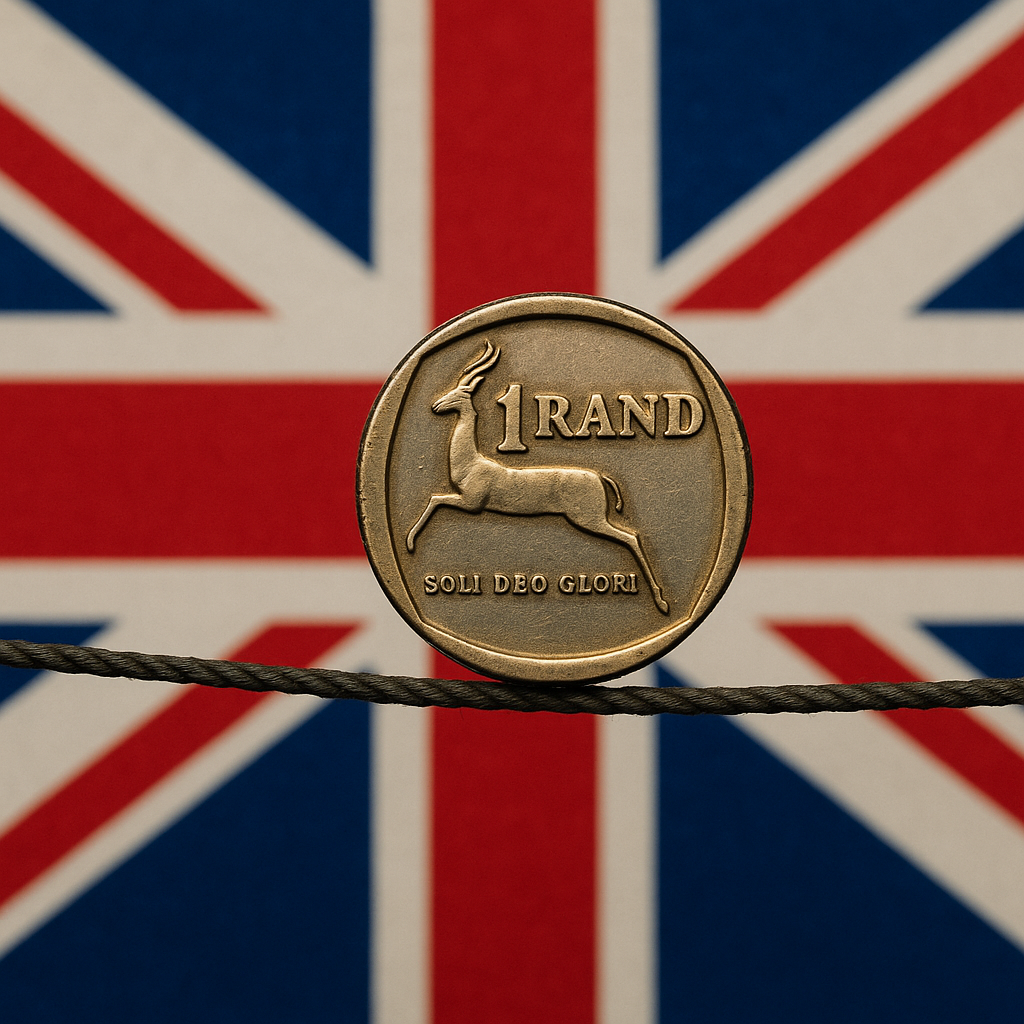
The rand defies its volatile past in 2026 due to commodity booms, fiscal repair, and Eskom stability, impacting SA expats in the UK.
The South African Rand (ZAR) is surprisingly steady right now, acting like a calm commuter train instead of its usual wild roller-coaster ride. This new calm comes from more money pouring in from mining exports, the government saving more cash, and fewer power cuts. Also, South Africa is trading more with countries like China and India, making the Rand less affected by old money rules. Still, things like messy politics or problems with the country's freight system could shake things up.
Why is the South African Rand (ZAR) currently so stable against the British Pound (GBP)?
The Rand's unusual stability against the Pound is due to several factors: increased mining export receipts, consistent government budget surpluses, improved predictability of power supply from Eskom, and a shift in trade partners towards South-South cooperation. These elements have collectively reduced the currency's historical volatility, making it more stable.
Get Cape Town news in your inbox
Stay updated with the latest stories from the Mother City.
1. From Shock Therapy to Steady Hand
The rand’s newfound composure is the talk of trading floors north of the Thames. Gone are the days when every Eskom tweet or Moodies rumour would detonate a three-cent lurch. In June 2026 a single question dominates: how long can the currency shrug off its old reputation for hair-pin bends?
For the quarter-million South Africans earning pounds in the United Kingdom the answer is not academic. They must still service Pretoria mortgages, send groceries to ageing parents and stuff tax-free wrappers with rands. The exchange rate that once resembled a roller-coaster now feels closer to a commuter train, and the timetable matters.
2. A Year Inside the Narrowest Corridor on Record
Look at the charts and the calm is unmistakable. Cable is printing £1 = R21.80-22.00 this week, yet the twelve-month tunnel has been R24.17 on top and R21.39 at the bottom. Ten years ago that three-rand span would have been a slow afternoon; now it took the currency 365 days to trace it out.
Bloomberg’s data cupboard shows why. Implied one-month realised volatility on the pair has slumped below 11 %, the lowest print since the vendor started logging the figures in 2003. Traders are rubbing their eyes while expats are dialling in automated alerts rather than panic-Googling “rand collapse”.
Why the Rand Is Stuck in Slo-Mo
1. Mining Receipts Are Flooding In
Gold exploded to an all-time record of $2 850/oz in March after a perfect storm of central-bank buying, Middle-East sabre-rattling and momentum-chasing hedge funds. Platinum, South Africa’s second-biggest export earner, pitched camp between $1 330 and $1 350, triple its COVID lows and 42 % richer than its five-year average.
The combined annualised export value of the two metals clocked $46 billion in Q1 2026. Foreign buyers settle a growing slice of their invoices in local rands, so every bullion shipment tightens liquidity and pins the currency down.
2. The Treasury Keeps Showing a Surplus
S&P gave the sovereign a return ticket to BB in November 2025, the first upward nudge since 2009. The reason? Three straight primary budget surpluses between April 2025 and March 2026, fuelled by chunky mining royalties, frozen civil-service wages and a R28 billion undershoot on non-interest spending.
Interest on debt has retreated from an eye-watering 22 % of revenue two years ago to 16.8 % today. That is still too high for investment grade, yet the trajectory is crystal-clear; markets care more about whether the arrow points up or down than where it sits today.
3. Power Cuts Have (Temporarily) Become Predictable
The unplanned capacity factor at Eskom fell under 23 % for the first winter since 2021. Nine-month losses narrowed to R7.4 billion from R17.2 billion a year earlier thanks to sliding-scale tariffs blessed by NERSA and far less diesel-guzzling by open-cycle turbines.
Nobody is hanging up victory bunting, yet the utility is no longer the single-point-of-failure that used to send FX desks scrambling for cover.
4. The Trade Map Has Tilted South-South
China and India now absorb more than 25 % of South Africa’s merchandise exports, up from 15 % in 2019. Those invoices clear largely in renminbi and rupees, but offshore banks still square their books in rand liquidity.
Add the expanded BRICS settlement muscle that welcomed Egypt, Ethiopia and Saudi Arabia at the 2025 Kazan summit and the traditional USD-centric reflex is fading. Weekend sell-offs that once felt inevitable are now just one risk among many.
Potholes That Could Still Shake the Ride
1. Transnet Can Still Throw a Spanner in the Works
The freight-rail operator is shifting 152 million tonnes of coal and ore a year, better than the 148 million tonnes trough of FY24 but still 30 % short of the 2017 peak. When a derailment hits the Richards Bay coal artery the rand still quivers - yet the tremor is now ten to fifteen cents, not the half-rand spasms of yesteryear.
2. South Africa Still Owes the World
The country’s net international investment position is stuck at minus 17 % of GDP. The Reserve Bank has five months of import cover, a respectable cushion, yet a violent portfolio reversal - think hawkish Fed shock or Shanghai market meltdown - would quickly remind everyone that the rand remains an emerging-market unit.
Scenarios That Could Unpin the Pound-Rand Peg
1. A BoE-SARB Policy Divorce
Markets currently assign a 65 % chance that the Monetary Policy Committee will shave the UK base rate from 4.25 % to 3.75 % in September 2026. If the South African Reserve Bank eases further - repo is 7.5 % after a surprise 25 bp cut in May - sterling could storm toward R23.50 .
Flip the script: UK inflation rekindles, the BoE hikes and the rand could slide below *R21.00 * without resistance.
2. Political Shock at Home
South Africans vote in August 2026. Polls suggest the ANC will drop below 50 % for the first time, forcing a coalition. A centrist pact with the DA and IFP would be greeted by fireworks on trading screens; an alliance with the EFF and MK could usher in a 5 % overnight collapse.
Option desks have already loaded 30-delta GBP/ZAR calls struck at R24.00 and R25.00, skew that did not trade twelve months ago.
3. UK Crypto Rules Drag Money Back to Banks
Tighter Travel Rule compliance for crypto-service providers might push the sizeable cohort of expats who once routed remittances via stable-coins back into SWIFT lanes. Volumes would spike, spreads widen and spot prices could gap on a quiet Sunday night.
A Practical Playbook for Expat Portfolios
1. Stop-Loss Bands Instead of Crystal-Ball Guessing
Forget the mythical “best” rate. Set bilateral alerts: transfer when GBP/ZAR > R22.50 (sell sterling strength) or < R21.00 (sit on your hands). Two-factor push notifications from Wise, Remitly or Currencies Direct allow execution within minutes once the trigger bites.
2. Slice, Don’t Lump
Divide large transfers into tranches* * around typical UK paydays (month-end) and SA bond dates (week-one). Spreading three to four bites** smooths the average rate and removes Monday-morning regret.
3. Shop the Spread
High-street banks still quote 2.8-3.5 % above mid-market for GBP/ZAR. Specialist desks on IG, Saxo or Revolut Business will do the same ticket above £10 000 for < 0.5 %. On a R2 million property deposit the saving often tops R60 000.
4. Harvest the Double-Tax Angle
If you have formally broken tax residence under SARS 2026 rules, you can emigrate retirement-annuity proceeds within three years without triggering capital-gains withdrawal tax. A softer rand in year-three can therefore crystallise an effective 20-25 % discount on the original liability - a nuance spreadsheet-only planners miss.
5. Pocket the Carry, Hedge the Tail
UK cash yields 3.5-4.1 % gross; SA money-market funds deliver 7.9 % net of 15 % dividend withholding tax. After allowing for 1 % quarterly rand depreciation the 3.5-4 % spread still tempts. Hedge half the exposure with rolling 3-month USD/ZAR NDFs. Annual carry-plus-roll cost is running at 1.8 %, leaving a net pick-up of 2 % - scalable when the numbers line up.
Emerging Tools for 2026-27
1. Digital Rand Corridors
The Intergovernmental Fintech Working Group has approved two stable-coin pilots fully backed by rand deposits at the Reserve Bank. Pilot “eZAR-BRIDGE”* * promises sub-three-second settlement between UK e-money issuers and SA retail banks. If quarterly cross-border limits of R5 billion survive regulatory scrutiny, expats could move money outside banking hours**, dodging weekend gaps entirely.
2. Climate-Finance Arbitrage
- Gold Fields and Sibanye-Stillwater have issued rand-denominated green bonds* to fund renewable roll-outs at their mines. UK expats can use these instruments to tick ESG boxes at home while scoring a synthetic rand exposure and a greenium.
3. Retail CBDC on the Horizon
The SARB retail digital-currency sandbox launches late 2026. Early use-cases include P2P rand transfers and programmable escrow for property purchases. UK pioneers will be able to swap sterling through authorised e-money institutions into the retail-CBDC wallet, skipping the correspondent-bank daisy chain and shaving FX spreads to a flat 0.15 %.
4. Payroll Day Behaviour Hacks
Academics at the London School of Economics show that expats paid on a Monday* * remit 22 % more than those paid on a Friday , a “cash-flow effect” linked to weekend spending inhibition. Automating the transfer for the Thursday after payday** both curb overspending and, coincidentally, improve the average GBP/ZAR capture.
A Thought Experiment for 2027
Picture Transnet pushing 200 million tonnes of cargo, the repo at 5.5 % and the UK base rate at 3 %. In that world the pound-rand range could settle at 19.50-20.50 , levels last printed in 2012. Such a reset would scramble every mental model built on “divide by 20”. Early tools - forward contracts, dual-currency accounts and algorithmic triggers - will count far more than guessing when the next 50-cent lurch finally arrives.
[{"question": "
Why has the South African Rand (ZAR) become surprisingly stable recently?
\nThe Rand's recent stability, a departure from its historical volatility, is attributed to several key factors. Increased revenue from mining exports, particularly gold and platinum, has injected more foreign currency into the economy. The government's fiscal discipline, evidenced by consistent budget surpluses and reduced interest payments on debt, has also boosted confidence. Furthermore, improvements in Eskom's power supply predictability have reduced a significant source of economic uncertainty. Lastly, a shift in trade patterns towards countries like China and India (South-South cooperation) has diversified South Africa's economic ties, making the Rand less susceptible to traditional Western market dynamics.
\n","answer": ""},{"question": "What factors are currently contributing to the Rand's 'slow-mo' movement against major currencies like the British Pound?
\nThe Rand's current narrow trading range is a result of a combination of internal and external economic forces. Significant mining receipts, with gold reaching record highs and platinum maintaining strong prices, are flooding the economy with foreign exchange. The South African Treasury has also shown fiscal responsibility with three consecutive primary budget surpluses, leading to an S&P ratings upgrade. Predictable (though not perfect) power supply from Eskom, with a lower unplanned capacity factor, has removed a major source of economic instability. Additionally, a pivot in trade towards China and India, which now absorb over 25% of South Africa's merchandise exports, is redefining the Rand's sensitivity to traditional market movements.
\n","answer": ""},{"question": "What are the potential risks or 'potholes' that could still destabilize the Rand's current calm?
\nDespite its current stability, several factors could still disrupt the Rand's performance. Problems with Transnet, the state-owned freight-rail operator, such as derailments on key arteries like the Richards Bay coal line, can still cause the Rand to quiver. South Africa's net international investment position, which is still negative at 17% of GDP, and its import cover of five months, while respectable, mean the Rand remains vulnerable to significant global economic shocks, such as a hawkish Federal Reserve or a market meltdown in Shanghai. These external events could trigger a violent portfolio reversal, reminding investors of the Rand's emerging-market status.
\n","answer": ""},{"question": "How could central bank policy differences between the UK and South Africa impact the GBP/ZAR exchange rate?
\nA divergence in monetary policy between the Bank of England (BoE) and the South African Reserve Bank (SARB) could significantly influence the GBP/ZAR exchange rate. If the BoE cuts its base rate more aggressively (e.g., from 4.25% to 3.75% as some markets predict) while the SARB eases further (such as its recent surprise 25 basis point cut), sterling could strengthen against the Rand, potentially pushing the rate towards R23.50. Conversely, if UK inflation rekindles and the BoE is forced to hike rates, while the SARB maintains or further cuts its repo rate, the Rand could strengthen, potentially sliding below R21.00 as investors seek higher yields in South Africa.
\n","answer": ""},{"question": "What role could South African politics play in future Rand volatility, especially with the upcoming elections?
\nThe upcoming August 2026 South African elections pose a significant risk to Rand stability. Polls suggest the ruling ANC might drop below 50% for the first time, necessitating a coalition government. The nature of this coalition could have vastly different impacts on the Rand. A centrist coalition, for example, with parties like the Democratic Alliance (DA) and Inkatha Freedom Party (IFP), would likely be viewed positively by markets, potentially leading to a stronger Rand. However, an alliance with more populist parties, such as the Economic Freedom Fighters (EFF) or uMkhonto we Sizwe (MK), could trigger a substantial overnight collapse of the Rand, reflecting investor uncertainty and concern over policy direction. Option desks are already hedging against this political risk, with increased demand for GBP/ZAR calls at higher strike prices.
\n","answer": ""},{"question": "What practical advice is available for South African expats in the UK managing their finances and transfers?
\nFor South African expats, several practical strategies can help navigate the current Rand stability and mitigate future risks. Instead of trying to predict the 'best' rate, setting bilateral stop-loss alerts (e.g., transfer when GBP/ZAR > R22.50 or < R21.00) allows for automated execution. Large transfers should be 'sliced' into tranches spread across typical paydays and bond dates to smooth out the average exchange rate. Shopping around for specialist currency brokers (like IG, Saxo, or Revolut Business) rather than high-street banks can significantly reduce transfer fees, saving substantial amounts on large transactions. Expats who have formally broken tax residence can also explore emigrating retirement annuity proceeds within three years to potentially gain an effective discount on original liabilities. Finally, 'pocketing the carry' by investing in higher-yielding SA money-market funds while hedging half the exposure with rolling 3-month USD/ZAR NDFs can offer a net pick-up.
\n","answer": ""}]
Sizwe Dlamini is a Cape Town-based journalist who chronicles the city’s evolving food scene, from boeka picnics in the Bo-Kaap to seafood braais in Khayelitsha. Raised on the slopes of Table Mountain, he still starts every morning with a walk to the kramat in Constantia before heading out to discover whose grandmother is dishing up the best smoorsnoek that day.
View all articles →