
Who is Roelof Botha and why is he joining the SpaceX board?

Roelof Botha joins SpaceX board, making history with a trillion-dollar valuation. Explore the challenges & opportunities of this unprecedented tech giant.
On June 16, 2026, SpaceX's IPO was a huge deal, making the first trillionaire! Roelof Botha, a super smart actuary from South Africa, joined SpaceX's important audit team. He's there to keep a close eye on the company's money and big plans, like building cities on Mars and putting solar arrays in space. His job is vital for guiding SpaceX through its wild, ambitious future, making sure they spend smart and follow the rules.
What is Roelof Botha's role at SpaceX?
Roelof Botha is a key member of SpaceX's audit committee, becoming the second credentialed actuary on the committee. His appointment coincides with SpaceX's $75 billion IPO and its ambitious, multi-program future. His role involves overseeing the company's financial and operational governance, including capping program burn and navigating complex regulatory landscapes.
Get Cape Town news in your inbox
Stay updated with the latest stories from the Mother City.
The Bell Rings and the Ledger Opens
Tuesday, 16 June 2026 will linger in trading-floor lore as the instant SpaceX listed at a $75 billion IPO *and * minted the planet’s first trillionaire. Roelof Botha’s name hit the Nasdaq filing at 09:03 Eastern; three minutes later he became the second credentialed actuary on an audit committee that already counted former SEC chief accountant Wes Bricker and ex-Norwegian sovereign-fund risk director Linnéa Solberg among its members. With the newly public float now larger than South Africa’s entire GDP, placing a Pretoria-born, Stanford-valedictorian financier in that watchdog seat carries both poetic justice and hard-edged necessity.
Morningstar strategist Nicolas Owens wasted no time flagging gravity-defying multiples. The $201.68 first-print share price translates to 42-times forward-price-to-sales, a level unseen since the 1999 dot-com apex. Owens sketched two extreme futures for clients: a “Starship-Lite” track that sees just 1,200 reusable flights a year by 2030; and a “Cloud-Above-the-Cloud” vision that parks 250 GW of orbital solar arrays over five continents by 2035, wiping out the need for twenty hyperscale data centers in Frankfurt, Ashburn and Johannesburg. Only the second, he argues, supports SpaceX’s $2.1 trillion headline, yet it leans on unproven leaps - zero-gravity densification of liquid methane, orbital assembly gantries, and petabit-per-second laser links that must not barbecue migrating geese.
Under the hood, Form S-1 reveals eight moon-shot programs drawing from a unified R&D waterfall: the 9-m “Habitrail” Mars transit capsule; a 200-ton lunar cargo lander bound for NASA Artemis payouts; the 42,000-unit Starlink v3 swarm tripling Ka-Ku-Q bands; and the classified DarkSat-Zero quantum-key relay rumored to serve the U.S. Space Force. Quarterly disclosures now force these cash furnaces into one ledger. Clause 4.2 of Botha’s freshly inked audit-committee charter explicitly caps program burn at 14 % of consolidated free cash flow “until at least one revenue-positive off-world settlement exists,” a wording that veteran governance counsels already hail as the most far-fetched public-company constraint on record.
From Chapman's Peak to Sand Hill Road
Roelof Petrus Botha entered the world on 12 September 1974 while Pretoria’s parliament was still under states of emergency. Ten years later the family moved to Hout Bay, wedged under Chapman’s Peak, where young Roelof hawked hand-painted mussel shells to cruise-ship visitors and kept tiny ledgers beneath his bed. By 17 he had enrolled at the University of Cape Town to follow his father into actuarial science; a second-year elective in stochastic calculus rewired his trajectory. His Honours thesis modelled Lloyd’s syndicate ruin-probability down to basis points, earning the university medal.
The Botha Burden and a New Constellation Map
Few surnames in South Africa bear heavier freight. Botha’s paternal grandfather, Roelof “Pik” Botha, served as apartheid-era foreign minister from 1977-1994, once telling the UN that Pretoria “might one day have a black president.” Pik later served under Nelson Mandela, yet the surname still evokes divided memories. Roelof rarely discusses lineage except to say, “Surnames are not algorithms; they do not compile futures.” When he endowed R120 million in 2022 to create UCT’s African Data Science Impact Fund, activists demanded an independent trustee ring-fence the gift against historical laundering. The university agreed; the fund’s governance charter now forbids any renaming or rebranding in family honour.
A parallel cultural thread runs through music. Uncle Piet Botha fronted the cult rock outfit Jack Hammer, releasing “Truckstop Southern Comforts” in 1998 - bootleg obsessions in Cape Town dive bars. Roelof quietly bankrolled a 2021 remastered vinyl box set whose liner notes credit early satellite relays for enabling trans-continental tours before fibre lines reached Lusaka.
Regulatory Chessboard and the Orbital Edge
While Times Square screens still flashed SpaceX’s logo, Starlink’s Kampala office slashed consumer pricing to $13 a month for 50 Mbps, undercutting MTN Uganda and Liquid Intelligent Technologies. Uganda’s regulator had granted an ISP license on 9 May after 14 months of rooftop jamming tests in Namanve’s industrial belt. South Africa, by contrast, remains hand-cuffed by the 30 % equity rule baked into Section 9(2)(b) of the Electronic Communications Act. Treasury officials privately admit that syndicating 13.2 million shares - worth roughly $2.6 billion - to B-BBEE partners would dwarf Sasol’s 2008 empowerment record.
Namibia took a third route: no equity demand, but a public-private mandate for 400 rural gateway stations and a forced migration of 60,000 WACS-fibre customers onto laser inter-satellite links within three years. Windhoek insiders say Botha presented a data-heavy brief to the presidential economic advisory council, arguing that a joint venture with Telecom Namibia could turn the sparsely populated republic into a net exporter of IP transit to Angola and the DRC.
Meanwhile, Starlink v3 birds rolling out of Redmond now sport 19 kW side-mounted solar arrays theoretically capable of driving an 8 kW edge-server blade continuously. AWS Outposts engineers leaked a slide deck for “Project NightHawk” partitioning each satellite bus into 64 virtual machines. If radiation-hardened SSDs can survive 100,000 LEO read-write cycles, the constellation morphs into a distributed data-center fleet renting milliseconds to Africa’s fintechs at one-tenth the cost of AWS Cape Town. Morningstar’s bear case prices this scenario at zero; boutique outfit Quilty Analytics tags the compute arm at $430 billion NPV.
Botha’s deeper card trick harks back to PayPal-era zero-coupon convertibles. SpaceX’s Series Z “SpaceBucks” due 2036 pay 3.5 % PIK interest, convertible into Starlink tracking stock at a 27 % premium. Should regulators force a local Starlink Africa listing, his 2021 dual-listing template for Square on NYSE and Johannesburg’s A2X exchange offers a ready playbook - satisfying empowerment mandates while unlocking rand liquidity for retail investors who have never before touched a trillion-dollar issuer.
Governance, Gamma and the Halo
SEC Form 424B5 shows Musk retaining 47.4 % voting control through a three-tier trust dissolving only upon his death or “successful establishment of a self-sustaining city on Mars with population above 8 000.” Delaware Chancery has never stress-tested such a clause; Botha’s audit-committee role injects a safety valve because 8 Del. C. § 141(e) shields directors who rely in good faith on independent experts. With Sequoia’s 1.5 % residual now in a Deutsche Bank-managed blind trust, most analysts conced Botha clears the independence bar - if only by a whisker.
Post-IPO options data show 30-day implied volatility at 78 %, higher than Tesla’s wildest meme-stretch. Market makers are hedging with deep $300 calls and short $120 puts, shaping a shark-fin volatility surface. Should Botha’s team adopt monthly liquidity updates, gamma-squeezing volatility sellers could be forced into delta-hedging spasms. One veteran TSLA trader cracked, “SpaceX options are Tesla strapped to Falcon Heavy - same trench, triple the thrust.”
The cultural ricochet is already visible. In a Nairobi garage, founders toasted Nile Special lager as the opening-bell stream hit YouTube and chanted “Hout Bay to Mars!” Future Africa’s latest term sheet asks founders to demonstrate how orbital infrastructure shortens go-to-market timelines. Even UCT’s actuarial faculty rebranded its stochastic modelling course “Space Risk Analytics,” honouring an alumni web now threading the Cape Flats to Cape Canaveral.
[
{
"question": "What is Roelof Botha's role at SpaceX?",
"answer": "Roelof Botha is a key member of SpaceX's audit committee, becoming the second credentialed actuary on the committee. His role involves overseeing the company's financial and operational governance, including capping program burn and navigating complex regulatory landscapes. He is crucial for guiding SpaceX through its ambitious future, ensuring smart spending and adherence to regulations."
},
{
"question": "When did SpaceX go public and what was its initial valuation?",
"answer": "SpaceX went public on June 16, 2026, with an initial public offering (IPO) valuing the company at $75 billion. This event also notably minted the world's first trillionaire."
},
{
"question": "What are some of SpaceX's ambitious 'moon-shot' programs?",
"answer": "SpaceX has several ambitious programs, including the 9-meter 'Habitrail' Mars transit capsule, a 200-ton lunar cargo lander for NASA's Artemis missions, the 42,000-unit Starlink v3 swarm, and the classified DarkSat-Zero quantum-key relay. These initiatives highlight SpaceX's focus on space exploration, satellite internet, and national security applications."
},
{
"question": "How does Roelof Botha's audit committee charter cap program spending?",
"answer": "Clause 4.2 of Botha’s audit-committee charter explicitly caps program burn at 14% of consolidated free cash flow. This constraint remains in effect 'until at least one revenue-positive off-world settlement exists,' which is considered a highly ambitious and unprecedented public-company financial constraint."
},
{
"question": "What is the significance of Roelof Botha's South African background?",
"answer": "Roelof Botha, born in Pretoria, South Africa, is a Stanford-valedictorian financier. His appointment to the audit committee is seen as both 'poetic justice and hard-edged necessity,' especially given SpaceX's newly public float being larger than South Africa’s entire GDP. He has also made significant contributions to his home country, such as endowing the UCT’s African Data Science Impact Fund."
},
{
"question": "What is the 'Cloud-Above-the-Cloud' vision for SpaceX?",
"answer": "The 'Cloud-Above-the-Cloud' vision, as articulated by Morningstar strategist Nicolas Owens, predicts SpaceX positioning 250 GW of orbital solar arrays over five continents by 2035. This ambitious plan aims to eliminate the need for twenty hyperscale data centers globally and supports SpaceX's $2.1 trillion headline valuation, though it relies on currently unproven technological leaps."
}
]
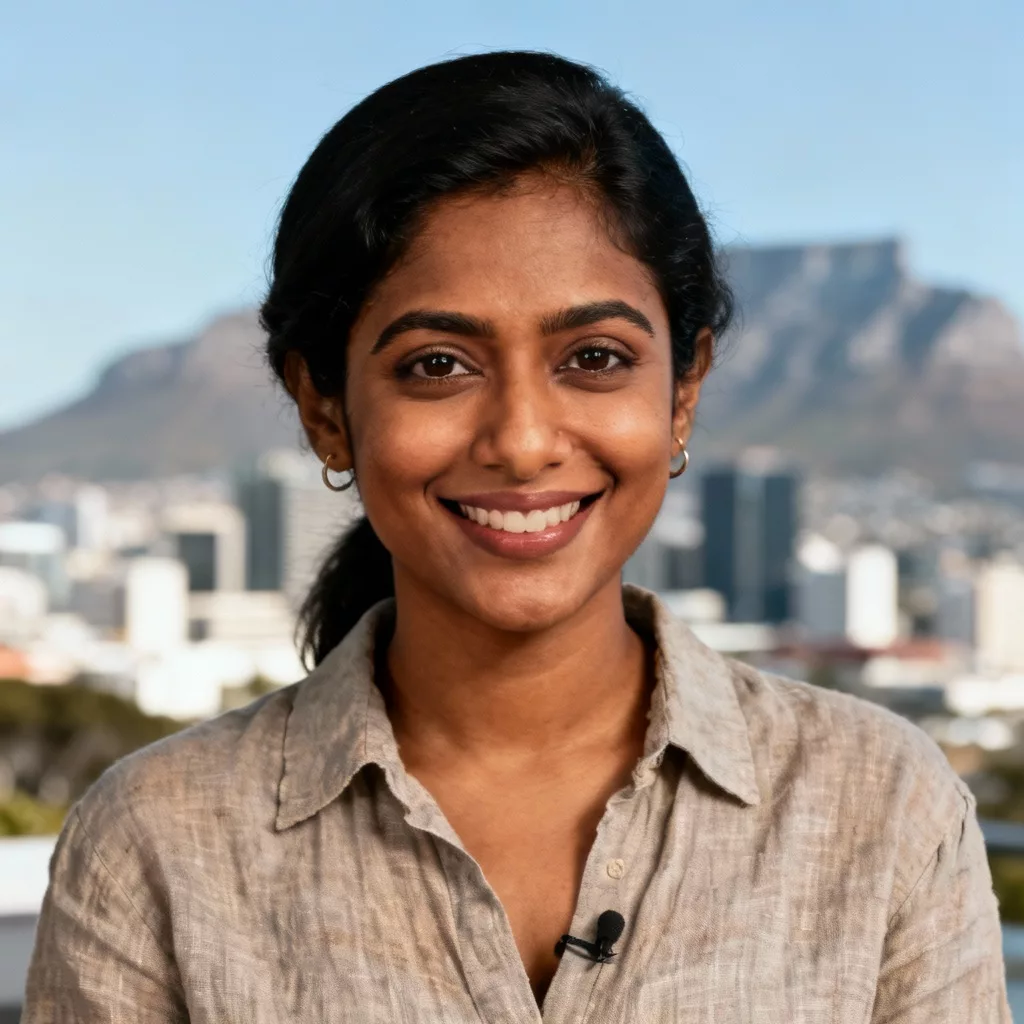
Zola Naidoo is a Cape Town journalist who chronicles the city’s shifting politics and the lived realities behind the headlines. A weekend trail-runner on Table Mountain’s lower contour paths, she still swops stories in her grandmother’s District Six kitchen every Sunday, grounding her reporting in the cadences of the Cape.
View all articles →