
WHY ARE ATMs CHANGING?
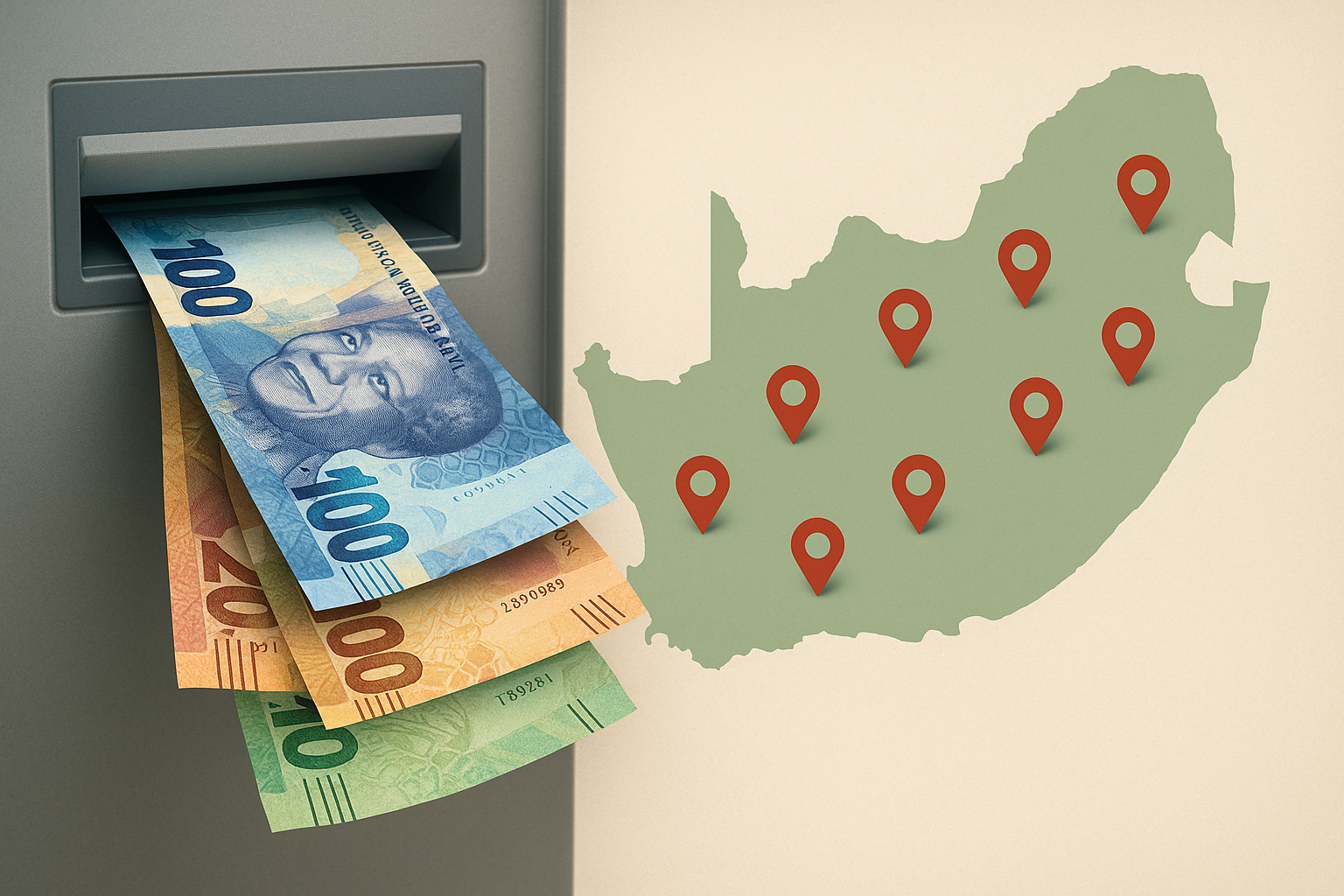
South Africa is transforming its cash ecosystem with white-label ATMs, creating a national cash utility to cut costs & improve access.
South Africa is changing how people get cash. Old bank ATMs are disappearing, but new, unbranded 'white-label' ATMs are coming. These new ATMs are not owned by one bank, so everyone can use them easily. This will make cash cheaper to get, especially for people in far-off places. The government wants these new ATMs to be a big part of how South Africans use money, like how phone banking changed things before.
What are white-label ATMs?
White-label ATMs are unbranded cash machines that are not owned by a single bank. They dismantle the traditional vertical integration of ATMs, allowing various entities (e.g., supermarkets, independent maintenance firms, different banks) to contribute to their operation. This design enables customers from multiple banks to use the same machine.
Get Cape Town news in your inbox
Stay updated with the latest stories from the Mother City.
South Africa's relationship with physical money stands at a critical juncture. Across township taxi ranks, rural spaza shops, and urban supermarket queues, paper currency still dominates daily commerce more than digital alternatives ever have. Yet the familiar bank-branded cash machines that have served communities for forty years are vanishing rapidly - roughly 1,200 disappear annually, according to industry data from the Payments Association of South Africa. Into this widening gap steps an intriguing alternative: "white-label" ATMs, machines stripped of corporate branding, running flexible software, and designed to serve broad public interests alongside private profit motives. The South African Reserve Bank's Position Paper on Cash, unveiled in late 2023, sketches an ambitious future where these neutral devices anchor a government-regulated "national cash utility." While stopping short of binding legislation, the document's technical appendices and financial projections outline a transformation reminiscent of how telephone banking displaced post-office services three decades ago.
Understanding the White-Label Architecture
Conventional ATMs function as miniature bank branches under single ownership. One financial institution controls every element: the physical hardware, the retail lease, the vault cash, the proprietary software, the surveillance systems, and even the printed receipts that announce your R9.50 transaction fee. White-label machines dismantle this vertical integration entirely. A supermarket chain might provide the physical space. An independent maintenance firm handles technical servicing. A cash-in-transit company supplies the money. Any licensed bank - or even an unlicensed fintech - can process transactions through shared networks like SASWITCH or PayShap's emerging cash infrastructure. The visible branding becomes minimal: perhaps a national flag, a modest "SARB Cash Utility" emblem, and a QR code enabling price-comparison apps to display real-time fees across providers. This agnostic design allows customers from Capitec, Absa, or purely digital banks to use identical machines with different back-end processing, comparable to how mobile phones roam internationally across competing networks.
The Hidden Costs of Cash Access
The Reserve Bank's comprehensive cost-of-cash analysis reveals expenses far exceeding visible bank charges. Direct fees total R31 billion annually, but this represents merely the surface. Transportation expenses - petrol, minibus fares, vehicle depreciation - consume another R12 billion. Time lost traveling to machines, valued at median wage rates, adds R28 billion. Insurance and cash-in-transit robbery losses contribute R18 billion more. Geography emerges as the decisive inequality factor: South Africa's poorest third travels 18 kilometers further per withdrawal than its wealthiest third. Strategic placement of neutral ATMs within established high-traffic retail locations - spaza networks, Shoprite Usave outlets, petrol station forecourts - could collapse these distances, eliminate transport costs, and flatten the national expense curve. Experimental deployments in Mpumalanga's Msukaligawa Municipality demonstrate this potential dramatically, cutting median access time from 42 minutes to 11 minutes and generating roughly R1,800 in annual household savings.
Building the Regulatory Framework
Financing Models and Global Precedents
Financial institutions have spent ten years reducing ATM fleets to trim operational spending. A single branded rural machine can cost R35,000 monthly once cash logistics, generator fuel, security personnel, and insurance accumulate. White-label operators reverse this equation entirely. Host retailers absorb electricity and telecommunications expenses in exchange for micro-commissions per transaction. Independent deployers finance capital investment through securitized bonds. Fees feed into a Reserve Bank-administered "universal service pot," with 40 percent reserved for expansion into quintile-one municipalities currently lacking any ATM access. International experience validates this approach. India's National Financial Switch connects 250,000 brown-label machines, driving average withdrawal costs from 20 rupees to 12 rupees within five years. Brazil's "Banco24Horas" network, launched through retailer-bank partnerships, achieved positive cash flow in 36 months and now processes 3 billion annual withdrawals at one-third traditional ATM costs.
Engineering Security for Violent Contexts
Solving the Interoperability Challenge
Kenya's unsuccessful 2018 shared ATM pilot taught a crucial lesson: hardware neutrality fails without software openness. South Africa's response, "OpenATM," provides a uniform API gateway built on ISO 20022 messaging standards underlying PayShap. Licensed fintechs can interface directly, offering supplementary services - airtime, electricity purchases, parcel collection codes - without machine ownership. Testing participants include a stokvel management application enabling treasurers to pre-order specific denominations for group distributions, and a livestock auction platform issuing QR-coded receipts redeemable exclusively at white-label machines within 48 hours, eliminating cash transport across remote terrain.
Transforming Small Retail Economics
For spaza shop proprietors, hosting white-label ATMs potentially outperforms traditional merchandise sales. A 4 percent commission on R100 withdrawals yields R4, compared to roughly R1.70 net margin on a R20 bread loaf. Early adopters in KwaMashu report ATM commissions surpassing grocery profits within six months. The challenge involves cash-flow timing: machines emptied by 11 a.m. on paydays lose subsequent customer traffic. The Reserve Bank experiments with dynamic pricing - surge fees during peak periods rationing demand and encouraging off-peak usage, analogous to ride-sharing supply management. Retailers receive predictive dashboards forecasting vault depletion based on local grant schedules and school fee payment deadlines.
Environmental and Accessibility Benefits
Carbon reduction represents an underappreciated advantage. WWF South Africa's 2023 research found rural consumers averaging 14-kilometer round trips to bank ATMs, generating 3.4 kg CO₂ per withdrawal. Consolidating cashpoints within existing retail clusters could eliminate 120,000 annual transport emission tons - equivalent to removing 26,000 vehicles from roads. Solar-powered units with lithium-iron-phosphate batteries minimize grid impact; each machine consumes merely 0.8 kWh daily, below a 60-watt bulb's overnight consumption.
Global Comparisons and Unique Elements
Australia's "Bank@Post" converts postal outlets into shared cash hubs, but depends on state-owned infrastructure Pretoria partially privatized in 2021. Canada's "Exchange Network" links 3,600 credit union machines and mandates fee waivers for member institution customers - legislated interchange subsidies South African commercial banks strongly oppose. Nairobi's "agency banking" permits shops to host bank-branded POS devices, yet cash flows through commercial partnerships. South Africa's distinctive approach positions the central bank simultaneously as rule-maker and partial funder, preserving private sector innovation while ensuring social service commitments.
Implementation Roadmap
Realizing this vision depends less on technical feasibility than political will, funding arrangements, and South Africans' persistent preference for tangible currency amid proliferating WhatsApp payments and cryptocurrency alternatives. For the present, cash maintains sovereign status across much of the nation; the uncertainty concerns how extensively that sovereignty will extend.
[{"question": "
What are white-label ATMs?
", "answer": "White-label ATMs are unbranded cash machines that are not owned by a single bank. Unlike traditional ATMs, they are not vertically integrated, meaning different entities can contribute to their operation. This allows customers from various banks to use the same machine, making cash access more flexible and potentially cheaper. They are designed to serve broad public interests alongside private profit motives, similar to how phone banking transformed financial access years ago."}, {"question": "Why are white-label ATMs becoming important in South Africa?
", "answer": "South Africa is experiencing a significant decline in traditional bank ATMs, with roughly 1,200 disappearing annually. Despite the rise of digital alternatives, physical cash still dominates daily commerce for many South Africans. White-label ATMs are stepping into this gap as a neutral, accessible alternative. The South African Reserve Bank views them as a potential 'national cash utility' to improve financial access, especially in underserved areas, and reduce the overall cost of cash transactions."}, {"question": "How do white-label ATMs reduce the cost of cash access?
", "answer": "The Reserve Bank's analysis shows significant hidden costs associated with cash, including transportation expenses, time lost traveling to ATMs, and security risks. By strategically placing neutral white-label ATMs in high-traffic retail locations like spaza shops and petrol stations, these machines can drastically reduce travel distances and associated costs. Experimental deployments have shown a reduction in median access time and significant annual household savings, mirroring success in countries like India and Brazil."}, {"question": "What is the 'OpenATM' initiative and why is it important?
", "answer": "The 'OpenATM' initiative is South Africa's response to ensuring software openness and interoperability for white-label ATMs. Built on ISO 20022 messaging standards, it provides a uniform API gateway that allows licensed fintechs to interface directly with the machines. This enables supplementary services like airtime and electricity purchases, and even specialized applications for stokvels or livestock auctions, without needing to own the hardware. This initiative learned from Kenya's unsuccessful shared ATM pilot, highlighting the need for software neutrality alongside hardware neutrality."}, {"question": "How can spaza shops and small retailers benefit from hosting white-label ATMs?
", "answer": "For spaza shop proprietors, hosting white-label ATMs can be more profitable than traditional merchandise sales. They can earn a commission per transaction, which has, in some early cases, surpassed grocery profits within months. The challenge lies in managing cash-flow timing, especially during peak periods like paydays. The Reserve Bank is exploring dynamic pricing and providing retailers with predictive dashboards to help manage vault depletion and maximize earnings."}, {"question": "What are the environmental and accessibility benefits of this new ATM model?
", "answer": "Consolidating cashpoints within existing retail clusters through white-label ATMs can significantly reduce carbon emissions by eliminating long travel distances to bank ATMs. Research suggests this could eliminate 120,000 annual transport emission tons. Additionally, the use of solar-powered units with efficient batteries minimizes the grid impact. These ATMs also improve accessibility for remote communities, reducing travel time and costs, and are part of a broader government vision to ensure financial services reach all South Africans, similar to how mobile banking expanded access in the past."}]
A Russian-Spanish journalist and Cape Town native, channels his lifelong passion for South Africa into captivating stories for his local blog. With a diverse background and 50 years of rich experiences, Serjio's unique voice resonates with readers seeking to explore Cape Town's vibrant culture. His love for the city shines through in every piece, making Serjio the go-to source for the latest in South African adventures.
View all articles →