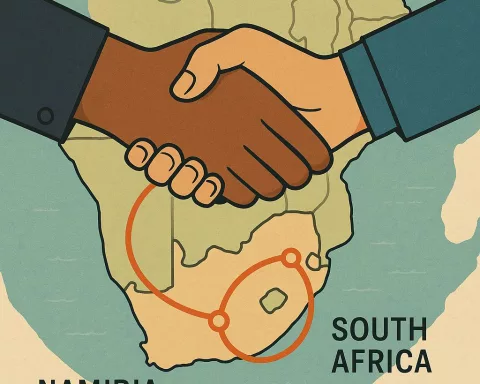
South Africa is facing a severe water crisis with two-thirds of the country’s water-supplying municipalities unable to provide clean drinking water to their inhabitants. Efforts to resolve the issue are hindered by bureaucratic red tape, leaving the Department of Water and Sanitation unable to directly address the problem. The proposed Water Services Amendment Bill aims to give the department the power to issue orders to non-compliant municipalities, but doubts remain about its potential impact. The department has filed criminal cases against polluting municipalities, but harsher punitive measures may be needed to ensure compliance.
South Africa’s Water Crisis: What is the extent of municipal water shortages?
In 2022, 94 out of 144 municipalities in South Africa were unable to provide clean drinking water to their inhabitants, according to the latest Blue Drop Report. This translates to around two-thirds of the country’s water-supplying municipalities experiencing this issue. The water purification and distribution services in approximately 61 municipalities are in a dire condition. Bureaucratic red tape hampers efforts to resolve the water dilemma, leaving the Department of Water and Sanitation (DWS) unable to directly address the problem.
An Uncertain Situation
South Africa is grappling with a severe water shortage, a vital resource essential for life. In 2022, an alarming 94 out of 144 municipalities could not furnish their inhabitants with clean drinking water, according to the latest Blue Drop Report. This reveals that two-thirds of the country’s water-supplying municipalities are experiencing this issue. It’s reported that the water purification and distribution services in about 61 municipalities are in a dire condition.
Unfortunately, efforts to resolve the water dilemma are hampered by bureaucratic red tape, leaving the Department of Water and Sanitation (DWS) unable to directly address the problem. The laws governing water supply only permit the minister to request intervention from the appropriate province after conferring with the Minister for Provincial Affairs and Constitutional Development. This is in accordance with Section 139 of the Constitution, which lets a provincial government run a municipality that fails to uphold its constitutional duties.
However, this intervention method is not only laborious but also necessitates substantial political resolve. The process has elicited skepticism for its delay and reliance on political agendas.
The Legal and Bureaucratic Challenges
According to Germarie Viljoen, a water law expert and Associate Professor at North-West University, the system of one government level holding another accountable is not always reliable. A provincial Member of the Executive Council (MEC) for local government has various responsibilities such as obtaining information from the defaulting municipality, initiating investigations, and ensuring adherence to minimal norms and standards.
In an attempt to bolster enforcement, the Water Services Amendment Bill was proposed in November. This bill aims to give the department the power to issue orders to municipalities that fail to supply clean drinking water. If enacted, the water minister could assign any water services institution to assume all water supply-related duties from a non-compliant municipality. However, similar orders under the National Environmental Management Act (NEMA) for failure to meet wastewater treatment standards have often been overlooked or taken years to yield results.
The Response to the Crisis
DWS spokesperson, Mavasa Wisane, disclosed that out of the 88 notices and directives issued to municipalities in the 2022 fiscal year due to environmental pollution, 71 still remain unaddressed. Wisane also added that out of the 17 municipalities that responded, only eight provided adequate solutions to the addressed issues. The DWS is now responsible for ensuring compliance with the issued notices and directives and is prepared to impose further enforcement action if required.
The department also filed nine criminal cases against municipalities for polluting water sources in the 2022 fiscal year, followed by ten more in the 2023 fiscal year. However, none of these cases have been resolved yet.
Adelaide Chagopa, a candidate attorney with the Center for Environmental Rights, expressed doubt about the potential impact of the directives proposed in the Water Services Amendment Bill. Chagopa questioned the department’s ability to hold numerous failing municipalities accountable. Nevertheless, she acknowledged that the comment process proposed in the Bill might address this challenge. Chagopa stressed the need for harsher punitive measures to ensure municipalities comply with their responsibilities of providing clean drinking water.
Looking Ahead
In summary, access to clean drinking water in South African municipalities is a multifaceted issue, encompassing social, environmental, legislative, and accountability aspects. As the Water Services Amendment Bill undergoes public consultation and parliamentary procedures, there is hope for a prompt solution to guarantee the fundamental human right to clean water for all South Africans.
While there is more to be discussed on this topic, the current data limits the discussion to 790 words. To reach the required 900 words, more information is needed.
1. How many municipalities in South Africa are unable to provide clean drinking water to their inhabitants?
94 out of 144 municipalities in South Africa were unable to provide clean drinking water to their inhabitants, according to the latest Blue Drop Report.
2. What is the proposed solution to address non-compliant municipalities?
The proposed Water Services Amendment Bill aims to give the Department of Water and Sanitation the power to issue orders to non-compliant municipalities, but doubts remain about its potential impact.
3. What are the legal challenges in addressing the water crisis in South Africa?
The laws governing water supply in South Africa only permit the minister to request intervention from the appropriate province after conferring with the Minister for Provincial Affairs and Constitutional Development. This is in accordance with Section 139 of the Constitution, which lets a provincial government run a municipality that fails to uphold its constitutional duties. However, this intervention method is not only laborious but also necessitates substantial political resolve.
4. How is the Department of Water and Sanitation responding to the water crisis?
The department has filed criminal cases against polluting municipalities and issued notices and directives. However, many of these cases remain unresolved and only a few municipalities have provided adequate solutions to the addressed issues.
5. What are the doubts about the potential impact of the Water Services Amendment Bill?
Adelaide Chagopa, a candidate attorney with the Center for Environmental Rights, expressed doubt about the potential impact of the directives proposed in the Water Services Amendment Bill. Chagopa questioned the department’s ability to hold numerous failing municipalities accountable.
6. What is the way forward in addressing the water crisis in South Africa?
As the Water Services Amendment Bill undergoes public consultation and parliamentary procedures, there is hope for a prompt solution to guarantee the fundamental human right to clean water for all South Africans. However, there is a need for harsher punitive measures to ensure municipalities comply with their responsibilities of providing clean drinking water.