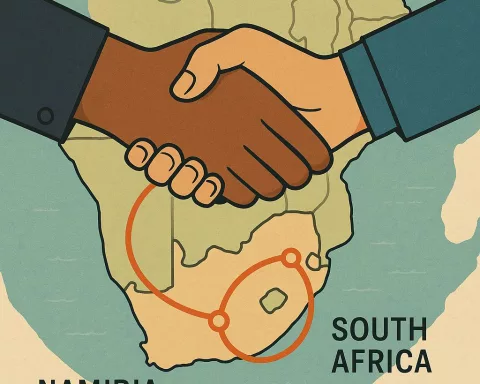
Errol Langton and his Afrikaner family left South Africa in 2024 after a U.S. order allowed white South Africans facing discrimination to seek refuge. They settled in Birmingham, Alabama, where family support and government help like healthcare made the hard journey easier. Though facing doubts about their refugee status, the Langtons worked to build a new life, learning local customs and finding kindness in their new community. Their story shows how migration is both a personal challenge and a search for safety and belonging.
Why did Errol Langton and his Afrikaner family migrate from South Africa to Alabama?
Errol Langton’s Afrikaner family migrated to Alabama in 2024 after a U.S. executive order allowed white South African minorities facing racial discrimination to seek refuge. They chose Birmingham for family support, accessing resettlement aid like Medicaid and job assistance while adapting to a new culture.
A Modern Migration: Leaving South Africa
The migration story of Errol Langton unfolds amid shifting global currents, blending personal ambition, historical legacy, and political controversy. Langton, rooted in Afrikaner heritage and experienced in the IT sector, found his life in South Africa increasingly precarious. In early 2024, the United States presented an unexpected path forward: an executive order from President Donald Trump opened the doors for white South African minorities to seek refuge, responding to claims that these communities faced racial discrimination at home. Langton, together with 47 other South Africans, became part of the first wave to test this new policy.
The motivation behind Trump’s executive order ignited debate on both sides of the Atlantic. Supporters saw it as a humanitarian gesture, acknowledging alleged injustices suffered by South African whites in the changing political landscape. Detractors, meanwhile, accused the order of privileging one group’s plight over the more widespread struggles faced by other marginalized communities. For the Langtons, these debates unfolded at a distance. Their focus remained on the daunting logistics of uprooting their lives: organizing documentation, saying farewell to familiar landscapes, and preparing for a leap into the unknown.
Langton’s journey reflects the timeless challenges of migration. He left not only the fields and hills of KwaZulu-Natal but also the intricate web of relationships, language, and customs that shaped his family’s identity. The decision to move, while driven by a desire for security and opportunity, came with deep personal cost – a blend of hope, anxiety, and the quiet sorrow of leaving home.
Building a New Life in Birmingham
Arriving in Birmingham, Alabama, Langton encountered a region with its own layered history of migration, race, and social change. The choice of Birmingham was not arbitrary; relatives had previously settled there, establishing a small but meaningful support network for the newcomers. For Langton, Alabama offered both comfort and complexity: the warmth of Southern hospitality, but also the memory of a region long marked by racial tension and reconciliation.
Early days in the United States posed immediate, practical hurdles. Langton praised the efficiency of American government systems, expressing particular gratitude for the healthcare provisions that supported his family during their first year. Medicaid provided much-needed medical coverage, while the US refugee resettlement program offered temporary financial assistance as they adapted to life in a new country. These tangible supports eased the transition, allowing the family to focus on integration rather than mere survival.
Yet, adjustment required more than bureaucratic compliance. Langton confronted the everyday realities of American life: securing Social Security numbers, navigating the process of obtaining driver’s licenses, interpreting unfamiliar customs, and learning the nuances of local culture. He spoke candidly about the frustrations these processes entailed, but remained optimistic, emphasizing the generosity and helpfulness of his American neighbors. For his children, the move offered stability and new prospects; Langton described their life in Birmingham as “good,” a succinct but meaningful affirmation amid the turbulence of change.
Negotiating Identity and Facing Skepticism
Not everyone embraced the Langtons’ story without reservation. In South Africa, public reaction to Errol’s new status as an “Afrikaner refugee” ranged from skepticism to outright hostility. Critics scrutinized his background, questioning whether he truly represented the embattled farmer archetype cited in US policy debates. Was Langton, a successful IT businessman according to his LinkedIn profile, truly deserving of refugee status? Detractors accused him of exploiting the system for personal advantage, especially given his decision to settle in a state where he already had family connections.
Such criticism did not go unanswered. Langton defended his identity and motives, insisting that his claim to Afrikaner heritage and farming experience remained legitimate, even if others disputed the specifics. He acknowledged the ambiguity inherent in claims of identity, noting wryly that labels often depend on the perspective of outsiders. The controversy extended to his own family, with his stepdaughter among the voices raising doubts about the narrative presented to the public.
This struggle over authenticity exemplifies broader questions confronting diaspora communities everywhere. The Afrikaners themselves, descendants of Dutch, German, and French settlers, have long navigated shifting fortunes – from colonial pioneers to architects of apartheid, and, in recent years, to a community grappling with new vulnerabilities in a democratic South Africa. Debates over who qualifies as a “real” Afrikaner or a “genuine” refugee reflect deeper anxieties about belonging, legitimacy, and the right to define one’s story.
Life Beyond Headlines: Belonging and Adaptation
Langton’s experience in Alabama offers a window into the day-to-day realities of resettlement – realities that often receive less attention than the political controversies that ignite public debate. The American South, from its earliest days, has absorbed waves of newcomers, each group negotiating its place in a society shaped by both tradition and transformation. Langton’s family joined a lineage that includes Scotch-Irish settlers, Eastern European immigrants, and, more recently, Latino and Asian communities.
The mechanisms of resettlement – welfare benefits, language classes, job placement assistance – reflect a long-standing American commitment to integrating newcomers, even as public attitudes swing between welcome and suspicion. Langton expressed appreciation for the practical support his family received, highlighting the importance of community kindness in easing the burden of transition. He described the Americans he encountered as “accommodating,” noting that neighbors and local officials alike extended a hand rather than turning a cold shoulder.
Still, the adjustment process brought its own set of challenges. Langton chronicled small victories and setbacks on social media, offering a near-daily diary of adaptation. His updates reflected both the joy of seeing his children thrive and the exhaustion of navigating unfamiliar systems. In these posts, the abstract notion of “migration” takes on flesh and detail: the relief of a functioning healthcare system, the pleasure of simple routines, the satisfaction of forging new friendships.
Rethinking Refuge, Identity, and the Future
The Langton family’s story raises important questions about the meaning of “refugee” in the modern world. The executive order that facilitated their move did not solely target farmers or those facing imminent violence but instead cast a wider net for “minorities suffering persecution.” Langton himself acknowledged that not all the South Africans arriving with him fit the stereotypical image of the embattled white farmer. This nuance complicates the popular narrative and challenges easy assumptions about deservingness and victimhood.
Broader debates over the politics of resettlement resonate on both sides of the ocean. In the United States, the controversy over prioritizing one group’s suffering reflects a long history of racial and ethnic tension. In South Africa, the departure of white professionals and landowners continues to stir heated discussion about land reform, reparations, and national identity. The Langtons’ move thus occupies a complex intersection of personal need and global politics.
Despite these pressures, Langton chooses to focus on the process of building a new life. He finds solace in the ordinary routines of Alabama – children adapting to school, community events, the straightforward functioning of public systems. These moments, though quiet, form the backbone of resettlement and hint at the gradual formation of a new sense of home. His journey, both unique and representative, illuminates the tangled realities of migration in a world where identity, belonging, and opportunity remain fiercely contested.
In tracing Errol Langton’s path from South Africa to Alabama, we see a story that blends individual struggle with larger forces of history and society. The journey, shaped by political decisions, contested identities, and daily resilience, underscores the unpredictable nature of migration. Ultimately, Langton’s experience stands as a testament to the enduring search for safety, dignity, and a place to belong in an ever-changing world.
Frequently Asked Questions about Errol Langton’s Migration Story
1. Why did Errol Langton and his Afrikaner family migrate from South Africa to Alabama?
Errol Langton and his family left South Africa in 2024 after a U.S. executive order allowed white South African minorities who claimed to face racial discrimination to seek refuge in the United States. They chose Birmingham, Alabama, largely due to existing family connections and the availability of resettlement support such as Medicaid, job assistance, and community networks, which helped ease the transition to a new country and culture.
2. What motivated the U.S. government to offer refuge to white South Africans?
The executive order, issued under President Donald Trump, aimed to provide refuge to white South Africans who alleged systemic racial discrimination and persecution in the post-apartheid era. Supporters viewed the order as a humanitarian response to an under-recognized minority group, while critics argued it privileged one demographic over others facing broader socio-economic challenges. The policy sparked debate over the definition of persecution and refugee status.
3. How did the Langton family adapt to life in Birmingham, Alabama?
Upon arrival, the Langtons benefited from healthcare programs like Medicaid and refugee resettlement services that provided temporary financial support and job placement assistance. They faced practical challenges such as obtaining Social Security numbers and driver’s licenses, learning local customs, and navigating American bureaucracy. Despite initial difficulties, they found warmth and kindness in their community, and their children adapted well to school, helping the family build a new sense of belonging.
4. What controversies or criticisms surrounded the Langtons’ refugee status?
Errol Langton’s refugee claim was met with skepticism, especially in South Africa. Critics questioned whether his background as a successful IT businessman and his settled family connections in Alabama warranted refugee status. Some accused him of exploiting the U.S. system, while others doubted the authenticity of his Afrikaner farming heritage. These disputes highlight broader tensions about identity, legitimacy, and who qualifies as a genuine refugee.
5. How does the Langton family’s story reflect broader issues about migration and identity?
Their journey encapsulates the complex intersection of personal ambition, political policy, and contested identities. It illustrates how migration is not just about physical relocation but involves negotiating belonging, cultural adaptation, and community acceptance. The story sheds light on the challenges refugee communities face in defining themselves amid external skepticism and internal doubts, especially for groups with complicated historical legacies like the Afrikaners.
6. What does Errol Langton’s experience tell us about the modern concept of “refugee” and resettlement?
Langton’s case challenges simple definitions of refugee status, showing that modern resettlement policies may include diverse groups beyond traditional images of persecuted farmers or victims of violence. It also reveals how resettlement involves both political controversies and everyday realities – like accessing public services and building social networks – that shape the refugee experience. Ultimately, his story highlights the ongoing search for safety, dignity, and belonging in a complex global landscape.
If you want to learn more about the political context or the challenges faced by Afrikaner refugees, feel free to ask!