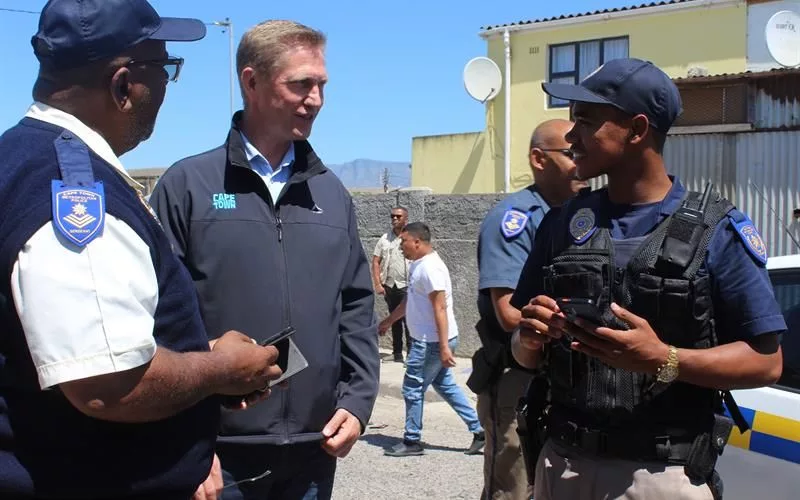
Cape Town is changing how it keeps people safe with 420 special officers. These officers don’t just enforce laws; they also help people and connect them with social services. They use cool technology and talk to the community to solve problems like crime and broken things. It’s like a new way to make the city better, using smart ideas and local helpers.
How is Cape Town enhancing city safety through its Neighbourhood Safety Officers?
Cape Town is enhancing city safety through 420 Neighbourhood Safety Officers (NSOs) who integrate by-law enforcement, traffic policing, and social-work triage. These officers use data-driven strategies, community engagement, and innovative technology to address crime, social vulnerabilities, and service failures across 90 wards.
Dawn on the Grid: From Paper Maps to Living Data
Cape Town’s street atlas is being redrawn before sunrise. Surveyors with tripods never appear; instead, 420 Metro Police Neighbourhood Safety Officers (NSOs) step off branded Hyundai vans and open tablet screens that pulse like heart monitors. Since September, these crews have walked, cycled and carpooled across 90 wards, logging every busted stop-sign, every tik-lab Wendy house and every stop-and-search that ends in a handshake rather than handcuffs. The scoreboard is eye-catching – 200-plus arrests, 1 070 parcels of narcotics, 28 home-made or stolen firearms, and 1 247 living “street files” that update faster than most social-media feeds. Yet the bigger story is invisible: a daily experiment that folds by-law enforcement, traffic policing and social-work triage into one patrol rhythm.
Inside the Bellville traffic depot, a projector wall renders the city as a kaleidoscope of icons. Red dots flare for firearms, amber for suspected drug houses, blue for traffic violations, white for families that need social-worker reach-outs. Every 90 seconds the picture refreshes, fed by SAPS dockets, ambulance logs, traffic-camera snapshots and even the GPS pings of burst water pipes – because analysts noticed that service failures often foreshadow a crime spike two days later. Each night an algorithm ranks the 20 hottest micro-locations in every ward; by the time the kettle boils at dawn, crews know which crossing to stake out, which alley nickname to remember, which school gate to shadow when the last bell rings.
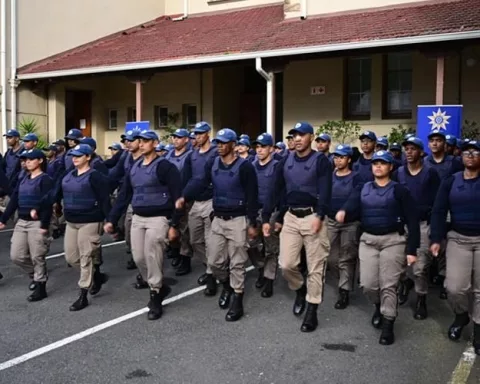
The officers themselves are local first, civil servants second. A standard six-person squad mixes a former CPF patroller who grew up on the block, a traffic warden who can quote the National Road Traffic Act in three languages, a law graduate paying off study loans, and three metro recruits who swapped rifles for body-cams and 60-second TikTok briefings. Uniforms are deliberately bilingual or trilingual – Ukhuselo, Veiligheid, Safety – while firearms stay locked in portable safes unless a situation turns violent. The mantra is presence before force, conversation before citation.
The Mitchells Plain Clinic: A Tuesday Morning Masterclass
At 07:20 in Ward 82 – Dennemere, Mitchells Plain – Constable Ursula de Jongh angles her van across the pedestrian stripe of Sildale Primary. Two months earlier, a 12-year-old boy chased a soccer ball into that same crossing and met a VW Polo that never slowed; surgeons spent weeks lifting skull fragments from his motor cortex. Today, De Jongh’s body-cam films every number plate while her partner, 22-year-old Azola Dinginto, hands out A5 flyers: a R1 500 fine for failure to stop and a WhatsApp number for parents to upload dash-cam clips. Within half an hour three minibus taxis are impounded – two for expired licences, one whose driver tests positive for tik in an oral swab. The queue of delayed commuters mutates into an open-air town hall: a grandmother admits her flat is being used as a tik den, a teenager wants help retrieving a stolen phone, a tuck-shop owner offers CCTV passwords. Every plea is entered under the “social” tab; within 72 hours a social worker will knock on the relevant doors under a new “notice of vulnerability” by-law.
By 10:00 the crew has drifted to the Kapteinsklip River wetlands where gang back fences lean over reeds. Legally the patch is a maze: the river belongs to the province, the shacks sit on SANRAL land, the tik labs are mobile Wendy houses that can be craned onto a flat-bed in 45 minutes. The workaround is a covenant signed in October that labels any structure within five metres of the water as an “illegal obstruction” under the National Water Act. No eviction hearings, no three-year court delays – just 14 structures removed, two mini-labs dismantled, and chemicals trucked to Brackenfell’s hazardous-waste depot. The addicts themselves are not cuffed; NGO Choices ferries them to a 24-hour “stabilisation tent” in Lentegeur where buprenorphine calms withdrawal until state-rehab beds open.
Gun recoveries follow a different choreography. In Atlantis, 50 km north, officers noticed BMWs with cloned plates parked outside a house whose smart meter guzzled 200 kWh a night while the lights stayed off. A 02:00 drone flight revealed infrared blobs matching a desktop CNC mill. The warrant turned up a garage factory stamping “zip guns” from 2 mm sheet metal; each costs R120 to build and sells for R1 800 to teen gang tax collectors. Eleven finished firearms, 34 barrels and a 3-D-printed magazine template hidden on a Raspberry Pi were seized. Ballistic technicians have since digitised the rifling pattern; any bullet fired from the batch can now be traced nationwide.
Labs, Apps and Invisible Evidence
Even seized drugs become open-source intelligence. One tablet in every 50 is sacrificed to the University of the Western Cape’s mass-spectrometry lab where graduate students catalogue cutting-agent fingerprints. Mandrax now averages 38 % caffeine and 7 % diazepam, a blend mirroring northern Mozambican seizures – evidence that the old Transkei smuggling corridor has shifted. Tik crystals are growing: 68 % purity in October versus 54 % in June, proof that local cooks are importing precursor drums instead of stripping cold-medicine blisters. When purity spikes, patrol density around primary schools is doubled – history shows dealers recruit 12- to 15-year-old runners when margins fatten.
Money for the programme is not new money; it is old money moved. The City’s R7.1 billion safety budget sacrificed 180 vacant traffic posts, triggering an 11 % drop in speeding fines but a 25 % jump in guilty pleas – body-cam evidence and digital dockets have bumped convictions from 42 % to 67 %, trimming an estimated R18 million in court hours. Household-burglary claims in the 90 wards have fallen 9 %, saving insurers R31 million in trauma compensation.
Next-layer tech is arriving faster than policy can file paperwork. In Manenberg, gun-shot microphones clipped to streetlights triangulate calibre signatures within 30 seconds and push GPS pins to NSO radios. Seventy-eight percent of audible shots are never phone-reported; the sensors already linked one burst to a hijacked Toyota Quest torched in Bishop Lavis, leading to an arrest before the strip-and-sell could begin. Privacy hawks worry about eavesdropping; the City has commissioned an audit and limited audio storage to 30-second loops that self-erase unless a gunshot algorithm triggers retention.
December will see the soft-launch of “Silent Panic,” an app that needs no data plan. Five clicks of the power button fire a 433 MHz Bluetooth mesh signal that hops phone-to-phone until it reaches an NSO tablet or a Wi-Fi lamppost, turning the entire street into a distress beacon. Beta tests in Kosovo informal settlement relayed 800 metres in 12 seconds – faster than the 90-second emergency-call answer rate. A reputation engine punishes hoaxers by throttling their future alerts.
Night Shift, Therapy Dogs and the Prediction Frontier
After dark, the mission mutates. At 19:30 in Bonteheuwel, female officers who graduated from a UN Women “Safe Cities” course take over, cruising arterial routes where 68 % of rapes occur within sight of a taxi rank. They ride in pairs with a social-worker tail car, armed with pocket infrared torches that detect semen traces on clothing at 15 metres, letting them secure evidence without forcing survivors into squad cars. Since October, 14 on-the-spot positive identifications have led to immediate arrests; in three cases the suspect was still flushing clothes in a communal toilet.
Even pit bulls have been drafted. In Langa, 43 dogs once bred for underground fighting now attend a Stellenbosch University behaviourist course where they are imprinted on tik, heroin or nyaope scents. Leashed beside their owners, they constitute a community-driven detection unit that sidesteps the red tape plaguing SAPS narcotics dogs. Six weeks in, three positive indications led to stash-house consent searches that produced court-ready evidence without warrant challenges.
The metric that keeps planners awake is “time-to-normal.” After a double homicide outside Ravensmead schools in October, NSOs convened education officials, pastors, taxi bosses and violence interrupters. They reopened classrooms in 36 hours, rolled in a mobile-library truck, and staged a “reverse march” where 400 learners reclaimed the shooter’s escape route with chalk art and hopscotch grids. Attendance bounced to 92 % within a week; a similar incident two years earlier limped at 61 %.
Whether the experiment survives South Africa’s political cross-fire is uncertain. The DA-run City insists the officers are municipal staff, not a shadow constabulary; the ANC provincial administration accuses them of “policing populism” and threatens to freeze public-order grants. A council motion wants 48-hour “community courts” for by-law offences – an idea already sending constitutional lawyers into late-night huddles.
What is certain is that 4.6 million residents now generate 2 billion geotagged events a year – enough data, says the City’s chief data scientist, to train an algorithm that can forecast a shooting in any 100 m² city block 24 hours ahead with 71 % accuracy. The code is ready; the only question left is whether a democracy is prepared to act on a warning that arrests people for crimes they have not yet committed.
[{“question”: “
What is the core mission of Cape Town’s Neighbourhood Safety Officers (NSOs)?
“, “answer”: “The core mission of Cape Town’s 420 Neighbourhood Safety Officers (NSOs) is to integrate by-law enforcement, traffic policing, and social-work triage. They aim to enhance city safety by addressing crime, social vulnerabilities, and service failures across 90 wards through data-driven strategies, community engagement, and innovative technology.”}, {“question”: “
How do NSOs utilize technology and data in their daily operations?
“, “answer”: “NSOs use tablet screens to log incidents like broken stop-signs, suspected drug labs, and stop-and-search outcomes. A central system processes data from SAPS, ambulance logs, traffic cameras, and even burst water pipe locations, refreshing every 90 seconds. An algorithm ranks \”hottest\” micro-locations daily, guiding officers to specific areas for patrols. They also use body-cams for evidence collection, gunshot microphones for real-time alerts, and a \”Silent Panic\” app for distress signals.”}, {“question”: “
What kind of impact have the NSOs had on crime and safety statistics?
“, “answer”: “Since September, NSOs have made over 200 arrests, confiscated more than 1,070 parcels of narcotics, and seized 28 firearms. Body-cam evidence and digital dockets have significantly increased conviction rates from 42% to 67%. Household burglary claims in the 90 wards have fallen by 9%, saving insurers an estimated R31 million. The implementation of specific strategies, like the \”notice of vulnerability\” by-law and rapid response to school incidents, has also shown positive results in community re-stabilization.”}, {“question”: “
How are the NSOs selected and what is their approach to community interaction?
“, “answer”: “NSO squads are diverse, often including former CPF patrollers, traffic wardens, law graduates, and metro recruits. They are selected for their local knowledge first and civil service skills second. Their uniforms are deliberately bilingual or trilingual, and firearms are kept locked unless absolutely necessary. The mantra is \”presence before force, conversation before citation,\” emphasizing community engagement and connecting residents with social services.”}, {“question”: “
Beyond traditional policing, what innovative methods are NSOs employing to combat crime?
“, “answer”: “NSOs are employing several innovative methods, such as utilizing K9 units with dogs trained to detect specific drug scents, which originated from former fighting dogs. They are also using forensic analysis of seized drugs to track smuggling routes and local production trends. Female officers conduct specialized nighttime patrols in high-risk areas, using infrared torches to detect forensic evidence. Furthermore, a \”notice of vulnerability\” by-law allows social workers to follow up on pleas for help identified during patrols.”}, {“question”: “
What are the future technological advancements planned for Cape Town’s safety initiative?
“, “answer”: “Future advancements include the full deployment of gun-shot microphones on streetlights that triangulate calibre signatures and push GPS pins to NSO radios within 30 seconds. The \”Silent Panic\” app, currently in soft-launch, will allow residents to signal distress without a data plan, using a mesh network. The city is also developing an algorithm capable of forecasting a shooting in any 100m² city block 24 hours ahead with 71% accuracy, though its implementation raises ethical and political questions.”}],