Cape Town is turning a sleepy lagoon into a giant water hospital! They are using a huge machine called “Mvezo” to suck out 40 years of yucky mud. This will stop bad algae and make the water clean and fun again. This big cleaning project is a bold step to heal the lagoon, showing other cities how to fix their water problems too.
What is Cape Town doing to restore Zeekoevlei?
Cape Town is undertaking an audacious urban water ICU project at Zeekoevlei. It involves using a massive dredge, nicknamed “Mvezo,” to remove 207,000 m³ of nutrient-rich sludge. This process aims to detoxify the lagoon from four decades of pollution, prevent toxic algal blooms, and restore its ecological health and recreational value.
1. The Soundtrack Nobody Ordered
Zeekoevlei after dusk used to feel like nature’s private cinema: watercolour skies, coots folding wings, the occasional carp kissing the surface. That reel ended in June 2025 when a bright-yellow floating factory nick-named “Mvezo” anchored in Storm Bay and refused to leave. Its 450 mm suction mouth now gulps silt from 06:30 until 20:00 on week-days and 07:00-18:00 on Saturdays. The diesel-electric heartbeat is so steady that toddlers in Lotus River have stopped reacting to lullabies; parents say the engine purr knocks them out faster than white-noise apps. Only Sundays are spared – then ski-boats, canoeists and African fish-eagles reclaim the stage – yet every other day the 1 200-hectare reserve hums like an open-air factory.
Twelve-ton pumps, telemetry buoys and slurry pipes have become part of the scenery. Night herons now time their hunting sorties to the flood-light schedule, and water-ski instructors joke that the dredge’s foam trail works like a free speed-boost lane. The industrial choreography is deliberate: Cape Town is racing to suck out four decades of fertiliser-laden muck before the next drought tightens its grip.
2. A Mountain of Muck in Human Terms
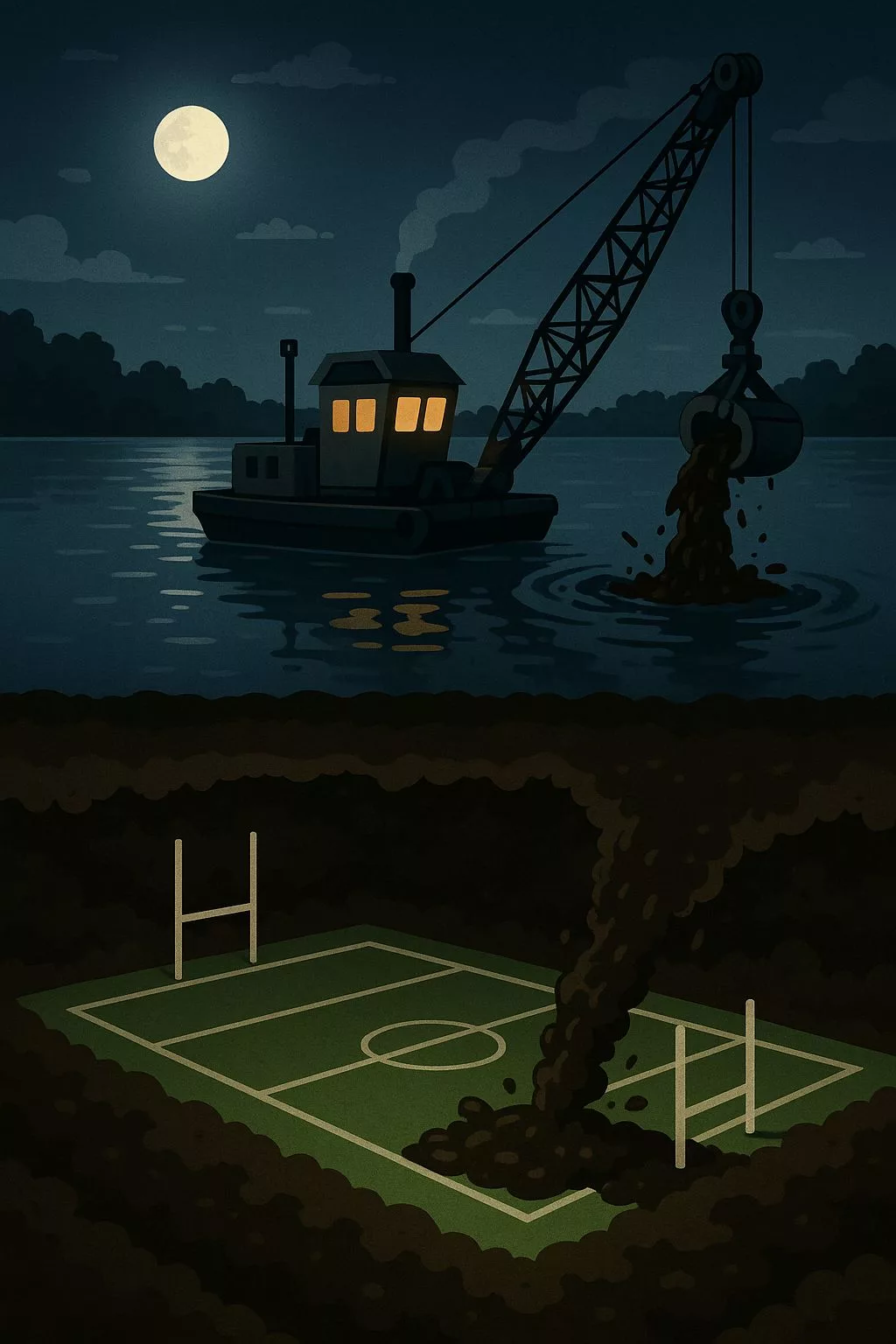
Raw numbers glaze eyes, so city engineers translate 207 000 m³ into something chewable. Imagine every rugby pitch in the Western Cape stacked 30 floors high with chocolate-pudding sludge – then add half another pitch for good luck. That heap is the legacy nutrient stockpile that has brewed toxic green broth almost every summer since 1978, when canal estates and garden-centre culture began hosing lawn chemicals straight into the vlei. The pantry now holds 1 400 t of phosphorus and 3 200 t of nitrogen, enough to keep cyanobacteria partying for years. By stripping out 85 % of that pantry in one 19-month gulp, the dredge performs surgical detox on an organ that has been failing for two generations.
The stakes are personal: irrigation pumps that feed the nearby sports fields jam within hours when the bloom peaks, and anglers have watched baby bass suffocate under fluorescent scum. The city’s maths says every tonne of sludge removed now prevents 120 kg of algal biomass next summer, translating into fewer blocked filters, healthier fish, and – crucially – less embarrassment for a tourism board that markets the lagoon as a paddler’s paradise.
3. The Weather Window They Never Planned For
Urban lakes elsewhere wait for winter, when inflows scour channels and crews can work without evaporation hassles. Zeekoevlei flips that script. Longer, hotter summers now drain the lagoon up to 45 cm between Guy Fawkes Day and Easter; instead of cursing the bathtub ring, engineers exploit it. Every exposed centimetre of bank is a centimetre they don’t have to pump, so the dredge chases the receding waterline like a surfer chasing tides. A special noise-exemption permit, issued under Section 25 of the municipal noise by-law, legalises what crews were already doing informally: stretching daylight until the last photon. Climate change did not just open the door – it handed out the keys and turned the lights on.
4. The Invisible River Beneath Your Feet
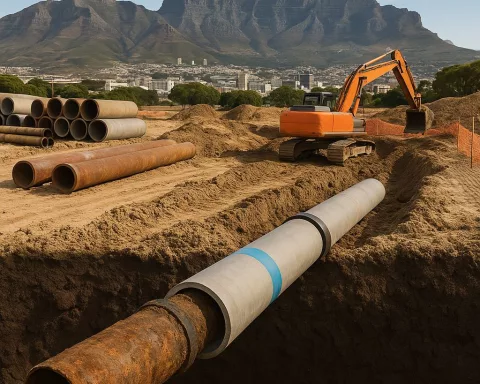
Most citizens will never see the 4.3 km HDPE artery that moves their lake uphill to the drying yards. Pipes the colour of margarine fuse at 210 °C, forming a subterranean river that slips under Peninsula Road, skate-park parking lots and a model-airstrip whose runway doubles as a seasonal wetland. To avoid nightly traffic chaos, crews slid steel sleeves under asphalt and threaded the slurry line through the tunnel – no trenches, no detours. Pressure sensors every 200 m gossip with the dredge’s SCADA brain; if friction spikes 0.2 bar, the cutter throttles before a suburban garden becomes a grey-milk fountain. The result is a subaqueous freight route that behaves like a living vein, pulsing 1 500 m³ of sludge uphill each day while cars overhead queue for groceries, unaware.
5. From Goo to Ground Floor
At Pelican Park the slurry meets its maker: four kidney-shaped ponds ringed by 4 m rock bunds quarried from on-site Malmesbury shale. A pinch of anionic polyacrylamide plus a whisper of bentonite flocculates the solids; within 24 hours crystal-clear water decants back to the treatment works via a 2.3 km return pipe. The remaining cake sunbathes for three months until its shear strength hits 60 kPa – stiff enough to carry light roads. Lab bricks blended 30 % with conventional fill already pass SANS 227 compression tests, turning yesterday’s aquatic goo into tomorrow RDP-house walls. By converting disposal cost into resale value, the project knocks R120 million off its own bill, a ledger flip that has treasurers from Johannesburg to Jakarta asking for the recipe.
6. Creatures of the Night Shift
Twenty-four-hour clatter sounds like ecological heresy, yet engineers cut a deal with darkness-loving wildlife. Directional LEDs bathe the deck in 3 000 K amber, a spectrum chosen because mayflies ignore it and bats still recognise their sonar. Result: insect biomass dipped 14 % in week one, then bounced as opportunistic predators learned to hunt inside the light cone. Meanwhile, silt curtains keep turbidity spikes below 3 NTU – about as murky as a cup of Rooibos – well under the 8-NTU kill-switch that would stall blades and idle payroll. Microphones record fish-eagle calls at 02:00, proof that even icons can adapt when the menu improves.
7. Energy Maths on a Warming Planet
Each thousand cubic metres of sludge demands 2.4 MWh of juice, enough to run 60 middle-class homes for 24 hours. To keep carbon books in the black, the city wheels 1.2 kWh of solar power from the Roggeveld wind farm for every kWh the pumps consume, verified through international renewable-energy certificates. Diesel tail-pipe emissions – 1 900 tCO₂e – are offset by purchasing certified emission-reduction credits from a Brazilian biogas plant, a move some NGOs dismiss as “green guilt postcards”. The rebuttal is already under construction: a 500 kWh battery barge that will float beside “Mvezo” in 2026, allowing the cutter to sip stored sunshine during peak-tariff hours and proving, kilowatt by kilowatt, that even heavy industry can diet on renewables.
8. Radical Transparency as Sedative
Remember those stuffy town-hall evenings where engineers talked at glazed citizens? They’re extinct. In their place lives an open-source dashboard that updates faster than social-media gossip. Any resident can ping the server and receive an SMS if decibel levels at the nearest lamp post top 65 dB(A) for half an hour. Breach the threshold and the city owes you double-glazing coupons, a portable air-conditioner, or – if you’re the audiophile type – a pair of premium noise-cancelling headsets. After six months only 42 households redeemed hardware; the other 1 800 seem content simply knowing the numbers, proof that data sunlight soothes better than promises.
9. The 17-Day Breather That Teaches a Bigger Lesson
On 19 December 2025 the engines will idle for 17 days – too short to mothball gear, too long to stay warm. Instead of paying crews to babysit machinery, the city will bus 60 operators to Cape Peninsula University of Technology for master-classes in sonar mapping, polymer chemistry and conversational isiXhosa. The micro-break doubles as a dress rehearsal for 2026, when “Mvezo” migrates to Home Bay to chew through another 157 000 m³. Sociologists are already convening “dredge-fatigue” focus groups, betting that today’s gratitude will curdle into tomorrow’s backyard revolt. The experiment is simple: can a city outsource ecological housekeeping without outsourcing public patience?
10. A Manual Hot Cities Will Copy
Zeekoevlei is not an exotic outlier; it is a beta-test for urban lakes from Bangalore to Houston choking on identical cocktails of lawn fertiliser, tyre dust and plastic beads. Cape Town’s playbook hinges on five levers that must move together: a climate-forced working window, a regulatory fast-track, an energy-offset mechanism, a social licence stamped in real-time data, and – most importantly – a business case that converts muck into money. By baking dredged spoil into SANS-approved bricks, the project flips an expense line into revenue, shaving 18 % off the total bill. Municipal bean-counters on three continents have already booked site visits, notebooks ready.
When the last blade lifts and the lagoon slips back into obsidian silence, the headline won’t be the 364 000 m³ of sludge that left town. It will be the template that stayed: a step-by-step guide for tomorrow’s hotter, drier cities to mine their own mistakes – one polymer-dosed, solar-offsetted, decibel-monitored scoop at a time.
[{“question”: “What is the \”Midnight Mirage\” project in Cape Town?”, “answer”: “The ‘Midnight Mirage’ project is Cape Town’s ambitious initiative to restore Zeekoevlei, a lagoon that has accumulated 40 years of pollution. It involves using a large dredge, nicknamed \”Mvezo,\” to remove nutrient-rich sludge and revitalize the aquatic ecosystem. The project aims to convert the removed sludge into construction materials, making it financially self-sustaining and a model for other cities.”}, {“question”: “What is Mvezo and what does it do?”, “answer”: “Mvezo is a massive yellow floating dredge, described as a ‘floating factory,’ employed in the Zeekoevlei restoration project. Its primary function is to suck out 207,000 m³ of nutrient-rich silt from the lagoon. This process is crucial for removing the legacy pollution, preventing toxic algal blooms, and restoring the lagoon’s ecological health. It operates for extended hours on weekdays and Saturdays, with its powerful diesel-electric engine creating a constant hum.”}, {“question”: “How much sludge is being removed and what are its contents?”, “answer”: “The project aims to remove 207,000 m³ of sludge, which is equivalent to stacking every rugby pitch in the Western Cape 30 floors high with chocolate-pudding sludge. This muck contains an estimated 1,400 tonnes of phosphorus and 3,200 tonnes of nitrogen, accumulated from decades of fertiliser runoff and other pollutants. Removing 85% of these nutrients is expected to significantly reduce algal blooms.”}, {“question”: “How does Cape Town manage the removed sludge?”, “answer”: “The sludge is transported through a 4.3 km subterranean pipeline to drying yards at Pelican Park. Here, a process involving anionic polyacrylamide and bentonite flocculates the solids, allowing crystal-clear water to be decanted. The remaining sludge cake dries for three months until it reaches a shear strength suitable for construction materials. This dried sludge is then blended with conventional fill to create bricks that pass SANS 227 compression tests, effectively turning aquatic goo into RDP-house walls.”}, {“question”: “How is the project addressing environmental concerns, particularly noise and wildlife?”, “answer”: “The project has implemented several measures to mitigate environmental impact. A special noise-exemption permit allows for extended operating hours, and an open-source dashboard provides real-time updates on decibel levels, offering compensation to affected residents. For wildlife, directional amber LEDs are used during night operations, chosen to minimise disturbance to insects and bats. Silt curtains maintain water clarity to protect aquatic life, ensuring turbidity spikes remain below critical levels.”}, {“question”: “What makes this project a model for other cities?”, “answer”: “The Zeekoevlei project is considered a beta-test for urban lake restoration globally because it integrates five key elements: a climate-forced working window (exploiting dry periods), a regulatory fast-track, an energy-offset mechanism (using solar and wind power), a social license built on radical transparency and real-time data, and a business case that converts waste into revenue. By transforming dredged sludge into SANS-approved bricks, the project significantly reduces its overall cost, making it financially sustainable and a replicable model for other cities facing similar water quality challenges.”, “additional_info”: “The project’s innovative approach to converting sludge into building materials, its use of renewable energy to offset its carbon footprint, and its commitment to public transparency through real-time data distinguish it as a pioneering effort in urban ecological restoration. This holistic strategy provides a blueprint for how hot, dry cities can address their water problems while also contributing to sustainable development and economic benefits.”}]