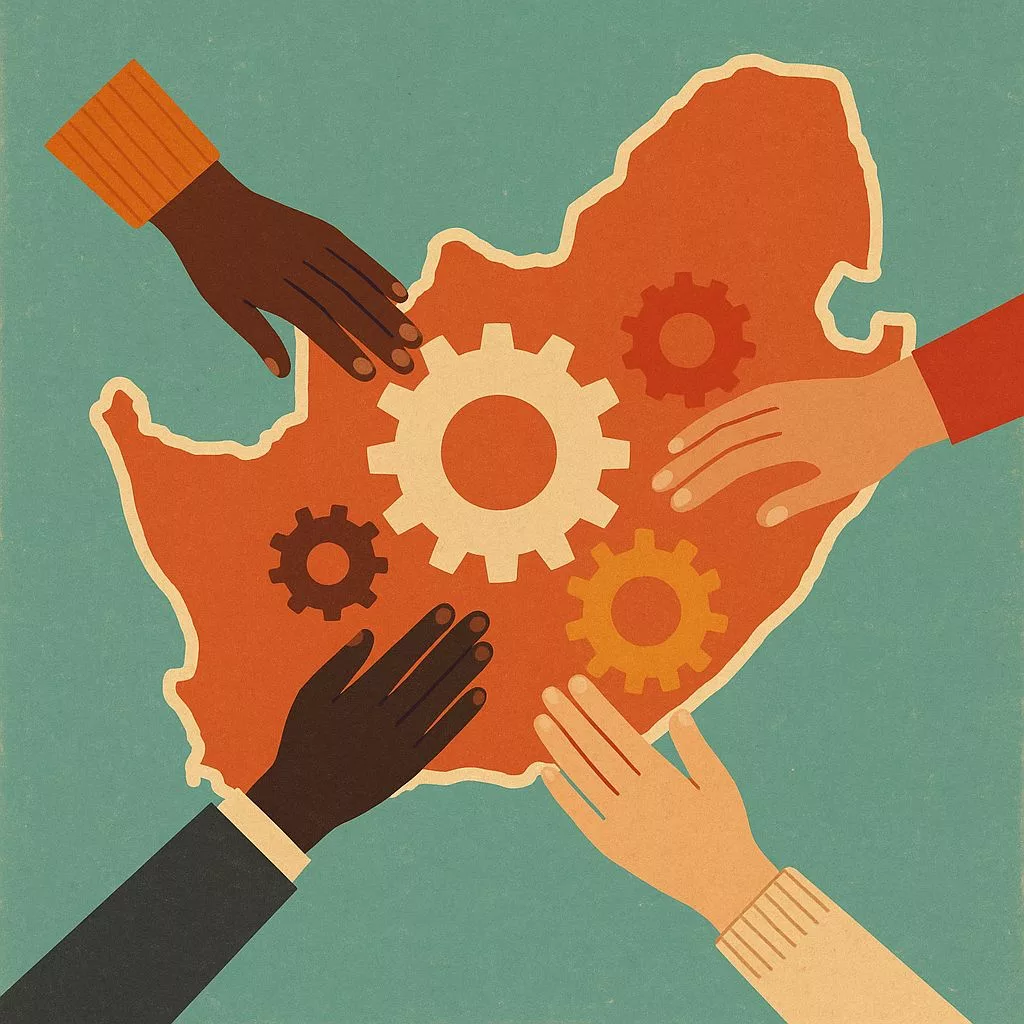
South Africa, choked by coal and facing financial ruin, created a special group called the Presidential Climate Commission (PCC). This group brought together enemies – like union leaders and mining bosses – to talk and find solutions. They made deals to switch from coal to clean energy, which helped them get lots of money from other countries. Now, this unique way of solving big problems is being copied by nations worldwide, showing how talking can turn enemies into partners for a greener future.
What is the Presidential Climate Commission (PCC) in South Africa?
The Presidential Climate Commission (PCC) is a 25-seat, round-the-clock negotiation chamber created by President Cyril Ramaphosa to address South Africa’s climate challenges. It unites diverse stakeholders, including union bosses, mining CEOs, and environmental NGOs, to forge domestic trade pacts for a just energy transition, aiming to secure international funding and address the country’s reliance on coal.
1. A Country on the Brink, a Table in the Middle
In late 2020 South Africa was coughing on its own smoke: 85 % of its watts came from coal, rolling black-outs had shaved a full percentage point off GDP for ten straight years, and the Treasury’s red-ink forecast warned of R2.3 trillion in stranded mines, boilers, rails and ports if the trading partners finally pulled the carbon curtain. Dock workers, coal miners, climate lawyers and stock-exchange titans were all threatening to march – or sue – while the currency wobbled.
Instead of appointing another expert panel to write a glossy report nobody would read, President Cyril Ramaphosa created a 25-seat, round-the-clock negotiation chamber: the Presidential Climate Commission (PCC). Union bosses, mining CEOS, professors, traditional leaders, youth organisers and green NGOs would sit as equals, co-chair every sub-committee and, if they disagreed, append a dissenting view for the world to see. The Commission’s only weapon was transparency; its promise was that a deal struck at home could be invoiced abroad.
The bet was audacious: turn the constitutional right “to an environment that is not harmful” into a domestic trade pact, then swap that pact for cheaper dollars, euros and yen. Five years on, the wager is beginning to pay, and foreign diplomats are photocopying the playbook.
2. Inside the Bargaining Room – How Enemies Learned to Count Together
-
Talking Across the Aisle, Not Past It*
South Africa’s post-apartheid labour market was built on a four-way forum called Nedlac, where business, labour, community and government hammer out labour law. The Commission copied that culture verbatim: every working group must be led by two chairs who historically despise each other. Minerals Council lobbyists sit opposite groundWork activists; COSATU trade-unionists share the gavel with solar-company executives. Consensus is defined as “everyone nods,” not “majority wins,” forcing each side to tattoo the other’s red lines onto their own foreheads. -
Quick Wins That Kept Eyelids Open*
Long negotiations die when people stop believing. The PCC therefore published three practical gifts within six months: a map of 27 coal towns most likely to implode, a score-card showing how local-content quotas can rise without breaking WTO rules, and a list of 88 existing land-claim and community-benefit deals that could be folded into a wider just-transition ledger. Because the spreadsheets were released under Creative Commons, journalists and opposition parties could probe the cells, not just the spin. Debate moved from “Should we act?” to “Who pays which line-item?” -
The Paper Trail of Dissent*
Any commissioner unable to swallow a recommendation may attach a minority annex. That simple rule killed the old Pretoria habit of forum-shopping: you can’t lobby Cabinet next door if your objection is already on the website. Business groups learned to bargain harder inside the room; unions discovered that screaming press statements carried less weight than a signed footnote.
3. From Shared Excel Sheets to a R131 Billion Wallet
-
Pre-Cooked Contracts, Not Wish Lists*
Once the sectors had agreed on plant-by-plant retirement dates, local-content ratios and worker-reskilling tables, the Commission bundled the homework into a 67-page legal term-sheet: the Just Transition Investment Plan (JTIP). It listed every Eskom coal station, every kilometre of transmission corridor and every decommissioning calendar, complete with cost curves and social clauses pre-signed by unions and coal-community mayors. European, US and British envoys no longer had to imagine what South Africa wanted; they could cut and paste the contracts into their own board papers. Due-diligence time dropped from the usual three years to nine months. -
Cheaper Money, Greener Strings*
The resulting Just Energy Transition Partnership (JET-P) unlocked R131 billion in loans at a 0.4 % blended interest rate, with a 14-year grace holiday. A unique local-content kicker sweetens the deal: for every extra 10 % of South African-made components beyond 45 %, the coupon drops by 0.25 percentage points. The PCC, not Treasury, certifies the ratio, giving unions and business a mutual profit motive to police factory floors together. -
Court-Ready Climate Law*
While money was flowing, commissioners were busy writing themselves into statute. The 2023 Climate Change Act now defines “just transition” as an equitable process that redresses past harm, protects present livelihoods and enables future resilience, explicitly linking section 24 of the Constitution with the Paris Agreement. In July 2024 a Pretoria judge relied on that clause to cancel environmental permits for a revived 4,000 MW coal “super-critical” station, the first Global South ruling to kill a fossil project on climate-equity merits rather than on bureaucratic slip-ups.
4. Beyond Power Stations – Agriculture, Slums and the Care Economy
-
Food, Water and Municipal Debt*
Coal may grab headlines, but seventy percent of national emissions come from cows, maize, landfill sites and leaky cities. A PCC tri-sector study warns that if South Africa keeps flood-irrigating 1.8 million hectares of maize under a drying climate, calorie production will fall 19 % by 2040. The Commission therefore convened an Adaptation & Resilience Investment Corridor, pooling R38 billion from three existing pots – the Municipal Infrastructure Grant, the Land Bank and the Jobs Fund. Cities and farming districts can tap the kitty only if they sign long-term water-thrift and biodiversity agreements. In uMgungundlovu, 9,000 ha of thirsty sugar-cane is being converted to drip-irrigated turmeric and avocado, cutting water use 42 % and lifting farm incomes 34 %. -
Women, Youth and the Care Dividend*
Green-economy forecasts ignore the fact that two-thirds of climate-related job losses by 2035 will hit women in informal retail or subsistence farming, while less than half of the promised 1.1 million green jobs are automatically open to them. The Commission ring-fenced R4.5 billion from the National Skills Fund for “climate care” modules: installing rooftop solar water heaters, retrofitting early-childhood centres, running township weather-alert services. Because the work slots into the existing Presidential Employment Stimulus, participants draw a stipend from day one. Forty-seven thousand women aged 18-35 have enrolled; every R1,000 spent returns R2,300 in household energy savings and avoided hospital visits. -
Data for the People, Not for Paywalls*
All commission-funded data sets – Eskom’s transmission shape-files, hourly coal-plant heat-rates, landfill-gas maps – are now open-source. Student coders built an alert bot that tells solar installers when a substation is nearing thermal limits, cutting curtailment losses 7 %. Trash-pickers use landfill coordinates to launch 4 MW methane projects. An open-access “Just Transition Scenario Explorer” lets any mayor plug in local assumptions and print job-and-emissions curves overnight. Outsourcing oversight to citizens creates a surveillance web no single ministry could afford.
5. Cities, Exports and the Next Reckoning
-
Municipal Balance-Sheets on the Couch*
257 cities and towns owe Eskom R78 billion and bondholders another R70 billion. The PCC is piloting climate-adjusted audits that treat avoided flood costs or carbon-credit streams as hard assets in restructuring talks. Rating agencies will, on trial, accept PCC-certified books, potentially unlocking R110 billion in low-interest refinancing that simultaneously cuts emissions and upgrades slums. -
Export Ghosts and Street Protests*
Coal exports are still riding a Ukraine-war boom, undermining the domestic closure story. Township protests over black-outs are growing, stoked by the perception that rooftop-solar suburbs are leap-frogging the poor. Commissioners are testing a “Second Generation Social Compact” that pegs every new renewable megawatt to an equal drop in township outages, verified by open-source smart meters. A 0.5 % levy on the JET-P concessionality margin could fund a “transition basic income” wired directly to indigent households. -
Exporting the Playbook*
Pretoria now hosts a quarterly “climate minilateral” where Brazil, India, Indonesia and Saudi Arabia synchronise carbon-border-tax data, offsetting Brussels’ standard-setting power. Africa’s climate negotiators have adopted the PCC’s Equity Reference Framework as their fairness formula. What began as a survival roundtable for a debt-saddled coal nation has become the standby manual for any middle-power trying to flip climate risk into development cash – provided it is willing to sit its bitterest foes around the same spreadsheet and keep the Wi-Fi on.
What is the Presidential Climate Commission (PCC) in South Africa?
The Presidential Climate Commission (PCC) is a unique 25-seat negotiation chamber established by President Cyril Ramaphosa in late 2020 to tackle South Africa’s significant climate challenges. It acts as a multi-stakeholder forum, bringing together diverse and often opposing groups like union leaders, mining executives, environmental activists, academics, and youth organizers. Its primary goal is to forge domestic agreements for a just energy transition, moving South Africa away from its heavy reliance on coal towards clean energy, while ensuring social equity and economic stability. By fostering transparency and consensus, the PCC aims to secure international funding and serve as a model for other nations facing similar climate dilemmas.
Why was the PCC created?
The PCC was created in response to South Africa’s severe climate and economic crisis. In late 2020, 85% of the country’s electricity came from coal, leading to chronic rolling blackouts that cost 1% of GDP annually for a decade. The Treasury predicted R2.3 trillion in stranded assets if global trading partners implemented carbon restrictions. With various powerful groups threatening action, President Ramaphosa opted for a collaborative solution over another expert report. The PCC was designed to turn the constitutional right to a non-harmful environment into a domestic trade pact, which could then be leveraged to attract international investment for a green transition.
How does the PCC facilitate agreement between opposing parties?
The PCC adopts a unique approach to negotiation, drawing inspiration from South Africa’s post-apartheid Nedlac forum. It mandates co-chairmanship of working groups by individuals who historically hold opposing views (e.g., Minerals Council lobbyists and groundWork activists, COSATU trade-unionists and solar-company executives). Consensus is defined as “everyone nods,” not a simple majority, forcing all parties to deeply understand and accommodate each other’s ‘red lines’. This method encourages genuine dialogue and compromise, transforming adversaries into partners.
What are some of the PCC’s key achievements and innovations?
The PCC has achieved several significant milestones. It published practical tools like a map of vulnerable coal towns, a scorecard for local-content quotas, and a list of existing land-claim and community-benefit deals to facilitate the transition. Crucially, it developed the 67-page Just Transition Investment Plan (JTIP), a pre-negotiated legal term sheet detailing plant retirement dates, local-content ratios, and worker reskilling, which significantly streamlined due diligence for international funders. This led to the Just Energy Transition Partnership (JET-P), unlocking R131 billion in low-interest loans. Furthermore, the PCC played a role in shaping the 2023 Climate Change Act, which legally defines “just transition” and has been used in court to halt new fossil fuel projects.
How has the PCC expanded its focus beyond power generation?
While coal is a major focus, the PCC recognizes that 70% of South Africa’s national emissions come from other sectors like agriculture, waste, and urban areas. It established an Adaptation & Resilience Investment Corridor (pooling R38 billion) to support cities and farming districts in climate-smart initiatives, such as converting water-intensive crops to more sustainable alternatives. The PCC also ring-fenced R4.5 billion from the National Skills Fund for “climate care” modules, empowering women and youth in sectors like solar water heater installation and early-childhood center retrofitting, addressing both climate and social equity challenges. All commission-funded data is also made open-source, empowering citizens and innovators.
How is the PCC’s model influencing other nations?
The PCC’s unique model, where diverse stakeholders collaborate transparently to create actionable plans, has become a global negotiation manual. Foreign diplomats are now actively studying and copying its playbook. Pretoria hosts a quarterly “climate minilateral” with countries like Brazil, India, Indonesia, and Saudi Arabia to coordinate carbon-border-tax data. African climate negotiators have adopted the PCC’s Equity Reference Framework as a basis for fairness in international climate discussions. This demonstrates how South Africa’s challenging journey to address its climate crisis has provided a practical, replicable framework for other middle-power nations seeking to convert climate risks into development opportunities.