
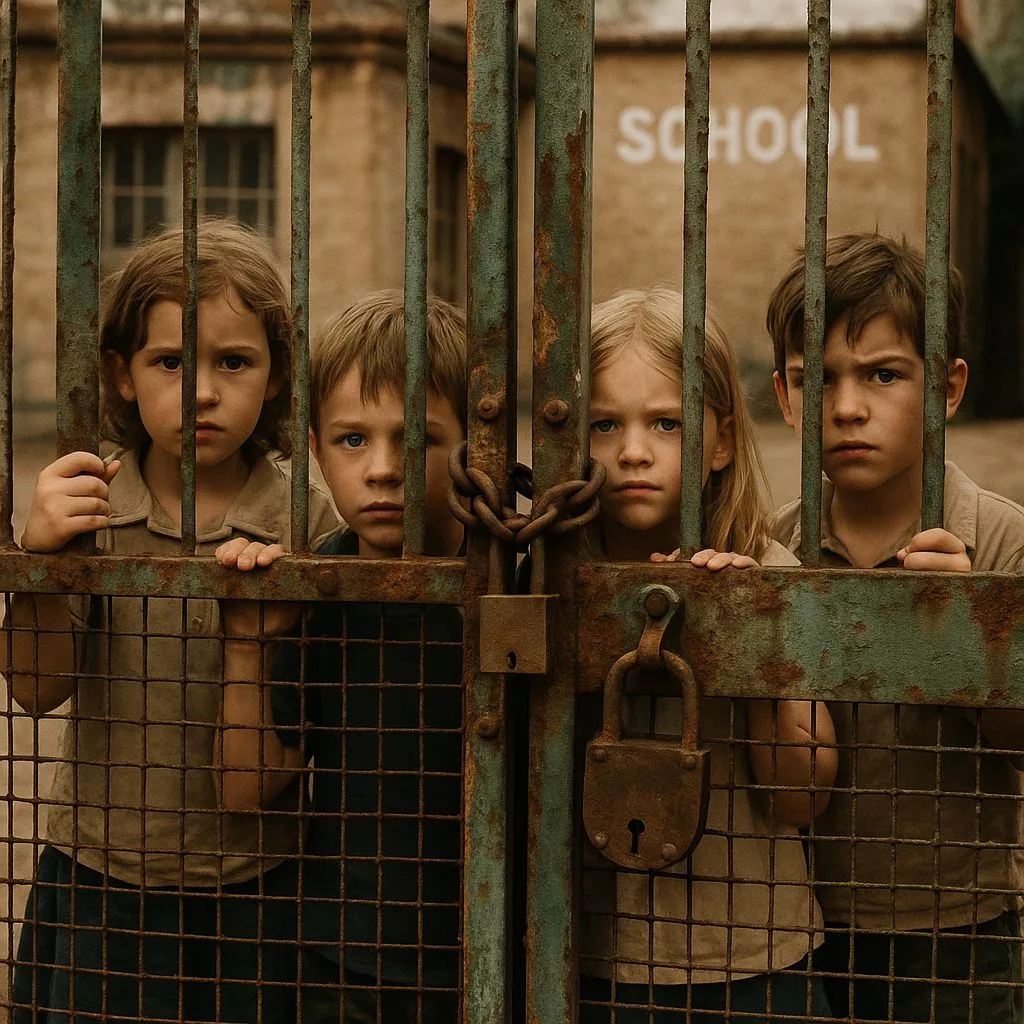
The Western Cape’s school system is broken, leaving thousands of children without a place to learn. Old computer rules and slow officials make it hard for kids, especially those moving from other areas, to get into schools. This leads to overcrowded classes in flimsy mobile rooms, and children with disabilities or those considered “too old” are left behind. It’s a sad picture where promises are broken, and many young lives are unfairly affected.
What are the key issues with the Western Cape’s school admission system?
The Western Cape’s school admission system faces several critical issues, including: a flawed algorithm using outdated census data, leading to miscalculated capacity; a dysfunctional manual appeals process; inadequate and overpriced mobile classrooms; a lack of provisions for disabled students; and an inability to correctly process “over-age” students from other provinces, particularly the Eastern Cape.
Section 1 – The Scan That Revealed a Metastasised Bureaucracy
The Western Cape High Court’s thick judgment, delivered on a Friday drowned in winter rain, feels more like a medical scan than a legal ruling. Page after page it exposes a provincial education engine that has learned to treat thousands of five- to eighteen-year-olds as rounding errors and their parents as background chatter. The Constitution commands that children be “prioritised”; the province has turned that promise into a hangman’s noose.
Officials have seen this wave coming for years. E-mails subpoenaed by Equal Education show department staff nicknaming the January stampede “the cattle truck,” an annual convoy of mostly black, rural families chasing jobs in supermarkets, vineyards or suburban kitchens. The truck’s arrival, the e-mails concede, is “predictable to the week.” Yet every December the department shuts its ledger, proclaims the system “full,” and feigns shock when the gates swing open to emptiness.
Section 2 – The Ghost Algorithm and the Shadow Heap
Parents are told to apply online between March and August. A computer then scores each child: 40 % for living nearby, 30 % if a sibling already attends, 20 % for coming from a feeder primary, 10 % for a parent’s workplace address. The machine, however, still chews on 2011 census data. Khayelitsha has added 48 % more people since; Kraaifontein has ballooned 63 %. The software therefore doles out 1 200 chairs to a campus that now has 2 400 hopefuls within walking distance. Every child above the cutoff is stamped “late,” even when the upload button was clicked in April.
Rejections shunt families into a second universe: the “manual appeals heap.” Paper files are stacked in plastic trays colour-coded by tragedy – green for eviction from Eastern Cape farms, red for farm-owner evictions, yellow for refugee paperwork still “pending.” On 4 February 2023 an analyst counted 1 800 folders in the Metro East appeals room; four weeks later 1 400 of those children were still adrift. The folders had simply migrated to a locked cupboard marked “archived,” a bureaucratic oubliette.
When cornered, officials chant the mantra “we add capacity.” Translation: tin boxes on wheels. A 2022 Treasury sample found 42 % of the “mobile classrooms” delivered to Metro East schools never gained a sewer link. At Solomon Qatyana Primary, 110 Grade-1s squeeze into one such unit whose floor collapsed mid-year; lessons now unfold beneath a jacaranda while the principal scavenges bricks for a latrine. Each box costs the province R 1,2 million, triple the price of conventional bricks and mortar. Treasury traced the markup to a single supplier tied to a former MEC’s adviser. The contract – R 680 million over five years – was quietly renewed in December 2022, the same week the department told Parliament “resources are stretched.”
Section 3 – Disability, Age and the Mirage of Planning
The admission policy’s clause 13 never mentions disability. Parents who arrive with neurologist’s letters hear: “First get a seat, then we’ll discuss support.” Children who roll in with wheelchairs are rejected for “spatial mismatch”; those with dyslexia or hearing aids are waved toward special schools, although a 2021 court order instructed those very schools to reserve one-fifth of places for mainstream overflow. Twenty-three special schools exist in the province; nineteen squat in the leafier, formerly white suburbs. Transport help tops out at R 550 a month – enough for a single weekly taxi round-trip. For the other 27 mornings the child simply stays home.
South Africa stops automatic promotion after Grade 9; fail, and you repeat. Eastern Cape failure rates are triple those in the Western Cape, so a 17-year-old often lands in Cape Town clutching a Grade 5 report. The computer flags the youngster as “over-age” and refuses a placement number. A leaked 2021 memo told data typists to “re-set age to 13” so the algorithm would swallow the entry – an instruction to forge rather than fix. Equal Education found 378 such cases last year; the youngest was a 16-year-old trying to enter Grade 5. Most are boys, because rural districts still keep girls at home to mind babies. The court has now ordered the code rewritten within 90 days, but the legacy program – Microsoft Access 2008 – cannot read age brackets past 15.
Statisticians at the University of Cape Town have plotted every late-application hotspot from 2014-2023. The geometry is ruthless. Each January a human tide rolls west along the N2, R304 and R102: Langa in week one, Philippi in week two, Mfuleni and Kraaifontein in weeks three and four. By February the crest surges again in Grabouw and Worcester as seasonal farm labourers are evicted post-harvest. The director’s office keeps this map pinned above her desk, yet no extra teachers are pre-booked, no mobiles pre-ordered. Instead, her secretary stocks form letters beginning: “Due to unprecedented numbers…”
Section 4 – The Bill, the Bench and the Blue Picnic Table
Stellenbosch economists calculate that one learner who sits out Grade 7 or 9 costs the provincial economy R 1,1 million over a lifetime, once lost wages, health costs and probable jail time are tallied. Multiply by the 2023 backlog of 6 800 children and the invoice hits R 7,5 billion – more than the education department’s entire capital budget for the next three years. Police data show a 22 % jump in contact crimes in Khayelitsha’s Site B during the first quarter, exactly when placement failures peak. Girls out of school are three times more likely to fall pregnant; boys drift into gangs.
Acting Judge Moosa, in dissent, insists the migration stream is “voluntary and black,” therefore any racial impact is “coincidental.” The majority answers in footnote 117: a policy that perfectly replicates apartheid geography is unconstitutional precisely because it is perfect. The court’s final order gives the province until 29 November 2024 to draft a plan that forecasts late applications within 10 %, triggers funds for mobiles once 105 % capacity is breached, swaps enrolment data with the Eastern Cape from August onward, allows zero-data uploads of documents, carves out a disability pathway, and publishes quarterly progress reports. Failure will be contempt, paving the way for class-action damages. The department has already advertised a R 14 million tender for a “predictive model,” oddly requiring bidders to boast experience with United Kingdom admissions software – a nation whose last internal migration crisis was the Blitz.
And still the cattle truck reloads. Principals received an internal circular last October warning them to “secure perimeter fencing” ahead of “increased walk-ins.” At Solomon Qatyana the jacaranda is flowering; the acting principal has bought a plastic picnic table and painted it cobalt. She calls it the registration desk, though teachers, textbooks and running water remain promises scrawled on a Treasury invoice. When the bell rings in January, the tree may shade another class of children whose names the algorithm never learned to spell.
[{“question”: “
What are the primary challenges within the Western Cape’s school admission system?
\n
The Western Cape’s school admission system is plagued by several significant issues. These include an outdated algorithm relying on 2011 census data, leading to inaccurate capacity planning; a largely ineffective manual appeals process; the use of inadequate and overpriced mobile classrooms; a severe lack of provisions for students with disabilities; and difficulties in correctly processing students, particularly those deemed \”over-age,\” who migrate from other provinces like the Eastern Cape.
\n”, “answer”: null}, {“question”: “
How does the admission algorithm contribute to the problem?
\n
The online admission algorithm uses criteria like proximity (40%), sibling attendance (30%), feeder primary school (20%), and parent’s workplace (10%) to score applicants. However, it operates on severely outdated 2011 census data, failing to account for significant population growth in areas like Khayelitsha (48% increase) and Kraaifontein (63% increase). This results in vastly underestimated school capacities, leading many applicants to be incorrectly labeled as \”late\” even when they applied on time.
\n”, “answer”: null}, {“question”: “
What happens to children rejected by the automated system?
\n
Children rejected by the automated system are shunted into a \”manual appeals heap.\” This process involves paper files often categorized by the nature of the family’s hardship (e.g., evictions, refugee status). The system is highly inefficient; for example, in February 2023, 1,400 out of 1,800 appeals in the Metro East appeals room were still unresolved weeks later, with many files simply moved to an \”archived\” cupboard, effectively losing track of the children.
\n”, “answer”: null}, {“question”: “
What are the issues with \”mobile classrooms\” used to address capacity?
\n
To address capacity issues, the province often resorts to \”mobile classrooms,\” which are essentially tin boxes on wheels. These are problematic because 42% of them lack basic services like sewer connections. They are also incredibly expensive, costing R1.2 million each, which is triple the price of conventional brick-and-mortar classrooms. This high cost is linked to a single supplier tied to a former MEC’s adviser, despite the department claiming stretched resources.
\n”, “answer”: null}, {“question”: “
How does the system fail children with disabilities and \”over-age\” students?
\n
The admission policy makes no explicit mention of disability, often directing parents to secure a seat first before discussing support, or rejecting children for \”spatial mismatch.\” While some are pushed towards special schools, these are geographically concentrated in wealthier areas, and transport subsidies are often insufficient. For \”over-age\” students, particularly those from the Eastern Cape who might have repeated grades, the computer system flags them and refuses placement. There have even been instructions to \”re-set age to 13\” to bypass the algorithm, indicating a systemic failure to accommodate these vulnerable groups.
\n”, “answer”: null}, {“question”: “
What are the long-term consequences and the court’s intervention?
\n
The failure of the system has severe long-term consequences, costing the provincial economy R1.1 million per child who misses Grade 7 or 9 due to lost wages, health costs, and potential incarceration. This translates to an estimated R7.5 billion for the 2023 backlog alone. Socially, it contributes to increased crime rates and higher rates of teenage pregnancy. The Western Cape High Court has intervened, ordering the province to develop a plan by November 29, 2024, to accurately forecast late applications, allocate funds for mobiles, exchange enrolment data, allow zero-data document uploads, create a disability pathway, and publish quarterly progress reports, with failure leading to contempt charges.
\n”}]