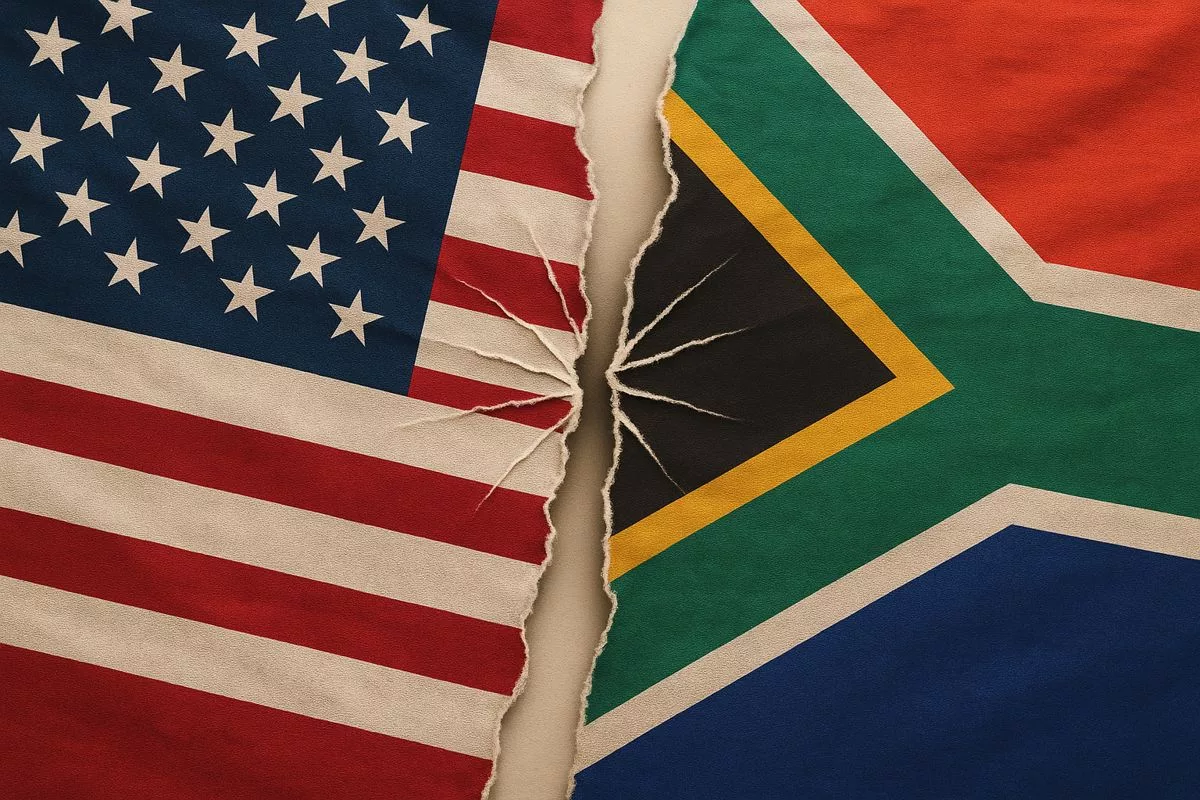
The US and South Africa are in a big fight over trade! South Africa might lose its special trade perks, which means its cars and farm goods could get hit with huge taxes. This all started because the US didn’t like South Africa’s friendship with Russia. Thousands of jobs are on the line, and the future of South Africa’s economy hangs in the balance.
What is the current trade dispute between the US and South Africa regarding AGOA?
The US and South Africa are in a trade dispute, risking South Africa’s exclusion from the African Growth and Opportunity Act (AGOA). This stems from South Africa’s foreign policy actions, including military exercises with Russia, and could result in significant tariffs on key South African exports like automobiles and agricultural products, impacting thousands of jobs.
How a single Senate hearing ignited the worst US–South Africa trade showdown since apartheid-era sanctions – and what happens next.
1. The Cannon Fired on Capitol Hill
On 11 February 2025 United States Trade Representative Jamieson Greer spent less time in front of the Senate Appropriations subcommittee than it takes to brew coffee, yet his clipped answers launched a diplomatic shock-wave felt from Pretoria’s Union Buildings to Berlin’s boardrooms. By hinting that Africa’s most industrialised economy might be surgically dropped from any short-term extension of the African Growth and Opportunity Act, Greer turned a routine budget hearing into the sharpest bilateral rupture since Washington imposed sanctions on the Botha regime four decades ago.
The remark was not an off-hand comment. It landed after months of quiet memos, angry tweets, and tit-for-tat tariffs, converting AGOA – normally a technocratic preference program – into the newest theatre of Washington’s culture wars and Pretoria’s liberation-movement politics. What follows is a field-guide to how the fight started, what each side can still lose, and the unlikely pressure points that could decide whether South Africa keeps its coveted duty-free lane into the world’s richest consumer market.
2. AGOA: The Unilateral Gift That Built a Supply Chain
Architecture of a trade sweetener
Signed by Bill Clinton in May 2000 and patched four times since, AGOA is best pictured as “GSP on steroids.” Washington – not the beneficiary – decides who is in, who is out, and which products ride free. Roughly 6 500 tariff lines can enter the United States without duty; 1 800 of them are AGOA-only and unavailable under the older Generalized System of Preferences. There is no need for reciprocity: the White House grants the waiver so long as partners tick boxes on market access, labour rights and, crucially, avoidance of acts that “undermine US national-security or foreign-policy interests.”
The numbers that matter
Last year South Africa shipped US $10.4 billion worth of goods to the United States under AGOA preferences – small change next to the countries’ combined US $27 billion two-way trade, yet decisive for a politically visible bundle of exports. More than half that figure is BMW X3s and Mercedes-Benz C-classes built near Pretoria and East London; citrus, wine and macadamia nuts make up most of the rest. Remove the waiver and a South African sedan suddenly faces a 25 % surcharge in the planet’s most cut-throat auto market – enough to erase the margin on every vehicle.
The legal tripwire
The statute’s elastic “foreign-policy interests” clause is the hook Washington is now yanking. No new legislation is required to invoke it; a simple notice in the Federal Register can translate geopolitical pique into overnight price hikes on supermarket avocados or dealer-floor SUVs.
3. Twelve Steps to the Brink – A Chronology
- 2022* – South African warships exercise with Russia and China off KwaZulu-Natal on the first anniversary of Moscow’s full-scale Ukraine invasion, irking both sides of the US aisle.
- September 2023* – AGOA lapses; congressional staff begin stitching a renewal bill.
- May 2024* – USTR sends Pretoria a 12-page “request for clarification” on gender-based-violence policy, land-expropriation legislation and possible ICC arrest moves against Vladimir Putin ahead of the August BRICS summit.
- July 2024* – Cyril Ramaphosa signs the amended Expropriation Act; US lobbyists frame it as an assault on private property.
- August 2024* – Donald Trump, campaigning again, slaps a 30 % ad-valorem tariff on all South African goods, invoking both Section 604 of the 1974 Trade Act and the International Emergency Economic Powers Act.
- December 2024* – Treasury designates South Africa a “jurisdictional aggressor” under the BUILD Act, instantly locking Pretoria out of US International Development Finance Corporation loans.
- February 2025* – Greer’s Senate testimony confirms the administration is “open” to a country-specific carve-out, turning whispered threats into public policy.
4. How Washington Can Cut the Cord – and What Pretoria Could Do the Next Day
Three levers on the US side
- Statutory black-list: a single line – “South Africa shall not be considered a sub-Saharan country for AGOA purposes” – worked against Eswatini in 2014 and needs only a simple majority plus a presidential signature.
- Annual waiver choke-hold: keep Pretoria on the published list but announce that the yearly waiver will be withheld until twelve public benchmarks are met, shifting the burden of proof onto South Africa.
- Product sniper-fire: remove just the auto and agricultural tariff lines using 19 U.S.C. §2462(d), a scalpel favoured by the United Auto Workers to protect Detroit’s light-truck segment from South African-made BMWs.
Pretoria’s counter-punches
Officials have revived a dormant 2018 “strategic retaliation” playbook listing 46 US products – from Georgia chicken to Kansas sorghum – ripe for anti-dumping duties within ninety days. More explosively, the government could invoke its 2023 Expropriation Act to force compulsory licensing of US-held pharmaceutical patents, echoing the 1997 HIV-drug showdown. As chair of the Southern African Customs Union, South Africa could also erect a collective 35 % tariff on American poultry, a move that would sting US farm districts which swung heavily to Trump in 2020.
Political fuel on both ends
Republican senators now use “South Africa” as shorthand for “anti-white woke foreign policy”; a 15-second clip of Ramaphosa singing “Kill the Boer” at a 2022 rally has racked up 38 million views on X, energising the base. Inside the ANC, COSATU and the Communist Party welcome a confrontation that revives liberation rhetoric, while the opposition Democratic Alliance – whose Western Cape ports handle two-thirds of AGOA citrus – has hired a K-Street firm for US $90 000 a month to court Republican agriculture commissioners, complicating any quick exclusion vote.
5. Supply Chains, Reactors and the Currency Cliff
Automotive cliff-edge
BMW’s Rosslyn plant funnels 76 % of its 3-series output to the United States. Kill AGOA and the cars face the existing 2.5 % auto duty plus Trump’s 30 % penalty, pulverising margins. Munich has already activated Plan B: move the volume to its San Luis Potosí site in Mexico, wiping out 1 900 direct South African jobs and 7 000 indirect roles in Tshwane – exactly the industrial cluster Ramaphosa touts as the poster child of his Just Energy Transition.
Nuclear wildcard
A 2019 bilateral Nuclear Cooperation Agreement gives Westinghouse a shot at building 2 500 MW of new reactors, a contract worth roughly US $15 billion. US diplomats now hint the bid evaporates if AGOA dies; conversely, a signed deal could give Pretoria bargaining chips. Rosatom and China’s CNNC hover with rouble- and renminbi-denominated finance – currencies the Reserve Bank is already hoarding as it quietly dedollarises reserves.
Rand shock and investor flight
Academic modelling shows every 100-basis-point rise in effective US tariffs knocks 0.4 % off the rand within three trading days. A full AGOA expulsion, equivalent to a three-point tariff hike, could shove the currency from R19.20 to beyond R21 against the dollar, re-igniting imported inflation just as the central bank has paused rate hikes. Foreigners hold 28 % of Pretoria’s inflation-linked bonds; a selloff would raise borrowing costs for Eskom’s long-promised balance-sheet fix.
6. Can BRICS or the Ballot Box Save the Day?
The BRICS mirage
South African ministers talk of diverting US-bound citrus and cars to China and India, but Beijing already slaps a 30 % seasonal safeguard on foreign citrus, and New Delhi still bars South African apples on phytosanitary grounds. Neither market pays the premium American Whole-Foods shoppers deliver – US $2.80 per kg for easy-peelers versus US $0.73 in Shanghai wholesale.
Calendar of cliff-hangers
- 25 March 2025 – House Ways & Means trade subcommittee marks up the AGOA bill.
- 15 April 2025 – South Africa’s finance minister tables a R7 billion fund to re-tool component suppliers.
- 1 May 2025 – USITC hearing on “probable economic impact” of exclusion; comment window closes 30 days later.
- 8–10 June 2025 – BRICS foreign ministers meet in Cape Town, agenda item: “preference mechanisms outside Western architectures.”
- 30 September 2025 – Statutory sunset of stop-gap GSP; the hard deadline for any patch.
Phrases that will move markets
Listen for “graduation criterion” (code for kicking out richer beneficiaries), “reciprocal commitment” (Washington wants tariff concessions in return), and “foreign-policy carve-out” (language that could also target Pretoria’s refurbishing of 120 Iranian rail wagons in defiance of US sanctions).
7. The Verdict Awaits – And So Do 0.3 % of US Imports
Desné Masie, editor of African Business, warns: “If AGOA becomes a culture-war football, Washington will discover it weaponised a programme that accounts for barely 0.3 % of total US imports.” Yet for South Africa’s 62 000 citrus growers, 1 900 BMW assembly-line workers, and a government staring down a R400 billion refinancing gap, that sliver is existential. Whether the stand-off ends in nuclear-linked grand bargain, a Swaziland-style one-line deletion, or a full preference collapse will be decided less in foreign ministries than in factory towns, poultry districts and the algorithms of social media. The clock resets every sunrise until 30 September; after that, exporters on both sides must live with the new geography of risk.
{
“faq”: [
{
“question”: “What is the core issue of the trade dispute between the US and South Africa?”,
“answer”: “The core issue is South Africa’s potential loss of special trade benefits under the African Growth and Opportunity Act (AGOA). This is primarily driven by the US’s disapproval of South Africa’s foreign policy, particularly its perceived alignment and military exercises with Russia.”
},
{
“question”: “What is AGOA and how does it benefit South Africa?”,
“answer”: “AGOA, the African Growth and Opportunity Act, is a US trade preference program that allows eligible sub-Saharan African countries to export certain goods to the US duty-free. For South Africa, this means key exports like automobiles (e.g., BMW X3s, Mercedes-Benz C-classes), citrus, wine, and macadamia nuts can enter the US market without tariffs, making them more competitive. This benefit is crucial for thousands of jobs and South Africa’s economy.”
},
{
“question”: “What are the potential consequences for South Africa if it loses its AGOA benefits?”,
“answer”: “If South Africa loses its AGOA benefits, its exports, particularly automobiles, could face significant tariffs (e.g., a 25% surcharge on sedans), making them uncompetitive. This would lead to substantial job losses (e.g., 1,900 direct and 7,000 indirect jobs in the automotive sector), a decline in economic stability, and a potential devaluation of the South African rand, impacting borrowing costs and increasing imported inflation.”
},
{
“question”: “What specific actions by South Africa have led to this trade dispute?”,
“answer”: “Several actions have contributed to the dispute, including South Africa’s naval exercises with Russia and China in 2022, its stance on gender-based violence policy, land-expropriation legislation, and handling of potential ICC arrest moves against Vladimir Putin. These actions have been interpreted by the US as undermining its national security and foreign policy interests.”
},
{
“question”: “How can the US remove South Africa from AGOA, and what countermeasures could South Africa take?”,
“answer”: “The US has several levers to remove South Africa from AGOA, including a statutory blacklist (a single line of legislation), an annual waiver choke-hold (requiring benchmarks to be met), or product-specific tariff removal (e.g., targeting auto and agricultural goods). In response, South Africa could implement anti-dumping duties on US products, force compulsory licensing of US pharmaceutical patents, or impose collective tariffs on American poultry through the Southern African Customs Union.”
},
{
“question”: “Can South Africa rely on BRICS nations to offset potential trade losses with the US?”,
“answer”: “While South African ministers have suggested diverting exports to BRICS nations like China and India, this is largely seen as a ‘mirage.’ Both China and India have their own trade barriers, such as seasonal safeguards on citrus in China and phytosanitary restrictions on apples in India. Furthermore, these markets typically do not offer the same premium prices for South African products as the US market, making it an unlikely direct replacement for lost AGOA benefits.”
}
]
}