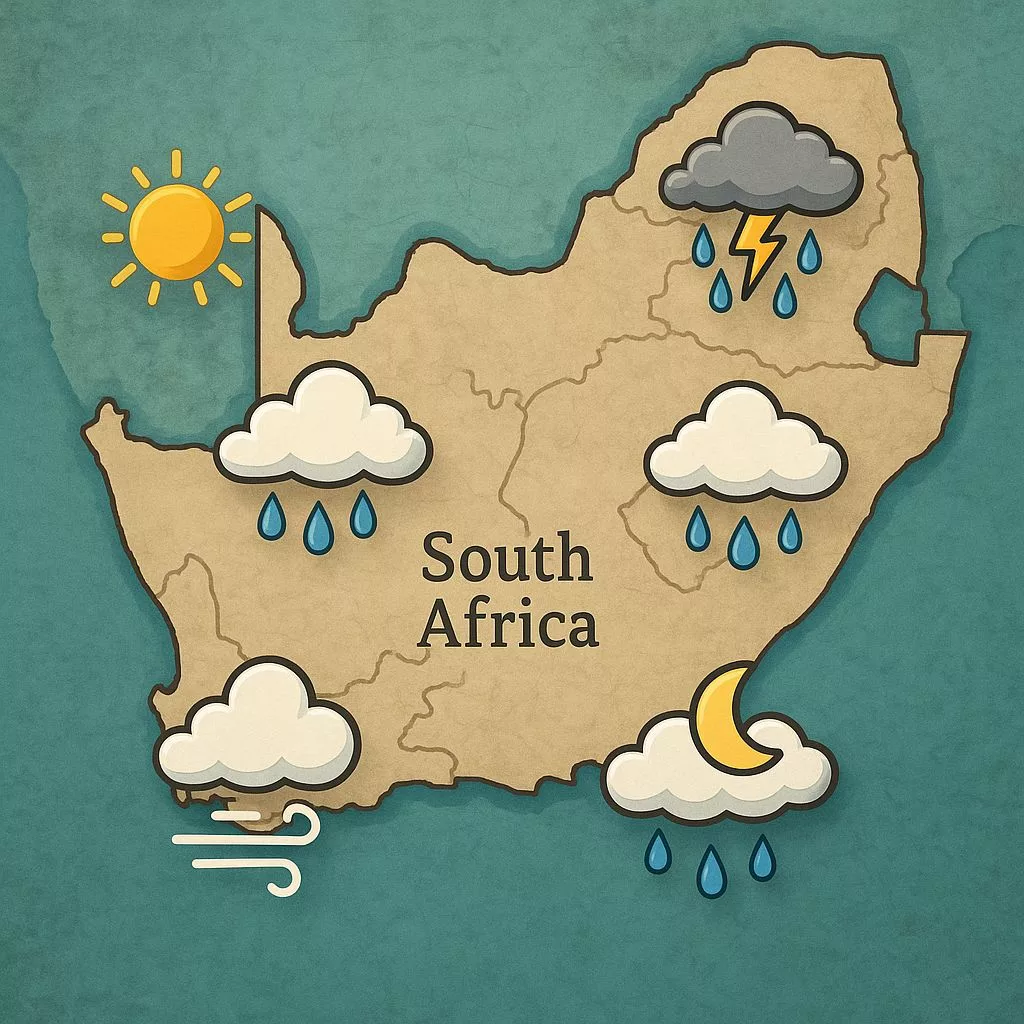
South Africa is facing crazy weather right now, like a wild movie playing across the land! Cities are baking hot, while fierce thunderstorms are dropping big ice chunks. Out in the country, thick fog makes roads slick, and the danger of fires is super high. Along the coast, huge waves crash, and the sun’s rays are so strong they can burn your skin in minutes. It’s a real mix of heat, hail, scary fires, and roaring oceans all at once!
What are the immediate weather conditions and hazards across South Africa?
South Africa is experiencing diverse and extreme weather, including urban heat (32°C in Joburg), severe thunderstorms with high CAPE values (2,000 J kg⁻¹), localized hail (2cm ice bullets), dense fog, and high fire danger (80% over Lowveld). Coastal areas face strong ocean swells, while high UVB levels (index 8) pose a significant burn risk.
Section 1 – Highveld Thunder and Urban Heat
The Reef’s concrete jungle is already simmering at shoulder-height by 09:00. Thermometers in central Joburg tick to 29 °C, yet the tarmac on Commissioner Street radiates 32 °C; the extra three degrees come from brick, tar and glass that soaked up dawn’s short-wave buffet. At 14:00 the convective kettle is 3 km deep and bubbling; CAPE values flirt with 2 000 J kg⁻¹, enough to spin up a five-minute waterfall that dumps 15 mm and stalls traffic under the M1 double-decker.
Pretoria’s northern suburbs enjoy a milder 26 °C thanks to tree cover, but the same canopy traps humidity; when the first bolt cracks, downdrafts ram cooler air into jacaranda-lined avenues and scatter purple blossoms like confetti. Commuters on the Tshwane BRT should carry a fold-up umbrella: the storm window is short yet brutal, and gutters rated for a five-year return period choke in minutes.
Ozone-poor skies push UVB to 8; unprotected Type-II skin turns pink in 18 min. A peaked cap is better than lotion alone – tilt the brim every few blocks so rays don’t sneak around the edge.
Section 2 – Escarpment Fog, Lowveld Boom
Before sunrise, hollows around Belfast fill with radiation fog thicker than double-cream. Tar drops to 6 °C, cold enough for micro-black-ice; bikers hitting the R540 curve can find themselves sliding on condensation that never quite froze. By 11:00 the sun lifts the mist, leaving 16 g of water in every kilogram of air – prime vapour for afternoon boomers.
Storm bases hug 1 200 m above the plateau, yet anvil crowns punch 11 km, tossing Johannesburg–Nelspruit flights like toys for 25 min. Pilots hug the left seat; passengers see cappuccino clouds scraping the windshield. Over southern Kruger, radar paints 20 mm cores in scarlet; elephants herd under Marula canopies while rangers count hail dents on Land-Cruiser bonnets.
The Lowveld hits 27 °C, the Highveld stops at 22 °C, and Sabie faces a one-in-five chance of 2 cm ice bullets. Macadamia growers wince – each lightning bolt can cook a R2 000 tree.
Section 3 – Bushveld Boil, Kalahari Blast
Polokwane’s dawn fog is leftovers from yesterday’s storms, sealed under a radiation inversion. Come midday, 36 °C air at Lephalale meets 18 °C dew-points at 850 hPa; the resulting –5 lifted index is a storm detonator. Lightning loves the copper-rich crust north of the Soutpansberg; avocado orchards lose 2 % of their canopy to direct strikes every year.
North-West’s Ghaap plateau touches 38 °C while the Kalahari heat low slumps to 1 005 hPa. A 40 km/h northerly freight train hauls beige dust 400 km south; visibility drops to 6 km and satellite algorithms scream “fire” every time a tractor turns soil. Magaliesberg’s scarps act as a trip-wire; cells explode at 17:00, shoving 60 km/h gusts into Johannesburg just in time for evening traffic.
Fire-danger needles flirt with 80 % over the Lowveld; a single match can raise grass to 300 °C in half a minute. Plantation managers start “Red Day” at noon: chainsaws silent, welders benched, tower lookouts scanning 360° every quarter-hour.
Section 4 – Coastal Contrasts, Ocean Fury & River Surge
Prince Albert roasts at 42 °C while False Bay stays 15° cooler thanks to 12 °C upwelled Benguela water. The same cold tongue fertilises plankton, luring southern-right whales to calve within smartphone range of Clovelly beach. Berg-wind descent shoves humidity to 5 %; static snaps a 2 cm blue spark from car door to wrist.
Offshore, a 1 020 hPa high ridges south, tightening the coastal pressure belt. Swell period leaps from 8 s to 12 s; wave steepness crosses the 0.05 danger mark and 3 m faces slam small craft. The Agulhas jet surges to 2.2 m s⁻¹; counter-eddies shave 5 kn off a yacht’s GPS speed. NSRI Durban hoists an orange alert, staging a 7 m RIB at Mtwalume.
Upriver, the Vioolsdrif gauge on the Orange sits at 2.3 m. A 50 mm cloudburst in the Karee catchment can shove 400 m³ s⁻¹ downstream in six hours; Vanderkloof Dam will then open yellow-coded sluices. Pecan farmers on the lower terraces pre-install 50 km of sandbags and move tractors to higher ground.
Section 5 – UVB, Lightning & Farming Decisions
Lightning is a silent tax on the countryside. SALDN clocks 3 000 ground strokes per hour at peak; every 30 kA bolt costs rural schools R1.2 million in toasted ICT gear each four-year cycle. SANS 10313:2022 now demands rooftop mesh cages for any classroom taller than 15 m.
UVB forecasting is trickier than “slap on sunscreen.” At 296.8 nm, a single Dobson-unit dip boosts burn potential 1.2 %; a cumulus tower can erase 70 % of that threat. Apple Watches vibrate every 60 min when the index hits 10, tailoring nudges to your personal Fitzpatrick score.
Peanut growers in the Free State park their sprayers when 10 m winds exceed 18 km h⁻¹ and delta-T climbs above 10 °C; evaporation would steal 30 % of the fungicide. Today’s delta-T peaks at 14 °C at 15:00, so pilots switch to dusk when a surface inversion hugs the crop.
Aviation rides the same sky drama. A SIGMET warns ofCB tops at FL380 between Bloemfontein and Cape Town; moderate chop peaks at FL280–320 with 4 m s⁻¹ vertical kicks. Seat-belts stay latched 25 min either side of top-of-descent, especially over the Hex River where nocturnal katabatics can hit 50 kt.
[{“question”: “What are the immediate weather conditions and hazards across South Africa?”, “answer”: “South Africa is experiencing a mix of extreme weather. This includes significant urban heat, severe thunderstorms with large hail, dense fog, and a high risk of fires. Coastal areas are facing strong ocean swells, and high UVB levels are causing a significant risk of sunburn.”}, {“question”: “How hot are the urban areas, and what causes the increased temperatures?”, “answer”: “Urban areas like central Johannesburg are experiencing high temperatures, with tarmac reaching 32 °C even when the air temperature is 29 °C. This extra heat is due to materials like brick, tar, and glass absorbing and radiating heat from the sun.”}, {“question”: “What are the characteristics of the thunderstorms currently affecting South Africa?”, “answer”: “Thunderstorms are severe, with high CAPE values (up to 2,000 J kg⁻¹) indicating strong convective energy. They can produce intense, short-duration rainfall (e.g., 15 mm in five minutes) and localized hail, with ice bullets potentially reaching 2 cm in diameter, particularly in areas like Sabie.”}, {“question”: “Where is fog a concern, and what are its associated dangers?”, “answer”: “Dense radiation fog is forming in hollows, particularly around areas like Belfast, before sunrise. This can lead to road surface temperatures dropping to 6 °C, creating micro-black-ice conditions that pose a sliding hazard for bikers and other vehicles.”}, {“question”: “What is the fire danger level, and where is it most pronounced?”, “answer”: “The danger of fires is very high, with fire-danger needles flirting with 80% over the Lowveld region. A single match can ignite grass to 300 °C in half a minute. This leads to ‘Red Day’ protocols in plantations, where activities like chainsaws and welding are halted, and tower lookouts are on high alert.”}, {“question”: “What are the coastal conditions and risks for individuals and marine activities?”, “answer”: “Coastal areas are experiencing strong ocean swells, with wave periods jumping from 8 to 12 seconds and wave steepness crossing the 0.05 danger mark, leading to 3-meter faces that threaten small craft. High UVB levels (index 8) pose a significant burn risk, with unprotected Type-II skin capable of turning pink in just 18 minutes.”}]