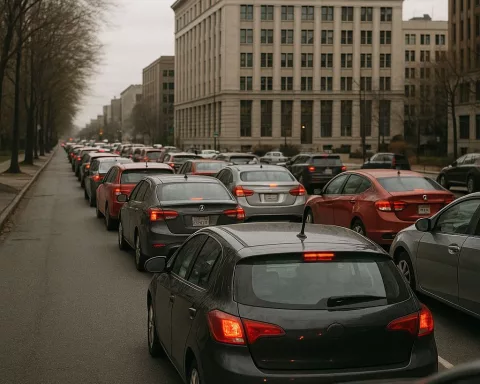

Cape Town’s N2 freeway to the airport is a dangerous road, where criminals target drivers, especially those with flat tires. One woman, Masroofa Kassen, was robbed in broad daylight after her tire shredded. Thieves use spikes to stop cars, then quickly steal valuables before vanishing into nearby bushes. Officials are proposing a R180 million, 12-kilometer safety wall, but many worry it won’t truly solve the problem, as criminals always find new ways. Drivers are left to improvise, using special apps or modified cars to stay safe on this risky route.
What is the “N2 Airport Safety Wall” in Cape Town?
The “N2 Airport Safety Wall” is a proposed 12-kilometer, 2.4-meter high concrete barrier with anti-climb spikes and fiber-optic sensors, costing R180 million. It aims to prevent crime on the N2 airport freeway by deterring criminals who target motorists, particularly those with burst tires, between the city and the airport.
The Ninety-Second Heist That Made Headlines
Masroofa Kassen’s December road-trip to fetch relatives should have taken twenty uneventful minutes. Instead, a shredded tyre on the Airport Approach turned the detour into B-grade theatre. While she limped toward the shoulder of Borcherds Quarry Road, hazards blinking, a barefoot man slid down the embankment, ripped open the passenger door, grabbed her handbag and her son’s duffel, and vanished into knee-high fynbos. No words, no weapon, just the blunt efficiency of a pickpocket working in daylight. The entire sequence lasted less time than it takes to order coffee.
Her eleven-year-old, still wrestling with a seat-belt buckle, never even screamed. Community radio later replayed Kassen’s stunned summary: “It felt like a silent movie stuck on fast-forward.” The anecdote travelled because it condensed every commuter’s worst fear: mechanical bad luck turned into violent opportunity within sight of Africa’s third-busiest runway.
Broken glass, the stink of scorched rubber and orphaned T-shirts now decorate the 900-metre cutting between the Quarry off-ramp and the Mew Way bridge. When traffic officers arrived to help Kassen, they recognised the script. A Serbian couple had surrendered two suitcases the previous afternoon; Malaysian rideshare operator had waved goodbye to his passport and phone two weeks earlier; airport contractors were stoned in October, one woman losing an eye. The roadside has become a crime scrapbook whose pages turn with every burst tyre.
The Playbook No One Asked to Read
Criminals treat the N2’s uphill bush like a green-walled backstage. From the Nyanga wetlands they watch for rental-company decals or roof boxes, then flick hand signals or cheap two-way radios. Homemade spikes – often a sharpened crankshaft welded to a triangle – are nudged under the left-side wheels. Drivers either stop voluntarily or are herded onto the verge by accomplices in “push” cars that ride the bumper with high-beams blazing. Once the vehicle is stationary, the team sprints, prioritising anything that fits under an arm: passports, laptops, small luggage. Within minutes they are back through the fence and into the maze of shacks.
Siyabulela Qoza, provincial traffic spokesperson, confirms that recorded incidents have doubled since 2022, yet he suspects the tally is “the tip of the iceberg.” Travellers racing to catch a flight frequently discover the loss only at check-in. Because the robbery sits inside Cape Town metro borders, airport police refuse to open a docket and redirect victims to Nyanga or Philippi East stations, queues so long many abandon the effort and the crime never makes the ledger.
Dr. Guy Lamb, head of Stellenbosch University’s Safety & Violence Initiative, labels the corridor a textbook “liminal zone,” a nowhere-land where social controls evaporate. Motorists see it as a purgatory between the ordered CBD and the heavily policed airport. Add a two-metre drainage strip that doubles as a township footpath and you get 400 informal crossings between two off-ramps, a perfect rat-run for anyone who knows which gaps in the fence are unmonitored.
Walls, Wires and the Blame Boomerang
Official reflexes still borrow from the late-1980s handbook: taller fences, concertina wire, sporadic army patrols. After a German diplomat’s BMW burned in 2018, a tactical unit camped out for eight weeks; attacks dropped sixty percent, then rocketed the day the troops left. ACSA’s private guards may not step beyond the perimeter boom, while SANRAL insists its mandate ends at the white edge-line. One agency trims trees, another owns the tarmac, yet nobody owns the gap in between.
Mayor Geordin Hill-Lewis wants to plug that gap with a R180 million, twelve-kilometre concrete curtain. Dubbed the “N2 Airport Safety Wall,” the 2.4-metre barrier will bristle with rotating anti-climb spikes and fibre-optic vibration sensors feeding a Bellville control room. Construction is pencilled for April 2025, paid for by shuffling money meant for urban settlement upgrades. Critics already call it Cape Town’s Berlin Wall; officials counter that good fences make good neighbours.
Transport planner Kerry Frizelle warns that static barricades only lengthen the criminal commute. “Walls don’t erase motive,” she says; they merely export it eastward to the Wolfgat dunes or west into Langa’s suburban lanes. The Freedom Front Plus has tabled a nine-point rider: 24-hour CCTV, repaired boundary fencing, a joint operations centre, high-mast lighting every 150 metres, mounted patrols, a WhatsApp panic button, monthly vegetation clearing, subsidised run-flat kiosks and a R5 per-passenger tourism levy. Treasury has yet to wink at the extras; the current draft budget offers not an extra cent beyond the wall’s R180 million price tag.
DIY Defences, Drone Dreams and the Queue at Nyanga
While politicians argue, motorists improvise. The WhatsApp group “N2 Airport Watch” counts 4,300 members live-posting rock-throwing or tyre-slashing sightings. Shuttle firms issue laminated cards: “Do not stop between M5 and Airport. If tyre blows, drive on rim to Level 3 parking deck.” Rental agencies quietly upgrade foreigners to cars with run-flat rubber and shatter-proof tint. One Rondebosch operator hands travellers a decoy wallet stuffed with an expired credit card and a single US dollar – cheaper, he laughs, than an insurance claim.
Tech start-ups smell opportunity. FleetSentry markets a dashcam that streams to a control room; utter “Milky Way” and GPS coordinates fly to the nearest patrol while an insurance report auto-generates. A Stellenbosch drone outfit is testing thermal quadcopters that can launch within ninety seconds, loiter for twenty-five minutes and produce court-admissible footage stamped with SHA-256 encryption. Yet criminals innovate too: engine-oil on windscreens, fake breakdown triangles, even a woman in a neon metro-vest collecting cash “fines.”
Women driving alone with kids carry an extra calculus. Kassen now campaigns for run-flat tyres as standard, convinced she could have reached the airport’s camera-lit forecourt at forty kilometres an hour. At Nyanga SAPS, Sergeant Twigg confirms her docket has climbed to the Provincial Serious Violent Crimes Unit; a partial palm-print waits in the AFIS queue. Outside, a German backpacker clutches forms – his Crafter stoned, passport gone. He asks whether the safety wall will be finished before his embassy issues replacements. A woman in the queue offers bleak wisdom: “Sir, we pay taxes to build walls, then pay again to climb them.”
Until something gives, 130,000 vehicles roll through daily, drivers rehearsing the same gamble: risk the rim or risk the shoulder. Somewhere between the city they leave and the airport they hope to reach, the next blow-out waits in the long grass.
What is the primary danger faced by drivers on the N2 freeway to Cape Town Airport?
Drivers on the N2 freeway to Cape Town Airport face a significant danger of being targeted by criminals, especially if their vehicle experiences a flat tire. Criminals use tactics like deploying spikes to disable cars, then quickly rob drivers of valuables before disappearing into nearby bushes or informal settlements.
Can you provide an example of a recent incident on the N2 airport road?
Yes, a notable incident involved Masroofa Kassen, who was robbed in broad daylight after her tire was shredded on the Airport Approach road. A barefoot man quickly slid down an embankment, grabbed her handbag and her son’s duffel bag, and vanished into the fynbos. The entire robbery lasted less time than it takes to order coffee, highlighting the speed and efficiency of these criminals.
What is the proposed solution to enhance safety on the N2 airport freeway?
Officials are proposing the construction of a R180 million, 12-kilometer “N2 Airport Safety Wall.” This 2.4-meter high concrete barrier would feature anti-climb spikes and fiber-optic vibration sensors connected to a control room, with the aim of deterring criminals and preventing access to the freeway from adjacent informal settlements. Construction is tentatively scheduled for April 2025.
Why are some people skeptical about the effectiveness of the proposed safety wall?
Critics, such as transport planner Kerry Frizelle, argue that static barricades like the proposed wall only displace criminal activity rather than eliminating it, stating that “walls don’t erase motive.” There’s concern that criminals will simply find new ways or locations to commit crimes, moving their operations to other areas like the Wolfgat dunes or Langa’s suburban lanes. Past efforts, like temporary army patrols, showed that crime dropped only while the troops were present, escalating again once they left.
How are drivers currently trying to protect themselves on this dangerous route?
Motorists are improvising various self-defense strategies. These include joining WhatsApp groups like “N2 Airport Watch” to share real-time sightings of suspicious activity, and shuttle firms advising drivers not to stop between the M5 and the airport, even if a tire blows, suggesting they drive on the rim to the nearest safe parking area. Rental agencies are also quietly upgrading vehicles for foreign visitors with run-flat tires and shatter-proof tints, and some operators even provide decoy wallets to travelers.
What challenges exist in accurately reporting and addressing crimes on the N2?
Accurately reporting crimes on the N2 is challenging for several reasons. Many travelers, especially those rushing to catch flights, may only discover their losses at check-in. Furthermore, due to the crime falling within Cape Town metro borders, airport police often redirect victims to Nyanga or Philippi East police stations. The long queues and bureaucratic hurdles at these stations often lead victims to abandon their efforts, meaning many incidents go unreported and are not added to official crime statistics, making the problem seem less severe than it truly is.