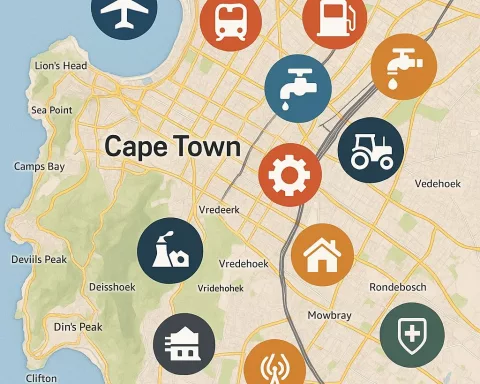
Cape Town’s trains are a wild, daily adventure! Imagine broken windows, cash-only tickets, and guards with dogs more interested in snacks than safety. Some rides show off stunning ocean views, but most are a bumpy mix of old trains, tricky timing, and unexpected detours. It’s a tough journey, yet people ride it every day, finding small moments of hope and community amidst the chaos.
What is it like to commute by train in Cape Town?
Cape Town’s commuter trains offer a unique and often challenging experience. Commuters face unpredictable schedules, cash-only payments, and informal vendors. While some lines provide scenic coastal views, security issues, infrastructure decay, and frequent delays are common, reflecting a system grappling with underfunding and mismanagement.
05:20 – Cape Town Station: The River Begins to Flow
Headlights spill across the concourse while the sky is still the colour of dishwater. Cleaners in high-vis lime shuffle past first-years in hoodies, plaster-dusted builders and a nurse squeezing her lunchbox like a life-buoy. A tired loudspeaker coughs departures in isiXhosa, Afrikaans and English, but the analogue clock over Platform 11 is thirty beats late, its second hand clacking like loose cutlery. The 05:20 Northern Line slides in, stainless steel scrubbed for show, yet the third coach still wears a net of cracked glass stitched together with yellow “DO NOT LEAN” tape that flutters like birthday ribbon after the party. Three guards patrol with a brown Labrador more interested in a soggy vetkoek than in anyone’s backpack. No turnstiles block the way – the metal ribs were ripped out years ago and allegedly sold for scrap, leaving rectangular scars in the concrete.
Passengers bunch anyway, forming an unwritten queue that snakes around the cement pillar where gospel singers usually set up on Sundays. The price of a ride is recited like a catechism: fourteen rand one-way, eighty for a weekly, about three hundred and twenty a month – less than a single fill-up for the 1998 Tazz that Abigail Makhawula no longer risks parking outside Stellenbosch wine farms. She unfolds a plastic stool she stores in her employer’s pantry; even fourth in line she will stand until Bellville, the mathematics of bodies outweighing courtesy. Behind her a Grade-9 learner balances an exercise book on a vertical pole, using the station’s fluorescent glare because the power at home was load-reduced before dawn.
When the doors hiss shut the train exhales and the city’s silhouette starts to scroll. Between Mutual and Paarden Eiland the line dips beside salt marsh; diesel and kelp seep through the vents. A gumbooted entrepreneur walks the aisle offering loose Peter Stuyvesants for two rand, the LED lamp on his forehead spotlighting imaginary “train tadpoles” he claims live in the puddles beneath the sleepers. Commuters buy the myth along with the nicotine – it beats admitting the water is just runoff from a broken sewer main. At Century City a handful of office types hop off, careful to land on a freshly painted yellow edge installed after a 2023 incident in which a commuter lost a leg in the gap. The paint is already scuffed, but the lawyers sleep easier.
Northern Arc: Goodwood to Eersteriver – The Gradient of Giving Up
Travelling north is like turning the pages of an atlas nobody updates. Goodwood’s sandstone station wears a new coat of PRASA lime, yet the gutters sag like old underwear elastic. Behind a rolled-down shutter a cardboard sign announces, “Tickets on train only – cash only – no silver coins please.” The conductor who swings aboard at Thornton carries a bulging canvas purse and the sleight-of-hand of a street conjurer, flipping coins with one palm while steadying himself against a seatback with the other. Two teens sporting faint moustaches claim to be under six; he sells them half-price coupons anyway, “for the theatre.”
By the time the train wheezes into Eersteriver the choreography collapses. The island platform was designed for eight hundred but only two hundred queue markers were ever painted; at 07:10 three human streams collide – Strand-line passengers, Khayelitsha feeder riders and taxi drop-offs sprinting across the forecourt. A mother wedges one twin into a repurposed 20-litre Plascon bucket labeled “Bitter Chocolate,” ties the other to her back and shuffles forward like a human totem. Overhead an automated voice still begs for one-metre social distancing, the recording left on loop since 2020. A teenage couple exploit the squeeze to share a five-second kiss, masks dangling like mismatched earrings.
Stellenbosch station, twenty minutes on, doubles as an open-air mall. Spinach bunches, hair extensions and second-year accounting textbooks share the same blanket between the rails. The air is a cocktail of vetkoek oil, brake-pad dust and fermenting grape skins drifting across from the Spier barrel-washing depot. Lecturers in suede jackets pray the 06:55 shows; on 28 November it didn’t, the cancellation notice taped up after passengers had already boarded. A viticulture docent eventually paid R240 for an Uber – six days of train fares – vowing to factor the risk into future lesson plans. PRASA’s apology, photocopied to vanishing pale grey, cited “previous station delays,” the corporate equivalent of “the dog ate my homework.”
Southern Line: False Bay’s Moving Postcard
South of the central divide the railway becomes a coastal balcony. Sleepers sit so close to the ocean that spring-tide spray freckles the windows with salt constellations. Between Retreat and Fish Hoek commuters routinely spot whale plumes 200 m offshore; the carriage smells alternate between kelp and yesterday’s hake from Kalk Bay’s platform kiosk. Timetable predictability hovers around sixty percent, yet a Muizenberg-to-Observatory run can still beat the M5 parking-lot freeway by twenty-five minutes, a bragging right repeated like scripture among surfers and cardiac nurses alike.
Class overlap is unavoidable. Rondebosch, flanked by private schools whose annual fees outstrip national median salaries, hasn’t staffed a ticket booth since Tuesday. Lycra-clad joggers board for free because there is literally no one to pay. Further on, where shacks nudge the rail reserve, queue length quadruples and inspectors dish out R80 spot fines to kids in worn-out sneakers. Inside one vestibule an equity analyst balances a MacBook on his knee while a fish-factory packer cradles a plastic bag of snoek heads; by Wynberg they have swapped WhatsApp contacts and a promise of Saturday childcare work.
Evening peak at Fish Hoek turns the platform into a morality play. Two queues form beneath fading arrows – “Tickets” and “No Tickets.” A retired magistrate advises newcomers to flash their monthly pass like a passport; nothing speeds human flow like documentary virtue. Yet faded signage sends five befuddled professionals into the defaulters’ column each night, their cheeks colouring when the guard waves them aside. The portable card machine inevitably suffers cardiac arrest until a commuter produces a power-bank; spontaneous applause erupts when the screen flickers back to life. The promised smartcard system remains a mirage, evidenced only by a validator bolted to the wall scrolling “OUT OF ORDER” like a stuck emoji.
Weekend Rolling Galleries & The Money That Isn’t There
Saturday trains morph into culture capsules. Surfers jam 2.1 m boards between seat backs; briny runoff races chicken bones toward the doorway. Entire coaches serve as rolling murals – Madiba smiles alongside Cape Flats gang calligraphy. PRASA gave up on protective vinyl after scrap hunters peeled the adhesive for fire-lighter fuel. Between Lakeside and False Bay College a church choir climbs aboard and launches three-part harmonies that ricochet off the aluminum roof; hungover passengers tap the beat on denim knees, redemption by osmosis.
Security is ghost-work. Plain-clothes “Ghosts” in sneakers and hoodies swoop in pairs, cable-tying drunks and fare dodgers, refusing selfies or name tags. Rumour pegs them as cash-strapped varsity students paid per arrest; their tally skews toward ticket-scofflaws rather than phone-snatchers, a metric easier to invoice. During three weeks of rides only one bust stuck: a 14-year-old sweet seller marched off at Langa and released thirty minutes later after his mother produced a crisp R50 “administration” fee.
Behind the scenes, numbers tell their own bleak joke. Out of 580 coaches assigned to the Western Cape, 387 count as “usable,” a category that includes units with shoelace-tied doors and ceilings stripped of copper by midnight metal miners. PRASA’s 2024 ledger shows a R3.8 billion refurbishment shortfall; the Chinese Afro 4000 locomotives imported in 2015 idle in Salt River like giant yellow elephants, picked clean for spares. Volunteer collective “Rail Riders” crowd-sourced R1.2 million to repaint three coaches heritage green; since October 2024 those cars sparkle on Instagram but amount to 0.5 % of the fleet, a teaspoon in a collapsing dam.
Signalling – the invisible heartbeat – was strangled by graft. A R2.7 billion advance was paid for 42 km of fibre that never arrived; what lies in the ground is ordinary telecoms duct spray-painted battleship grey. Until a new tender surfaces, dispatchers in Bellville still slide magnetic tabs across a 1970s steel mural, kindergarten-style, capping trains at four-minute intervals. Drivers clutch pink paper “authorities,” phoning control at each signal; one dead spot equals twenty lost minutes while the cab becomes a call-centre on wheels.
Storms, too, have joined the sabotage club. Northwest winter fronts now shove boulders and kelp across the sea wall between Muizenberg and St James. After a 2023 derailment the speed limit dropped to 40 km/h, erasing six minutes per run, totalling eighteen lost train-hours daily – the schedule equivalent of cancelling two full services. Engineers dream of floating concrete pontoons, but an environmental study alone will cost R12 million and swallow three years, an epoch in commuter time.
Side-Hustles & The Chessboard of Promises
Still, hustlers colonise every gap. At Mutual, Theo the ex-fitter built a throne from discarded seat cushions and charges R30 for a shine, stocking Wi-Fi vouchers on the side. In Kalk Bay a barista converted a guard’s van into a micro-café; salvaged solar panels power a R18 flat white – half the beachfront price. Students run “silent discos” to Simon’s Town on Fridays: neon headphones, no noise complaints, the guard complicit because the party corrals itself into three middle coaches and leaves the rest in peace. Not a rand reaches PRASA’s account, yet tolerance prevails; goodwill is currency the agency no longer knows how to mint.
The long game is a stalemate of paperwork. National Treasury has dangled a R17 billion lifeline tied to 36 milestones – biometric clock-ins, a permanent board, quarterly loss-shrinkage charts. Milestone one, turnstile pilots at ten stations, was due March 2025; the vendor missed the cut when chip-card readers languished behind containers of plastic pumpkins in Durban harbour. The Western Cape government is dusting off legislation to run its own “inner-city” service, arguing that the phrase can stretch 60 km to Stellenbosch. The Constitutional Court may rule in 2026; if the province wins, Metrorail could end up a tenant on tracks it once owned, paying access fees like any long-distance trucker on a toll road.
Until judges gavel, the ritual resets each dawn: the 05:30 Kayamandi lifeline, the folding stools, the salt spray, the sniffer dog that chooses pastry over duty, the magnetic tabs, the folk tales of train tadpoles, the smell of vetkoek and warmed vinyl. Steel wheels laid in 1861 still murmur the same lullaby, rocking a nation that has not yet solved the algebra of moving millions without wasting time, money or the last grains of public trust.
What is it like to commute by train in Cape Town?
Cape Town’s commuter trains offer a unique and often challenging experience. Commuters face unpredictable schedules, cash-only payments, and informal vendors. While some lines provide scenic coastal views, security issues, infrastructure decay, and frequent delays are common, reflecting a system grappling with underfunding and mismanagement.
What are the typical operating hours for Cape Town’s trains?
While specific operating hours aren’t detailed, the provided information suggests that trains start very early, with the 05:20 Northern Line service mentioned, indicating a dawn start to the commuting day. The system continues through the day, with evening peaks also described.
What are the ticket prices and payment methods?
Ticket prices are relatively low, with a one-way fare costing fourteen rand, a weekly pass eighty rand, and a monthly pass around three hundred and twenty rand. Payment is strictly cash-only, and sometimes even silver coins are not accepted, as indicated by a sign at Goodwood station.
What are some of the challenges faced by commuters on Cape Town’s trains?
Commuters face numerous challenges including unpredictable timing, frequent delays, broken infrastructure (like ripped-out turnstiles and cracked windows), security concerns (though guards are present, their effectiveness is questioned), and an unreliable ticketing system. Load shedding can also affect power at home before dawn, impacting commuters.
Are there any positive aspects or unique experiences on Cape Town’s trains?
Despite the challenges, there are moments of community and hope. Some routes, particularly the Southern Line along False Bay, offer stunning ocean views and opportunities to spot whales. There’s a vibrant informal economy with vendors selling everything from cigarettes to vetkoek. Weekends see trains transformed into