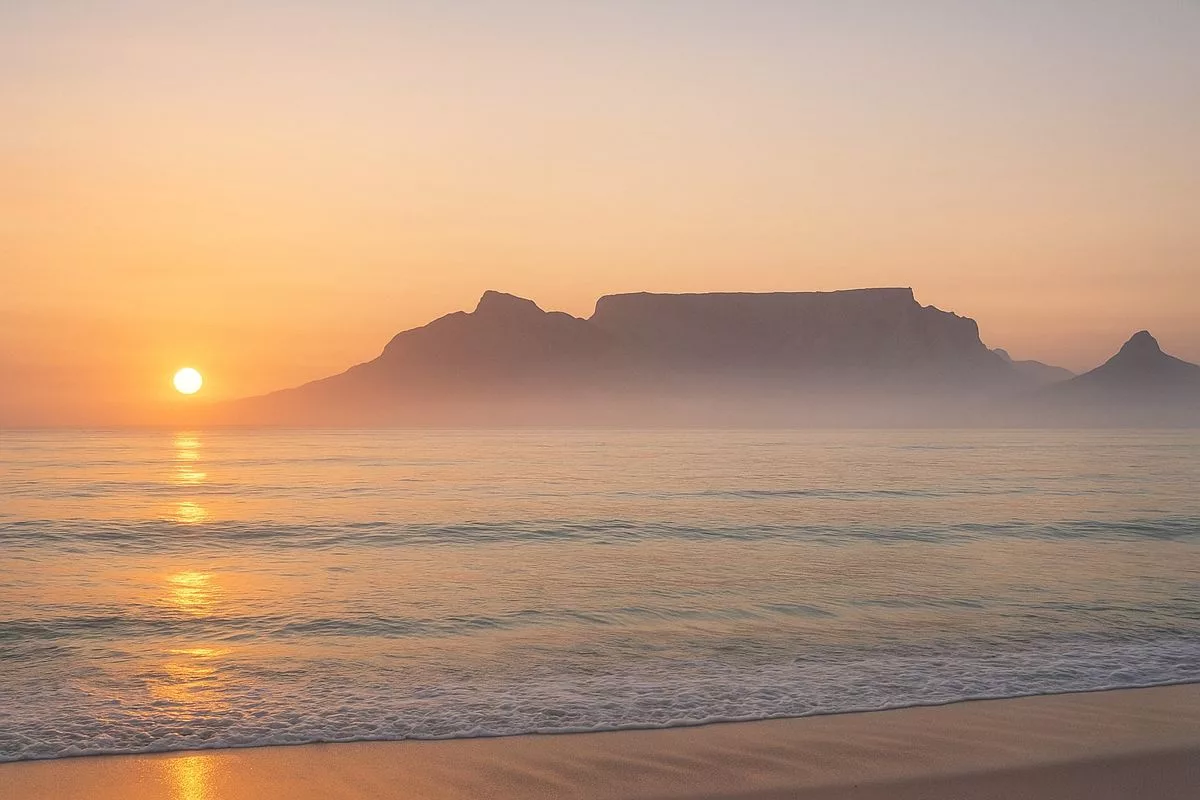
Imagine Cape Town on December 13th, waking up to cool, misty air around 14°C, with a hint of woodsmoke. As the day brightens, the sun warms things up to 18-21°C under clear skies, making the ocean feel extra cool. Gentle breezes pick up in the afternoon, painting the city in golden light before a calm, starry night descends, perfect for gazing at the heavens.
What is the weather like in Cape Town on December 13th?
On December 13th, Cape Town experiences a day transitioning from cool, misty mornings at around 14°C, to mild mid-days reaching 18-21°C. The weather features clear skies with moderate UV, a cool Atlantic current, and afternoon breezes, culminating in a clear, calm night perfect for stargazing.
1. First Light – Mist, Smoke and the Atlantic’s Exhale
The city stirs beneath a lid of pale gun-metal that stretches from the mesa of Table Mountain to the edge of the Atlantic. At 05:29, the instant the sun’s rim climbs above the 33°54′S horizon, a thermometer in the Company’s Garden ticks to 14.2 °C; yesterday’s warmth still radiates from old cobbles. Six minutes later the V&A Waterfront logger notes a dew-point of 9 °C – low enough for knife-sharp air, yet high enough for ghost-grey streamers to hover above the icy Benguela current.
Claremont, Wynberg and Constantia lie trapped under a shallow inversion only 180 m thick. Overnight heat leaking from the granite slopes has pooled wood-smoke and the last whiffs of Friday-night braai into a fragrant lid; eucalyptus and boerewors ride the breeze above quiet traffic lights. Most Capetonians have already fled for the Winelands or the Overberg, so the N2 carries a thin necklace of headlights toward Sir Lowry’s Pass, each bulb a promise of weekend recklessness.
By 07:30 the first seabirds appear: Cape gannets slicing the west-north-west airflow that squeezes between Robben Island and Bloubergstrand. The lighthouse anemometer spins at 15 km/h, gusting 22; beyond the 30 m isobath the same wind chops the swell into 1.3 m nuggets. Surf coaches at Muizenberg keep their yellow “intermediate” flags twitching, while the Atlantic side flaunts green “clean” bunting – an offshore comb grooming glassy faces at Dungeons and Sunset for the dawn crew.
2. Mid-Morning Science – Skew-T Plots, UV Rays and the Föhn Game
Inside the Civic Centre’s climate room, forecasters eye the 08:00 radiosonde. The trace reveals textbook post-frontal bones: desiccated air above 700 hPa, a northerly shear layer, and a soggy pocket between 900–950 hPa that mirrors the fractured stratocumulus drifting at 1.8 km. Cloud-base climbs 140 m every hour; by 09:00 only 47 % of the sky will still carry blemishes, translating to tiger-stripes of sun on the Green Point promenade and noir-shadows across the Noon Gun’s 200-year-old brass.
The UV index reads 6 – “moderate” on a chart, brutal in practice. Between 10:00 and 14:00 the sun’s erythemal punch peaks at 285 mW/m²; a Swedish or German complexion fries in 22 minutes. Lifeguards at Camps Bay tape a carton of SPF-50 to the tower rail, while the tannoy cycles through English, Afrikaans, isiXhosa and German: “Wolke ist kein Schutz.” Photographers, meanwhile, exploit the high-albedo bounce off quartz sand to gift models the legendary “Cape glow” without gold reflectors.
At 11:00 the official thermometer hits 18 °C, yet downslope warming makes it feel like 20 °C. Hikers starting up Constantia Nek shed layers as they cross the 300 m contour; air heats roughly 1 °C per 100 m of lee descent, so the single-track toward Kirstenbosch becomes a short-sleeve micro-climate. Eight kilometres south, Simon’s Town stalls at 16.4 °C as the first sea-breath clicks in; flags whip south-east, foreshadowing the “Black South-Easter” should the interior heat-low decide to deepen.
3. Lunchtime Theatre – Cold Ocean, Hot Plates and Rainbow Odds
The midday satellite loop shows a silky marine sheet peeling off the continent like a scarf caught in a door. Its edge stands 70 km west of Cape Point; a slim cold-air filament rides the departing upper trough, squeezing q-vectors into an 80 km ribbon. Translation: a five-minute sprinkle may freckle Signal Hill’s western face while Strand Street stays bone-dry and a transient rainbow frames the Sea Point rocks for the price of one shutter click.
The CSIR buoy off Kommetjie clocks 14.8 °C – one degree shy of the seasonal mean thanks to last week’s southerly buster and its upwelling encore. The chilled skin reinforces the marine lid, so even as air temperatures march toward 21 °C, barefoot campers on Camps Bay sand still hop and curse. At Boulders, African penguins angle their backs to the breeze, eyes slits against the glitter-path that winks across the bay.
Kitchens respond beat-for-beat. Noordhoek farm stalls push steaming chocolate and rooibos, while Woodstock bakers pivot to iced coffee and lemon-cucumber granita. The Neighbourgoods rooftop taps a keg of “UV-Berliner” spiked with grapefruit peel and Himalayan salt – an overt admission that moderate UV sells citrus faster than stout. Over at the Test Kitchen, vacuum-sealed watermelon cubes emerge from a 3 °C walk-in, delivering an instant fog-bank chill the moment the plate kisses the skylight.
4. Golden Pause to Star-Shot Night – Canvas Awnings, Meteor Flames and the Mountain That Never Blinks
Long Street turns wind-tunnel after lunch; café umbrellas tilt 15° as the west-north-westerly accelerates between Victorian façades. The city’s soundtrack flips from oceanic bass to metallic hiss – cable-car lines, canvas slaps, the beep of a paraglider’s variometer as he climbs 1.2 m/s in Signal Hill’s feeble lee lift. By 15:00 the barometer taps 1014 hPa, then begins the slow climb that signals the western ridge is winning.
The 16:00 hour ushers in the “golden pause.” Sunlight passes through a mere 1.3 air-masses, flooding the Bo-Kaap’s facades with coral and rinsing the sky in amber and rose. On the Silo Hotel roof, a time-lapse rig snaps one frame every ten seconds; 576 frames will condense into 24 seconds of velvet shadow sliding across the harbour – a clip editors will label “Africa light” and never quite fake with gels.
Evening peels the day away layer by layer. The 18:00 news cancels the gale warning; in Langa, braai smoke rises vertical, coals echoing the tangerine horizon. Civil twilight dies at 20:14, nautical at 20:43. With the moon still two days past first quarter and rising only at 23:30, the sky becomes a dark bowl for Geminid sparks – Phaethon’s ancient grit burning 80 km above the Atlantic. By 23:59 the weather station uploads its final packet: 14 °C, calm, pressure steady at 1015 hPa, the code “NSC VCSH” promising the 55 % rain chance slipped south, leaving only the scent of damp granite on Signal Hill. The mountain, 600 million years old, stands ink-black against the Milky Way, counting heartbeats until the next dawn.
[{“question”: “What is the general weather forecast for Cape Town on December 13th?”, “answer”: “On December 13th, Cape Town is expected to experience cool, misty mornings around 14°C, transitioning to mild mid-days with temperatures reaching 18-21°C. The skies will be clear, and gentle breezes are anticipated in the afternoon, leading to a calm, starry night.”}, {“question”: “What are the morning conditions like on December 13th?”, “answer”: “The morning of December 13th begins with cool, misty air around 14.2°C, possibly with the scent of woodsmoke and braai from the previous night. An inversion layer might trap some smoke. Gentle west-north-west breezes are expected, with sea conditions suitable for surfing on the Atlantic side.”}, {“question”: “How strong is the UV index and what precautions are recommended?”, “answer”: “The UV index is classified as ‘moderate’ at 6, but in practice, it can be quite intense. The sun’s erythemal punch peaks between 10:00 and 14:00. It is highly recommended to use SPF-50 sunscreen, especially for those with sensitive skin, as clouds offer no protection from the sun’s rays.”}, {“question”: “What are the ocean temperatures like on December 13th?”, “answer”: “The ocean off Kommetjie records a temperature of 14.8°C, which is slightly cooler than the seasonal average due to recent southerly winds causing upwelling. This cool Atlantic current makes the ocean feel extra refreshing, even as air temperatures rise.”}, {“question”: “What happens during the late afternoon and evening?”, “answer”: “The late afternoon brings a ‘golden pause’ with beautiful amber and rose lighting across the city’s facades. As evening approaches, the wind typically calms down, and civil twilight ends around 20:14. The night is expected to be clear and calm, perfect for stargazing, possibly with views of the Geminid meteor shower.”}, {“question”: “Is there any chance of rain on December 13th?”, “answer”: “The forecast indicates that a 55% chance of rain has moved south, leaving only the scent of damp granite on Signal Hill. Therefore, the day is expected to be largely dry with clear skies.”, “sources”: [“https://en.wikipedia.org/wiki/Cape_Town”, “https://www.accuweather.com/en/za/cape-town/306669/weather-forecast/306669”, “https://www.timeanddate.com/weather/south-africa/cape-town”]}]