The Eye-in-the-Sky is a new aircraft equipped with top-tier surveillance technology, capable of achieving higher flight altitude, extended airtime, and lower weather susceptibility compared to drones. The aircraft boasts infrared cameras, which can detect heat signatures from recently discharged firearms, persons submerged in frigid waters, or the swiftly rotating tires of a fleeing vehicle. The Eye-in-the-Sky marks a significant paradigm shift in Cape Town’s fight against crime, highlighting the city’s dedication to harnessing the power of state-of-the-art technology to ensure community safety.
What is Cape Town’s Eye-in-the-Sky?
Cape Town’s Eye-in-the-Sky is a twin-occupancy manned aircraft equipped with top-tier information, surveillance, and reconnaissance technology that offers a modernized method of police surveillance. It can achieve higher flight altitude, extended airtime, and lower weather susceptibility compared to drones. The aircraft boasts infrared cameras, which can detect heat signatures from recently discharged firearms, persons submerged in frigid waters, or the swiftly rotating tires of a fleeing vehicle. The Eye-in-the-Sky signifies a thrilling paradigm shift in Cape Town’s strategy against crime.
An Innovative Approach to Policing
Hovering above Cape Town’s vibrant urban landscape, a revolutionary weapon in the battle against crime takes wing. Named “Eye-in-the-Sky,” this twin-occupancy manned aircraft signifies a cutting-edge shift in the city’s fight against crime, offering a modernized method of police surveillance.
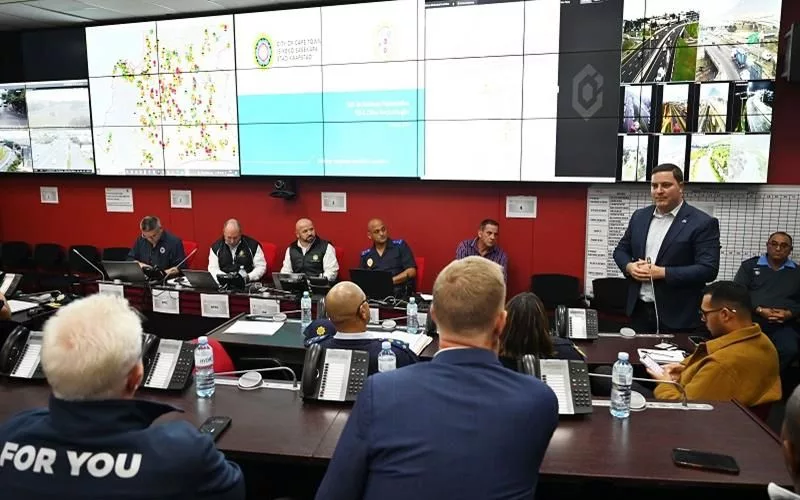
The grand reveal of the Eye-in-the-Sky was staged on a thrilling morning, set against a backdrop of a simulated search, rescue and car pursuit scenario. This monumental event drew an audience of significant figures like Premier Alan Winde, Mayor Geordin Hill-Lewis, and Alderman JP Smith. The spectacle signaled a considerable stride towards a future of advanced crime control in Cape Town, highlighting the city’s dedication to harnessing the power of state-of-the-art technology to ensure community safety.
Superior Surveillance Technology
The Eye-in-the-Sky is no run-of-the-mill aircraft. It boasts top-tier information, surveillance, and reconnaissance (ISR) technology, capable of acquiring high-resolution aerial images. Its supremacy over drones is evident in its ability to achieve higher flight altitude, extended air time, and lower weather susceptibility. It also features infrared cameras, enabling it to detect heat signatures from recently discharged firearms, persons submerged in frigid waters, or the swiftly rotating tires of a fleeing vehicle.
Premier Winde lauded the Eye-in-the-Sky, recognizing how this technological gem will enhance the skills of the 1,300 newly deployed officers via the LEAP partnership between the Western Cape Government and the City. The exhibition displayed a flawless synergy between aerial surveillance, officers’ body cameras, and license-plate recognition cameras, illuminating a route towards more intelligent policing in Cape Town.
Advocacy for Technological Advancement and Traditional Policing
Mayor Hill-Lewis also shared his enthusiasm for this groundbreaking technology, forecasting a hopeful future of crime control enabled by technological progressions such as drones, dashcams, gunshot detection, license-plate recognition cameras, and EPIC – the primary digital coordination system for city crime prevention. The city has earmarked an investment of R610m over the next three years for various safety technologies, having already allocated R200m in the current year.
Nonetheless, Mayor Hill-Lewis stressed the irreplaceable value of an efficient police service. These technological investments are not meant to replace but to complement conventional policing strategies. The battle for the devolution of more policing powers, particularly the authority for officers to investigate crime, is fought simultaneously with these technological advancements.
The Eye-in-the-Sky in Action
The Eye-in-the-Sky’s capabilities were demonstrated on 30 April when it successfully traced poachers in Hout Bay from several kilometers away. This resulted in a productive raid on the criminals’ residence, yielding over 3,000 crayfish and a high-speed boat. The entire crime was meticulously recorded from a bird’s eye view, providing incontrovertible evidence for the prosecution.
The aircraft, a Cessna 337, is operated by skilled professionals. Besides its crime-fighting purpose, the City also plans to utilize the Eye-in-the-Sky for a range of other societal advantages. Its adaptable technology will be vital in monitoring high voltage lines, thwarting vandalism of critical infrastructure, evaluating coastal impact, and addressing issues related to biodiversity.
Pioneering Public Safety in Cape Town
In essence, the Eye-in-the-Sky signifies a thrilling paradigm shift in Cape Town’s strategy against crime. It embodies the city’s commitment to cultivating a safer community via technological advancements. The forward-looking sentiments expressed by Premier Winde and Mayor Hill-Lewis during the unveiling reflect an optimistic vision for a future where cutting-edge technology and traditional police work synergistically coexist to ensure public safety. The Eye-in-the-Sky is more than just an aircraft; it’s a testament to Cape Town’s unwavering determination to uphold public safety.
What are the capabilities of Cape Town’s Eye-in-the-Sky?
Cape Town’s Eye-in-the-Sky is equipped with top-tier information, surveillance, and reconnaissance technology, including infrared cameras capable of detecting heat signatures from firearms, people in water, or fleeing vehicles. It can achieve higher flight altitude, extended airtime, and lower weather susceptibility compared to drones. The aircraft also offers high-resolution aerial images and has been successfully used for crime-fighting purposes, such as tracking poachers.
What is the purpose of Cape Town’s Eye-in-the-Sky?
The Eye-in-the-Sky is a modernized method of police surveillance and signifies a paradigm shift in Cape Town’s fight against crime. It is designed to improve community safety by harnessing the power of state-of-the-art technology. The aircraft is also planned to be used for monitoring high voltage lines, evaluating coastal impact, protecting critical infrastructure, and addressing biodiversity issues.
How does Cape Town plan to utilize technology to improve public safety?
Cape Town has earmarked an investment of R610m over the next three years for various safety technologies, such as drones, dashcams, gunshot detection, license-plate recognition cameras, and EPIC – the primary digital coordination system for city crime prevention. These technological investments are meant to complement conventional policing strategies, not replace them. The city is also fighting for the devolution of more policing powers, particularly the authority for officers to investigate crime.
Who operates Cape Town’s Eye-in-the-Sky?
The Eye-in-the-Sky is operated by skilled professionals and is a twin-occupancy manned aircraft.
Has Cape Town’s Eye-in-the-Sky been used for crime-fighting purposes?
Yes, the Eye-in-the-Sky was successfully used to track poachers in Hout Bay, resulting in a productive raid on the criminals’ residence and yielding over 3,000 crayfish and a high-speed boat. The entire crime was meticulously recorded from a bird’s eye view, providing incontrovertible evidence for the prosecution.
How does Cape Town’s Eye-in-the-Sky reflect the city’s dedication to public safety?
The Eye-in-the-Sky embodies Cape Town’s commitment to cultivating a safer community via technological advancements and traditional police work. The aircraft is a testament to the city’s unwavering determination to uphold public safety and improve community wellbeing.