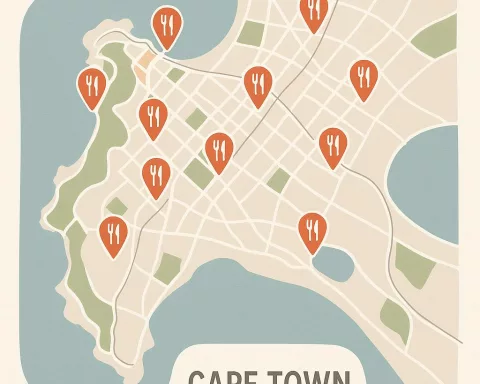

Cape Town’s housing woes are NOT really Airbnb’s fault, even though a viral photo tried to blame them! The real problem is that not enough homes are being built, and lots of new people are moving to the city. Getting building permits takes forever, making homes expensive. Airbnb brings in lots of money and jobs, and even if all Airbnbs disappeared, it wouldn’t fix the big housing shortage. The city needs to build more homes and make it easier to do so, not just point fingers at tourists.
What is causing Cape Town’s housing crunch?
Cape Town’s housing crunch is primarily due to a decade-long construction slump and rapid population growth, with new residents far outstripping new housing units. Bureaucratic delays, taking up to 11 years for project approvals, and financial barriers for developers exacerbate the problem, rather than short-term Airbnb rentals which constitute less than 1% of the city’s housing stock.
1. One Viral Photo, a Million Angry Clicks
A February-2024 drone shot lit up X (formerly Twitter) before it hit Parliament. The picture: three Sea Point apartment blocks at 10 p.m.; only seven black windows. The caption screamed that short-stay platforms had “killed” the neighbourhood. Within two days the image had 1.4 million views and was waved in the National Assembly as proof that Airbnb had hollowed out the city.
Council records tell a different story. The same three blocks contain 84 separate owners, two-thirds of whom are on the local voters’ roll. The units are neither empty nor foreign-owned shells; they are simply rented to visitors instead of long-term tenants. Yet the post was potent precisely because it distilled a wider feeling: visceral, camera-ready and data-light.
The episode set the tone for 2024 policy hearings. Moral panic, not spreadsheets, dominated the room.
2. The Maths: What Happens If Every Airbnb Vanishes Tomorrow?
Cape Town’s formal housing stock is roughly 818 000 dwellings. In 2023 a total of 7 330 entire-place listings earned at least one paid night on Airbnb, a slice equal to 0.9 % of the city’s housing pie.
If, by decree, every one of those flats reverted to normal lease tomorrow, the metro’s vacancy rate would rise from 0.9 % to about 1.8 % – still under the 3 % threshold planners regard as “balanced.” Add spare-room listings (granny flats, spare bedrooms) and the tourist pool climbs to 1.4 % of dwellings, but those rooms were never vacant in the first place; they sit inside already-occupied homes.
In short, even the nuclear option – total ban – would not move the needle on availability.
3. Demand Is Growing Three Times Faster Than Supply
Between 2020 and 2023 Cape Town added an estimated 280 000 new residents – equal to the population of Polokwane – driven by Eskom-black-out refugees from Gauteng, European remote workers and Eastern-Cape job hunters. At the national household-formation ratio of 3.4 people per dwelling, the city needed 82 000 extra units just to stand still. Barely 27 000 were completed.
Blaming tourists is convenient; acknowledging a decade-long construction slump is less so.
4. Tourist Money Keeps the Lights On – Literally
Visitors booked through short-stay platforms pumped R 14.4 billion into the metro in 2023, according to municipal economic modelling. Applying the provincial Treasury’s 1.67 multiplier, that becomes R 24 billion of GDP – bigger than Cape Town’s annual capital budget for water, roads, drains and solid waste combined. The same spend chain supports roughly 49 000 informal and formal jobs, from cleaners to Uber drivers.
As analyst Renier Kriek notes, “If you delete the platform supply, the visitor doesn’t evaporate – he books a hotel in Sandton or Lisbon.”
5. The Red-Tape Conveyor Belt: 54 Steps, 11 Years, One Front Door
Inside the planning department hangs an A3 flow-chart nick-named the “Snakes & Ladders Board.” A greenfield project must clear 54 statutory gates – environmental scoping, heritage appeals, engineering sign-offs, re-zoning, re-submission loops – before a title deed issues. Median elapsed time: 11 years. Fastest on record: seven years (a city-owned infill site). Slowest: 18 years (a privately owned, heritage-flagged plot in Bo-Kaap).
Every extra year adds roughly 9 % to the final unit cost in carrying charges, inflation and consultant rewrites. Those digits eventually show up in higher purchase prices and rents – costs that have nothing to do with Airbnb and everything to do with bureaucratic sprawl.
6. “Just Tax Them Like Hotels” Sounds Clever – Until You Read the Fine Print
Treasury officials periodically suggest shifting short-stay flats onto “commercial” rates, quadrupling the municipal account of a R 2.5 million apartment. What the talking points skip is that commercial ratepayers may depreciate buildings at 5 % straight-line and reclaim 15 % VAT – benefits unavailable to ordinary homeowners.
Many sectional-title schemes already sit on Residential-zone 3 tariffs, so by-law definitions would first have to be rewritten. A four-fold jump on a modest two-bedroom flat (currently ± R 1 400 a month in rates) lifts carrying cost to R 5 600. Evidence from Sydney and Barcelona shows that when net rental yields fall below 3 %, owners simply withdraw stock and leave units vacant, chasing capital gain instead of rent – shrinking, not expanding, supply.
7. Micro-Developers Hold the Keys – If the State Would Get Out of the Way
National schemes such as FLISP (the Finance-Linked Individual Subsidy Programme) and the City’s Land Release Strategy share one blind spot: they equate “developer” with JSE-listed giants. In Cape Town’s townships the real builders are stokvels, brick-layer co-ops and grandmothers who pool five-to-fifteen-unit plots. They cannot wait 11 years.
Urban economist Tauhira Ajam recommends a one-stop statutory room where environmental, cadastral and engineering sign-offs are collapsed into a 90-day window for projects under R 10 million. Town-planner Roché van Wyk piloted exactly that in Kraaifontein: 42 units moved from raw land to roof height in 14 months by compressing approvals to eight steps. The file now gathers dust on the MEC’s desk; no legislative reform has followed.
8. Data We Already Have – and Data We Refuse to Collect
- Bedroom stock: Stats SA counts “dwellings,” not rooms. A 2022 CSIR aerial-laser trial estimates Cape Town holds an extra 90 000 habitable rooms inside existing houses – enough space for 225 000 people if retro-fitted.
- Dark-night vacancies: The Deeds Registry lists owners, not occupants. A UCT spatial-scan project will soon overlay night-light satellite data, Wi-Fi packet density and utility consumption to flag long-term empties – crucial before any “empty-home tax” can be designed.
- Business vs. leisure: Roughly 38 % of Airbnb room-nights in 2023 came from domestic consultants and film crews on 21-plus-night stays, a segment poorly served by hotels because corporate travel policies cap nightly spend below R 1 200. Killing short-stay supply merely exports those budgets to Gauteng or Dubai.
9. International Leakage: Where Tourist Cash Actually Goes
Barcelona’s 2018 clamp-down removed 5 000 short-stay units overnight; hotel average daily rate leapt 23 % the next summer, while overnight visitor numbers dropped 7 %. A 2021 Universitat Autònoma study found “no statistically significant effect” on long-term rents. Berlin’s 2016 “misuse ban” pushed investors back into conventional hotels, again with zero measurable moderation in local rents. The lesson: visitor demand follows city brand equity, not platform rules.
10. Granny Flats, Garage Rooms and the 45 000-Unit Grey Zone
Municipal by-laws distinguish “home-sharing” (owner on site) from “home-letting” (owner away), but say nothing about the backyard cottage that taps the main house’s water meter yet carries its own Dwelling Unit Number. City officials estimate 45 000 such flats exist – twice the entire Airbnb stock. Squeeze the formal short-stay market and tourists will simply migrate into these unregulated structures, the very outcome housing activists claim they want to prevent.
11. Finance: The Elephant Charging 12 % Interest
Even if every approval were granted tomorrow, a 50 m² Breaking New Ground house costs R 300 000 all-in (construction plus bulk-infrastructure levy). A household earning the city median of R 6 400 a month qualifies for a R 190 000 FLISP subsidy, leaving a R 110 000 mortgage gap. At today’s prime-plus-2 %, monthly repayments on that gap equal R 1 450 – 24 % of gross pay, above the 20 % prudential ceiling. The affordability crisis is therefore not only a supply drought but a financing canyon.
12. The Density Paradox – and the NIMBY Wall
Cape Town averages 1 900 residents per km², half that of Johannesburg and one-fifth of Durban’s core. The 2018 Spatial Planning Land Use Management Act amendment allows 12 storeys along “transit-intensive routes,” yet 78 % of such applications are appealed by neighbourhood associations within 30 days. Airbnb’s 0.9 % slice pales beside the 40 % of well-located land locked into single-storey legacy zoning.
13. Two Price Charts Tell the Real Story
Long-term asking rents climbed 8.4 % in 2023; the replacement cost of new housing rose 11 %. When construction inflation outruns rental inflation for seven straight years, developers down tools and future supply stalls. Today’s rent pain is the echo of that building hiatus, not of tourists snapping up flats.
14. A Registers-Only Reform Everyone Already Agrees On
Airbnb’s public-policy team will back a Lisbon-style host licence provided it is one municipal fee, turns around in 48 hours, respects body-corporate rules, and is not retroactive. City officials privately warn that council’s SAP backbone dates to 2003; any digital portal will have to be built manually and will probably crash during the first summer registration rush. Still, both sides prefer a register to a ban – if only the IT budget can be found.
15. Political Economy: Who Really Benefits from the “Airbnb Villain” Narrative?
Hotel groups hold 31 % of the Western Cape tourism board’s voting seats and channel R 1.2 billion a year in marketing and events spend. Airbnb, by contrast, routes promotion cash straight to hosts via Google-ad vouchers, sidestepping bureaucratic turf. Painting short-stay rentals as the bad guy therefore suits incumbents who would rather not compete on price or convenience.
16. Policy Levers that Match the Scale of the Problem
a) By-right zoning for “incremental infill” up to 30 units on any stand ≥ 900 m² within 1 km of a MyCiTi trunk station.
b) Deemed-consent rule: if no formal objection is lodged within 60 days, planning permission is automatic.
c) City-backed gap-finance facility that secures mortgages at 4 % for households earning R 5 000–R 15 000, funded by a 0.25 % levy on luxury hotel stays – letting tourism cross-subsidise affordable stock rather than cannibalise it.
d) Voluntary host-to-long-term-lease portal: Airbnb landlords who sign a 12-month unfurnished lease at 10 % below median Trepp-index rent receive a three-year 25 % rates rebate. Atlanta and Vienna have netted 2 000–3 000 units each without a single eviction.
17. 2030 Baseline: What Happens If Nothing Changes?
If approval timelines stay put, the housing backlog will exceed 400 000 units by 2030. Even if Airbnb dedicated stock compounds at 15 % a year, it will reach just 17 000 units – still under 2 % of the formal pie. Eliminating every tourist flat would therefore leave the city staring at a backlog six-lanes wide.
18. The Bottom Line – According to Citizens, Not Headlines
A 2023 Afrobarometer micro-poll asked 2 100 Cape Town residents to rank their “top three housing fixes.”
– 71 % chose “faster subsidy-house delivery.”
– 54 % chose “cheaper home loans.”
– Only 14 % picked “restrict Airbnb.”
The message is blunt: fix the pipe, don’t blame the tap.
[{“question”: “What is the primary cause of Cape Town’s housing crunch?”, “answer”: “Cape Town’s housing crunch is primarily caused by a significant construction slump over the past decade and rapid population growth. The city has seen an influx of new residents far outstripping the number of new housing units being built. Bureaucratic delays in obtaining building permits, which can take up to 11 years, and financial barriers for developers also exacerbate the problem, making homes expensive.”}, {“question”: “How significant is Airbnb’s impact on Cape Town’s housing shortage?”, “answer”: “Airbnb’s impact on Cape Town’s housing shortage is minimal. Data shows that short-term Airbnb rentals constitute less than 1% of the city’s formal housing stock. Even if all Airbnb units were to disappear and revert to long-term leases, the city’s vacancy rate would only increase marginally, from 0.9% to about 1.8%, which is still below the 3% threshold considered ‘balanced’ by urban planners. The housing shortage is a systemic issue related to supply and demand, not short-term rentals.”}, {“question”: “What is the economic contribution of tourism via short-stay platforms in Cape Town?”, “answer”: “Visitors booking through short-stay platforms like Airbnb injected R 14.4 billion into Cape Town’s economy in 2023. With a multiplier effect, this translates to an estimated R 24 billion of GDP, which is more than the city’s annual capital budget for essential services like water, roads, and waste management combined. This economic activity supports approximately 49,000 informal and formal jobs, ranging from cleaners to Uber drivers.”}, {“question”: “What are the main challenges in building new homes in Cape Town?”, “answer”: “The primary challenges in building new homes in Cape Town involve extensive bureaucratic hurdles and lengthy approval processes. A greenfield project can face up to 54 statutory gates, leading to a median approval time of 11 years. Each additional year of delay adds roughly 9% to the final unit cost due to carrying charges, inflation, and consultant fees. This red tape significantly increases housing prices and rents, independent of Airbnb’s presence.”}, {“question”: “Would taxing Airbnb like hotels solve the housing crisis?”, “answer”: “Simply taxing short-stay flats at ‘commercial rates’ like hotels is not a straightforward solution and could be counterproductive. While it might quadruple municipal accounts for owners, commercial ratepayers also receive tax benefits like depreciation and VAT reclamation, which are not available to ordinary homeowners. Evidence from cities like Sydney and Barcelona shows that when net rental yields fall too low, owners often withdraw their properties from the rental market and leave them vacant, chasing capital gains instead of rent. This would shrink, rather than expand, housing supply.”}, {“question”: “What are more effective policy levers to address Cape Town’s housing crisis?”, “answer”: “More effective policy levers would involve addressing the root causes of the supply shortage. These include implementing ‘by-right zoning’ for incremental infill projects to increase density, introducing ‘deemed-consent rules’ for planning permission if no objections are lodged within a specified period, and creating city-backed gap-finance facilities for affordable mortgages. Additionally, establishing voluntary ‘host-to-long-term-lease portals’ with incentives like rates rebates could encourage landlords to switch from short-term to long-term rentals without forced evictions. Streamlining the approval process for micro-developers is also crucial.”}]