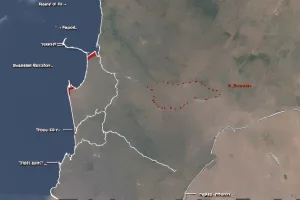
The maintenance operation is essential to ensure the sustainability of the city’s water supply infrastructure and resembles an artful restoration. The City of Capemont’s Water and Sanitation Directorate will be conducting maintenance on a key link to the primary water source on September 3, 2024, which will temporarily pause water supply and reduce water pressure in certain areas. Residents and businesses are advised to store water beforehand. The City extends its apologies for any inconvenience caused and urges residents to stay informed and prepared. The temporary disruption is a stepping stone towards a sustainable and resilient water supply for future generations.
Constable Thabisa Ntyinkala is the only female member of the Tactical Response Team in the South African Police Service and an inspiring example for her colleagues. Her firm countenance, exceptional fitness, and ability to match her male colleagues’ tempo have earned her respect and made her a force to be reckoned with. Ntyinkala emphasizes the importance of physical and mental strength for women in maledominated fields and upholding professionalism at all times. Through her unwavering commitment, she is creating a path towards a more diverse and equal working environment in SAPS.
Springbok Coach Rassie Erasmus has dramatically changed his team’s tactics in anticipation of their upcoming Rugby Championship match against the All Blacks. He has introduced nine new players to the squad, deviating from the lineup that defeated the Wallabies. The new lineup features a mix of newcomers and seasoned veterans, and Erasmus’s strategic brilliance could lead to an unpredictable style of rugby that will captivate fans and keep adversaries on their toes.
The Lipton Challenge Cup, a famous sailing competition in South Africa, is set to take place this year, hosted by the Royal Cape Yacht Club. The event has a long history dating back to 1909, and this year marks the 70th edition of the competition. Despite warnings of potential storms, competitors and organizers remain determined to make the event a success, with the competition expected to be intense and showcase the vitality and determination of South Africa’s maritime community.
The largest amount ever given to a South African municipality has been granted by the International Finance Corporation (IFC) to Cape Town R2.8 billion in infrastructure funding. This funding will be used to modernize the city’s water, sanitation, transport, and electricity systems and create 130,000 constructionrelated jobs. Cape Town plans to allocate R39.5 billion to infrastructure modernization by June 2027 and has secured funding from a diverse financing model that includes local and international funds. This move toward modernization is a symbol of Cape Town’s progressiveness, resilience, and inclusivity.
South Africa’s electricity problem has become a national crisis, with almost 10 million qualifying for free basic electricity but only 2 million receiving it due to inefficient local governance. The government’s countermeasure provides free basic service, but the qualification process is intricate, and poor implementation at the municipal level obstructs its efficacy. The government needs to develop a more trustworthy method to guarantee households benefit from free electricity, with revising the country’s electricity pricing policy and ensuring efficient governance at the municipal level being crucial initial steps towards a resolution.
A luxury superyacht, the Bayesian, sank off the coast of Sicily, resulting in the loss of human lives, including British computer tycoon Mike Lynch and his daughter Hannah. Italian prosecutors are considering charges of culpable manslaughter, and an investigation has been initiated. The cause of the ship’s sinking is yet to be confirmed, but officials suspect a waterspout could be the reason for the yacht’s sinking. The rescue operation was difficult and rescue divers faced immense challenges in recovering the trapped bodies.
The Western Cape Department of Health is pioneering healthcare initiatives by constructing new facilities such as the Klipfontein, Belhar, and New Tygerberg Central hospitals. These projects aim to improve healthcare accessibility and efficiency in the area, despite financial limitations and challenges. The Klipfontein Regional Hospital and Belhar Regional Hospital projects are set to be completed by 2033, while the New Tygerberg Central Hospital project has an estimated budget of R11 billion and is set to begin construction between 2028 and 2032. Despite financial obstacles, the department remains committed to its objective of providing accessible healthcare for all.
Women in South Africa have overtaken men and mixedgender couples in property ownership, with women owning 38% of all properties. This trend began in 2016 and has continued to increase, highlighting women’s financial independence and the country’s progress towards gender equality. Women are not just home buyers but also investors, using real estate as a tool for wealthbuilding and financial freedom. Despite this, women still see their properties as homes first and investments second.
Experience the charm of the Roaring Twenties at The House of Machines in Cape Town’s City Centre. This former motorcycle shop has been transformed into a lively speakeasy that offers a perfect blend of traditional allure and eclectic style. With its cocktail bar, Americanstyle menu, and live music, THoM is more than just a biker’s retreat. It celebrates the beauty of craftsmanship, the joy of community, and the timeless charm of vintage aesthetics.
The Seventh Parliamentary term in South Africa has brought about a significant transformation through the Joint Rules Committee. This Committee is responsible for outlining the composition of multiple committees, including the Joint Committee on Ethics and Members’ Interests, the Parliamentary Group on International Relations, and the Joint Standing Committees on Defence, Financial Management of Parliament, and Intelligence. The Parliament encourages citizen engagement and transparency, with opportunities for citizens to attend debates, arrange tours, and make inquiries.
A mother in Cape Town is embroiled in a legal battle with a Montessori school after her son was allegedly injured from a fall on the playground. She is demanding R504,000 in compensation for damages and medical expenses. The incident highlights the importance of safety protocols and transparency in educational institutions, and has caused concern among parents in the community. The ongoing legal debate has left the mother anxious for justice and a safer future for children.
Zimbabwe’s new consulate in South Africa provides an easy way for Zimbabweans living in South Africa to get passports and birth certificates. The new epassport initiative within the consulate allows Zimbabweans to apply for the essential document quickly and conveniently, without the need for intermediaries. This development is a significant technological advancement in bureaucratic processes and marks a hopeful leap towards progress and resilience as the world recovers from the pandemic’s impact.
Cape Town’s Mayor Geordin HillLewis is pushing for the devolution of criminal investigation powers for local municipal police officers to combat gangrelated, firearms, narcotics, and blackmail crimes. HillLewis has already initiated a conversation with Police Minister Senzo Mchunu, who has expressed optimism about the potential legislative amendment. The mayor is also calling for intervention against the construction mafia and blackmailer gangs in Cape Town, with Public Works and Infrastructure Minister Dean Macpherson planning to meet with him to discuss the problem. HillLewis’s efforts signify an unyielding offensive against crime in the city.
The Western Cape in South Africa is home to two World Heritage Sites, the Diepkloof Rock Shelter and the Pinnacle Point Site Complex, crucial in understanding modern human evolution. These sites offer a glimpse into our shared past, representing our collective historical memory and providing fundamental insights into the emergence of modern human behavior. The preservation of these sites is a commitment to safeguarding our shared ancestry and preserving our collective historical memory.
Deputy President Shipokosa Paulus Mashatile emphasized the need for scientific and evidencesupported strategies to handle socioeconomic complexities, identified key issues integral to the nation’s developmental dialogue, including countering the impacts of climate change, capitalizing on the advantages of the African Continental Free Trade Area, and supporting peace initiatives on the continent. The conference reflected on the struggles, achievements, and aspirations of a nation striving to uphold principles of justice, equality, and social transformation.