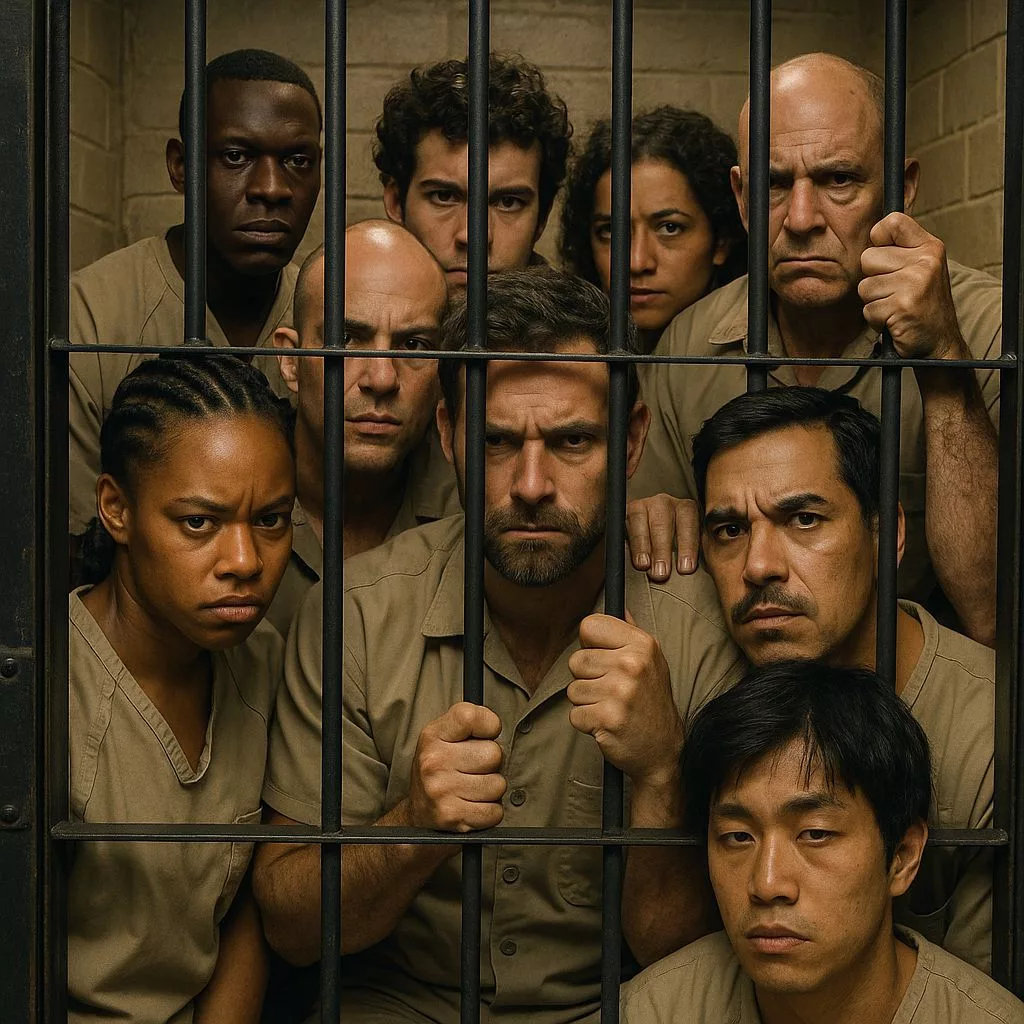
South African prisons are bursting at the seams, holding double the number of people they were built for! Thousands of foreign inmates are stuck, making things even worse because sending them home is super slow. This dangerous overcrowding causes sickness and makes crime even more organized inside. The system is like a ticking time bomb, needing quick changes to stop it from exploding.
Why are South African prisons severely overcrowded?
South African prisons are severely overcrowded due to a combination of factors, including a head-count that has outgrown the original blueprint, a significant population of foreign inmates awaiting complex deportation processes, slow legal processes like Section 63A petitions, and a lack of effective alternative sentencing measures such as ankle bracelets. This leads to a prison system operating at 200% capacity.
Section 1 – A Head-Count That Outgrew the Blueprint
On a sticky April morning in 2025 the turnstiles locked behind 165 417 bodies.
The architect’s drawings said 118 572.
The overflow alone – 46 845 – is a city the size of Paarl, except every resident sleeps on cardboard, head-to-toe, breathing the same lungful of air every four minutes.
Pollsmoor Remand, licensed for 1 619 awaiting-trial prisoners, clocked 4 302 at 06:00 roll-call.
Sun City, the continent’s largest single complex, squeezes 7 842 men into clinics built for six wards.
In Mthatha’s Medium B, 714 inmates share showers designed for 208; UCT tracer bugs prove a single cough of XDR-TB reaches the last bunk within two days.
Section 2 – The Foreign Cohort Nobody Wants on Paper
Correctional Services Minister Pieter Groenewald told parliament the foreign tally is 27 033 – one in every six sentenced prisoners.
Gauteng hosts 22 % of them, Limpopo 31 %, Mpumalanga 28 %.
Drug offences dominate: 38 % were couriering tik or heroin; the rest drift between border fraud, common robbery and counterfeit papers.
Keeping them costs R463 a day each – R4.3 million every 24 hours before a single magistrate glimpses the docket.
Annual bill: R1.57 billion, enough to run 4 000 rural clinics, while extradition or deportation crawls for half a decade.
Section 3 – Why “Just Send Them Home” Hits a Wall of Forms
Three legal tracks exist, all lined with triplicate:
– Multilateral – the 2004 SADC Protocol waits for ten more states to ratify the prisoner-swap clause.
– Bilateral – active with Zimbabwe (2019), Namibia (2021), Mozambique (2022), yet each transfer still needs capital-verified citizenship, translated sentencing records, victim-compensation proof and a DIRCO note that the move “will not embarrass Pretoria”.
– Ad-hoc – 14 charters since 2020, averaging 18 months and R87 000 in escorts, medical clearances and leased aircraft.
Home-affairs databases last saw a full update in 2014, so proving someone is Malawian, not Zambian, can consume two seasons.
Section 4 – Section 63A: The Safety-Valve That Creaks Open One Day a Week
The 2021 amendment lets a prison boss ask for bail-slashing or release when an untried prisoner has already served half the probable sentence, cannot afford the amount, committed a non-violent crime and poses no public danger.
January–March 2025 produced 2 533 petitions; 397 walked out.
April court returns show 2 884 fresh applications; 606 granted.
Success rate: 21 % – double last year, yet still leaves four in five clogging the drain.
Magistrates whisper the quiet part: foreign addresses supplied by Home Affairs are often a dusty post-office box in Beitbridge – granting bail feels like signing a deportation order the accused will simply outrun.
Section 5 – When the Air Itself Turns Pathological
Overcrowding is no longer discomfort; it is a disease vector.
National prisoner TB incidence hit 7 200 per 100 000 in 2024 – eighteen times the rate outside the fence.
Pollsmoor’s hospital ward, drawn for 42, now treats 117; oxygen concentrators ping alarms every few minutes as power trips.
Desmond Tutu researchers calculate one undetected remandee infects 8.6 cellmates before isolation – a reproductive ratio higher than measles in a crèche.
Section 6 – The Invisible Bazaar Behind the Bars
The state allocates R9.20 a day to feed a mouth.
Inside, a loose cigarette retails for R5, a thimble of fruit-brew “booster” for R7, two minutes on a smuggled charger for R2.
Gang taxes skim every transaction; Institute for Security Studies estimates the 28s, 26s and 27s netted R52 million in Pollsmoor alone last year.
Where legitimate calories end, extortion begins – and the taxpayer still foots the R463 daily bill.
Section 7 – Women and Babies Pay Compound Interest
Female remand stands at 143 % occupancy, but the headline hides toddlers.
Pollsmoor Female permits 40 mothers; it currently holds 62 infants under two on 30 g of protein a day – WHO says minimum is 18 g twice that.
UCT paediatrics record 34 % stunting among these “innocent lifers” whose only crime is geography.
Section 8 – Ankle Bracelets and the Pilot That Ran Out of Straps
Treasury bought 5 000 GPS bracelets in 2022; eighteen months later 1 142 blink on legs.
Each gadget needs a magistrate’s bail variation, a plug point, and R450 airtime – rural Eastern Cape averages four black-outs a day.
Officers drive more kilometres to collect flat devices than to chase breaches.
Section 9 – The Neighbours’ Empty Beds Nobody Can Swap
Botswana’s Serowe prison floats 38 % vacancy; Zambia’s Mukobeko has 716 spare bunks after 2024 sentence-cutting reforms.
Their offer: we take our nationals if you absorb some of your remandees.
Constitutional lawyers wave Section 35(3)(d) – every accused has the right to be tried “in a South African court” – and election-season banners warn voters not to “export crime”.
The swap stalls, the cells swell.
Section 10 – The Emergency Bail Marathon That Freed 418 in One Weekend
Chief Justice Mandisa Maya commandeered airport hangars outside four prisons for 48 hours in May 2025.
Sixty-five magistrates, 35 prosecutors, 120 legal-aid lawyers finalised 1 200 Section 63A files.
By Sunday night 418 detainees boarded minivans clutching taxi vouchers and court slips for 2026.
Kokstad Remand dropped overnight from 198 % to 173 % – theatre to critics, breathing space to the night shift.
Section 11 – Tech Shortcuts That Fit a Wallet, Not a Budget
- 134 645# USSD bail deposits cut average release from 14 days to 36 hours – Legal Aid SA pilot.
- Biometric remand cards slice roll-call 11 minutes per courtroom, clawing back a full session day each month.
- Court-in-a-Box shipping container with satellite link let 18 % more foreign witnesses testify by video in Musina, slashing postponements.
All work; none scale without data bundles Treasury won’t fund.
Section 12 – Modular Steel Cells: The Fantasy That Costs Less
An 1 800-bed brick project approved in 2017 is still trenches and rebar.
Engineers now pitch Lego-style steel pods – 300 beds craned into place in six weeks, solar geysers included.
Private consortiums want R390 per inmate per day – cheaper than the current R463 – but lock the state into 25-year “prison mortgages” opposition parties call predatory.
Section 13 – Voices From the Human Pipeline
- Malawian fisherman, 2 kg rock-lobster tails, R5 000 bail, 29 months inside, taxpayer bill R402 000 and counting.
- 19-year-old Zimbabwean, borrowed ID for a hospitality job, R2 000 bail, still waiting 11 months after cousin refused to testify.
- Grandmother, 180 km monthly trip to Klerksdorp, 14 trial postponements since 2021, takeaway parcel in a pink plastic bag.
Stories statistics cannot sweat out.
Section 14 – The Forecast If the Tap Stays Open but the Drain Blocks
CSIR modellers feed murder graphs, arrest ratios, glacial trial pace into a Monte Carlo engine:
– Prison population crosses 200 000 by November 2026.
– 73 % of centres breach WHO “extreme overcrowding” (150 %).
– Probability of coordinated national prison unrest before 2027: 35 %.
The software does not model broken hearts.
Section 15 – Bills Already on the Clerk’s Table, Waiting for Politics
- Criminal Procedure Amendment B31-2024: presumption of non-custody for first-time non-violent offences.
- Foreign Prisoner Repatriation B18-2025: ministerial transfer order once an MoU exists.
- Court Modernisation B42-2025: 90-day statutory remand cap, electronic case file, virtual hearings.
Committee timetable earliest promulgation: Q2 2026 – after the elections, after the pitch has swallowed 6 000 more bodies.
Section 16 – A Single Chart That Is Worth 900 Words
Picture a soccer field, goals removed.
Pack 6 000 standing adults shoulder-to-shoulder.
Each dawn the referee admits another 250; each dusk only 210 leave.
The grass vanishes, the whistle never blows, and the game is played against a clock no one can reset.
Why are South African prisons severely overcrowded?
South African prisons are severely overcrowded due to a combination of factors, including a head-count that has outgrown the original blueprint, a significant population of foreign inmates awaiting complex deportation processes, slow legal processes like Section 63A petitions, and a lack of effective alternative sentencing measures such as ankle bracelets. This leads to a prison system operating at 200% capacity, meaning they hold double the number of people they were designed for.
How many foreign inmates are currently in South African prisons and what is the cost associated with them?
There are currently 27,033 foreign inmates in South African prisons, making up one in every six sentenced prisoners. Keeping these foreign inmates costs approximately R463 per day per inmate, totaling R4.3 million every 24 hours, or an annual bill of R1.57 billion. This significant expenditure could otherwise fund around 4,000 rural clinics.
What makes it difficult to deport foreign inmates from South Africa?
Deporting foreign inmates is a slow and complex process due to several legal and administrative hurdles. There are multilateral agreements (like the SADC Protocol, which requires more ratifications), bilateral agreements (active with Zimbabwe, Namibia, and Mozambique but still requiring extensive documentation and verification), and ad-hoc transfers (which are costly and time-consuming, averaging 18 months and R87,000 per transfer). Outdated Home Affairs databases also make verifying citizenship challenging, sometimes taking two seasons to confirm a prisoner’s country of origin.
What are the health risks associated with prison overcrowding in South Africa?
Prison overcrowding in South Africa is a significant disease vector. The national prisoner TB incidence rate hit 7,200 per 100,000 in 2024, which is eighteen times higher than outside the prison walls. Overcrowded conditions, such as 714 inmates sharing showers designed for 208, facilitate rapid disease transmission. Research indicates that one undetected remandee can infect 8.6 cellmates before isolation, highlighting the severe public health crisis within these facilities.
What is Section 63A and how effective is it in addressing overcrowding?
Section 63A is a 2021 amendment that allows a prison boss to request bail reduction or release for untried prisoners who have served half their probable sentence, cannot afford bail, committed a non-violent crime, and pose no public danger. While the success rate for petitions granted has doubled to 21% (e.g., 606 out of 2,884 applications granted in April), it still leaves four out of five applicants clogging the system. Magistrates are often hesitant to grant bail if foreign addresses are unreliable, fearing the accused will abscond.
What solutions are being considered or piloted to alleviate prison overcrowding?
Several solutions are being considered or piloted, including parliamentary bills for presumption of non-custody for first-time non-violent offenses, ministerial transfer orders for foreign prisoners, and modernization of court processes (e.g., 90-day remand caps, electronic case files). Technological shortcuts like USSD bail deposits and biometric remand cards are showing promise. Additionally, modular steel cells are being proposed as a faster and potentially cheaper alternative to traditional brick construction, and there have been discussions with neighboring countries like Botswana and Zambia about prisoner swaps, though constitutional and political hurdles remain.