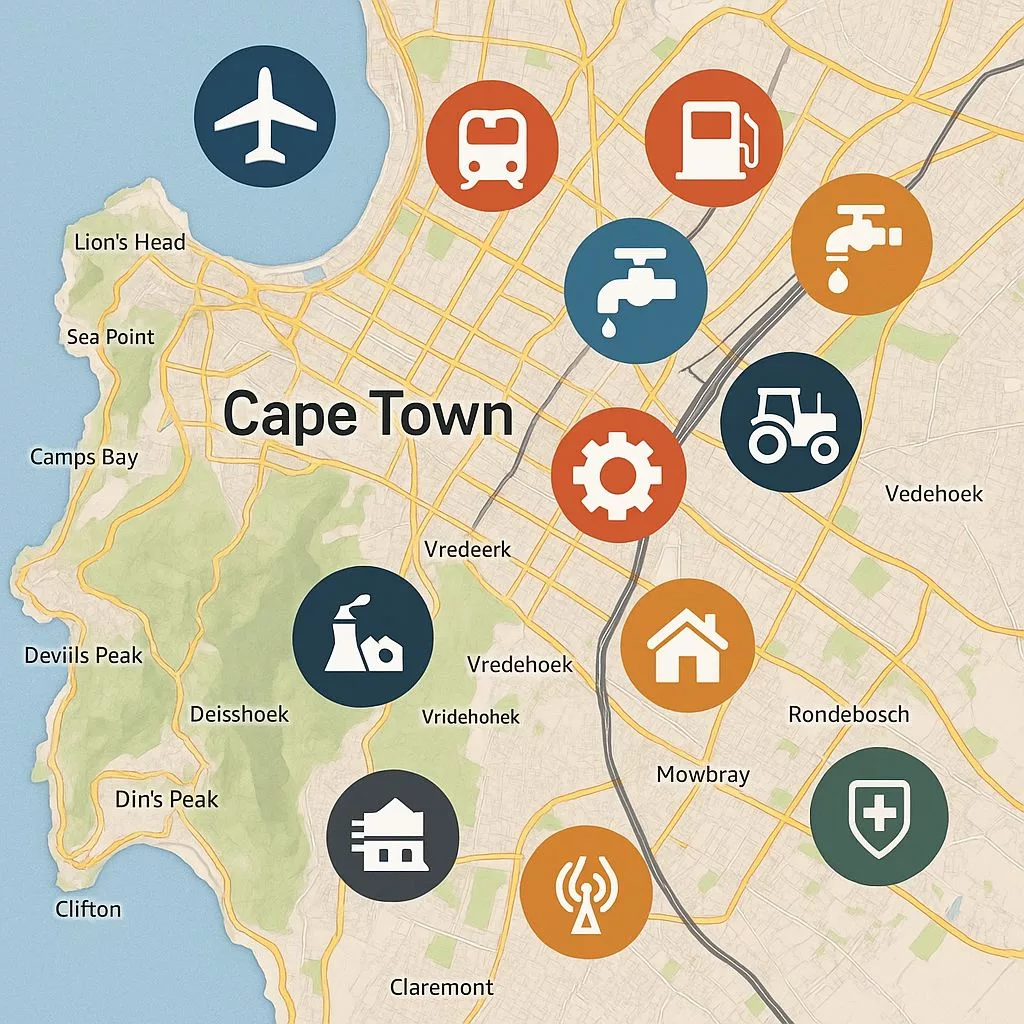
Cape Town is making big changes by 2025! They are spending billions to make water, power, and roads better. New electric buses zoom silently, and clever systems stop bad smells. Even with tough problems like housing, the city is building a brighter future, one project at a time. It’s all about making life better for everyone.
What are the key infrastructural developments happening in Cape Town by 2025?
Cape Town is investing R9.7 billion in infrastructure by 2025, focusing on key areas:
* Water and Sanitation: 217 km new water mains, 89 km upgraded sewer lines, and a new 8 km storm run-off tunnel.
* Electricity: R2.4 billion for battery-electric buses, a 4.3 MW landfill-gas plant, and two 25 MW / 56 MWh battery islands for grid stability.
* Roads: R680 million to resurface 178 km of roads and convert 43 km of residential streets to durable concrete block paving.
Dawn of the E-Bus: January’s Quiet Revolution
At 04:47 on a colour-washed January morning, the first battery-electric bus eased out of Green Point depot without the usual diesel cough. Twelve months later that single whisper became a 62-vehicle chorus that had already carried commuters three million kilometres and kept roughly 2 700 t of carbon out of the sea breeze above the Atlantic Seaboard. Staff inside Strand Street headquarters took the numbers as proof that a council once famous for begging residents to shower in 120-second bursts can now shift people with electrons instead of tankers – and it did so without waiting for a bankrupt national rail operator or a broke treasury to bless the move.
Yet the bus rollout is only one strand in a web of projects that together make up the costliest, most sued-over and most audited municipal programme the country has seen since stadiums rose for the 2010 World Cup. Mayor Geordin Hill-Lewis calls the emerging picture the “City of Hope”, lifting a slogan from a 1989 Urban Foundation paper that helped pave the road out of apartheid. Whether the label sticks in 2025 depends on which balance sheet, traffic island or protest placard you choose to read first.
Infrastructure: R9.7 Billion, 4 812 km of Cable and One Underground River
The headline price tag – R9.7 billion – hides a level of detail normally reserved for site engineers. More than half the money soaked into “wet” assets: 217 km of brand-new water mains, 89 km of upgraded sewer lines, the first bulk reservoir raised since 1972 (Vrygrond II, 55 megalitres), and an 8 km tunnel that finally keeps storm run-off out of the sewerage web in the Lotus River catchment. The tube – three metres wide, lined with fibre-reinforced concrete – dives 14 m below Philippi vegetable plots and empties into Zandvliet treatment works. Crews steered an Austrian tunnel-borer nicknamed Inkanyamba through clay and dune sand, finishing four months ahead of an already squeezed timetable. Within six weeks overflows into the Lotus River fell 64 %, rehydrating a peat patch that had not tasted standing water since Ronald Reagan’s first term.
Electricity ate another R2.4 billion. Besides the headline-grabbing 4.3 MW landfill-gas plant at Coastal Park, the City switched on two “grid-forming” battery islands at Athlone and Kakamas substations. Each 25 MW / 56 MWh lithium-iron-phosphate rack can keep a slice of Cape Town alive for four hours if Eskom ever unleashes the mythical “Stage 16” blackout. Officials bought the units under a dollar lease that flips to municipal ownership in year seven, a workaround that keeps the debt off the balance sheet and within constitutional borrowing caps.
Roads swallowed R680 million yet resurfaced only 178 km, a stark reminder that polymer-modified bitumen able to survive 46 °C summers now costs as much as entry-level real estate. Engineers quietly abandoned tar on any residential street narrower than six metres, switching to concrete block paving that carries a 40-ton truck yet lasts four decades. Forty-three kilometres of ochre-and-grey herringbone brick now thread through Langa, Gugulethu and Tafelsig, looking like giant pizza ovens and outlasting asphalt by at least 25 years.
Housing: Micro-Plots, Missing Middle and the Shack Shuffle
The official housing backlog stands at 375 000 units, a queue that grows by 1 100 families every month because births and in-migration outpace construction. Rather than chase impossible 25-storey towers, planners now legalise micro-developments on “gap” erven as small as 150 m². A Land Use Scheme Amendment promulgated in April lets one title deed splinter into four separate residential plots, each ripe for a duplex or four-storey walk-up. Developers must bankroll internal roads and hand 20 % of flats to the City for rental at R1 050 a month. The pilot site is a disused bowling green in Thornton where 88 homes rise in two- and four-storey clusters; the bricks carry a pink tinge because the builder blended in iron-oxide soil scooped from the Bellville rail cutting, saving R3.2 million in quarried aggregate.
Alongside these micro-projects, the City released 14 parcels of municipally owned land – mostly pine plantations bought in the 1970s for stadiums that never arrived – for 12 000 subsidised Breaking New Ground units. The biggest, Mfuleni Extension 8, will host 4 800 families on a 192 ha grid laid out at 32.4 m intervals so that every second road can one day take a Bus Rapid Transit lane without fresh expropriation. Each erf already contains a 20 mm conduit so households can pull fibre once national spectrum finally goes to auction. Yet the arithmetic remains cruel: the Human Settlements grant gives Cape Town cash for 3 800 subsidised units a year, implying a 99-year hold-up for anyone earning below R3 500 a month.
Informal settlements get upgraded through a mixture of de-densification and “re-blocking”. In Kosovo and Ruo Emoh – two of Philippi’s most crowded backyards – 1 100 shacks were jacked up, swivelled and repositioned along three-metre accessways wide enough for a refuse truck to turn without reversing. The manoeuvre freed 1.6 linear kilometres into which crews inserted 1.9 km of water pipes and 2.3 km of sewer lines, all without carting a single family to a relocation camp. The method, borrowed from Indian and SDI shack-dweller networks, cost R68 000 per erf – one-third of a greenfield move.
Safety, Power and the Smell of Progress
Cape Town’s murder tally is still triple the national figure, but 43 % of killings occur in only 12 of 116 police precincts. The Metro Police added 800 fresh officers trained on EU-funded simulators, lifting the ratio to 1.8 per 1 000 residents – higher than Johannesburg or Ekurhuleni. Hill-Lewis paired the rollout with intelligence-led “area crime combat units” that embed 12-person teams inside the hottest shot-spotter zones. Between March and October they executed 1 400 search warrants, impounded 167 illegal guns – including a Yugoslav RPG-7 found in a Delft chicken coop – and achieved 411 convictions. An 82 % conviction rate outstrips the SAPS national average, largely because retired senior prosecutors build dockets before arrests, not afterwards. Yet the mayor admits the force remains “an army that can arrest but cannot convict” without investigative powers; a constitutional court case set down for February 2026 will decide whether Cape Town can run its own detectives and ballistics lab.
Electricity once arrived 89 % from Eskom; by December 2025 that share is 71 % and sliding. The City now buys 380 MW of privately wheeled solar, 25 MW of biogas from Kraaifontein digesters and 120 MW of dispatchable hydro from the vintage Steenbras scheme. On a mild Sunday lunchtime these sources cover 38 % of demand and occasionally shove surplus electrons into neighbouring towns. A Mauritius-registered entity, City Power Cape Town (Pty) Ltd, signed 18-year purchase agreements at 92 c/kWh – 34 c below Eskom’s 2025/26 rate. Savings are ring-fenced to repay a R4 billion bond that paid for thicker cables, but tariff cuts should reach consumers by 2027/28. Households are piling in: a revamped feed-in tariff pays R1.08 for every kWh exported between 10:00 and 15:30, ballooning registered rooftop systems from 1 047 to 30 336 in twelve months. Mitchells Plain alone sports 5 kW kits on 9 % of its formal roofs, and an AI-driven portal issues compliance certificates in Afrikaans, isiXhosa and English within 48 hours of a satellite pass.
Even the air smells better. Forty-seven e-nose sensors – bird-house-sized gadgets tuned to hydrogen sulphide and ammonia – now stream real-time data across the Cape Flats. In 2023 the Athlone wastewater works violated WHO odour thresholds on 228 days; in 2025 the stench breached the line only 41 times, thanks to fine-bubble aerators that starve sulphate-reducing bacteria. Complaints to the call centre dropped 63 %, and primary-school attendance in nearby Rylands rose 4 % as fewer children stayed home with chronic headaches. It turns out dignity has a scent – and it no longer resembles rotten eggs.
From silent buses to odour sensors, Cape Town is financing optimism with bond coupons, concrete and the certainty that next year’s storm will arrive right after the auditor-general’s report. Whether that counts as hope depends on which street you call home.
[{“question”: “
What are the key infrastructural developments happening in Cape Town by 2025?
“, “answer”: “Cape Town is investing R9.7 billion in infrastructure by 2025, focusing on water and sanitation, electricity, and roads. This includes 217 km of new water mains, 89 km of upgraded sewer lines, a new 8 km storm run-off tunnel, R2.4 billion for battery-electric buses and grid stability solutions, and R680 million for road resurfacing and concrete block paving.”}, {“question”: “
How is Cape Town improving its public transportation system?
“, “answer”: “Cape Town has launched a significant battery-electric bus initiative. Starting with one bus in January, the fleet grew to 62 vehicles within a year, covering three million kilometres and preventing approximately 2,700 tons of carbon emissions. This move demonstrates the city’s commitment to shifting towards more sustainable public transport options.”}, {“question”: “
What measures are being taken to improve water and sanitation infrastructure?
“, “answer”: “More than half of the R9.7 billion infrastructure budget is allocated to ‘wet’ assets. This includes the installation of 217 km of new water mains, upgrading 89 km of sewer lines, the construction of the Vrygrond II reservoir (the first new bulk reservoir since 1972), and an 8 km storm run-off tunnel in the Lotus River catchment. The storm tunnel alone reduced overflows into the Lotus River by 64%.”}, {“question”: “
How is Cape Town addressing electricity supply and stability?
“, “answer”: “Cape Town is investing R2.4 billion in electricity infrastructure. This includes a 4.3 MW landfill-gas plant at Coastal Park and two ‘grid-forming’ battery islands (25 MW / 56 MWh each) at Athlone and Kakamas substations. These battery units can power a portion of Cape Town for four hours during severe blackouts. The city is also reducing its reliance on Eskom, with the share of electricity from Eskom projected to drop from 89% to 71% by December 2025 by incorporating privately wheeled solar, biogas, and hydro power.”}, {“question”: “
What strategies are being employed to tackle the housing backlog?
“, “answer”: “With a housing backlog of 375,000 units, Cape Town is implementing several strategies. These include legalizing micro-developments on small ‘gap’ erven, allowing a single title deed to be subdivided into up to four residential plots, with developers required to allocate 20% of flats for municipal rental. Additionally, 14 parcels of municipally owned land have been released for 12,000 subsidised Breaking New Ground units. Informal settlements are also being upgraded through de-densification and ‘re-blocking’ methods, re-positioning shacks to create space for essential services like water and sewer lines without relocating families.”}, {“question”: “
How is Cape Town improving safety and environmental conditions?
“, “answer”: “Regarding safety, the Metro Police force has added 800 new officers, increasing the ratio to 1.8 officers per 1,000 residents. They are implementing intelligence-led ‘area crime combat units’ that have achieved an 82% conviction rate. Environmentally, the city is improving air quality by deploying 47 e-nose sensors to monitor hydrogen sulphide and ammonia. Improvements at the Athlone wastewater works, using fine-bubble aerators, have drastically reduced odour threshold violations from 228 days in 2023 to 41 times in 2025, leading to a 63% drop in related complaints.”}]