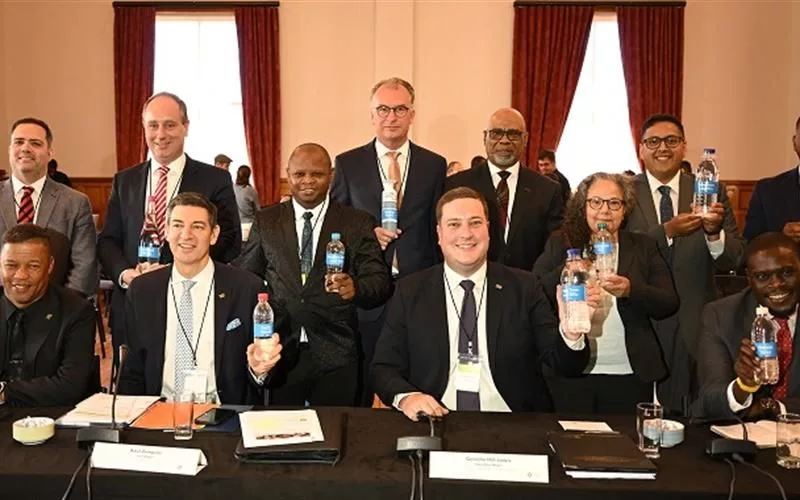
In a high-profile gathering that attracted several international attendees, the city of Cape Town is forging the path towards an environmentally responsible future. The city was the proud host of its inaugural International Water Re-use Conversation, a momentous move towards sustainable management of water resources. The event drew many notable figures, including mayors and officials from seven international cities such as Perth, Nairobi, Los Angeles, Wulpen, Windhoek, Beaufort West, and George, all under the stewardship of Cape Town Mayor Geordin Hill-Lewis.
Establishing New Water Strategy
Under the city’s New Water Strategy, a framework has been created where water re-use is projected to account for roughly 7% of Cape Town’s total bulk potable water supply by 2040. This initiative forms an integral part of the city’s expansive New Water Programme. This forward-thinking programme is set to integrate an additional 300 million litres of water daily from diverse sources such as water re-use, seawater desalination, and groundwater extraction from two main aquifers by the year 2030.
Global Sustainability Through Water Reuse
Cape Town is certainly not alone in its pursuit of water sustainability. Indeed, it has now become part of a global consortium of municipalities that have been implementing water re-use practices for over 50 years. To bring this initiative to life, a state-of-the-art New Water Scheme is expected to be launched at the Faure Water Treatment Plant and Reservoir in the upcoming years.
This facility will make use of treated wastewater derived from the recently upgraded Zandvliet Wastewater Treatment Works. The water will then undergo further purification to meet drinking water standards using a multi-barrier purification process, upholding the strictest safety standards possible. Once the purification process is complete, the water will be combined with dam water, thereby bolstering the existing water supply of the Faure Water Treatment Plant. The purified water will then be distributed throughout the city’s water supply networks.
Laying the Groundwork for a Sustainable Future
The foundation for this project was built by operating a water re-use demonstration plant at the Zandvliet Wastewater Treatment Works for a period of two years. This successful operation resulted in unmatched water quality, with many lessons learned, particularly in terms of protocols and procedures. This knowledge is expected to offer invaluable insight as work begins on developing the full-scale Faure New Water Scheme.
The need to execute such a robust plan was highlighted by Cape Town’s recent droughts and the uncertainties caused by rapid urbanization and climate change. Councillor Zahid Badroodien, Mayoral Committee Member for Water and Sanitation, stressed the need to change our perspective on water as a limited resource, stating, “There is no ‘wastewater’, only wasted water.”
International Collaboration and Unity
The International Water Re-use Conversation brought together a diverse group of attendees, including Ms. Nancy Sutley, Deputy Mayor for Energy and Sustainability from the City of Los Angeles, Mr. Basil Zempilas, Lord Mayor of the City of Perth, Honourable Johnson Sakaja, Governor of Nairobi City County, and Dr. Thomas Honer, MD of the Windhoek Goreangab Water Reclamation Plant, among others.
Without question, Cape Town’s initiative is a stellar example of future-oriented urban planning, offering sustainable solutions to issues of water scarcity. As the city marches towards its vision of being a beacon of hope in the world, the impetus of innovation and unity is at the forefront of its journey.