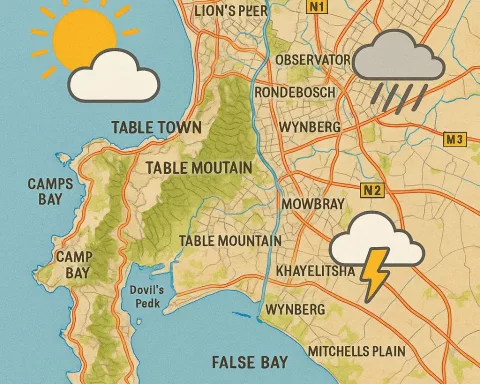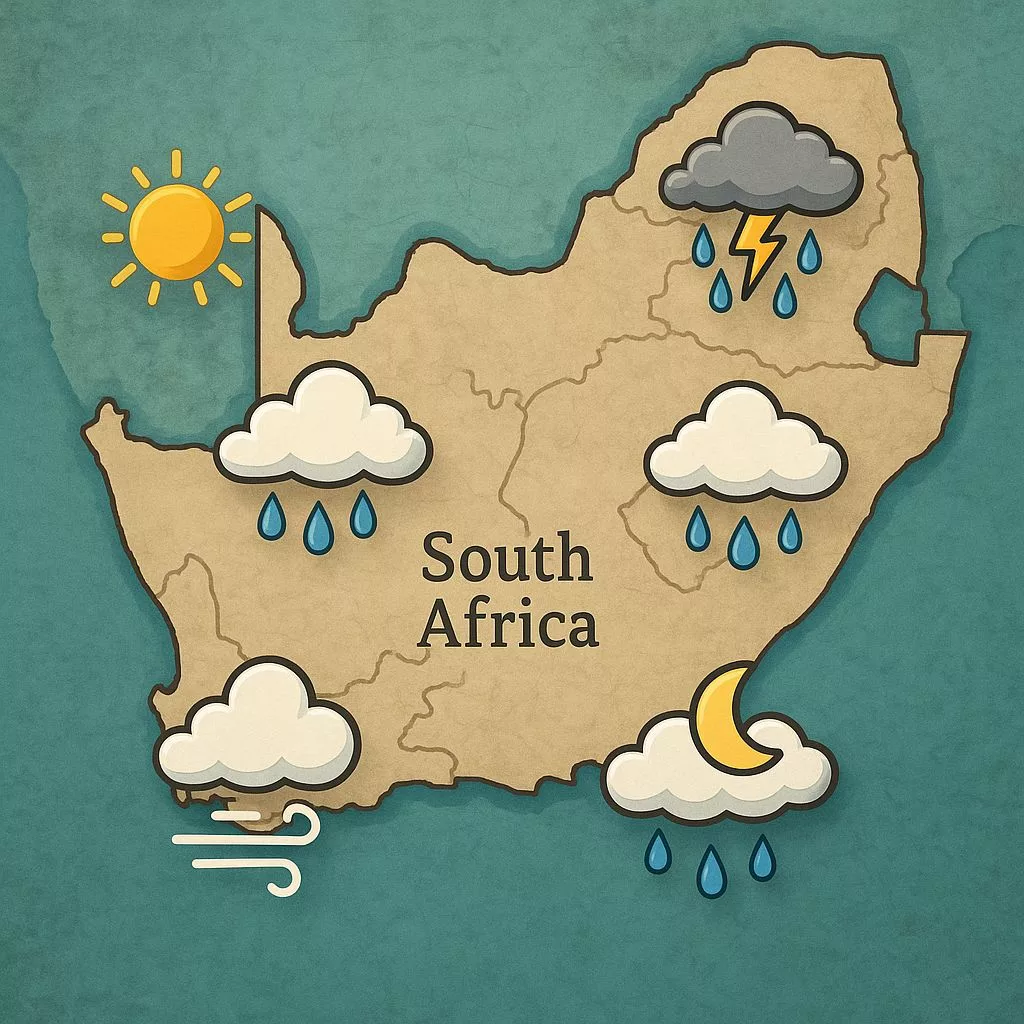
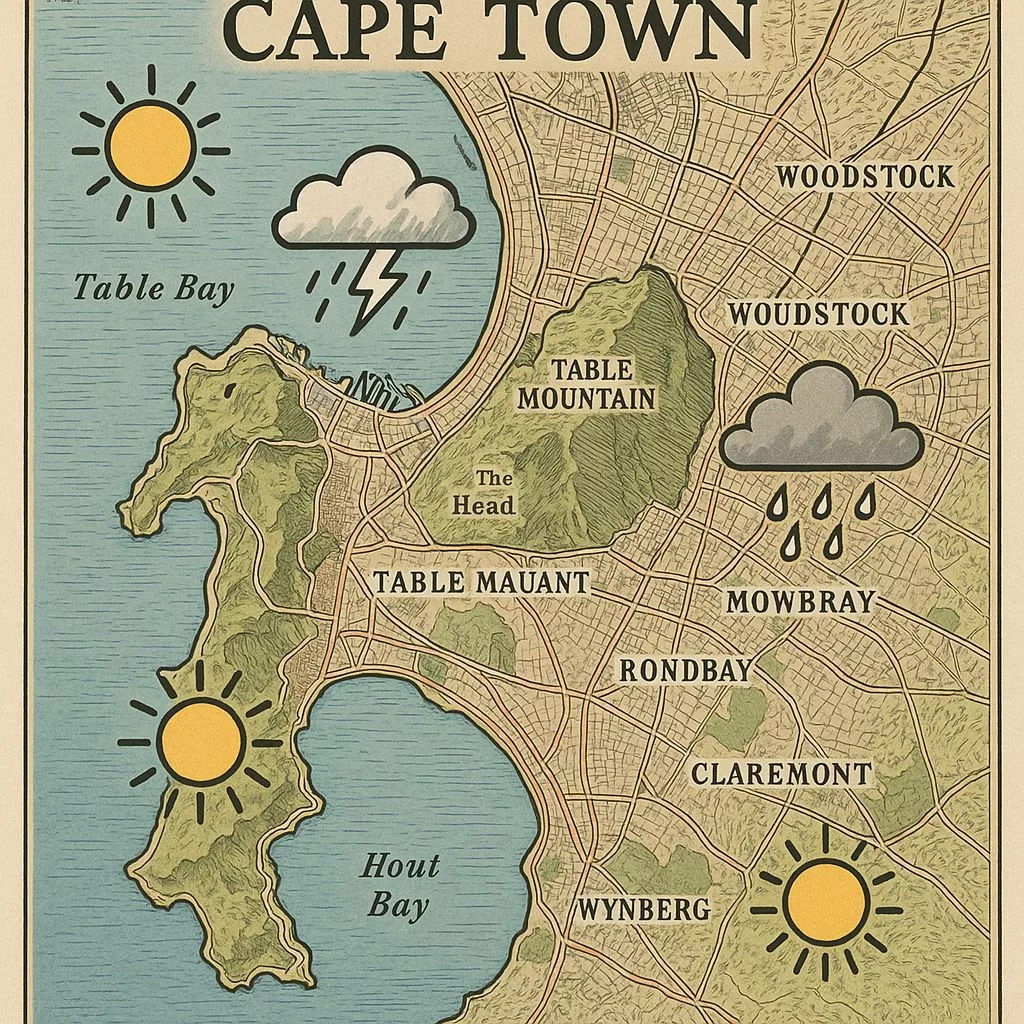
Cape Town on December 12th will be a day of weather drama! Expect a battle between fading drizzle and new cold air, creating a mix of clouds, clear skies, and different conditions everywhere. You’ll see mist, feel strong winds, and there’s even a chance of thunder and rain. Don’t forget your sunscreen and a jacket – the weather will keep you on your toes!
What is the weather forecast for Cape Town on December 12th?
Cape Town on December 12th will experience a tug-of-war between departing drizzle and arriving polar air, resulting in a day of micro-drama with layers of cloud, crisp skies above, and varying conditions across the city. Expect mist, moderate UV, strong winds, and a chance of thundershowers.
- What the heavens are cooking while you juggle diary, backpack and camera.*
Dawn’s Chessboard – Two Air-Masses Collide
A bruising low has parked 800 km south-west of Africa’s tip and slings a cold front toward the peninsula like a surf-slap. Cape Columbine felt the slap at 03:05; barometers in Saldanha nose-dived 4 hPa inside ninety minutes. Behind the curtain, a 1020 hPa oceanic high is already sliding in from the west, so the day becomes a tug-of-war: departing drizzle versus arriving polar air. Sandwiched between, Cape Town gets layers – cloud quilt below, crisp sky above – and the squeeze generates twenty-four hours of micro-drama.
The city wakes under a 3 km-thick lid of stratocumulus. Satellite loops show the blanket fraying from the north-west at bicycle pace – about 12 km each hour – so Atlantic-side suburbs will glimpse first blue just after 07:30. Meanwhile, heat leaking from tar and tiles is still too timid to punch holes; the urban island is only 0.8 °C warmer than the fynbos fringe. Expect a silvery, directionless light until the sun finally wins a round.
Road thermometers on the N2 read 11 °C, two degrees below the dew-point. Translation: mist forms directly on the warm asphalt, not in the air above it. If you drive in from the airport, the tarmac looks sweat-slick between the M5 and the Foreshore. Add five minutes to your commute and keep headlights dipped; the droplets are tiny, more glare than puddle.
Sunrise to Mid-Morning – Light Tricks and Commute Cues
Official sunrise is 05:28, yet the first visible glow starts at 05:16 as a peach smear behind the clouds. Ride the cable-car to the upper station (1 067 m) and you may catch a razor-thin green rim: the cloud deck bends the last ray into a one-second emerald flash. Tripod, tele-lens and seven layers of clothing are mandatory; the summit thermometer already hovers at 7 °C and loses half a degree every hundred metres you climb.
By 06:00 the front’s tail still swirls overhead, but the high’s drier fingers prod from the west. Sea Point, Green Point and Camps Bay will spot pale blue windows around 07:40. Until then, the city keeps a soft-box ceiling – perfect for portraits, awful for shadows. If you jog the Promenade, expect damp hair even without rain; the air is a suspended mist, not a falling shower.
Traffic engineers hate mornings like this. Drizzle has oiled the N2, yet visibility drops only when warm tyres atomise the film. RDS-matrix boards flash “SLIPPERY” but say nothing about the white-out between concrete walls. Count on an extra four to six minutes into the CBD; that’s the gap between the usual bumper ballet and today’s mist-waltz.
Midday Squeeze – UV, Thermals and the Mountain Lottery
By 10:00 the UV index claws to 3 – moderate on paper, sneaky in practice. The cloud veil is thin (optical depth 0.7), so 30 % of burning radiation still reaches skin. Add wet slate roofs and pale quartz pavers at the Waterfront; they bounce another quarter of rays back upward. Dermatologists warn that 60–90 % cloud cover tricks people into lobster territory 70 % faster. SPF 15 slapped on at 08:00 degrades to SPF 10 by 11:30; re-coat when your shadow shrinks shorter than your height.
Sailors and kite-boarders feel the next act. A 5 hPa pressure gap between Granger Bay and the off-shore buoy squeezes 25 knots through the harbour mouth. Inside Zandvlei estuary, the same breeze slips to 15 knots, twisted and throttled by the Steenberg ramparts. Launch a dinghy at 09:00 and you’ll face 30-degree wind-shifts crossing from False Bay to Table Bay; kite-surfers score 22-knot pulses at Dolphin Beach, best sampled between the third and fifth whitecap for silk-smooth lift.
Noon fires the mountain’s own engine. A -18 °C pool at 5 km altitude hands Cape Town a 24 °C lapse rate – rocket fuel for rising parcels. Kirstenbosch and the Back Table sit under 14 °C low-level air; a quick sun-patch warms the slope to 19 °C and triggers orphan thundershowers 1.9 km overhead. Hikers above Skeleton Gorge will notice wind hush before the first growl; drop 100 m and you dodge the lightning channel. Carry a lid but don’t bet your life on it – timing beats gear.
Afternoon Parade – Streets of Cloud and Wind
Once Table Mountain’s thermostat clicks, convection rolls line up like aerial lanes. Each ribbon stretches 3 km long, 400 m wide, spaced 1 km apart. Best box-seat is the M3 lay-by above Rhodes Memorial; point your lens 200° azimuth at 15:10 and spin the polariser for cobalt stripes on porcelain blue. The spectacle lasts until heat fades around 16:30.
Down in the grid, architecture becomes a wind tunnel. Signal Hill and Lion’s Head form a natural fjord; skyscraper walls rise 60 m, canyon floor 800 m wide. CFD studies show pedestrian-level wind equals 1.7 times the open-coast value – today that’s 41 kph sustained, 65 kph jabs. Revolving doors at Buitengracht & Strand can slam with 180 N of force, enough to bruise a shoulder. Tuck scarves inside collars and grip your hat like you mean it.
Energy planners watch the clock too. Koeberg Unit 2 and 4 nap for refuel, so the province imports 1 100 MW from Gauteng. A 0.5 mm conductive drizzle film can spike line faults 12 %. Eskom’s risk desk prices a 7 % chance of Stage 3 load-shedding sparked by wet insulators or a veld-fire trip. Top up laptops and power banks before 18:00; darkness loves surprises.
Dusk to Deep Night – Scent, Sound and Starlight
Sunset official time is 19:51, yet the sun vanishes behind an 850 m cloud wall off Slangkop. Glaciated tops bounce orange light sideways, gifting Camps Bay a bonus five-minute “horizontal golden hour.” A 25 % drizzle chance tags along – radar shows 25 dBZ, enough for perfumed fynbos mist that smells like crushed pine and honey. Milnerton gets it at 19:15; open the car window, inhale, then dash before the beads dry into salt freckles.
Night sound changes frequency. Cloud blankets shave high notes but amplify bass; the Waterfront’s 55 Hz chillers hum two kilometres up Bree Street, while gull cries die within 200 m. Stand on the N2 footbridge and count gusts: every 70 kph pulse lifts white-noise 6 dB and hits your left ear 1.2 s earlier than the right – a free wind-shear meter.
By 21:00 the cloud base lifts to 1 200 m and the ISS glides overhead at magnitude -3.4. Nine ships swing at anchor off Robben Island, bows into a 17 kph breeze. The K-index sits at 2, pinning GPS accuracy to 30 cm – ideal for drone work. Launch from Green Point and you’ll wipe drizzle off the lens, yet lose no signal. Close the bedroom window if you fancy stars, crack it for fog; model spread is 0.4 g kg⁻¹ humidity – tiny but decisive. Check your windscreen at 06:30: beads mean the ECMWF won the duel, dry glass crowns GFS king.
Quick-Look Tables – Wardrobe, Wave, Wildlife
-
Wardrobe math:* 8 °C on the summit, 19 °C in town; wind-chill steals 3 °C at 25 kph, 5 °C at 45 kph. Merino 180 g base plus 0.5 cfm shell keeps hikers smug; city diners trade shell for waxed cotton that beads rain yet exhales steam. Sneakers need gum soles – today’s salt spray eats aluminium eyelets for breakfast.
-
Surf dial:* Low tide 15:42 (0.34 m), high 21:58 (1.64 m). A 12-second, 2.2 m SW swell wraps into False Bay; Muizenberg softens to 1.3 m beginner sets. Water 15.8 °C gives you 35 minutes before fingers fumble, 3 mm suit mandatory.
-
Wildlife memos:* Rock hyraxes bask 20 minutes earlier on post-front days – if they line up like solar panels at 08:10, cloud break is minutes away. Oystercatchers evacuate rocks when gusts top 50 kph; flock lift-off at 16:45 is a living anemometer.
Close the log, zip the jacket, pocket the power bank – Cape Town has shown its hand. The rest is timing, appetite and curiosity.
What kind of weather can be expected in Cape Town on December 12th?
Cape Town on December 12th will experience a dynamic day with a mix of fading drizzle and incoming cold air. This will lead to varying conditions across the city, including layers of cloud, clear skies, mist, strong winds, and a chance of thundershowers. It’s described as a “tug-of-war” between two air masses.
What time will the sun rise and what are the best viewing opportunities?
Official sunrise is at 05:28, with the first visible glow starting at 05:16 as a “peach smear” behind the clouds. For a unique experience, riding the cable-car to the upper station (1,067 m) might offer a chance to see a “razor-thin green rim” at sunrise, a phenomenon caused by the cloud deck bending light. However, be prepared for cold temperatures at the summit (around 7 °C).
What are the driving conditions expected to be like, especially for commuters?
Early morning commuters should be aware of mist forming directly on the warm asphalt, particularly between the M5 and the Foreshore on the N2. This can make the tarmac appear “sweat-slick.” Visibility might drop, and drivers are advised to add five minutes to their commute and keep headlights dipped. RDS-matrix boards will flash “SLIPPERY,” indicating potential hazards.
What is the UV index and what precautions should be taken?
By 10:00, the UV index will reach 3, which is considered moderate. However, the cloud veil is thin, allowing about 30% of burning radiation to reach the skin. Surfaces like wet slate roofs and pale quartz pavers can bounce additional rays upward. Dermatologists warn that cloud cover can trick people into getting sunburned faster. It’s recommended to reapply SPF 15 sunscreen by 11:30 as it degrades to SPF 10.
How will the wind affect activities like sailing and walking?
Strong winds are expected. A 5 hPa pressure gap will create 25-knot winds through the harbour mouth, potentially reaching 15 knots in Zandvlei estuary. Kite-surfers at Dolphin Beach can expect 22-knot pulses. For pedestrians, skyscraper architecture can create wind tunnel effects, with sustained winds of 41 kph and gusts up to 65 kph in the city grid. Revolving doors can exert significant force, so holding onto hats and tucking in scarves is advisable.
What is the chance of load shedding and what should residents do?
There is a 7% chance of Stage 3 load shedding, primarily due to a 0.5 mm conductive drizzle film potentially spiking line faults by 12% or a veld-fire trip. Koeberg Unit 2 and 4 are napping for refuel, and the province is importing 1,100 MW from Gauteng. Residents are advised to top up laptops and power banks before 18:00 to prepare for potential power outages.