Cape Town is getting tough on road safety this holiday season! They’re setting up mobile checkpoints with fancy tech to quickly check cars for bad tires or shaky brakes. If your car isn’t safe, you’ll have to fix it before you can go on your vacation. This new plan is all about making sure everyone gets to their destination safely, rather than risking a dangerous breakdown on a long, dark road.
What is Cape Town doing to improve road safety during the festive season?
Cape Town has implemented mandatory roadside vehicle inspections using 28 mobile units at key exit points. These checkpoints quickly assess vehicles for critical defects like tire tread depth and brake function. Drivers with unsafe vehicles must get repairs before continuing, aiming to prevent accidents on long holiday journeys.
The Great Holiday Getaway: 2.2 Million Humans, 400-Kilometre Nights
Cape Town never sleeps in December, but the roads do most of the talking. In the space of nineteen frantic days, more than two million residents fire up engines and head north, east or west. Counters planted beside the Huguenot Tunnel watch the N1 swell from 14 000 to 32 000 vehicles a day; Sir Lowry’s Pass absorbs a similar shock as the N2 doubles to 37 000. Four out of ten of those cars will still be rolling after the 400 km mark, which translates to at least four straight hours of asphalt, frequently after sunset, often stuffed to the roof-rack, and usually piloted by a mind already sipping cocktails in the Transkei. Distance, darkness, cargo and exhaustion form a lethal quartet: the further each factor climbs, the faster the odds of disaster shorten.
Night-time magnifies the danger. Pupils dilate, reaction times stretch, and a single rear-tyre blowout can turn a holiday playlist into a rescue-helicopter whir. Traffic officers have long known that the worst crashes rarely happen in town; they crystallise on the long lonely gradients beyond De Doorns or the curves skirting the Garden Route. What the city needed was a way to intercept those rolling time-bombs before the city limits faded in the rear-view mirror.
The maths is merciless. A tyre that has baked for seven summers, a brake line held together with hardware-store ingenuity, a driver who climbed in straight after a night-shift – these defects compound exponentially. When the journey stretches past the 400 km mark, the vehicle becomes a referendum on every skipped service and short-circuited repair. Cape Town decided to rewrite the question so that “yes” or “no” could be demanded at 90-second notice on the shoulder of an on-ramp.
From Gentle Invite to Mandatory Spotlight: Why “Please” Lost Its Power
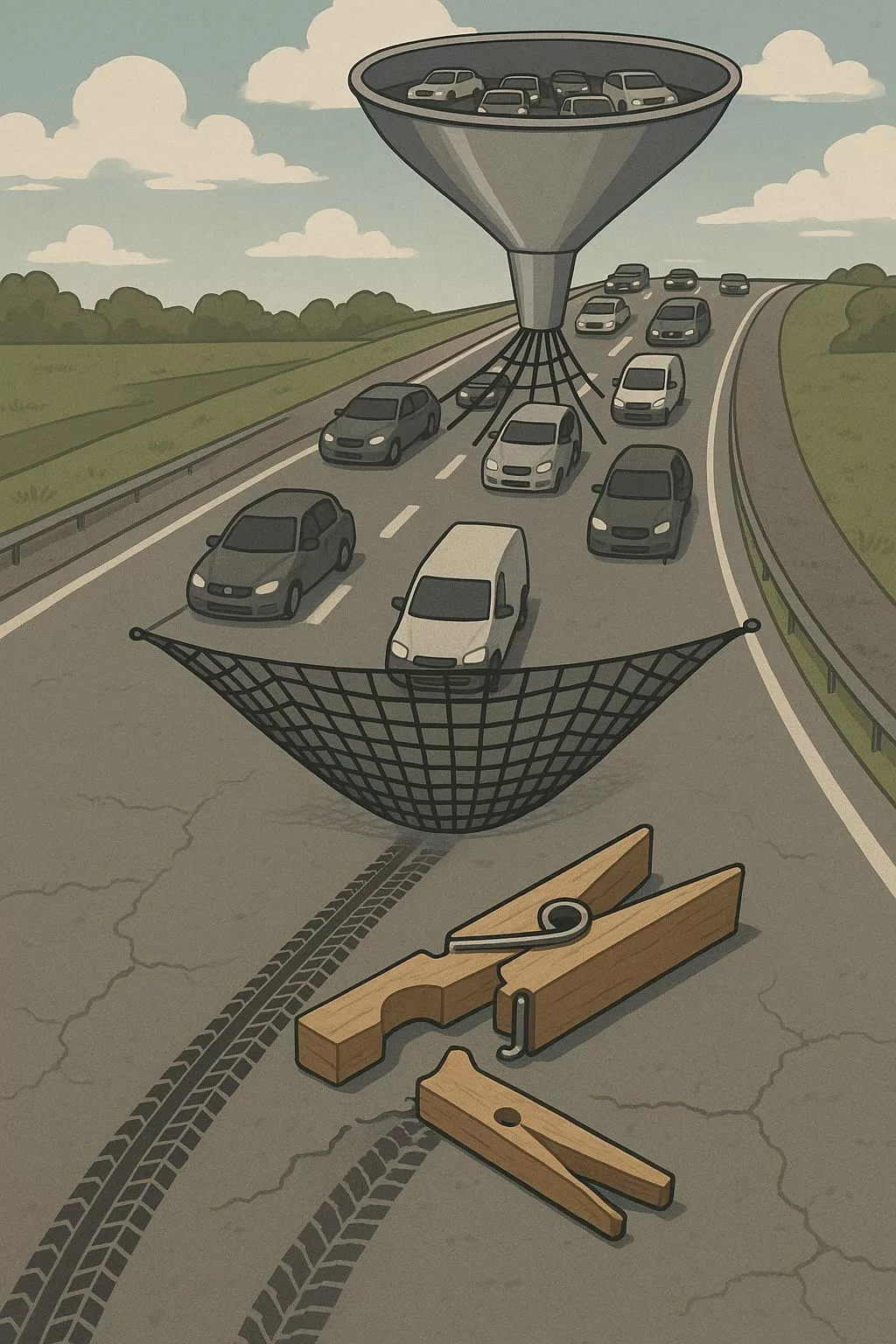
For twelve years the city’s road-safety plea went something like this: “Bring your taxi or coach for a free check-up and we’ll hand you a pretty green sticker.” Roughly 1 200 operators accepted the invitation each December – about eight percent of the public-transport fleet that actually leaves the metro. Private drivers were never formally courted. The outcome was equally formal: two-thirds of holiday fatalities involved cars that had never once seen a technician’s creeper. One August the emblem of failure arrived in a courtroom in Worcester: a brake line so rotten it had been pinched shut with a household clothes-peg. Eight people never made it home.
That peg became the city’s Rubicon. Officials retired the word “voluntary,” printed twenty-eight mobile inspection kits, and rewrote the script so that any car, bus or bakkie could be summoned to the kerb whether the driver liked it or not. The new brief is simple: if the wheels are turning toward the provincial border, they can be ordered to stop, dip, and prove themselves worthy.
The psychology flipped overnight. A green sticker used to be a pat on the back; now it is the price of leaving town without a police escort and a R2 500 fine. Operators who once calculated the odds of being caught discovered that the checkpoint itself had become the dice, loaded and ready to roll against them.
Roadside Reality Show: Twenty-Eight Pop-Up Gates, Four Minutes to Glory
Picture a flat-bed truck that can cough out cones, strobes and an inspection pit faster than most people parallel park. That truck, plus a chase car and a crew of six, is Cape Town’s newest holiday fixture. From 11 to 24 December these roaming gates will colonise the N1, N2, R27, R44 and M12 for sixteen hours a day. A driver sees flashing amber, pulls over, and within four minutes learns whether the journey continues or the holiday detours via Bellville.
The choreography is relentless. Infrared lamps reveal tread depth in the dark; a brake-roller quantifies stopping power to the percentage point; an NFC scanner interrogates the licence disc while the driver still has the key in hand. The legal tread cliff is 1.6 mm, yet officers will write a notice at 2 mm because asphalt in December behaves like a pizza oven and shaves rubber faster than arithmetic predicts. Fail any of the “fatal five” and a red disc lands on the windscreen; pass and you glide back into the stream, green sticker catching the sunrise.
Time is the commodity everyone hoards, so the city honed the process to a four-minute heartbeat. Overlapping shifts keep the barrels rolling, and a chase car shadows defect-laden vehicles to the nearest testing station so that no one can quietly peel back into traffic. The goal is not to trap but to triage: separate the fit from the fatal before the mountain passes do it more harshly.
Flunked the Test? Welcome to the Repair Pit and the Data Loop That Never Forgets
A red label is not a death sentence; it is a detour to Bellville or Joe Gqabi where municipal bays stay open late, parts vans sell bulbs and brake switches at factory price, and a fresh road-worthiness slip can be earned the same afternoon. A battery test costs R25 and could save a 2 a.m. stall in the Karoo with three cranky children and a melting cooler. Drivers who choose to ignore the invitation discover their licence discs confiscated and their number plates flagged in the national database until photographic proof of repair arrives.
Behind the scenes, every defect is immortalised. Tablets upload fault codes to a provincial dashboard that can spot patterns – three Volkswagen Caddy taxis from one fleet with splitting sidewalls triggers an audit that can freeze an operator’s permit within a day. WhatsApp summaries ping drivers, owners and insurers simultaneously, closing the information circle that once took weeks of affidavits to sketch.
Data from a pilot run last year still makes mechanics wince: more than a quarter of private cars rode on tyres older than seven years, the eldest a 2004 Dunlop willing to attempt 1 400 km to Musina. Such statistics turn abstract when an 80 km/h blowout catapults a roof-box into the overtaking lane. The city’s message is equally concrete: arrive with dubious rubber and you will be re-tyred before you see the countryside.
Nudges, Lux Meters and Coffee Rewards: The Soft Power Behind Hard Checks
Enforcement clears the road; behaviour keeps it safe. Travellers who sign a postcard-sized “Passenger Pledge” and clip it to the sun-visor drop their average speed by almost a fifth, suddenly reminded that every occupant earns the right to nag. Overhead gantries read tyre temperatures from sensors baked into the asphalt; when the reading tops 54 °C the next sign prods drivers toward a pressure bay five kilometres ahead. Petrol stations hand out free coffee stamps to app users who stop every 120 km, gamifying bladder breaks into life-saving pauses.
Even dazzling accessories face extinction. After-market LED bars wired directly to high beams can emit 18 000 K glare, triggering night-blindness in seconds. Traffic officers now carry lux meters; anything brighter than 430 lux at one metre is clipped, fined, and sent home in a plastic bag. Spare wheels receive the same scrutiny: if a can of sealant cannot inflate a flat to 2.1 bar in thirty seconds, or a space-saver lacks the legally required 80 km/h warning, the red label reappears.
Insurers sweeten the deal. Dialdirect, MiWay and King Price waive the first excess for cars that pass an Exodus check and crash within 48 hours, while those found defective and later wrecked see deductibles double and policies cancelled. Within three days of the announcement 9 000 motorists overwhelmed the booking portal, turning preventive maintenance into the hottest pre-holiday ticket since beach-house rentals.
December’s First Light: A Quantum, Two Radials and a Lesson in 18 Minutes
At 05:45 on launch day the inaugural checkpoint blossoms on the Sable Road on-ramp. A 2011 Toyota Quantum towing a family and a year of deferred maintenance is waved into the taper; the left-rear tyre measures 1.4 mm, 0.2 mm short of legal. The driver is escorted to Bellville, offered coffee, declines a part-worn substitute, and instead buys two new radials for R1 850. Eighteen minutes later he re-enters the N1, children asleep, spare wheel lashed, temperature gauge steady at 92 °C. Somewhere between De Doorns and Touws River the new tread hums a lower, safer frequency.
That micro-drama will repeat thousands of times before Christmas. Each stop is a referendum on maintenance culture, each green sticker a vote for arrival rather than tragedy. Cape Town cannot eliminate holiday collisions, but it has re-engineered the moment of choice: fix it now, in the sunshine with music playing, or gamble later in the dark where help is hours away.
When the last checkpoint folds on 24 December the province will tally defects averted, fines issued, and, most importantly, lives still in motion. The clothes-pegs stay in kitchen drawers; the roads, for once, will tell a quieter story.
What is Cape Town doing to improve road safety during the festive season?
Cape Town has implemented mandatory roadside vehicle inspections using 28 mobile units at key exit points. These checkpoints quickly assess vehicles for critical defects like tire tread depth and brake function. Drivers with unsafe vehicles must get repairs before continuing, aiming to prevent accidents on long holiday journeys.
Why did Cape Town switch from voluntary checks to mandatory inspections?
For twelve years, Cape Town offered voluntary checks that saw limited participation, primarily from public transport operators. Despite these efforts, two-thirds of holiday fatalities involved cars that had never been inspected. A critical incident involving a brake line repaired with a clothes-peg led the city to realize that voluntary checks were insufficient, necessitating a mandatory approach to ensure genuine roadworthiness and prevent tragedies.
What kind of technology is used in these mobile inspection checkpoints?
Each mobile unit is equipped with advanced technology for rapid vehicle assessment. This includes infrared lamps to measure tire tread depth, brake-rollers to quantify stopping power, and NFC scanners to quickly verify license disc information. These tools allow for a comprehensive check of critical safety components within approximately four minutes.
What happens if a vehicle fails the inspection?
If a vehicle fails an inspection due to critical defects (the “fatal five”), a red disc is placed on the windscreen, and the driver is directed to a nearby municipal repair bay in areas like Bellville or Joe Gqabi. These bays offer repair services, and a fresh road-worthiness slip can often be obtained the same day. Drivers who attempt to ignore the directive face confiscation of their license disc and their number plates being flagged in a national database until proof of repair is provided.
How does Cape Town encourage safer driving habits beyond mandatory checks?
Cape Town uses a multi-faceted approach. They encourage passengers to sign a “Passenger Pledge” to reduce average speeds. Overhead gantries monitor tire temperatures, advising drivers to check pressure if readings are too high. Petrol stations offer free coffee stamps for app users who take breaks every 120 km. Insurers also incentivize safety by waiving excess fees for drivers who pass checks and crash within 48 hours, while penalizing those who drive defective vehicles.
How quickly are these inspections conducted, and what is the goal?
The inspection process is designed to be highly efficient, taking approximately four minutes per vehicle. The goal is not to penalize or trap drivers, but rather to “triage” vehicles, separating those that are roadworthy from those with critical defects before they embark on long journeys. This proactive approach aims to prevent accidents and ensure safer travel for everyone during the busy festive season.