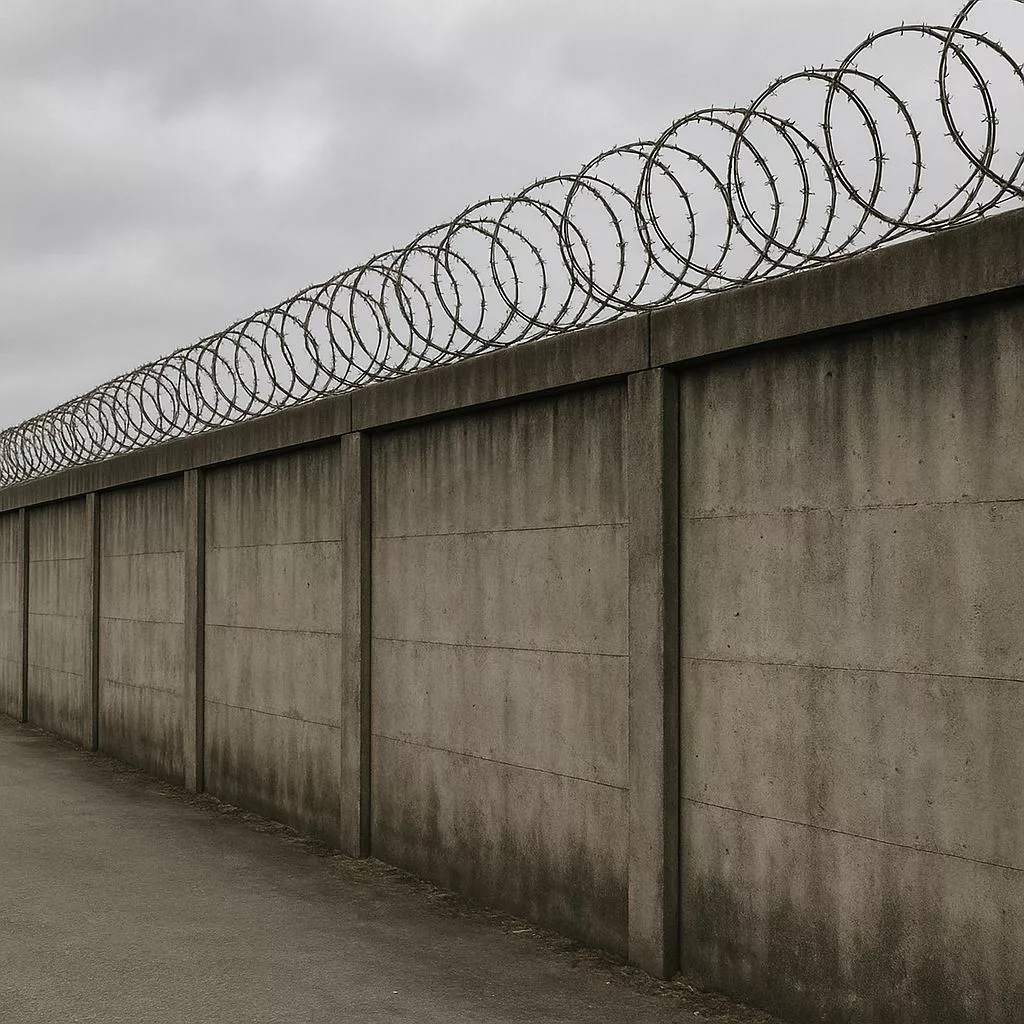
Cape Town’s N2 highway became a battleground, with constant attacks on drivers. To fight this, the city is building a huge concrete wall, almost 3 meters tall and over 9 kilometers long, with high-tech cameras and lights. This R330 million “fortress” aims to scare off criminals and keep people safe. But some wonder if this giant wall can really stop smart criminals, or if they’ll just find new ways to cause trouble. It’s a costly gamble, hoping concrete and cameras can solve a deep-rooted problem.
What is Cape Town doing to address crime on the N2 highway?
Cape Town is constructing a 9.3 km, 2.8m high reinforced concrete wall along the N2 with anti-scaling fins, fiber-optic cables, and 187 high-mast LEDs. This R330 million project aims to deter crime with advanced surveillance and a dedicated Highway Patrol Unit.
The Highway That Became a Battlefield
Every weekday, 180,000 vehicles crawl along Cape Town’s N2 between the airport and the city bowl. For most, the journey is measured in minutes lost to congestion; for an unlucky few, it is tallied in millimetres of safety glass that suddenly bloom into silver dust. In the past financial year, 2,125 separate events – ranging from smashed windscreens to fatal shootings – were logged between the Borcherds Quarry on-ramp and the M12 off-ramp to Khayelitsha. That figure, however, omits the sensory ledger: the smell of diesel mixing with burnt rubber, the high-pitched tinkle of tempered glass on asphalt, the heartbeat that seems to stall between the first thud and the realisation that you are still alive.
Motorists have responded by turning the road into an impromptu theatre of improvisation. Some wind passenger windows down at night so shards do not spray inwards; others keep a “decoy” handbag on the passenger seat, hoping a potential looter will grab it and sprint rather than linger. WhatsApp groups with names like “N2 Survivors” trade coordinates – bridge 14A “safe” until 18:30, bridge 17B “hot” after 19:00 – like battlefield intelligence. The attacks are so routine that tow-truck drivers have memorised which ambulances carry spare tyre plugs for the steel-belted radials routinely punctured by porcelain fragments harvested from broken toilet bowls.
City officials insist the violence is opportunistic, yet the choreography is eerily consistent. A rock arcs from the shadows, a vehicle swerves, accomplices surge across four lanes of traffic, and within ninety seconds wallets, phones and luggage vanish into the Cape Flats darkness. Because the entire sequence unfolds in the kilometre-wide buffer between the airport’s razor-wire perimeter and the first row of informal dwellings, the N2 has become a geopolitical no-man’s-land: too visible to ignore, too narrow to police, too profitable for criminals to abandon.
Blueprint for a Fortified Freeway
Pressed by insurers who hiked roadside-assistance premiums 34 % in two years, the City of Cape Town has opted for civil-engineering shock therapy: 9.3 km of reinforced concrete, 2.8 m high, crowned with outward-angled anti-scaling fins and embedded with hair-thin fibre-optic cables that can tell the difference between a bird landing and a drill bit gnawing for scrap metal. Construction is scheduled for October 2025–March 2027, deliberately avoiding the December holiday surge when car-hire fleets clog the inbound lanes and the winter rains that turn adjacent dunefields into salt-streaked swamps.
The specifications read like a military procurement sheet. Precast panels will sit on spun-pile foundations sunk eight metres through shifting Aeolian sand into bedrock, a technique borrowed from offshore wind farms at Saldanha Bay. Every 400 m, inspection hatches give access to a cable trench carrying power for 187 high-mast LEDs and 10 Gbps fibre piggy-backing on SANRAL’s toll-road backbone. The lights, angled 15° toward the tarmac, will bathe traffic in 5,000 K “daylight” while leaving the settlement side relatively dim – an asymmetry critics call “hostile lighting” and engineers defend as “optical discipline.”
If concrete is the skeleton, data is the nervous system. Vibrational sensors will stream to the existing Intelligent Transport System hub in Goodwood, overlaying ShotSpotter triangulations, vehicle speeds and CCTV feeds onto a single heat-map. Algorithms trained on 180,000 hours of N2 footage will flag “abnormal loitering” (defined as a stationary person within 50 m for more than 90 seconds) and auto-dispatch the Highway Patrol Unit – ninety officers on BMW R1250 RT bikes capable of 0–100 km/h in 3.2 seconds. Whether machine learning can out-think teenagers who communicate via voice notes – “Abantu abamnyama beza kuphela” (“Only the black uniforms are left”) – remains an open question.
The Price Tag and the Pivot Tables
Officially, the wall will cost R180 million, a figure repeated so often it has become a mantra. Less advertised is the R60 million “social facilitation” envelope – soccer tournaments, trauma counselling, recycled-brick cooperatives – and a further R40 million for a “virtual wall” of licence-plate recognition cameras every 750 m. Add geotechnical contingencies (R35 million), aesthetic mitigation demanded by Airports Company South Africa (R12 million) and a 10 % project reserve, and the grand total edges toward R330 million, roughly the price of 5,500 RDP houses or 110,000 communal taps.
To finesse Treasury oversight, the City has choreographed a fiscal pas de deux. R90 million will be re-allocated from the Urban Settlements Development Grant, originally earmarked for backyarder services in Khayelitsha. Another R50 million comes from a newly minted Violence Prevention Levy – essentially a 2 % surcharge on commercial rates in Bellville, Century City and Claremont. The balance will be raised via a ten-year “green” bond listed on the JSE and marketed to European funds hungry for “social-impact, climate-resilient” assets. Marketers highlight 17,000 m² of vertical gardens – succulent species nourished by brake-dust and sea fog – that will cloak the concrete and offset an estimated 18,000 t of CO₂-equivalent emissions. Bond traders privately call it the “aloe-for-security swap.”
Tender evaluation was split 70 % price, 20 % black-ownership equity and 10 % nebulous “community benefit.” The winning joint venture pairs Haw & L. Inglis – the firm that built the Mandela Rhodes Place precinct – with local BEE partner Umsizi Infrastructure and Israeli smart-city firm Magal Security Systems, whose share price jumped 4 % the day the award was gazetted. COSATU’s provincial secretary has accused the City of “importing spyware,” while the Freedom Front Plus insists criminals will simply relocate 900 m to where the wall terminates at a wetland – “a Maginot Line,” councillor Emre Uygun told a Brackenfell public meeting, “and the criminals are the Wehrmacht.”
Concrete Dreams, Sand Realities
Even if the Great Ribbon rises on schedule, its social licence is already fraying. A Wits University meta-study of 14 “freeway fortification” projects across the global South shows violence drops 38 % in the first nine months, then rebounds to 87 % of baseline levels once offenders adapt. Durable reductions – above 60 % after five years – occurred only when walls were paired with programmes that absorbed 15–20 % of local unemployed youth. Cape Town’s safety audit lists 412 “high-risk males” aged 14–35 living within 500 m of the fence; the current budget will fund 500 temporary jobs for six months, a numerical mismatch that fuels scepticism.
Engineers counter that the wall is merely “layer one” of a broader acupuncture strategy: a FIFA-standard 5-a-side pitch beneath the Borcherds Quarry bridge, a 24-hour AWS-sponsored coworking container at Monwabisi taxi rank, and a legal graffiti park where a 30 m portrait of Karin van Aardt – the retired teacher whose 2023 murder became the wall’s catalyst – already greets sunrise in aerosol halftone. Whether sporting astro-turf and Wi-Fi can outbid gang salaries of R500 per thrown rock is an experiment the N2 will write in real time.
On 12 May 2025, the experiment registered its first control failure. At 21:14, attackers shifted 60 m south of a completed section, killed a 34-year-old Ukrainian tourist and wounded her Uber driver. An LPR camera captured three figures sprinting across lanes, hoodies emblazoned with the logo of a high school that shut in 2020 after a 28 % matric pass rate. Within hours, the WhatsApp groups updated their maps: bridge 17B “hot” again, wall or no wall. Somewhere in the reed thickets, new river stones are already being weighed in calloused palms, their trajectories plotted against the luminous moat of 5,000 K daylight that soon will rise, shoulder-high and kilometres long, between the city and the people who live in its shadow.
What is the N2 highway’s significance in Cape Town?
The N2 highway is a critical transportation artery in Cape Town, with approximately 180,000 vehicles using it daily between the airport and the city bowl. However, it has become notorious for frequent and violent attacks on motorists, turning it into a “battleground.”
What measures is Cape Town implementing to combat crime on the N2?
Cape Town is constructing a nearly 3-meter tall, 9-kilometer long concrete wall along the N2. This R330 million project includes anti-scaling fins, fiber-optic cables, 187 high-mast LED lights, and a dedicated Highway Patrol Unit. Advanced surveillance with vibrational sensors, ShotSpotter triangulations, and CCTV feeds will be integrated into an Intelligent Transport System hub to detect “abnormal loitering” and dispatch patrol units.
What is the cost of this N2 fortification project, and how is it being funded?
While the official cost of the wall is R180 million, the total project cost, including “social facilitation,” a “virtual wall” of license-plate recognition cameras, geotechnical contingencies, aesthetic mitigation, and a project reserve, is approximately R330 million. Funding is sourced from re-allocated Urban Settlements Development Grant funds (R90 million), a new Violence Prevention Levy (R50 million), and a ten-year “green” bond marketed to European funds.
What are the concerns and criticisms surrounding the N2 wall project?
Critics raise concerns that the wall might not be a long-term solution, as criminals could adapt and find new targets. A study suggests that while violence may drop initially, it often rebounds. There are also criticisms about the “hostile lighting” design and the substantial cost, which could have funded alternative social programs. Additionally, some labor organizations have expressed concerns about the involvement of foreign security firms.
What social and technological features are integrated into the N2 wall project?
Beyond the physical barrier, the project incorporates advanced technology like fiber-optic cables to detect tampering, vibrational sensors, and 10 Gbps fiber for data transmission. Socially, the project includes a “social facilitation” envelope for community initiatives, and there are plans for vertical gardens with succulent species to improve aesthetics and offset carbon emissions. The data collected will be analyzed by algorithms trained on N2 footage to identify suspicious behavior.
What are the potential long-term effectiveness and unintended consequences of the N2 wall?
The long-term effectiveness of the wall is debated. While it aims to deter crime, studies suggest that such fortifications often lead to offenders adapting, with violence eventually rebounding to near baseline levels unless paired with significant social programs. There is a risk that criminals might simply relocate their activities to areas where the wall terminates, or find new methods to bypass the security measures, as demonstrated by an incident where attackers shifted their location shortly after a section was completed.