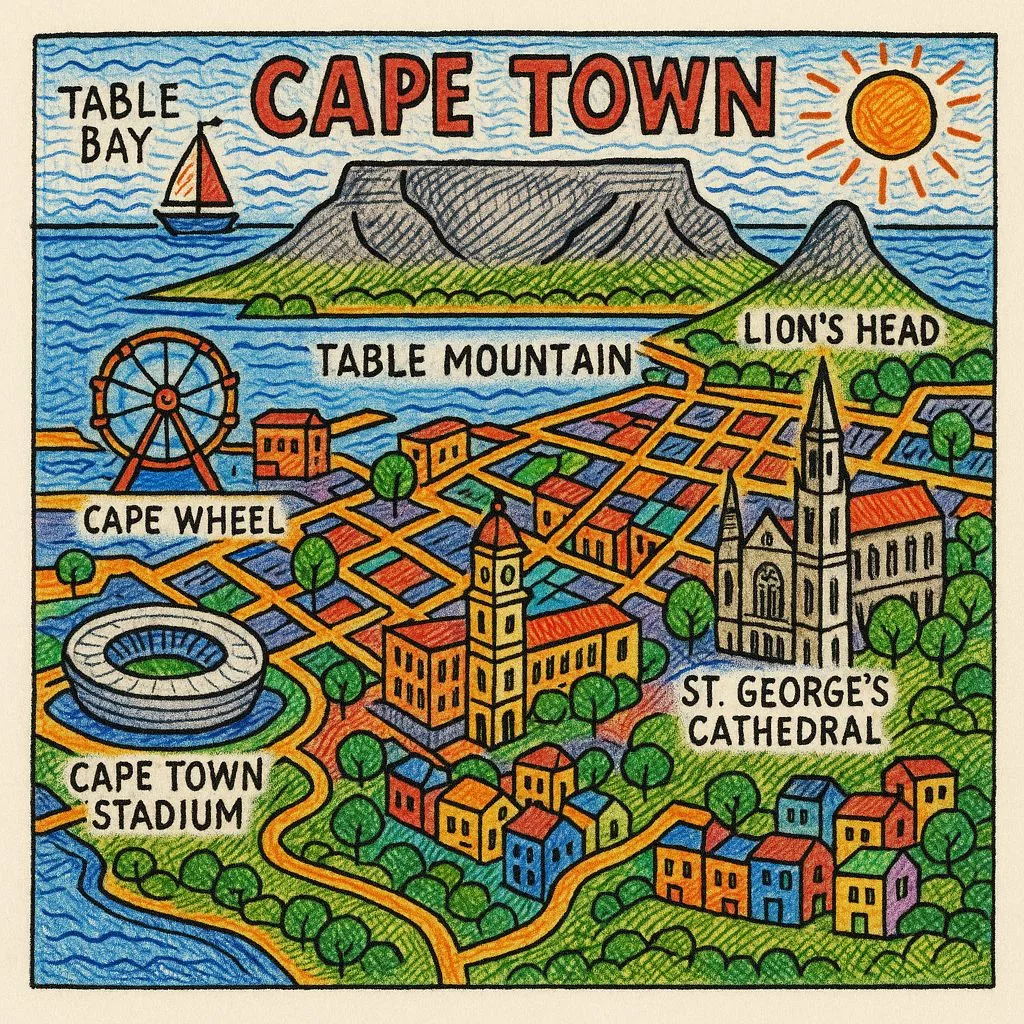
Cape Town is buzzing with young, creative power! Undergraduate designers and artists are turning everyday city life and problems into amazing, award-winning projects. They use local stories, art from shipping containers, and even everyday items to create fresh, unique designs that stand out on global stages. This exciting surge is putting Cape Town’s special “flavour” onto the world map, showing that creativity can bloom anywhere.
What is driving Cape Town’s new creative surge?
Cape Town’s creative surge is driven by undergraduate designers and artists who transform local experiences and challenges into unique, award-winning work. This includes innovative curriculum, partnerships with local communities, and using the city’s diverse landscape and social realities as inspiration for their projects, creating a distinct “Cape Town flavour.”
Dawn in the Districts: Young Blood Rewrites the City’s Visual Grammar
Long before the sun hits Table Mountain, Cape Town’s inner arteries already pulse with a rhythm older than the harbour horns. Espresso pitchers clink on Kloof Street, taxi sound systems thump through the dawn quiet, and the yeasty sigh of nearby breweries drifts down Devil’s Peak. In 2025, however, that familiar soundtrack is being remixed by a wave of undergraduate designers, illustrators, copywriters and art directors who have not yet graduated but have already started dictating how the city looks, talks and sells itself. Their “studios” double as classrooms in Salt River, graffiti-scarred shipping containers in Woodstock, or candle-lit bedrooms in Delft where Adobe Creative Cloud pings at 2 a.m. and deadlines chase dreams.
From these cramped launchpads, portfolios travel faster than luggage: a single Dropbox link can land on judging tables in London, Durban and Johannesburg before the ink is dry. The echo is immediate – statuesque Loerie trophies, D&AD Pencils, Pendoring medallions – yet the supply chain remains stubbornly local. Judges keep noting that the work tastes of sea salt, township dust and fynbos pollen rather than the sanitised neutrality of global mood boards.
The takeaway for observers is clear: the Mother City’s next golden age is not arriving; it is already here, wearing sneakers paid off in instalments and smelling of cutting-studio spray mount.
Inside Red & Yellow: How a Brick Box Became an Idea Rocket
One block back from the N2’s relentless incoming traffic, an unassuming brick façade hides the Red & Yellow Creative School of Business. Behind its walls, September’s Pendoring Awards turned into a personal playground for three BA Visual Communication students: Renée Pedegana, Caitlin Woldu and Tarryn de Wet. They walked into the Artscape Theatre carrying A2 boards that still smelled of solvent; they walked out balancing six gleaming trophies, including two Craft Golds and a Silver for innovation.
Pedegana’s “FUNdasie Werk” re-imagines foundation-phase phonetics as 32 pages of isiXhosa letterforms, each character built from brick shards collected on Langa’s pavements. The rubble’s irregular texture becomes the alphabet’s body, proving that indigenous language can shoulder Western typographic discipline without becoming exotic décor. Judges praised the project for treating isiXhosa as load-bearing structure rather than colourful garnish.
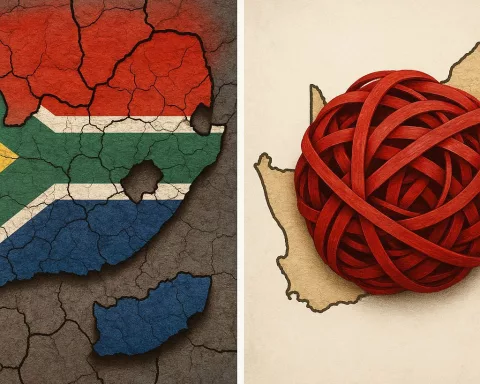
Woldu and De Wet joined forces on “Koppel Kaaps,” a hand-drawn, fictitious map that merges Cape Flats slang with 17th-century Dutch cartography. “Dala jy” sprawls across a Table-Mountain-shaped ridge; “Ghwarra” labels a desertified Flats. Rotring ink meets calf-skin parchment aged in rooibos tannin, producing an artefact that feels half museum piece, half late-night freestyle, and wholly committed to the notion that creole speech deserves copperplate dignity.
From City Hall to Shoreditch: Radio Stutters, Blockchain Seedlings
A week after Pendoring, the same contingent relocated to Cape Town City Hall for The Loerie Awards. Under cobalt lights that once framed apartheid-era council sessions, 1,400 delegates from 16 countries watched Red & Yellow collect thirteen awards – two Golds, seven Silvers, three Bronzes and one Craft Certificate – spanning disciplines from long-form radio to integrated branding.
Second-years Aaliyah Davids and Josh Naidoo snagged Gold for “Stammer Street,” a three-minute radio drama that treats a teenager’s stutter as percussion, looping it over a muted gqom beat until impediment becomes instrument. The tagline, “Every voice has a tempo, let’s dance to it,” reframed disability as compositional opportunity. Crucially, the pair recorded 18 raw hours inside a Mitchells Plain support group, then submitted the rough mix untouched. Juror Alistair King admitted the entry’s lo-fi honesty was “rocket fuel” in a category slick with studio gloss.
July took the story global. At D&AD’s New Blood Awards in Shoreditch, students Jaden Thompson, Nina van Wyk, Chloe Vos and Tyla Lottering answered Spotify’s challenge to weld music discovery to eco-action. Their “Play it Forward” plug-in turns every 60 streamed minutes of local African music into an Outeniqua-Tsitsikamma sapling, GPS-verified and minted as generative playlist art. The team taught themselves enough blockchain coding to prototype the flow, and flew home with the only African Wood Pencil among 1,200 hopefuls. Spotify Johannesburg has since green-lit a December pilot.
Field Notes Before Pixels: How Constraints Manufacture Edge
Industry watchers credit the 2019 curriculum overhaul for the medal haul. Every undergraduate must complete three “Immersion Modules” that force them off campus to gather primary insight before opening a laptop. Partnerships range from taxi associations and church choirs to spaza shops and neighbourhood NGOs. Lecturers call the approach “concept-before-craft,” demanding that every colour, crop or cadence be traceable to something a grandmother said in a Gugulethu kitchen at 9 a.m. Faculty now spend 40 % of contact hours riding shotgun on minibus field trips, but the trophy cabinet suggests the labour buys exponential return.
Cape Town itself doubles as unwilling co-author. Spatial contradictions – sea-view wealth rubbing against apartheid’s still-visible buffer strips – generate creative friction faster than any strategy deck. Blackouts become grainy texture maps; spring-tide floods leave water-stained documents that reappear as Photoshop overlays. Even the 2016-18 drought lives on as the “Day Zero” brief, where students must communicate complex messages – say, menstrual health – using only 25 litres of physical water. A 2024 campaign for UCT’s Period Project used beetroot dye, roof-harvested rainwater and sun-fixed cotton, cutting H2O usage by 92 % and winning a Silver Loerie for sustainable design. Scarcity, it seems, mothers invention better than unlimited Mac-lab budgets.
Corporate South Africa is taking notice. Nando’s now pays third-years real fees to concept packaging that doubles as township street-art stencils. Anglo American, under reputation pressure, commissioned an “Ethical Extraction” brief yielding an AR filter that visualises the city’s historic clay-brick skyline returned to open pits; 2.3 million TikTok views later, the 19-year-old creator interned at the firm in a path she calls “from protest to payroll.”
Ashes, Visas & Fellowships: The After-Party Economy
Global networks hover too. Droga5 London slip-noted five final-year students for apprenticeship visas during a quiet April scouting mission. The One Club invited Red & Yellow to chair the 2026 Young Ones brief, potentially forcing thousands of international submissions to answer to Cape Town township vernacular. Alumni start-ups bloom in the school’s basement: a VR township-story studio, an algae-pigment lab harvesting the V&A Waterfront, a queer zine distributor already stocked at MoMA Design Store. The shared trait is impatience; in a city where inequality grinds on, waiting feels like complicity.
Funding models adapt in real time. A “Pay-It-Forward Fellowship” auctions every winning trophy – even the coveted D&AD Pencil – and banks the proceeds for students from under-represented communities. In 2025 the fund holds R1.8 million, covering tuition and MacBook rentals for 14 Fellows who, in turn, mentor high-school art clubs at home, widening the talent funnel faster than corporate transformation quotas.
Technology is welcomed but shackled. Generative AI is taught as a sparring partner, never a ghostwriter. Students must journal every Midjourney misfire and explain why the algorithm still misses a nuance they witnessed in the field. When Liam Jansen storyboarded an illegal-electricity campaign, he kept the AI’s tilting pylons but replaced its generic shacks with 35 mm photographs from Imizamo Yethu; the hybrid art direction won Bronze at the Loeries, and jury notes praised the “human-tuned algorithm” as secret sauce.
Graveyards, Strobes & Compound Interest: Where Nightlife Meets CVs
Awards are more than egos; they are passports across South Africa’s rigid class boundaries. With national unemployment at 32 %, a Loerie statue becomes a visa stamp HR departments recognise. The school’s 2024 exit survey shows alumni with at least one medal earn starting salaries 38 % higher than non-medalled classmates, compressing student-loan payback from 8.5 years to 5.2. In a country where “creative” is still dismissed as the soft option, trophies convert into compound interest.
Nightlife doubles as curriculum extension. Every Thursday, students haul USBs to The Armoury, a 120-year-old CBD warehouse reborn as rave-cum-gallery. Projection mapping turns cracked walls into moving canvases; anyone bringing original VJ loops drinks free. Ideas that survive the 3 a.m. strobe often reappear, refined, in award annuals six months later. A Gold-winning ASMR gin spot began life on this dancefloor, its 108 BPM brand mnemonic sampled from inadvertently synchronised crowd claps.
Even failure is curated. “The Graveyard,” held monthly in a disused mortuary chapel, invites students to eulogise campaigns killed in crit. The work is then cremated in a steel drum while a trumpeter plays a New-Orleans dirge. Photos of the unburned remnants live on Instagram under @deadbriefs, an account mined by recruiters for risky concepts. Two dead campaigns have already been recommissioned by NGOs, proving that in the attention economy even ashes carry market value.
The Audition Line Starts at Dawn: Three Questions, No Words
Application season sends hopefuls snaking around the block each September. Security guards hand out coffee in cups wrapped with the winning motif from a former student’s packaging brief, reminding the queue that today’s applicant may be tomorrow’s client. Inside the assessment room, panellists ask only three questions: What did you see that nobody else noticed? Who benefited when you wrote it down? And how will you keep the idea alive once the brief is paid for?
Successful candidates answer with artefacts, not words: seedlings bursting from cracked cassette cases; protest signs rewoven as varsity jackets; a working radio built from dumped Cape Flats electronics that picks up only stations broadcasting in indigenous languages. If the object’s story passes the smell test of social relevance, the applicant walks out with a scholarship number and a borrowed laptop, ready to join the assembly line that starts in township kitchens and ends on global stages.
For Cape Town, the formula is simple: turn spatial scars into storyboard beats, let students trip over reality before they open Photoshop, and take the trophies they bring home seriously enough to auction them off so the next kid in line can afford the same shot. The city keeps humming its old song – espresso steam, taxi bass, brewery yeast – but the frequency has been hijacked by transmitters too young to know the rules, and too busy winning to care.
What is driving Cape Town’s new creative surge?
Cape Town’s creative surge is driven by undergraduate designers and artists who transform local experiences and challenges into unique, award-winning work. This includes innovative curriculum, partnerships with local communities, and using the city’s diverse landscape and social realities as inspiration for their projects, creating a distinct “Cape Town flavour.”
How does Cape Town’s creative education system foster this talent?
Cape Town’s educational institutions, like the Red & Yellow Creative School of Business, have revamped their curriculum to include “Immersion Modules.” These modules require students to engage directly with local communities and real-world issues, gathering primary insights before developing digital designs. This approach ensures their work is deeply rooted in local contexts and authentic experiences.
What kind of awards are these young creatives winning?
Cape Town’s young designers and artists are consistently winning prestigious national and international awards, including Loerie trophies, D&AD Pencils, and Pendoring medallions. These accolades span various disciplines, from radio dramas and integrated branding to innovative product design and digital solutions.
Can you give examples of specific award-winning projects?
Certainly! Renée Pedegana’s “FUNdasie Werk” re-imagined isiXhosa phonetics using brick shards from Langa. Caitlin Woldu and Tarryn de Wet created “Koppel Kaaps,” a map merging Cape Flats slang with 17th-century Dutch cartography. Aaliyah Davids and Josh Naidoo won a Gold Loerie for “Stammer Street,” a radio drama using a teenager’s stutter as percussion. Jaden Thompson, Nina van Wyk, Chloe Vos, and Tyla Lottering developed “Play it Forward,” a Spotify plug-in that plants trees for every streamed minute of local African music.
How do these creative initiatives contribute to the local community and economy?
Beyond awards, these projects have tangible impacts. Corporate entities like Nando’s and Anglo American are commissioning student work, leading to paid opportunities and internships. A “Pay-It-Forward Fellowship” auctions off award trophies to fund tuition and resources for students from under-represented communities, thereby broadening access to creative education and fostering new talent.
What is the long-term impact of this creative surge on Cape Town and its artists?
This creative surge is transforming Cape Town’s identity on the global stage, showcasing its unique “flavour.” For artists, winning awards serves as a “visa stamp” for career advancement, leading to significantly higher starting salaries and faster repayment of student loans. It also fosters a dynamic ecosystem of alumni start-ups and global partnerships, ensuring a continuous flow of innovation and opportunity.