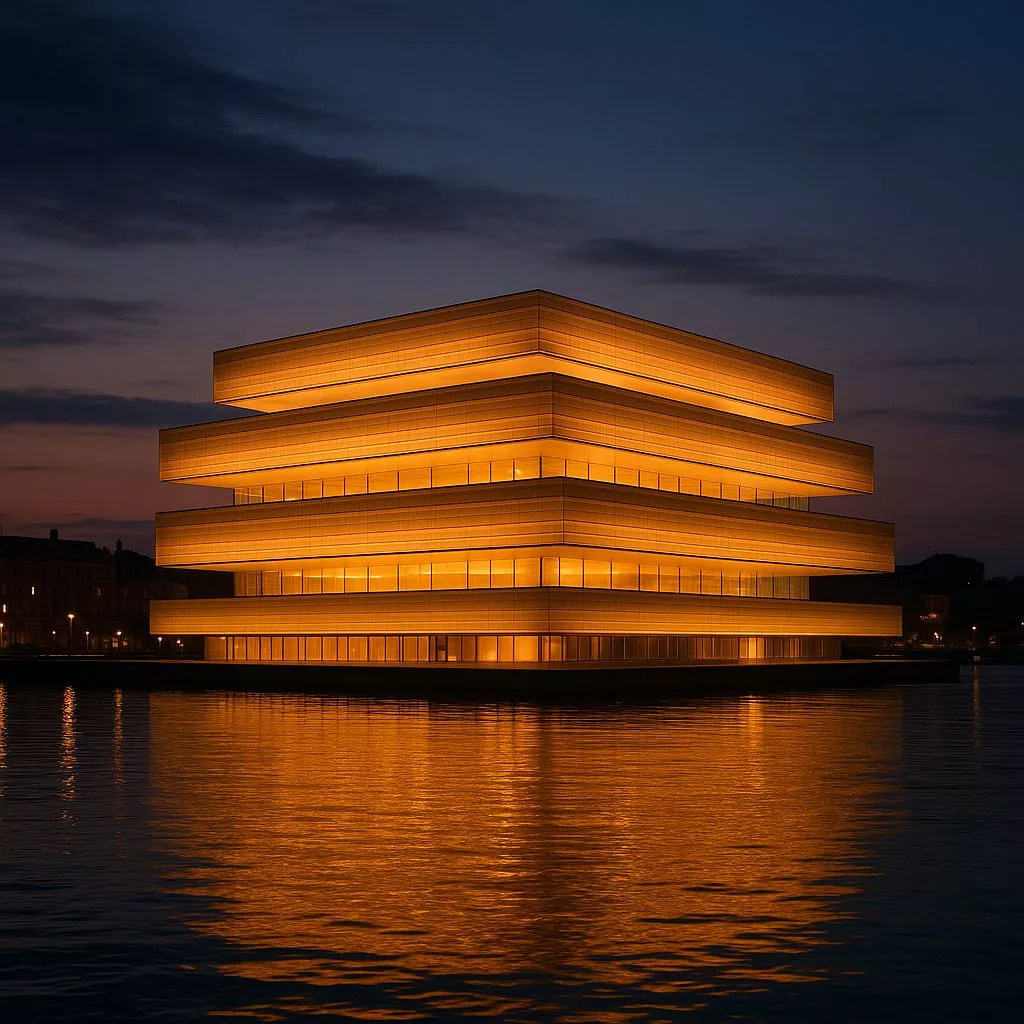
Get ready for a super cool new hotel in Cape Town! It’s called The Cape Town Edition and it’s going to be really fancy and special. This hotel is designed to be part of the city, using local stuff and even helping the environment. It will have amazing views of the mountain and the ocean, making it a truly unique place to stay. This hotel is a big deal, costing a lot of money and aiming to be one of the best luxury hotels in all of Africa!
What makes The Cape Town Edition a unique luxury hotel in Africa?
The Cape Town Edition stands out by blending local culture and sustainable practices with luxury. It features a unique design that tames Cape Town’s winds, a sundial precinct for year-round enjoyment, hyper-local materials, and carbon-negative conferencing, making it a culturally magnetic destination.
A Continent’s Missing Puzzle Piece
Cape Town’s working harbour will gain a fresh low-rise landmark in 2026, a horizontally stepped edifice that will light up at dusk like a giant paper lantern and mirror the shifting blues of Table Bay by day. Officially christened The Cape Town Edition, the project is still only a crater ringed by tower cranes, yet the name is already travelling the world faster than the concrete can rise. Last Thursday’s signing between Marriott International and V&A Waterfront Holdings did more than add 142 guest keys and six serviced apartments to the city; it slipped Cape Town into Edition’s ultra-exclusive atlas of “culturally magnetic” destinations, a club that currently lists Bodrum, Reykjavik and Tampa, and, until Tokyo debuts later this year, no African point at all.
Edition’s parent has spent ten years hoovering up almost every imaginable luxury badge – think Ritz-Carlton yachts, St. Regis safari lodges, W-branded desert camps – yet the world’s second-largest continent remained blank on its map. The gap turned awkward: the tally of ultra-wealthy travellers touching down in Africa has doubled since 2013, and Cape Town alone welcomed 2.6 million foreign visitors in 2023, a figure nudging pre-pandemic Barcelona levels. The hold-up was never demand; it was the scarcity of a site that met Edition’s unwritten law – each property must “flip the city inside out,” funnelling guests straight into the smells, sounds and vistas they could not taste anywhere else.
That criterion was finally met by Quay 7, an 8.5-hectare wedge of reclaimed land trapped between the Nelson Mandela Gateway to Robben Island and the new Granger Bay super-yacht basin. From the future rooftop lounge, patrons will glance south-west across a working dock still laced with kelp and diesel, north-east to the carnival swirl of the Watershed craft market, and dead south to Table Mountain’s sandstone ramparts – an unchanged tableau since Portuguese caravels sketched it on sixteenth-century charts.
A billion-rand ticket grabs attention in a market where a conventional five-star asset costs roughly half that, yet Edition’s maths is planetary. Madrid’s outpost, opened in 2022, paid back its entire equity in nineteen months on food-and-beverage receipts alone; Barcelona’s property sells 42 % of its inventory on five-night-or-longer stays at an average daily rate north of €950. Cape Town’s comparable stock presently hovers around R7 800 (€390), leaving the brand what revenue chiefs gleefully call “head-room.” Internal memos target a RevPAR premium of 35 % above the city’s existing luxury pack, a move that would make the Edition the first hotel south of the Sahara to crack the US$600 RevPAR ceiling outside the safari circuit.
A Design That Tames Wind, Time and Memory
Shanghai-based Neri & Hu and Cape Town studio StudioMAS co-wrote a brief that reads like cultural-studies coursework: “distil a trading-post metropolis – Dutch, Malay, Khoi, Victorian, Bauhaus, post-apartheid – then re-compose it as a sequence of courtyards, thresholds and curated views.” Lyndon Neri’s first site inspection coincided with a southeaster so vicious it scoured the team’s drone lenses; rather than curse, he envisaged a weather event that architecture could choreograph. The result is a façade sliced into horizontal louvres that pivot eighteen degrees, an angle tuned to turn the “Cape Doctor’s” blasts into gentle eddies fit for year-round alfresco dining. Local codes demand new buildings survive 160 km/h gusts; Edition’s engineers designed to 200 km/h and tucked tuned-mass dampers – gear normally planted on skyscraper summits – into the pool deck so ripples never become waves during February gales.
Material decisions follow the same glocal recipe. Lobby terrazzo is seeded with crushed Clanwilliam sandstone – the very rock that caps Table Mountain – yet the technique salutes Venetian merchants who once berthed where the hotel now rises. Headboards are woven from reeds cut along the Olifants River, then vacuum-pressed into resin panels using surfboard science; the motif echoes the checkerboard façades of 1830s Bo-Kaap houses, but shrunk to pixel scale so guests register abstract art long before they sense heritage. Kalahari black-and-white marble clads the bathrooms; the stone is so dense it dulls CNC bits. Off-cuts will be re-cut into cheese boards retailed in the gift shop – housed in a shipping container that once imported the very marble it now dispenses as memoirs.
Edition’s nightlife credo – bars that open at five and close only when the last reveller bows – runs straight into Cape Town’s solar curve: summer sundowns at 8 p.m., winter ones at 6. The fix is a “sundial precinct.” A forty-five-metre infinity pool stretches east–west so the sun appears to sink into the water whatever the month. Beneath it, a double-volume salon flips from co-working lounge to jazz cellar in thirty minutes thanks to rotating wall panels wrapped in fishing-net felt. DJs spin from a console carved out of the same sandstone underfoot in reception, guaranteeing bass notes warm rather than rattle. The yet-unnamed flagship bar will pour a single-malt finished in Pinotage casks – co-distilled with Bains Cape Mountain Whisky and unavailable anywhere else on the planet, duty-free included.
Culture is also measured in people. Edition’s talent scouts have locked in Athi-Patra Ruga to craft a staff-uniform line that mutates each quarter; Cape Town Opera will stage 3 a.m. “after-hours” recitals in the subterranean spa; and chef Wandile Mabaso – fresh from a New York Michelin stage – will fire a pan-African grill using vine cuttings from Constantia estates, lending Karoo lamb a whisper of Chenin Blanc. Employees, branded “hosts,” wear lapel pins that light up in the tongues they speak – isiXhosa, Afrikaans, English, French, Portuguese, Mandarin, Arabic or sign. Guests can filter the hotel app to locate a French-speaking bartender at 2 a.m. or a sign-fluent spa therapist for a deaf partner.
Residences, Wellness and the Business of Wow
The six serviced apartments – price tags between R28 million and R55 million – are already 70 % spoken for, half by South African renewables tycoons, the rest by diaspora Africans in London and Geneva craving a turnkey pied-à-terre with five-star backups. Owners pocket forty calendar nights a year; the balance joins the hotel pool under a 60/40 revenue split in their favour. Strata rules outlaw gold taps or leopard wallpaper – Edition must resell the space overnight without a hiccup – yet “soft” identity is allowed: a painting that can be wheeled into storage, or a birth-vintage stash pre-loaded by the head sommelier, ready to pour the moment the owner lands.
Latitude –33 demands its own wellness script. The spa will practise “algotherapy,” deploying kelp harvested the same dawn from the Atlantic side of the peninsula and trucked in chilled drums to beat oxidation. Therapists – recruited in coastal villages like Hermanus – blend Viking seaweed wraps with Xhosa umphokoqo grain scrubs. A post-treatment flotation pool is calibrated to 17 °C, the exact ocean reading that raises great-white warning flags – minus the sharks. Guests exit to a fire-pit deck where biltong and droëwors restore the sodium lost to cold-water immersion.
Conferences will bankroll a quarter of annual income, a far larger slice than in sister properties, because Cape Town’s association market is white-hot: medical congresses flee the European winter, film summits chase the weak rand, tech behemoths sync launches with “Tech Safari” side tours. The 1 200 m² pillar-free ballroom hovers one floor above sea level so waves slap the glass at high tide; a Meyer sound array tuned to pink noise masks ocean hiss so keynote speakers stay audible. Retractable façades reveal a 450 m² terrace where canapés can be drone-dropped from the kitchen deck one level up – both crowd-pleaser and load-shedding insurance: when lifts stall, drones still fly on battery power.
Sustainability clauses are baked into every supplier contract. Grey-water from sinks feeds the rooftop herb beds; black-water is treated to irrigation grade, then piped two blocks north to nourish the Waterfront’s new drought-proof park. Photo-voltaic fins sheath the west frontage, delivering 18 % of annual demand; the shortfall is covered through a fifteen-year power-purchase deal with a Northern Cape solar array, tracked minute-by-minute via blockchain certificates. Single-use plastics are verboten – room keys are whittled from leftover Pinotage staves, burgers arrive in sugar-cane pulp boxes that compost in ninety days. The show-stopper is carbon-negative conferencing: every delegate’s return flight is offset plus 20 %, paid from the hotel’s marketing levy rather than the client’s budget, a cost Marriott swallows in exchange for the right to call itself “Africa’s first carbon-negative meetings product.”
Streets, Sharks and the 186-Degree Solstice
Neighbourhood ties run deeper than press-release jargon. Edition funds a three-year residency for Cape Town artists who must run free workshops in adjacent Green Point and Salt River. A street-level gallery will sell their work with zero commission; proceeds split 50/50. The loading bay morphs into a micro-cinema on Tuesdays, projecting African sci-fi with directors in attendance; admission is free if you arrive by bicycle, subsidised by a transport budget that would otherwise bank Uber credits for staff. Even the employee canteen – usually a hidden calorie bunker – opens one lunch slot a week to local hospitality students, feeding future talent and ticking B-BBEE boxes in one stroke.
Getting there will soon be half the fun. The seldom-used Waterfront helipad becomes an Edition-branded shuttle to the winelands, trimming a 45-minute traffic slog to twelve minutes of aerial scenery. For tighter budgets, electric-water-taxi operator OceanX will dock at Quay 7, zipping guests to Camps Bay in twenty minutes for ride-hail money – plus complimentary prosecco. The city’s MyCiTi bus loop will bend toward the hotel entrance; Edition will underwrite 70 % of the annual subsidy, effectively bankrolling public transport for commuters who may never sleep in the building but whose daily ride now carries the Edition logo.
Security – in a metropolis famed for stark disparity – has been soft-sold as “invisible.” Razor wire is banished; landscape architect Peter Holderness planted a thicket of milkwood and boophone whose tangled limbs form a living barrier impossible to scale without botanical evidence. Cameras hide inside light poles forged by local blacksmiths to echo whale vertebrae; facial-recognition is disabled by policy, a sop to European GDPR jitters. Every floor contains a “quiet room” that deadbolts from the inside – legacy of Mumbai-terror drills – yet marketed to Americans as a tornado refuge for anyone who can’t pronounce “southeaster.”
Booking physics will invert the norm. Edition’s global channel mix runs 60 % direct, but Cape Town is projected at 70 % thanks to loyalty pent-up inside 180 million Marriott Bonvoy accounts, 3.2 million of whom tag Africa as a “dream” continent. Pre-opening sales will fire up eighteen months early via NFT deposits; each token is both a room night and a tradable collectible, a Miami pilot that pulled US$4 million in working capital before ground was even broken.
And then there is the view. During site surveys the architects discovered that the exact bearing from rooftop bar to Table Mountain summit is 186 degrees – the same azimuth along which the sun drops on 21 December, the southern solstice. They calibrated the parapet so that on that night, and only that night, the solar disc kisses the mountain silhouette for fifty-two seconds. Marketing has already christened the alignment “Solstice Shelf.” Invites will be capped at 186 guests, matching the degree count; each will receive a compass engraved with the hotel’s GPS coordinates. By 2027 the moment will be live-streamed to every Edition on earth, quietly anointing Cape Town the brand’s temporal Greenwich.
What is The Cape Town Edition?
The Cape Town Edition is a new luxury hotel being developed in Cape Town, South Africa. It’s designed to be a significant landmark, blending local culture, sustainable practices, and unique design features with high-end hospitality. It aims to be one of Africa’s premier luxury destinations.
When is The Cape Town Edition expected to open?
The hotel is expected to open in 2026. This date is associated with the low-rise landmark being built in Cape Town’s working harbour.
What makes The Cape Town Edition unique in terms of design and sustainability?
The hotel’s design by Neri & Hu and StudioMAS incorporates horizontally stepped edifices with pivoting louvres to mitigate Cape Town’s strong winds, making outdoor spaces enjoyable year-round. It uses hyper-local materials like crushed Clanwilliam sandstone and Olifants River reeds, and boasts carbon-negative conferencing, treating black-water for irrigation, and powering 18% of its demand with photovoltaic fins, with the rest from a Northern Cape solar array.
Where is The Cape Town Edition located, and what views will it offer?
It is located at Quay 7 in Cape Town, an 8.5-hectare wedge of reclaimed land between the Nelson Mandela Gateway to Robben Island and the new Granger Bay super-yacht basin. From its rooftop lounge, guests will have views of a working dock, the Watershed craft market, and Table Mountain.
What are some of the distinctive features for guests at The Cape Town Edition?
Guests can expect unique experiences such as a 45-metre infinity pool designed as a “sundial precinct,” a flagship bar offering a single-malt finished in Pinotage casks unique to the hotel, and a spa with “algotherapy” using freshly harvested kelp. Staff, known as “hosts,” will wear light-up lapel pins indicating the multiple languages they speak, and there will be 3 a.m. “after-hours” recitals by the Cape Town Opera in the subterranean spa.
How is The Cape Town Edition integrating with the local community and culture?
The hotel is deeply integrated with local culture. It funds a three-year residency for Cape Town artists who run free workshops and sell their work commission-free in a street-level gallery. The loading bay transforms into a micro-cinema for African sci-fi films, and the employee canteen offers lunch slots to local hospitality students. It also features uniforms designed by Athi-Patra Ruga and a pan-African grill by Chef Wandile Mabaso using local ingredients.