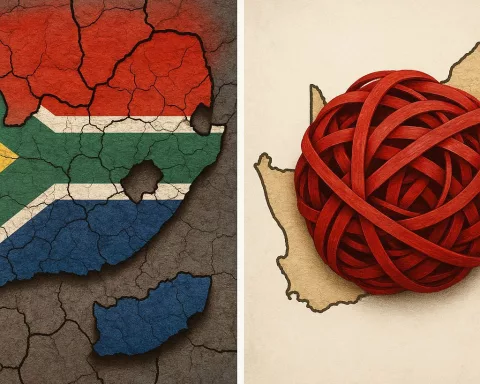

Cape Town has a big problem: bad guys are shaking down businesses and projects for money. They act like “taxmen” in townships, making building costs shoot up and forcing small shops to close. These criminals cause fear, stop important work, and even kill people who get in their way. It’s like a shadow government taking over, making life hard for everyone and costing the city tons of money. People are scared, and it’s unclear how this dangerous situation will ever truly end.
How does extortion impact Cape Town’s public-works projects and township economy?
Extortion in Cape Town significantly inflates public-works project costs, leading to abandoned contracts and substantial financial losses. It cripples township commerce by forcing small businesses to deregister, causing job losses, and creating a climate of fear that demands protection money for basic services and security.
1. From Building Site to Battlefield – the R112 million depot that blew the lid off
The MyCiTI Spine Road depot was meant to be a simple bus depot: 17 hectares of former coastal thicket wedged between Khayelitsha’s Mew Way and the N2. Instead, it has become the clearest X-ray of how organised crime is hijacking Cape Town’s public-works pipeline. When construction began in 2021 the City ticked every treasury box – open tender, 30% local-subcontracting rule, B-BBEE scoring matrices. Bidvest Protea Coin walked away with the R112 million security package. One of its 14 nominated sub-contractors, Sibakhulu Security & Projects, was barely three months old, hatched inside a Philippi shipping container. Its 29-year-old owner, Bongani “Bizza” Siyotula, had no construction pedigree, yet arrived with 120 self-styled “area patrol marshals” paid in folded cash at the gate.
Within a year the marshals had turned into a private toll-booth. Concrete mixers were charged R5 000 gate money, portable toilets R1 000 each, electricians forced to surrender 5% of every invoice. Non-payers woke up to missing keys, cement poured into excavations, or – in one spectacular case – a R1.3 million electrical kiosk reduced to molten plastic. Site managers began calling the surcharge “the Bizza levy.” By October 2024 Bidvest had cancelled the sub-contract, triggering the November civil interdict that now forces SANCO and its alleged surrogates to stay 200 m from the perimeter. It is the first time the City has used a civil court order as a surgical strike instead of waiting for overburdened criminal prosecutors.
2. Colour-Coded Fear – the secret map that shows only three “green” projects in the entire metro
A confidential risk dossier, stamped “Legal Privilege” and leaked to GroundUp in March 2025, lists 43 capital works from Langa cemetery to Dunoon’s bulk-sewer trench. Forty are either red (“extortion saturated”) or amber (“sporadic intimidation”). Contractors have quietly walked away from nine red sites, abandoning bid deposits and bank guarantees rather than absorb protection premiums that can inflate build costs by more than a third. The unit now recommends that every new tender price clause include an “extortion contingency” – a line item finance officers must justify to National Treasury.
The same spreadsheet tallies 11 SANCO office-bearers assassinated in 48 months, one every 16 weeks. Ballistic tests link six of the murders to a single batch of 9 mm Parabellum stolen from Bellville South police armoury in 2019, suggesting a rental-hit market where the gun, not the shooter, is the commodity. The signature is chillingly consistent: dawn ambush outside the target’s home, single shooter plus lookout on a stolen scooter, escape across wetlands where licence-plate cameras were either stripped for copper or never installed. Four dockets sit with the Hawks’ Organised Crime Component; the NPA will say only that “investigations are ongoing.”
3. Guilds, Ghosts and Golf Shirts – how protection money seeps into every crease of township life
Business forums have sprouted across Khayelitsha and surrounding townships, operating like medieval guilds. A builder must fork out an “entrance fee” (R20 000 or a double-cab bakkie) plus a weekly “float” (2% of every invoice) to a committee that claims to speak for “the community.” Veteran contractors say the giveaway is paperwork: a stamped receipt and a grievance WhatsApp number usually signals a legitimate forum; cash collected after dark points to plain racketeering.
Technology is weaponised on both sides. Investigators have traced 200 ghost Facebook accounts that geofence construction zones, pushing rumours of imminent shutdowns so legitimate subbies withdraw. One WhatsApp group, “Amabhereth,” circulates daily spreadsheets of City staff number plates and offers R3 000 for every MyCiTI dashboard camera disk. Meanwhile the metro itself is burning cash: between September 2024 and March 2025 it spent R100 million – R5.2 million a month – on protection details. Even so, extortionists now demand “night premiums” for concrete pours after 10 p.m., the hour when escort teams clock off.
Outside the building sector the tentacles reach spaza shops (a “shelf levy” to avoid stock confiscation), shebeens (a “music licence” to keep playlists running past midnight), even crèches (mandatory “playground insurance”). Gogo Noks, neighbour to slain SANCO leader Myolisi Magibisela, remembers the killers arriving at 5:12 a.m., accepting coffee, then walking Magibisela to his bedroom before shooting him. “That is a message,” she says. “We can reach anyone, anywhere.” His death shut 17 schools for 48 hours and pushed 12 000 pupils out of exam halls; a crisis council of clergy, principals and taxi bosses now demands a dedicated extortion court modelled on the 2012 drug tribunals.
4. Balance of Terror – can taxpayers and thugs co-exist on the same payroll?
The rand-value of fear is measurable. UNODC formulas (abandoned contracts + protection premiums + murder-related delays) put the 2024/25 loss at R2.1 billion – 0.45% of Cape Town’s GDP. Township commerce feels the sting more keenly: 4 600 foregone jobs, 900 small firms deregistered at CIPC, a 22% spike in insurance claims tagged “politically motivated loss.”
Hope, of a sort, is franchised by a new cadre of “compliance brokers.” For a 4% facilitation fee they pre-negotiate protection rates, supply vetted local sub-contractors and man a 24-hour armed-response hotline. Cela Solutions, run by ex-MK operative Lulama Qasana, claims it cut site stoppages by 70% on a R480 million Delft housing scheme by absorbing former extortionists into the value chain as labour-intensive subcontractors with pay slips and tax numbers. “You give a man a payslip, he thinks twice about burning the site that feeds him,” Qasana argues.
Yet symbolic reminders outpace spreadsheets. At Spine Road the depot’s fresh asphalt already carries scorched rubber donuts – an informal memo that an interdict is just paper. SANCO’s return date is 20 February 2026, when a judge must decide whether the organisation itself, and not freelance flag-bearers, orchestrated the violence. Until then the buses wait under dust covers, keys locked behind two biometric doors. Drivers resume training in January. Whether commuters climb aboard without glancing over their shoulders will hinge on a calculation no court can issue: the price of a bullet weighed against the price of a ticket, the speed of trust against the gravity of fear.
What is the primary issue plaguing Cape Town’s townships and public-works projects?
Cape Town is facing a severe problem of extortion, where criminal elements act as “shadow taxmen” in townships. They demand money from businesses and public-works projects, inflating costs, forcing closures, and creating a climate of fear. This effectively acts as a “shadow government” disrupting legitimate operations and costing the city significant resources.
How does this extortion specifically impact public-works projects and the township economy?
Extortion significantly inflates the costs of public-works projects, often leading to abandoned contracts and substantial financial losses. For the township economy, it cripples commerce by forcing small businesses to deregister, causing job losses, and instilling fear. Businesses are often forced to pay protection money for basic services and even security.
What is the “Bizza levy” and how did it originate?
The “Bizza levy” refers to illegal surcharges demanded by self-styled “area patrol marshals” at construction sites, such as the MyCiTI Spine Road depot. These marshals, led by Bongani “Bizza” Siyotula, imposed fees on concrete mixers, portable toilets, and demanded a percentage of electricians’ invoices. Non-compliance led to vandalism and destruction of property, making construction significantly more expensive and dangerous.
How widespread is the extortion problem in Cape Town, and what are its consequences?
The problem is widespread, as indicated by a leaked confidential risk dossier showing that 40 out of 43 capital works projects are either “extortion saturated” or experiencing “sporadic intimidation.” This has led to contractors abandoning projects, and the city is now considering an “extortion contingency” in tender price clauses. The human cost is also severe, with 11 SANCO office-bearers assassinated in 48 months, suggesting an organized “rental-hit market.”
How do these extortion schemes operate within townships, and what methods do they use?
Extortion schemes often operate through “business forums” that act like medieval guilds, demanding