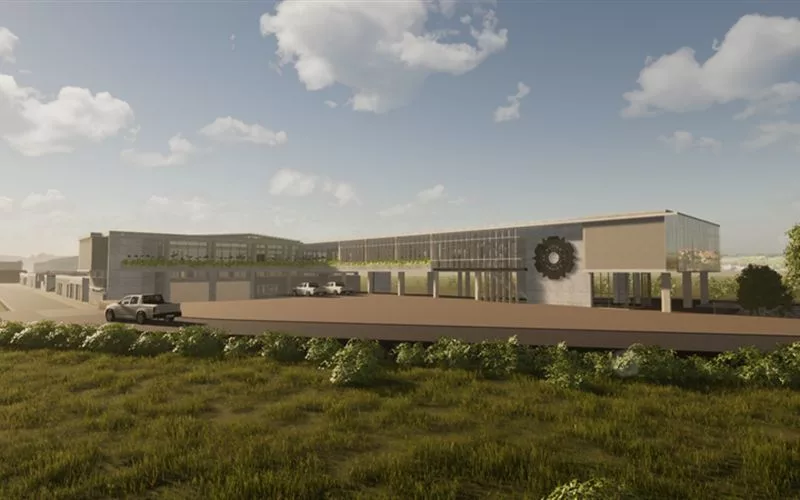
Cape Town is building two huge projects to get water. One project will clean sewage water, turning yesterday’s flush into tomorrow’s drink! The other project will take salty ocean water and make it fresh. These plans will give Cape Town lots of water by 2030, so they won’t have to worry about running out, even without much rain. It’s a big step to make sure everyone has water for years to come. These projects are like magic, making sure the city’s taps keep flowing!
How will Cape Town secure its water supply against future droughts?
Cape Town is implementing two mega-projects, the Faure New Water Scheme and the Paarden Eiland seawater plant, to deliver up to 170 million litres of water daily by 2030. These Public-Private Partnerships will tap into recycled sewage and filtered seawater, reducing reliance on rainfall and ensuring water security for the growing population.
1. The political pivot that made rain a side-show
Councillors rarely swoon over pipe diameters, yet on 4 December 2025 every hand in Cape Town’s chamber went up for a pair of dossiers thicker than phone books.
The decision was labelled “in-principle”, but in municipal law that word carries the weight of a guillotine blade: administration must now open the market, run a two-stage bid and have water flowing by 2030.
Together, the Faure New Water Scheme and the Paarden Eiland seawater plant will deliver up to 170 million litres a day – more than a third of what citizens now drink, cook and shower with – without waiting for a single cloud to burst over the Hottentots Holland mountains.
The package is wrapped inside a Public–Private Partnership, a creature equal parts lease agreement, Olympic gymnastics routine and risk-relocation device that keeps the debt off the City’s balance sheet while locking builders into penalties if promised droplets fail to appear.
Behind the vote lies a sobering stack of climate models.
University of Cape Town engineers, together with Danish hydrology group DHI, ran a million synthetic weather years through their computers and found that, even with new infrastructure, a Day Zero-scale drought could strike one year in twelve by 2040; skip the build-out and the odds leap to one in four.
Numbers like that convert even the most conservative politician into a fan of private capital, because PPPs promise speed and someone else’s shareholders carry the pain if geology or algae refuse to cooperate.
Consequently, rainfall augmentation – once the star of every water plan – has been downgraded to supporting actor; the headline roles now belong to recycled sewage and filtered seawater.
2. Turning yesterday’s flush into tomorrow’s drink
Faure, halfway between the vineyards of Stellenbosch and the tin roofs of Khayelitsha, already smells of chlorine and damp grass thanks to an ageing 150 megalitre-per-day sewage works surrounded by maturation ponds.
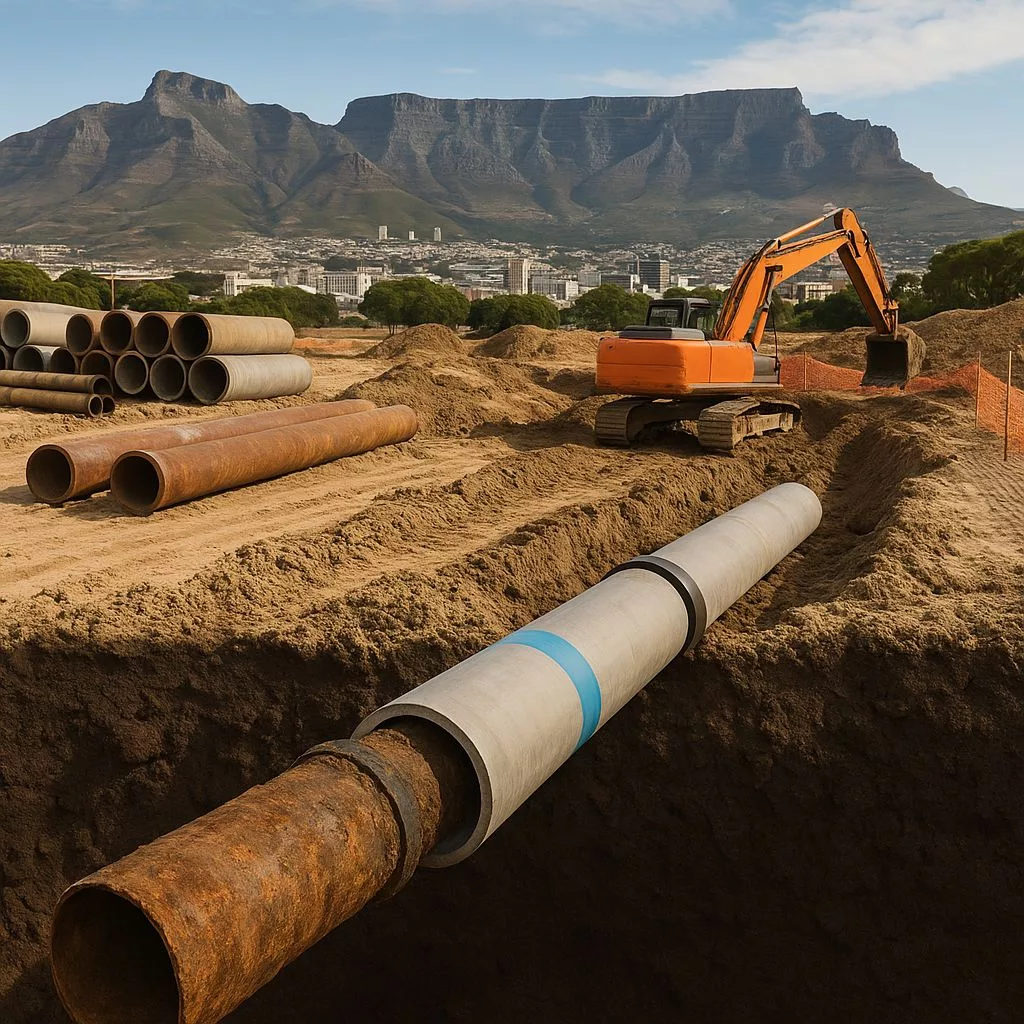
Next door, the City will bolt on a high-tech campus that sucks secondary-treated effluent straight out of the existing plant, scrubs it through a membrane bioreactor and low-pressure reverse-osmosis racks, then pumps the polished product 38 kilometres to the Blackheath reservoir where it will vanish into the normal supply network.
Energy appetite is budgeted at 0.9 kilowatt-hours per cubic metre – on par with Singapore’s much-lauded NEWater – thanks to variable-frequency drives, a rooftop solar farm the size of 18 soccer pitches and tiny turbines inside the brine stream that recycle hydraulic pressure like a bicycle freewheel.
What leaves the plant will not be the faintly green liquid currently irrigating nearby paddocks; it will pass a final ultraviolet advanced-oxidation barrier purpose-built to break down headache-inducing residues such as NDMA, a carcinogen sometimes born of chlorination.
Saltier leftovers will travel through a 1.2-kilometre rock tunnel bored beneath the dunes and trickle out through a seabed diffuser 50–60 metres below the surf, diluting to background salinity long before lobster larvae notice a change.
Because the new train abstracts effluent before the maturation ponds, existing farmers keep their free water; only the quality of what reaches them will improve as the overall load on the ponds drops.
Come 2031, up to 100 million litres of former flush will re-enter kitchens and coffee makers every day, invisible, odourless and indistinguishable from conventional supply.
3. Converting an old rail spur into an ocean-water straw
Paarden Eiland, once a neighbourhood of tyre factories and molasses sidings, has been rezoned “mixed-use waterfront utility”, the kind of bureaucratic poetry that signals pipes instead of pubs.
A 12-hectare brownfield wedge between Marine Drive and the R27 will host six reverse-osmosis halls fed by a 2.2-kilometre intake tunnel laid 14 metres below chart datum and capped by a 400-metre cigar-shaped velocity hood that slows the inflow so West-Coast rock lobster larvae can swim away.
Inside the complex, dual-media filters the size of backyard swimming pools strip algae and silt before the brine hits 16-inch Dow Filmtec membranes arrayed like organ pipes; post-treatment re-calcifies the water with crushed dolomite and a whiff of chlorine to protect pipes all the way to taps in suburban Bellville.
Concentrate that once would have been labelled waste is now an ingredient: a 5-to-1 blend with cooling water from the neighbouring Chevron refinery drops salinity to within two percentage points of ambient before the mix glides back into the harbour through a custom diffuser that meets its dilution target within 50 metres.
Initial capacity is 50–70 million litres daily, but civil designers have already poured the extra slabs and pipe racks needed to plug in two additional 25-million-litre trains without turning another clod of soil.
Environmental authorisation came with strings – real-time salinity probes must stream data to the government’s coastal observatory and discharge temperature may not nudge the sea warmer by more than two degrees – conditions the plant can meet only if operators choreograph refinery flows and membrane cleanings like air-traffic controllers.
4. Money, muscle and megabytes: how the deal stays glued together
Treasury Regulation 16, plus two thick practice notes, governs every comma in the 20-year design-build-finance-operate concession.
Seventy percent of the monthly invoice is “availability” money: if either plant drops below 95 percent volume or 99.5 percent water-quality compliance, chunks of revenue evaporate faster than spilled champagne.
Another fifth of the fee is performance-driven – measured against benchmarks such as kilowatt-hours per kilolitre, chemical grams per litre and staff per shift – while the remaining ten percent hangs on environmental scores: odour complaints, salinity spikes, sludge dryness.
Tariffs will creep upward each year using a basket of indices – 60 percent consumer inflation, 25 percent electricity inflation, 15 percent chemical prices – while currency risk is caged inside the private consortium, which must hedge every imported membrane and pump.
Balance-sheet math shows Faure swallowing R10.1 billion and Paarden Eiland R8.4 billion in 2025 money, one-third of it equity from bidder consortia expected to weave together French utility giants, local heavy-civil firms and local-government pension funds.
The remaining 65 percent will be debt wrapped by political-risk insurance and a partial guarantee from the Development Bank of Southern Africa, priced at roughly 2.25–2.50 percentage points above Jibar.
Cape Town itself only coughs up R1.8 billion for “enabling” bulldozer work – outfall tunnel, grid upgrade, road realignment – costs that are clawed back later through lower unitary charges once the taps open.
An early-works clause lets the winning team pour concrete twelve months before banks sign final paperwork, shaving a full year off the schedule by paying cancellation-insurance premiums instead of watching idle cranes rust.
Jobs will follow the money: 6 100 direct job-years during the construction binge of 2027-30, plus 330 permanent plant operators, laboratory chemists and drone pilots.
A 24-month Water Artisans Academy – co-financed by the Energy & Water Sector Education Training Authority – will school 600 young residents in HDPE welding, SCADA coding and membrane wrangling, guaranteeing first interviews for operator vacancies.
Local-content quotas bite hard: 40 percent of mechanical parts, 55 percent of civil concrete and 100 percent of unskilled labour must originate inside South African borders, with bonus evaluation points reserved for suppliers registered in the adjacent Cape Flats townships.
Beyond balance sheets and pay slips, residents will watch progress through virtual reality.
A public “New Water” portal already hosts drone-captured 3-D photogrammetry updated monthly; once pipes hiss, 1 600 internet-connected sensors will feed a pair of open-data digital twins that engineering students – or suspicious activists – can interrogate in real time under a Creative Commons licence.
Complaints route through a WhatsApp bot fluent in isiXhosa, Afrikaans and English that promises a human answer within 24 hours, while an independent Water Advisory Board chaired by the University of the Western Cape can trigger municipal step-in rights if community satisfaction dips below 75 percent for two quarters running.
The first ten million litres from Faure are scheduled to enter the network in April 2030; three months later both plants should hum at full song, pushing Cape Town’s water security beyond the horizon of the next drought.
Expansion beckons: Faure can double to 200 million litres, Paarden Eiland to 120 million, if StatsSA’s high-growth scenario proves true and 7.2 million people call the metro home by 2040.
Until then, the City can redirect surplus drops to neighbouring Stellenbosch or Drakenstein at marginal cost, seeding an informal bulk-water market that may outlive the original PPP contracts.
Rain, when it falls, will still be welcome; it just will no longer be vital.
What are the two mega-projects Cape Town is undertaking to secure its water supply?
Cape Town is investing in two major projects: the Faure New Water Scheme, which will treat and recycle sewage water, and the Paarden Eiland seawater plant, which will desalinate ocean water. These projects are designed to significantly increase the city’s water supply.
How will these projects ensure water security for Cape Town by 2030?
By 2030, the Faure New Water Scheme and the Paarden Eiland seawater plant are projected to deliver up to 170 million litres of water daily. This substantial increase in supply, derived from recycled sewage and desalinated seawater, will reduce the city’s dependence on rainfall and mitigate the risk of water shortages, even during droughts.
What technology will be used to treat sewage water at the Faure New Water Scheme?
The Faure New Water Scheme will utilize advanced treatment processes including a membrane bioreactor, low-pressure reverse-osmosis racks, and a final ultraviolet advanced-oxidation barrier. This multi-stage process will ensure that the recycled water is thoroughly cleaned, breaking down contaminants and producing water invisible, odourless, and indistinguishable from conventional supply.
How will the Paarden Eiland seawater plant desalinate ocean water?
The Paarden Eiland plant will use reverse-osmosis technology. Seawater will be drawn through a 2.2-kilometre intake tunnel, filtered to remove algae and silt, and then passed through 16-inch Dow Filmtec membranes. Post-treatment involves re-calcifying the water with crushed dolomite and a small amount of chlorine to make it suitable for drinking and distribution.
How will these projects be financed and managed?
Both projects are structured as Public-Private Partnerships (PPPs) with 20-year design-build-finance-operate concessions. The financing involves a mix of equity from bidder consortia (utility giants, local firms, pension funds) and debt secured by political-risk insurance and a partial guarantee from the Development Bank of Southern Africa. The City of Cape Town will contribute to enabling infrastructure, with costs recouped through lower unitary charges. The contracts include stringent performance and availability clauses to ensure quality and delivery.
What are the environmental considerations and community engagement plans for these projects?
Environmental authorizations for the Paarden Eiland plant include real-time salinity probes and strict discharge temperature limits for the concentrate. For the Faure plant, the highly treated concentrate will be diffused into the seabed to mix with background salinity. Both projects emphasize transparency, with a public “New Water” portal featuring 3D photogrammetry and open-data digital twins. Community complaints will be handled via a WhatsApp bot, and an independent Water Advisory Board will monitor community satisfaction and can trigger municipal intervention if needed.