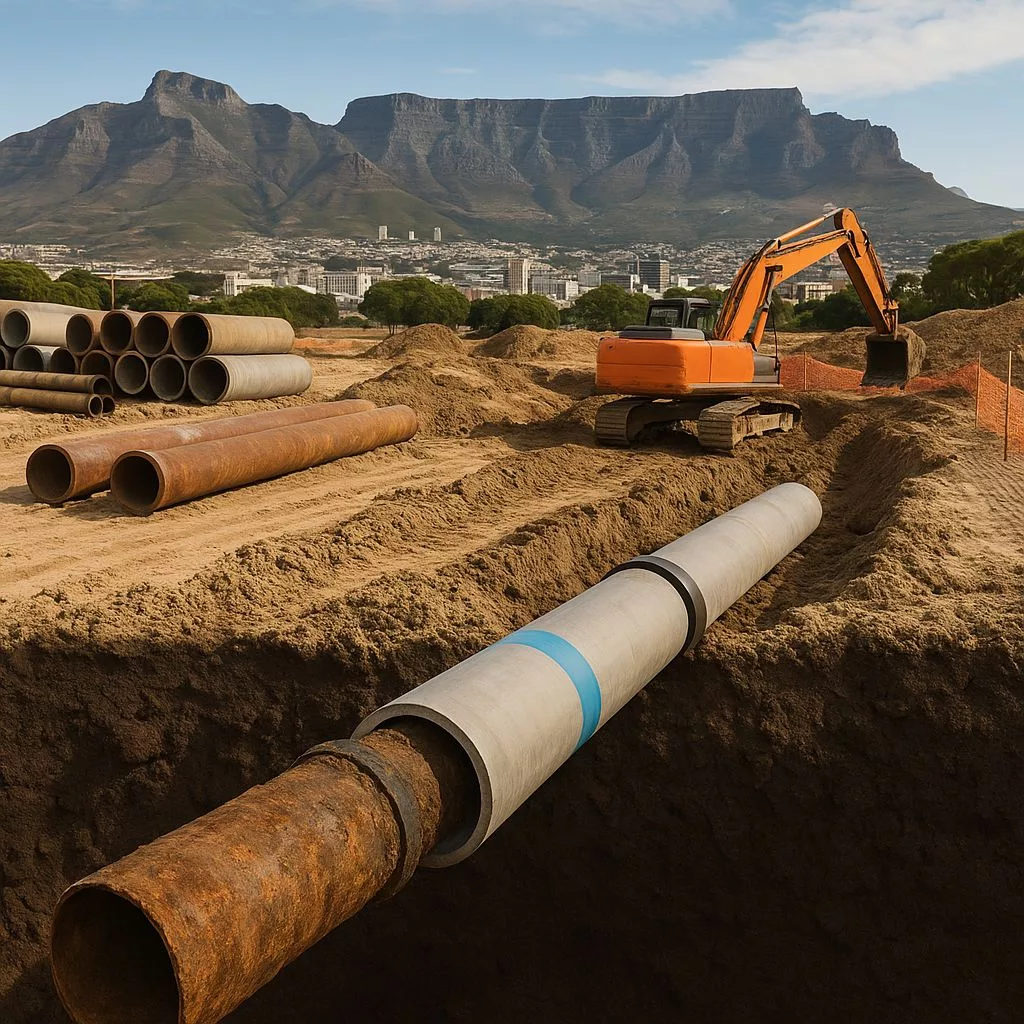
Cape Town is doing a massive underground makeover, replacing 49 kilometers of old water and sewer pipes with super strong new ones. Imagine tiny workers deep below your feet, battling old pipes and making everything fresh. This huge project, costing R589.5 million, means better water pressure, fewer leaks, and a super reliable system for everyone. It’s like the city is getting brand new veins and arteries, quietly making life better for everyone above ground.
What is Cape Town’s underground metamorphosis project?
Cape Town’s underground metamorphosis project is a massive infrastructure upgrade replacing 49.2 km of old water and sewer pipes with new, durable materials like HDPE and PVC-O. This R589.5 million initiative aims to replace 150 km of piping annually, improving water pressure, reducing leaks, and ensuring a resilient water and sanitation network for the city.
1. Dawn below the mountain
Long before the first cable car climbs Table Mountain, a second sunrise flickers beneath Cape Town’s asphalt. Welders kneel in glow-worm tunnels, robotic cutters nibble at 1910 brickwork, and freshly painted primer glimmers in the half-light. Since the start of July 2025 the Water and Sanitation Directorate has sliced open, on average, 137 metres of road every calendar day – weekends and Heritage Day included – delivering 49.2 km of brand-new water and sewer backbone before the jacarandas even sneezed purple.
Beneath the tourist postcard lies this other metropolis: one where a café’s espresso machine, a hospital’s steriliser and the Black River’s winter smell all hinge on pipe diameter choices made months earlier. The project is Cape Town’s quietest revolution, measured not in marches but in millibars of pressure saved, in litres of storm-water kept out of sewers, in collisions avoided by lime-green cones.
The scale is easy to miss from the pavement, yet the numbers are public. By October’s end the teams had locked 23.17 km of potable pipe and 26.03 km of foul sewer into the ground – 46 % and 26 % of their respective year-goals only four months into the financial cycle. At that cadence the water target should close by February and the sewer tally soon after, beating the winter rains and the Auditor-General’s clipboard.
2. How the city budgets a pipe year
Cape Town’s financial calendar runs July–June on purpose: it mirrors the Mediterranean rainfall graph so that new lines are pressure-tested before the first cold front. The 2025/26 purse holds R 589.5 million – about the price tag of two MyCiTi depots – ear-marked for 150 km of replacement: 50 km for drinking, 100 km for waste.
Material science has flipped the old bill of quantities. Cast-iron snap pipes and asbestos-cement are museum pieces; the new inventory is HDPE for water and PVC-O for sewer, both fusion-welded so leaks cannot “unzip.” Where 40-ton trucks grind overhead – think Bonteheuwel under the N2 or Century City’s rail spur – engineers slide a 316L stainless sleeve inside the HDPE, creating a sandwich that laughs at 1 600 kN/m² of ground force, the mass of a 160-ton locomotive.
Money follows the trench. Fifty-four cents of every Rand buy the polymer and valves; twenty-one cents pay the people; nine cents rebuild the road; seven rent the trench boxes and vacuum tankers; the rest mops up geotechnical surprises and uncharted copper cables. Contracts are diced into 5 km “lots” so emerging black-owned firms can lift a slice without mortgaging the planet; the biggest single award is R 42 million, small enough to keep monopolies at bay, large enough to justify a 180-ton butt-fusion rig.
3. October in close-up: 20.63 km of living geology
Forty-two crews scattered across 23 suburbs delivered October’s 20.63 km. The potable squad’s headline act was 1.8 km along Loebenstein Road in Parow Industrial, retiring 1950s mild-steel that had burst nine times in twelve months. On the sewer side, a 640 m micro-tunnel slipped under Kewtown’s heritage oak grid; a 900 mm slurry machine nick-named Rosie chewed through landfill and granite while homeowners brewed tea overhead, unaware their avenue would not lose a single tree.
Digital rehearsals precede jack-hammers. Engineers run a 48-hour twin simulation on EPANET-RTX, gulping live SCADA feeds every fifteen seconds. The model warned of an 18 % pressure dip in Bellville if the new 300 mm main stayed a dead-end; a back-feed loop was added before anyone noticed, preserving 3 bar of residual pressure during summer demand spikes.
Even the orange vest evolves. Reflective polymer road plates, rated for 40-ton axles, let trenches reopen to traffic in six hours, not 48. Crash data from the N2 upgrade persuaded psychologists to swap red cones for lime-green after dark; the retina grabs the hue 1.2 seconds faster under sodium light, cutting rear-end prangs by 27 %.
4. The next 1 000 days – and how to surf the trench
November 2025 will debut UV-cured glass-reinforced plastic liners in Gugulethu, hardening in 28 minutes instead of the usual hour. December brings “pipe-pods,” 12 m factory-fused strings trucked in at night like giant spaghetti, shaving trench-open time by a third. January’s hydrogen fuel-cell lighting towers will replace diesel burners in Philippi, trimming 2.4 t of CO₂ each month. By February a new pressure zone in Khayelitsha will silence the infamous “morning trickle,” balancing supply between the F-section reservoir and a 600 mm trunk.
Residents can play the game too. A WhatsApp bot called PipeAlert pings a 48-hour dig notice and a 360° verge photo once restoration is done. The “Cape Town H2O” app auto-credits 50 litres to your bill if the shut-off lasts more than four hours, validated by the smart-meter cloud. Park tyres perpendicular to the trench and you cut windshield micro-cracks by nearly a fifth; flush the first litre outdoors and you gift your begonias the sediment that never reached your geyser.
Cape Town is now replacing 4.2 % of its network annually – Amsterdam manages 1.9 %, Melbourne 1.4 %. At this cadence the full 11 000 km grid could be reborn in 24 years, comfortably inside the 40-year horizon the International Water Association recommends. Somewhere around 2030, spray-on bio-concrete laced with limestone-producing bacilli may let crews swap trenches for microscopic surgery, turning today’s subterranean battlefield into a self-healing ballet – one the jacarandas will never even notice.
What is Cape Town’s underground metamorphosis project?
Cape Town’s underground metamorphosis project is a massive infrastructure upgrade aimed at replacing old water and sewer pipes with new, durable materials. This R589.5 million initiative plans to replace 150 km of piping annually, which includes 50 km for drinking water and 100 km for wastewater, to improve water pressure, reduce leaks, and ensure a resilient water and sanitation network for the city.
How much is Cape Town investing in this project and what materials are being used?
Cape Town is investing R589.5 million in this project for the 2025/26 financial year. The project is replacing old cast-iron and asbestos-cement pipes with modern, super-strong materials. High-density polyethylene (HDPE) is used for water pipes and PVC-O (oriented polyvinyl chloride) for sewer pipes. Both materials are fusion-welded to prevent leaks, and in areas with heavy overhead traffic, 316L stainless steel sleeves are integrated for added strength.
What are the main goals of the pipe replacement project?
The primary goals of the project are to enhance water pressure, significantly reduce leaks, and establish a more reliable and resilient water and sanitation system across Cape Town. This upgrade is crucial for the city’s infrastructure, ensuring better service delivery and environmental protection by preventing sewage leaks and improving water quality.
How is Cape Town budgeting and allocating resources for the project?
The financial calendar for the project runs from July to June, aligning with the Mediterranean rainfall graph to allow for pressure testing before the cold front. Of the R589.5 million budget, 54 cents of every Rand are spent on polymer and valves, 21 cents on personnel, 9 cents on road rebuilding, and 7 cents on equipment rental. Contracts are divided into 5 km ‘lots’ to allow emerging black-owned firms to participate, with the largest single award being R42 million.
What innovative technologies and practices are being implemented?
The project incorporates several innovations, including the use of UV-cured glass-reinforced plastic liners for faster hardening, ‘pipe-pods’ (factory-fused pipe strings) to reduce trench-open times, and hydrogen fuel-cell lighting towers to cut carbon emissions. Digital twin simulations using EPANET-RTX help engineers predict and prevent pressure dips, and lime-green cones are used at night for improved visibility and safety.
How can residents stay informed and what benefits do they receive?
Residents can use a WhatsApp bot called PipeAlert to receive 48-hour dig notices and 360° verge photos after restoration. The ‘Cape Town H2O’ app auto-credits 50 litres to a resident’s bill if a shut-off lasts more than four hours. Additionally, residents are advised to park tyres perpendicular to trenches to reduce windshield micro-cracks and flush the first litre of water outdoors to benefit garden plants.