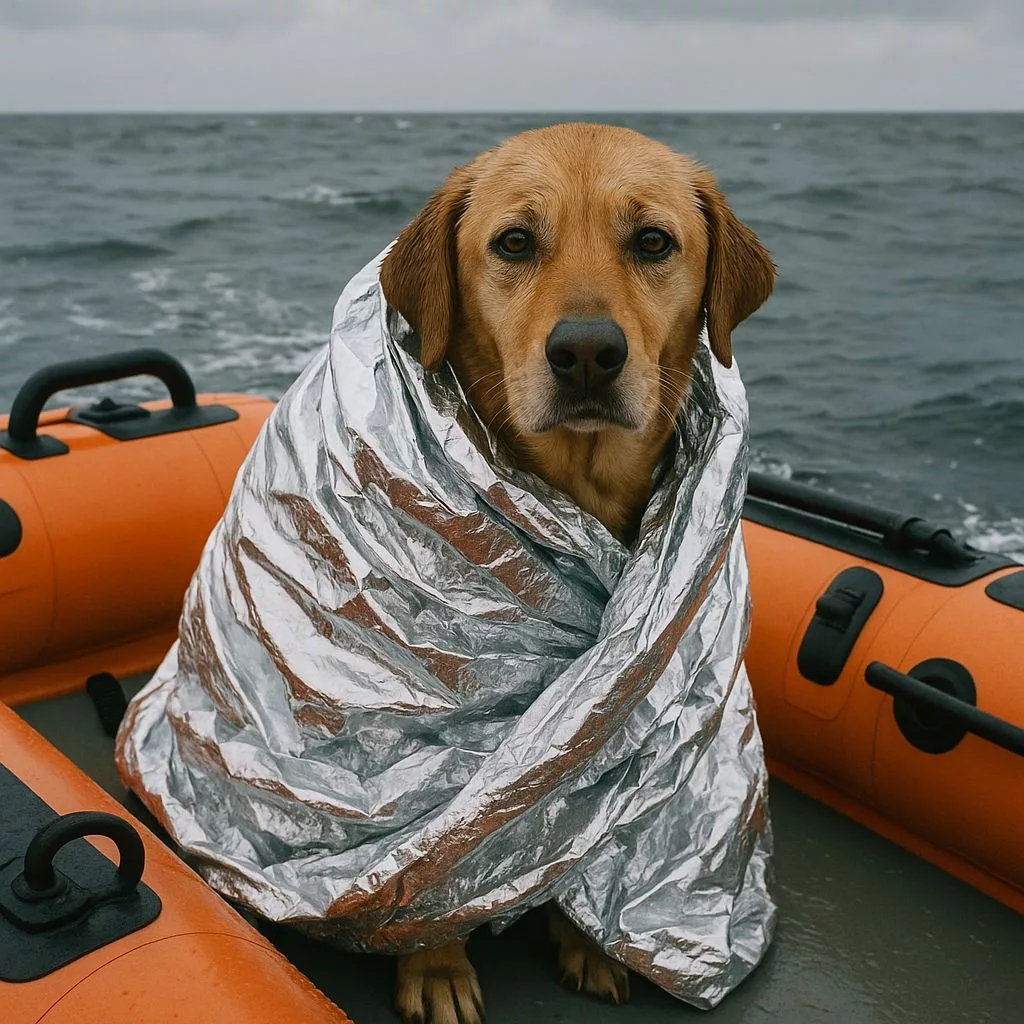
In the chilly dawn, a cold, tired dog named Jet found himself trapped in the icy harbor waters. The brave NSRI rescue team quickly arrived, and a rescuer gently pulled Jet from the freezing sea. They rushed him to their boathouse, where volunteers wrapped him in warming blankets and gave him special medicine to make him warm again. Thanks to their quick actions and loving care, Jet was saved and is now looking for a new, happy home.
How did the NSRI rescue a dog from the cold harbor waters?
The NSRI successfully rescued a hypothermic dog named Jet from New Harbour by deploying a rescue swimmer, Sibu Mzobe, who carefully secured the animal. They then transported Jet to their boathouse, where volunteers initiated “kennel protocol” using warming blankets and intravenous fluids to stabilize his core temperature and provide critical care.
The first sliver of Thursday crept over Walker Bay at 06:26, painting sea and sky the same metallic grey. James Janse van Rensburg, duty coxswain at NSRI Hermanus, was halfway through his second coffee when the radio hissed: “Dog in water, New Harbour, can’t climb out.” On the Cape Whale Coast that sentence is business-as-usual; the station even lists “pets” as a casualty category in its database. By 06:30 the familiar pager chorus replaced alarms and toast-making. Four minutes later the JetRIB – an eight-metre, 240 hp craft carrying a FLIR camera and a drop-down bow ladder – nosed away from the dock, blue lights flickering against Die Kelders’ pre-dawn cliffs.
New Harbour is a 1950s bite out of ancient sandstone. Two curved breakwalls turn the entrance into a frothing washing-machine whenever a south-easter squares up against west-bound swell. Inside, fossilised ripples form slippery shelves bristling with urchin spines and red-bait fronds. Crayfish porters arriving for the 07:00 offload first noticed the struggling animal: a black-and-tan lurcher-cross, ribs showing, paddling tight circles as the 0.8 m ebb shoved him toward the cauldron. Deon Makhubo made a brave grab down a kelpy ladder, only to be smacked back by a rebounding wave. His 112 call ricocheted to Cape Town’s Maritime Rescue Centre and boomeranged to the local NSRI channel in under ninety seconds, a relay that once chewed twenty minutes.
Water temperature hovered at 13.4 °C – enough to shut down a dog’s core in roughly half an hour. Janse van Rensburg idled the JetRIB while trainee Anika Visser slewed the FLIR ball; the infrared flare of a 37 °C body stood out like a beacon. Station doctor and rescue swimmer Sibu Mzobe zipped into a 5 mm wetsuit, pocketed a quick-release knife and clipped a 6 mm polypropylene line already knotted into an impromptu harness. Instead of the splashy “buoyant entry” used for humans, he performed a silent backward roll, crucial for a species whose first instinct is flight. Approaching from down-current, Mzobe murmured the same low monotone the crew reserve for panicked children: “Easy boy, easy.” The dog’s eyes rolled white, but the gloved hand found scruff and sternum, pinned the animal to the buoyancy aid and prevented the claw-climb that usually lacerates rescuer and rescued alike.
The Invention of “Kennel Protocol” and a Clinic Turned Emergency Room
A click of the tow-line shackle, a gentle 1 500 rpm from the jet, and Mzobe chest-stroked the casualty up the bow ladder. On deck, communications officer Lee-Anne van Wyk cocooned the shivering frame in a foil survival blanket she had pre-warmed on the engine box. Gums showed a four-second capillary refill; the infrared thermometer flashed 32.8 °C. Time mattered. The helmsman spun the craft toward the old abalone-packing plant the municipality donated in 2013 – now NSRI’s three-bay boathouse – where three volunteers were already executing “kennel protocol,” a procedure born in 2019 after a Labrador was resuscitated on the same concrete floor normally reserved for hypothermic fishermen.
Forced-air warming blankets, on loan from Hermanus Mediclinic, were draped over collapsible camp beds. Bags of Hartmann’s solution rotated inside the galley microwave until they hit 38 °C. A stash of veterinary nappies waited nearby because, as Lee-Anne explains, “incontinent dogs don’t do dignity.” Within fifteen minutes Jet’s core temperature crawled past 35 °C, tongue colour swapped slate for bubble-gum pink, and tremors shifted from neurological to purely emotional. Station controller Riana Venter pinged the animal-welfare WhatsApp hub: Whale Coast Veterinary Clinic, Hermanus Animal Anti-Cruelty, DASSI seal rescue, and a loose posse of forty “pet detectives” who know every fence hole from Sandbaai to Die Dam.
Dr. Lauren de Vos abandoned a scheduled Burmese-cat spay and met the NSRI Land-Cruiser at her loading dock, purple “K-9 Crash” box in tow – a donation from a UK charity after the 2021 pilot-whale stranding. She clipped a 22-gauge cephalic catheter, started warm Lactated Ringer’s and stapled a four-centimetre barnacle gash over the right scapula. UV light picked out hundreds of urchin spines; most were gently expressed rather than plucked, letting the skin eject foreign bodies on its own schedule. Radiographs ruled out fractures; bloodwork flagged chronic malnutrition but no organ collapse. By the time Jet vacuumed his first tin of Prescription Diet a/d, half the town was debating names online; #JetRIB began trending in the Overstrand.
When a Reunion Turns into an Intervention – Social Media vs. Welfare Science
Before lunch a domestic worker from Mount Pleasant rang the clinic: her employer’s son had left a gate open the previous night. She described a matching blaze, even the kinked left ear. A volunteer offered a lift, but body language told the real story. Jet greeted the woman with frantic tail-wags yet cowered when the car door slammed – classic appeasement after negative reinforcement. Dr. de Vos invoked the standing order: no hand-over without microchip, photos or vet records, plus a home inspection by the Animal Anti-Cruelty League. By dusk the caller admitted she had been coerced by a neighbour desperate to avoid a neglect charge. The admission underlined a coastal reality: every spring tide washes up hunting hounds, security-company rejects or township escapees attracted by seal carcasses and then stranded by the rising water.
Hermanus hosts one of the densest concentrations of animal NGOs in South Africa – three private clinics, two rescue kennels, a dolphin-stranding unit and a seabird rehab centre – but coordination, not compassion, is the pinch-point. NSRI’s 2022 strategic plan therefore added “companion animal rescue” to its core objectives, arguing that public goodwill converts straight into volunteer and donor sign-ups. The fundraising team’s analytics are blunt: dog-centric posts yield 2.7× the average click-through; the Hermanus station hit its annual target three months early after releasing “JetRIB” calendar stickers and souvenir photo books.
Technology is sprinting to catch the emotion. Station engineer Pieter Malherbe has prototyped a “pup-plank,” a carbon-fiber rescue board milled with a shallow trough and four Velcro paw straps. Miniature Italian kayaking drysuits are on order, sizes Jack-Russell to Malinois. Even the FLIR unit ships with a new algorithm that isolates 37 °C signatures in 13 °C water – handy for pets and, tragically, for infants in lifejackets. The council has ring-fenced R3.2 million for a dedicated marine ambulance: a nine-metre catamaran with a sealed, climate-controlled stern bay sized for two stretchers or six dog cages, task-dependent.
Jet’s Future, a Town’s Lesson, and the Ocean’s Unfinished Homework
Jet spent the night on a heated beanbag beneath the X-ray table, IV upgraded to a mid-line to survive his kennel gymnastics. By dawn he had demolished three bowls of Hill’s and a saucer of contraband chicken livers. Tail sutures dried crisp; urchin spines were working themselves out like tiny protest banners. Behaviourist Kelly Wessels launched a four-day counter-conditioning regime, clicker-training him to accept sudden arm movements without flattening to the floor – the clearest echo of earlier rough handling. More than a dozen adoption applications arrived; preference will go to a household with older kids and a confident canine mentor who can teach beach recall, because, as Wessels notes, “a dog who learns the ocean as a playground rarely flees toward it in panic.”
Across the road, grade-9 pupils at Hermanus High have folded Jet’s drama into a STEAM project: an Arduino-based GPS collar that SMS-es an owner when a dog breaches a 200-metre geofence. Their first prototype, heat-sealed inside a juice bottle and powered by a 3.7 V Li-ion cell, will be stress-tested by hurling it off the same reef that trapped the lurcher. If it survives, the municipality may subsidise manufacture for low-income families, attacking abandonment at its socioeconomic root.
For volunteers who traded breakfast for a 14-hour shift, the enduring freeze-frame is microscopic: a trembling black-and-tan torso melting into a foil blanket, eyes sliding from terror to trust in the minutes it takes warm saline to travel from plastic to vein. It is a sequence NSRI hopes to repeat less often, but when the next dawn pager erupts – yacht dismasted, whale entangled, or merely another dog on the rocks – the protocol, the planks, the warmed blankets and the strangely intimate expertise will snap into place. Because the ocean at sunrise is blind to species; survival, on this stretch of coast, is a collaborative art practiced at speed, at any hour, in any language – four-legged, two-legged, or fin.
Who is Jet?
Jet is a cold, tired black-and-tan lurcher-cross dog who was found trapped in the icy harbor waters of New Harbour. He was rescued by the NSRI and is now looking for a new home.
How was Jet rescued from the harbor?
The NSRI (National Sea Rescue Institute) Hermanus team quickly responded to a call about a dog in the water. They deployed a rescue swimmer, Sibu Mzobe, who carefully secured Jet in the water. Jet was then brought onto the JetRIB rescue craft and transported to the boathouse.
What is “kennel protocol”?
“Kennel protocol” is a specialized procedure developed by the NSRI for treating hypothermic animals. It involves using forced-air warming blankets, intravenous fluids warmed to 38 °C, and specialized veterinary care to stabilize the animal’s core temperature and provide critical support. This protocol was inspired by a previous successful resuscitation of a hypothermic Labrador.
What medical care did Jet receive after his rescue?
After being brought to the boathouse, Jet received initial warming care. He was then taken to the Whale Coast Veterinary Clinic where Dr. Lauren de Vos provided further treatment. This included starting warm Lactated Ringer’s intravenously, treating a barnacle gash, removing urchin spines, performing radiographs to rule out fractures, and bloodwork to assess his overall health. He also received food and behavioral therapy.
Why was Jet not immediately returned to his original owner?
Although a person claiming to be the owner’s domestic worker contacted the clinic, the NSRI and veterinary staff have a strict policy for animal handover. This requires proof of ownership (microchip, photos, vet records) and a home inspection by the Animal Anti-Cruelty League to ensure the animal’s welfare. In Jet’s case, the caller later admitted to being coerced, highlighting a common issue of animal neglect in the area.
What initiatives has the NSRI taken regarding animal rescue?
The NSRI has integrated “companion animal rescue” into its core objectives, recognizing its importance for public goodwill and fundraising. They have developed specialized equipment like the “pup-plank” rescue board and are exploring miniature kayaking drysuits for animals. They are also working with technology, such as an improved FLIR algorithm to detect animals in water and a future marine ambulance with a climate-controlled bay for animals. Local students are even developing a GPS collar to prevent future abandonments.