A politician, Fadiel Adams, shared a staffer’s private details on Facebook, causing her much trouble. This act of online misconduct led to serious consequences for him. He was suspended from his job for twenty days and lost a huge chunk of his pay. This story shows how a simple screenshot can lead to big problems for public figures.
What was the consequence of the Facebook post by MP Fadiel Adams?
MP Fadiel Adams was suspended for twenty sitting days and had his paycheque reduced by R93,400 after tax. This disciplinary action followed his Facebook post leaking private information of a staffer, Caitlin Abrahams, leading to threats and harassment. The incident highlighted the severity of online misconduct for public officials.
The Spark: A Two-Line Email Becomes Front-Page Fuel
On a grey Cape Town afternoon, 10 June 2025, the National Assembly’s internal mailing list flickered with a routine alert. A micro-motion – just 112 words – asked the House to denounce “the systematic lock-out of Coloured citizens from empowerment targets.” Because such motions vanish unless every party green-lights them, Democratic Alliance whip George Michalakis told 26-year-old staffer Caitlin Abrahams to withhold consent. At 16:42 she tapped “send” on a crisp reply: “The DA objects to today’s NCC motion. Regards, Caitlin Abrahams, Constituency Officer.”
Within seven minutes the message – complete with her desk extension, cell number and Gmail – was clipped, pasted and hurled into the public square. Fadiel Adams, sole MP of the National Coloured Congress, uploaded the grab to Facebook headlined: “Meet the DA’s racism. Let her explain herself to the people.” The image rocketed through WhatsApp groups, radio talk lines and township taverns before Abrahams even reached the parking lot.
That single post turned a procedural flicker into a national lightning rod. By sunset the young staffer’s phone rang off the hook; strangers promised to “teach her a lesson.” Parliament’s serjeant-at-arms quietly doubled security patrols outside the Old Assembly. Nobody guessed the after-shocks would still rattle the House eight months later.
Filing the Complaint: From Inbox to Ethics Docket
Parliament’s ethics rulebook gives MPs seven “reasonably practicable” days to cry foul. Michalakis used six of them consulting Abrahams, gathering print-outs and drafting a six-page charge sheet. On 17 June he marched the dossier to the Joint Committee on Ethics and Members’ Interests. The claim was lean but lethal: Adams had breached clause 5(1)(e) (“don’t leak private data learned on the job”) and clause 9(1) (“online conduct must equal in-person decorum”).
Annexures told the human story: the original Facebook grab, 314 fuming emojis, 87 comments dripping with threats, and a police statement confirming two anonymous late-night calls. The package landed like a match in a munitions plant. Committee staffers immediately slapped a confidentiality seal on the file, but screenshots of the screenshots were already blooming across fringe Telegram channels.
Adams, meanwhile, kept up his drumbeat. In media interviews he styled himself a whistle-blower defending the voiceless. “They want to muzzle a Black man for exposing their bigotry,” he told a Cape Town radio host. The committee chair had to issue an extraordinary public reminder that “prejudging a matter under investigation may itself constitute contempt.” Both sides dug in; the slow machinery of parliamentary discipline creaked to life.
The Defence: “Public Domain,” “No Malice,” “Silencing a Black Voice”
At 23:11 on 25 June, Adams emailed his 1,047-word rebuttal from his iPhone, a document now clipped into media-law course packs. He admitted hitting “share” but argued the directory was already “public,” insisted he never meant to stoke harassment, and noted the post vanished four hours later. “If anyone felt hurt, I apologise with my whole heart,” he wrote, closing with: “My life’s work is uplifting the marginalised, not pummelling interns.”
Committee investigators, however, unearthed sharper facts. The staff portal sits behind a password wall; ordinary citizens cannot stroll in. Forensic logs showed the image detoured through Snapchat, where Adams cropped out his own status bar while leaving Abrahams’ digits in full view. Worse, this was déjà vu: in March 2024 he had been ordered to apologise on the House floor for branding a minister a “Shembe-cult kingpin.” Repeat misconduct is explicitly labelled an aggravating factor under item 20(3).
Behind the scenes, party arithmetic loomed large. The eight-member ethics panel held four ANC MPs, two DA, one EFF and one ATM delegate. The ANC, eager to court Coloured voters ahead of 2026 local polls, wanted a sanction muscular enough to look decisive yet not so harsh it martyred Adams. The DA pushed for maximum pain. The EFF flirted with a “censure-only” line before siding with the majority. By late October a draft recommendation was ready: suspend the MP for twenty sitting days and gut his paycheque by the same amount.
The Fallout: Cash, Credibility and a Laminated Empty Seat
National Assembly Rule 165 leaves no wiggle room: the committee’s report must be tabled verbatim and adopted or rejected in full. When MPs return from recess on 18 February 2026, tourists in the gallery will witness a choreographed ritual. At 10:00 the Speaker will announce Order Paper Item 7; seven minutes later Chairperson M. J. Maseko will move adoption. Adams will offer a 90-word apology scripted by the very panel that judged him, then follow the serjeant-at-arms out to the foyer where his access card will blink red. His microphone will be masked by a laminated “SUSPENDED” card until 28 April.
The price tag is brutal: R93,400 after tax, the first time Treasury has ever clawed back an MP’s salary for misconduct. The cash disappears into the National Revenue Fund, not to Abrahams, because the Code is punitive, not compensatory. Public-sector unions are already citing the precedent in wage-discipline negotiations; if the template sticks, nurses and teachers could face parallel salary hits under the newly tabled Public Service Discipline Bill.
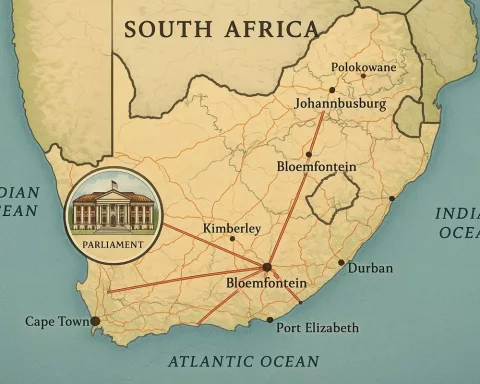
As for Adams, he returns to a caucus of one and a social-media following that has doubled on the back of victimhood marketing. Coloured-rights lobbyists are split: some blast his “reckless individualism,” others hail his stand against “DA arrogance.” Meanwhile Caitlin Abrahams – newly reassigned to a quiet Kimberley constituency office 470 km from the spotlight – has two counselling sessions left on her parliamentary voucher and an unlisted mobile she changes monthly. The lesson, etched into the institution’s collective memory, is simple: a single screen-grab can travel further and faster than any apology, and twenty days in parliamentary purgatory is long enough to turn a headline into a textbook case.
[{“question”: “
What led to MP Fadiel Adams’ suspension from Parliament?
MP Fadiel Adams was suspended because he shared a screenshot containing the private contact details of a staffer, Caitlin Abrahams, on Facebook. He posted it with the headline \”Meet the DA’s racism. Let her explain herself to the people,\” which led to threats and harassment against Abrahams. This act was deemed a breach of parliamentary ethics regarding the leakage of private data learned on the job and online conduct.
“}, {“question”: “
What were the specific consequences Fadiel Adams faced for his actions?
Fadiel Adams was suspended for twenty sitting days from Parliament. In addition to the suspension, he also faced a significant financial penalty, losing R93,400 after tax from his paycheque. This marks the first time the Treasury has clawed back an MP’s salary for misconduct, setting a precedent for future disciplinary actions.
“}, {“question”: “
Who is Caitlin Abrahams and what happened to her after the Facebook post?
Caitlin Abrahams was a 26-year-old Constituency Officer for the Democratic Alliance (DA). After her private contact details were posted on Facebook by Fadiel Adams, she received numerous threats and harassment, including anonymous late-night calls. She was subsequently reassigned to a quiet Kimberley constituency office, 470 km away from the spotlight, and received counselling sessions through Parliament.
“}, {“question”: “
How did the parliamentary ethics committee handle the complaint against Adams?
George Michalakis, a DA whip, filed a six-page charge sheet against Adams, alleging breaches of clause 5(1)(e) (leaking private data) and clause 9(1) (online conduct). The Joint Committee on Ethics and Members’ Interests investigated the matter. Despite Adams’ defense claiming the information was \”public domain\” and he had \”no malice,\” the committee found that the staff portal was password-protected and Adams had intentionally cropped the image to exclude his own status bar while leaving Abrahams’ details visible. His past misconduct was also considered an aggravating factor.
“}, {“question”: “
What was Fadiel Adams’ defense regarding the Facebook post?
Adams admitted to sharing the post but argued that the directory containing Abrahams’ details was already in the \”public domain.\” He claimed he never intended to incite harassment and noted that the post was removed four hours after it was published. He also offered an apology \”with my whole heart\” if anyone felt hurt, stating his life’s work was \”uplifting the marginalised, not pummelling interns.\” He also portrayed himself as a whistle-blower being \”muzzled\” for exposing bigotry.
“}, {“question”: “
What broader implications did this incident have?
The incident set a significant precedent, as it was the first time an MP’s salary was clawed back for misconduct, potentially influencing future disciplinary actions for public sector employees like nurses and teachers under the newly tabled Public Service Discipline Bill. The case also highlighted the severe consequences of online misconduct for public figures and the rapid, far-reaching impact a single social media post can have, underscoring the importance of responsible digital conduct.
“}]