South Africa is changing how people in places like Khayelitsha get clean toilets. They’re using new systems in shipping containers called “Loop-Flush.” These smart units clean dirty water using sunshine and wind power. This means people get clean, private toilets even where there are no normal pipes and sewers. It’s bringing dignity and a better life to communities that really need it.
How is South Africa revolutionizing sanitation in informal settlements?
South Africa is transforming sanitation in informal settlements like Khayelitsha through innovative container-based systems called “Loop-Flush.” These units use advanced membrane bioreactors and UV polishing to treat wastewater, powered by solar and wind energy, providing dignified, off-grid solutions where traditional infrastructure is challenging.
The Dawn of a New Era
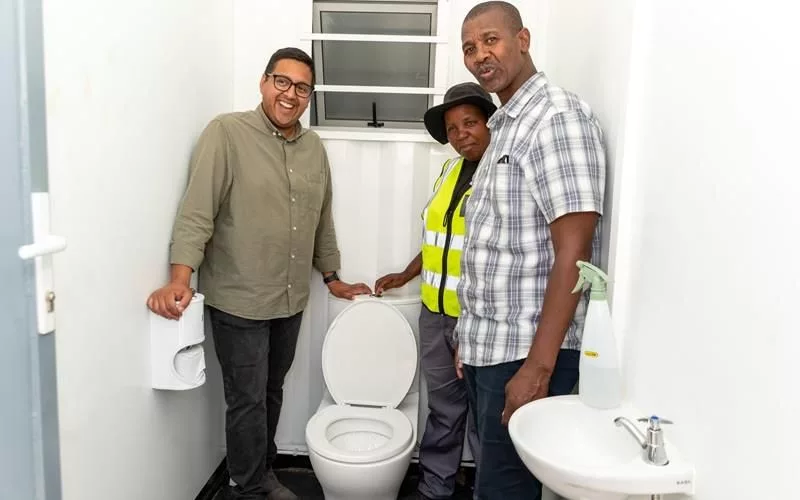
In the heart of Khayelitsha’s OR Tambo Informal Settlement, a transformation is unfolding that would have seemed impossible just months ago. Where once the morning air carried the unmistakable stench of bucket toilets and communal waste, now stands a testament to human ingenuity and perseverance. Three unassuming shipping containers, painted in cheerful blues and greens, have become the unlikely heroes of this community’s struggle for basic human dignity.
The journey began on a crisp November morning when 27 ceramic pans stood waiting, their lids raised like arms preparing to embrace a long-lost friend. Inside these modified containers, a marvel of modern engineering hums quietly, powered by nothing more than the sun overhead and the wind that sweeps across the Cape Flats. This isn’t just another sanitation project – it’s a complete reimagining of what dignified sanitation means for communities that have spent decades waiting for promises that never materialized.
What’s happening here goes far beyond simple plumbing. The system, christened “Loop-Flush” by its creators at WEC Water, represents a quantum leap in how we think about waste treatment in areas where traditional infrastructure remains a distant dream. By combining cutting-edge membrane bioreactors with anoxic denitrification and final UV polishing, this refrigerator-sized unit transforms what would typically require massive treatment plants into something that fits inside a space no larger than your average suburban garage.
How the Magic Works
The genius lies not in what you see but what’s happening behind those unassuming walls. Every day begins with roughly 600 liters making their way through nine cubicle blocks, weaving through a labyrinth of pipes and pumps before emerging transformed. The technology is designed to handle 1,500 liters daily, providing enough buffer to accommodate everything from weekend festivals to funeral gatherings that bring entire communities together. Rather than dumping the treated effluent, the system channels it back into cisterns painted a cheerful turquoise, creating a closed loop that would make environmental engineers weep with joy.
Power comes from a sophisticated hybrid system combining 3.2 kW rooftop solar panels with a 400 W vertical-axis wind turbine, ensuring operations continue even during Cape Town’s notorious load-shedding episodes. The entire system is orchestrated by a lithium-iron battery pack that stores excess energy, keeping pumps and PLC systems operational when municipal power fails. Every fifteen minutes, data points – pH levels, dissolved oxygen, turbidity, pump cycles – upload via 4G to a dashboard monitored by city engineers and two resident technicians who can address alarms before they escalate into costly system failures.
These technicians, Andile Ngqisha and Unathi Menze, aren’t just employees – they’re community members who understand firsthand the struggles their neighbors face daily. Both passed through a rigorous six-week program covering basic plumbing, color-coded safety signage, and perhaps most importantly, how to explain to skeptical relatives why only “pee, poo, and paper” should disappear down the hatch. Their salaries, funded through a collaboration between the city, Water Research Commission, and Gates Foundation’s “Reinvent the Toilet” initiative, provide dignity not just for those they serve but for themselves as breadwinners supporting families with steady income.
Beyond the Technology
But numbers alone don’t capture what’s happening here. Step closer to these containers, and you realize accessibility features exceed anything you’ll find in buildings across the country. For wheelchair users, there’s a cleverly designed flip-up GrabFold rail rated to 150 kg, allowing transfers from wheelchair to sanitation facilities with dignity and safety. Inside, 900-lumen motion-activated panels ensure peak hours see sanitation facilities cleaned and maintained, while high-contrast tactile icons help visually impaired users navigate independently. Even subtle details matter – low-lumen red LED strips that guide users after dusk without attracting insects, an innovation borrowed from Antarctic research stations where LED color temperature affects both pest control and circadian rhythms.
The impact extends far beyond immediate sanitation benefits. Previously, OR Tambo’s 2,400 residents relied on 22 communal bucket toilets emptied twice weekly at R28 per lift – a service consuming 168,000 liters of municipal water annually just for rinsing containers and odor suppression. The new closed-loop system eliminates this demand entirely, diverting an estimated 750 kg of nitrogen and 220 kg of phosphorus annually from the Cape Flats aquifer, a coastal sandy lens already struggling with legacy nitrate pollution from agricultural fertilizers. Effectively, the plant captures fertilizer equivalent to 18 hectares of spinach farm runoff, providing urban agriculture enthusiasts with conversation starters about future struvite recovery potential.
Pilot programs in nearby Makhaza, Browns Farm, and Driftsands have logged 14 months of cumulative operation time. Their data logs show 99.4% uptime, three membrane fouling events cleared with citric acid flushes, and zero vandalism after the first month. The secret, according to behavioral researchers, lies in combining capability with identity: residents must attend a 15-minute orientation to receive an RFID token, creating mild social friction that prevents cubicles from becoming curiosity-driven bicycle wash stations.
Building Tomorrow
Finance structure represents where Gates Foundation money truly demonstrates impact. A US$1.8 million grant underwrote research and development, container retrofits, and first-year risk guarantee. Unit capital expenditure works out to R108,000 per pedestal – steep against Ventilated Improved Pit latrines at R6,500, but half the cost of conventional sewer connections once excavation, manholes, and 160 mm piping across sandy unstable soils are factored. Most importantly, tariff model remains usage-agnostic: households pay flat R18 monthly through municipal billing system regardless of flushing frequency, aligning costs with ability to pay while keeping service off controversial “free basic sanitation” ledgers that Treasury maintains under austerity review.
Maintenance culture has been gamified ingeniously. Each cubicle door hides a QR code; scanning uploads timestamped selfie entering monthly grocery voucher draws. Partnership with local radio station Zibonele FM created gimmickry generating 2,100 scans already, providing engineers heat-maps of peak usage – 7 a.m. and 8 p.m., matching shift patterns at nearby Philippi East industrial park. This data prompted adjustments to janitorial schedules ensuring high-traffic hours see fresh sanitation facilities, not yesterday’s disappointments.
But critics argue high-tech containers represent merely glamorous band-aids on governance wounds: why install permanent sewers? City engineers counter that 42% of Khayelitsha sits on 2% slopes where conventional gravity sewers would require 4-meter-deep excavations, risking cave-ins and striking water table 1.2 meters below surface. Vacuum sewers could work but demand continuous power – problematic in country shedding up to 10 hours daily. Off-grid containers leapfrog both constraints, buying metropolis 10-15 years to retrofit bulk infrastructure while climate-proofing services against rainfall variability predicted by CSAG models forecasting 20% drier winters by 2040.
Neighbelling settlements are lobbying for inclusion. Rasta Camp in Ocean View, scheduled Q1 2026, will test hybrid variant: five containers linked to single 5,000-liter baffled reactor, feeding subsurface-flow constructed wetland planted with indigenous Cape thatching reed. Annual reed harvest, 4-5 tonnes, can sell to boutique craft market for roofing coastal holiday homes, partially offsetting operational costs and adding circular-economy narrative planners pitch to treasury negotiators.
Back in OR Tambo, at 5:30 a.m., first sunlight silhouettes container vents against lilac sky. Andile unlocks doors, taps HMI screen – all green – and nods to queue of early risers clutching toilet paper like golden tickets. Inside janitor’s closet, algorithm calculates aeration cycles while outside, universal note of dignity finally plumbed into place resonates through community transformed by shipping containers that brought more than sanitation – they restored human dignity where it was needed most.
[{“question”: “
What is the ‘Loop-Flush’ system and how does it work?
\n
The ‘Loop-Flush’ system is an innovative, container-based sanitation solution developed by WEC Water. It uses modified shipping containers to house advanced wastewater treatment technology, specifically membrane bioreactors with anoxic denitrification and UV polishing. This system treats dirty water from toilets, powered by solar panels and wind turbines, and then recycles the treated water back into the cisterns for flushing, creating a closed loop. This allows for clean, private, and dignified sanitation in areas without traditional plumbing and sewer infrastructure.
\n”,”answer”: “”},{“question”: “
Where is the ‘Loop-Flush’ system being implemented and what impact is it having?
\n
The ‘Loop-Flush’ system is being implemented in informal settlements in South Africa, such as Khayelitsha’s OR Tambo Informal Settlement. It’s transforming sanitation by providing dignified, off-grid toilets. Beyond the immediate sanitation benefits, it eliminates the need for bucket toilets, saves municipal water, diverts pollutants from aquifers, and provides employment and training opportunities for community members as technicians.
\n”,”answer”: “”},{“question”: “
What powers the ‘Loop-Flush’ sanitation units?
\n
The ‘Loop-Flush’ units are powered by a sophisticated hybrid energy system. This includes 3.2 kW rooftop solar panels and a 400 W vertical-axis wind turbine. A lithium-iron battery pack stores excess energy, ensuring continuous operation even during power outages (load-shedding episodes) in South Africa. This makes the system entirely off-grid and resilient.
\n”,”answer”: “”},{“question”: “
How is the ‘Loop-Flush’ system maintained and monitored?
\n
The system is maintained and monitored by local community members, such as Andile Ngqisha and Unathi Menze, who undergo rigorous training. Data points like pH levels, dissolved oxygen, turbidity, and pump cycles are uploaded every fifteen minutes via 4G to a dashboard monitored by city engineers and resident technicians. This allows for proactive maintenance and quick responses to any potential issues. Behavioral elements, like RFID tokens for access and QR code scans for grocery voucher draws, also help manage usage and incentivize proper care.
\n”,”answer”: “”},{“question”: “
Why are high-tech containers used instead of traditional sewer systems in these areas?
\n
Traditional gravity sewers are often impractical in informal settlements like Khayelitsha due to geographical challenges. For example, 42% of Khayelitsha sits on gentle slopes, requiring deep excavations that risk cave-ins and hitting the water table. While vacuum sewers are an option, they demand continuous power, which is problematic given South Africa’s frequent load-shedding. The off-grid container systems bypass these constraints, providing a viable and immediate solution while buying time for potential future bulk infrastructure upgrades and climate-proofing services against predicted drier winters.
\n”,”answer”: “”},{“question”: “
What are the financial implications and future plans for the ‘Loop-Flush’ system?
\n
The research and development, container retrofits, and first-year risk guarantee were underwritten by a US$1.8 million grant from the Gates Foundation. While the capital cost per pedestal is higher than basic pit latrines, it’s half the cost of conventional sewer connections when considering all associated works. Households pay a flat R18 monthly through municipal billing, making it affordable. Future plans include expanding to other settlements like Rasta Camp, with hybrid variants that could integrate features like constructed wetlands and circular economy initiatives, such as harvesting reeds for sale to offset operational costs.
\n”,”answer”: “”}]