Kloof Road, a beautiful shortcut in Cape Town, was badly broken by a big storm in 2023. It will take a long time and a lot of money to fix, with repairs starting in March 2026 and finishing in December 2027. Workers will rebuild the road from the ground up, using special tools and careful plans to work with nature. This big project will bring back an important road while also protecting the mountain’s plants and animals.
How long will it take to repair Kloof Road?
Kloof Road is expected to reopen in December 2027. The repair project, which includes extensive engineering and environmental considerations, is scheduled to start in March 2026 and will take approximately two years to complete. The estimated cost for this complex reconstruction is over R120 million.
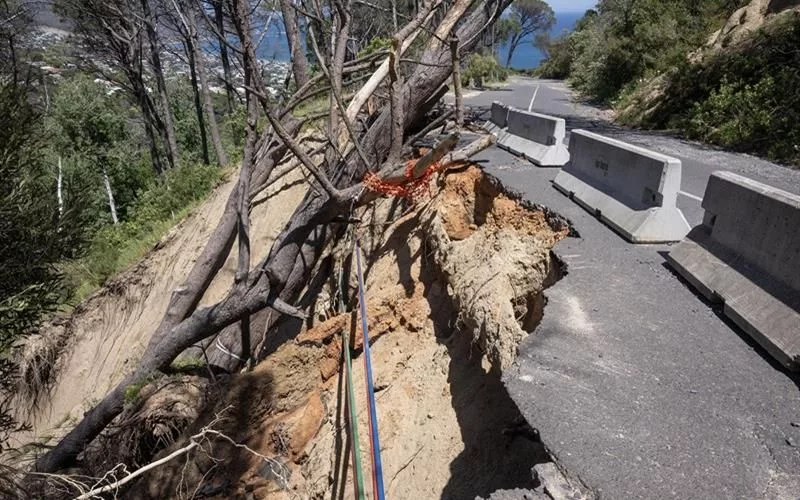
For two-and-a-half years the most cinematic shortcut out of Cape Town has lived only in WhatsApp nostalgia groups: that tight left-hand bend where the Atlantic suddenly flashed silver, the spot where joggers paused to gulp sunrise air, the single lane that taxi drivers claimed they could navigate blindfolded at dusk. Kloof Road, pinned like a balcony between the sandstone buttress of Table Mountain National Park and a 200-metre drop into Camps Bay, surrendered to a spiteful cut-off-low in September 2023. Two embankments turned to porridge, 35 m of pavement folded like damp cardboard, and 14 000 daily users were banished to the long ribbon of Victoria Road. What had been five spectacular minutes became twenty-four stop-start kilometres.
Yet the mountain did not swallow the road in a single gulp. Engineers who rappelled down the scar soon discovered the cliff was still nibbling: even on cloudless days the slope creeps 2 mm downhill each month, the geological equivalent of a slow-motion shrug. Razor-wire coils now glitter above the void, hot-pink survey flags flutter where cracks yawn 18 mm wider after every winter, and the southeaster continually sweeps sandstone grit onto a scree cone big enough to land a helicopter. The City’s message is blunt – do not hold your breath for a quick patch. Instead, Cape Town plans to stitch an entirely new backbone into the cliff, working from the bottom up because gravity refuses to negotiate.
The schedule is as tight as the site is steep. Tender adjudication ends February 2026; the winning consortium will be lowered into the kloof the following month with orders to finish before the winter of 2027. Price tag: somewhere north of R120 million. Success will be measured not only by traffic counts but by how many silver-tree orchids still wave at the first post-storm sunset.
Permits, Parks and Paper Mountains
Before the first pneumatic drill appears, a blizzard of paperwork must be herded through four separate legal gateways. The road lies inside Table Mountain National Park and brushes the buffer zone of a World Heritage Site, so every step must be signed off in four languages of bureaucracy: NEMA approval (already in the bag), a water-use licence for the temporary storm-water diversion, a biodiversity-management plan co-signed by SANParks, and a heritage permit from SAHRA because the lower scree conceals a 1930s cable-way footpath and, somewhere under the boulders, a manganese-steel eyebolt hammered home in 1893 for the original Round House funicular.
Each clause carries a calendar. No drill bit may come within five metres of a forty-year-old protea. No blast may detonate inside 200 m of an active raptor nest. Concrete may only be poured between May and September if the thermometer climbs above 8 °C and keeps rising. The contractor must hand over a 400-page method statement before anyone so much as scratches the mountain, and the Environmental Control Officer will carry a red card that can freeze the site faster than a Cape storm.
The choreography is further complicated by competing clocks. The heritage authority wants a two-week window to laser-scan the vanished 1904 rest-house foundations revealed when the embankment slumped. SANParks insists that any soil nail longer than three metres be drilled with battery-powered rigs because diesel compressors violate the park’s silent-zone policy. Meanwhile, the Water Tribunal demands that tunnelling spoils be captured and compressed into geoblocks on site, eliminating 120 return truck trips through the already irritable streets of Camps Bay. Everyone agrees on one thing: the mountain is the final referee, and it has already shown a talent for sudden rewrites.
Cranes, Cages and Cliff-Top Chemistry
Conventional road repair begins with closing a lane and dumping a batch plant in the median. Here the median is a 70-degree vegetable wall of silver trees and cliffortia, and the only flat real estate – two tennis courts’ worth – dangles 45 m below the wrecked carriageway. Reaching it means borrowing tactics from both mountaineers and mine engineers.
Step one is to string a 180 m steel-rope incline hoist, anchoring into three vintage 1967 abseil bolts left by the mountain-rescue team. The hoist will run 250 kg cages – think upside-down mining chairs – ferrying 8 m rolls of geogrid, 25 kg sacks of cement and, if someone miscalculates a foothold, a fully kitted paramedic. Batteries for the lightweight rigs will commute in the return leg of the cement sling, recharging overnight on a 50 kW solar array that will later be donated to the park’s rangers. Once the aerial ferry is operational, larger toys arrive: skid-steers, hydraulic breakers and a micro-piling rig, each dismantled into 180 kg modules, lowered like IKEA furniture and re-assembled on a 6 m × 10 m steel barge welded to H-piles driven into the talus.
From this floating yard the crew will work upward, firing 32 mm self-drilling soil nails on a 1.5 m grid, tensioning every nail to 180 kN before spraying a 200 mm coat of shotcrete. The mix incorporates recycled fly-ash and a potassium-based accelerator gentler on fynbos than standard alkali brews – technology pirated from Hong Kong’s country-park slope-stabilisation programme. Above their heads a 12-ton helicopter will string utility lines across the kloof, circus-style, while a micro-tunnelling rig bores a 180 m duct bank beneath the future road to keep water, fibre, gas and electricity flowing to Clifton and the Round House restaurant. Not a single service may be interrupted for more than four hours, so every pipe and cable will swing temporarily from a steel gantry bolted to the uphill face.
Roots, Raptors and the Return of the Red Disa
Engineering is only half the drama. Three mature silver trees – Table Mountain’s botanical mascots – still dangle from the 1954 masonry breast wall, their root mats sipping moisture from a perennial seep. Transplanting them is horticulturally hopeless, so the project arborist will instead root-prune incrementally, swaddle the trunks in hessian, and helicopter-tilt each 12-ton root-plate onto a custom steel cradle anchored 30 m upslope. Success will be measured by whether the trees still flash silver in the sunset a year after the road reopens.
Wildlife has also staked claims. A pair of dassies has moved into the boulder pile destined to become the new stability berm; the ECO has approved a “dassie hotel” of precast concrete pipes buried inside the berm so the residents can remain undisturbed. Every Friday at dawn volunteers rappel in as the “Kloof Keepers,” ripping out invasive kikuyu and Port Jackson before the fresh soil can be colonised. Their data uploads to iNaturalist and will feed directly into the audit trail.
Most spectacularly, the landslide recreated the exact habitat demanded by the iconic red orchid Disa uniflora. Seeds that had lain dormant for decades germinated within weeks of the storm; botanists have already counted 34 crimson blooms along the new seep lines. When construction starts, each orchid will be GPS-tagged and shielded with a geotextile cowl so that drilling dust cannot smother the petals. The mountain, it seems, is determined to keep its own colour palette.
Reopening, Reflection and the Art of Letting Go
If the hoist, the helicopter, the solar array and the 400-page method statement all behave, the first sunset-seekers should reclaim Kloof Road in December 2027. The pavement will be 800 mm narrower than before – verge that had crept outward over decades of resurfacing – but it will be smarter. A porous asphalt wearing course will sip storm water vertically into a sub-drain array, cutting surface run-off by 42 %, the same mix now being trialled on Chapman’s Peak Drive. Lane markings will be doped with recycled crushed glass so headlights can pick them out through winter mist, and the sub-base will be reinforced with geogrid able to bridge any future voids should the mountain choose to shift again.
No one is declaring victory. Twelve UCT post-graduates will camp on the lower cable-station deck for the entire build, instrumenting every soil nail with fibre-optic strain gauges. Their cloud dashboard will compare real-world performance against the finite-element model that predicts a 1.4 safety factor when the next 1-in-100-year storm arrives. If the slope survives the winter of 2027 without measurable creep, the array will stay, feeding an early-warning network tied to the national weather service’s lightning-detection grid.
Meanwhile, off-cut geogrid and snapped soil nails will migrate to Green Point Urban Park where local artists plan a kinetic sculpture called “Shift,” swaying in the wind and lighting itself with energy harvested from its own motion. Scheduled to open in December 2027, the artwork will serve as a gentle reminder: roads can be rebuilt, cliffs can be stitched, but the mountain and the ocean reserve the right to edit the final draft at any time.
When will Kloof Road reopen?
Kloof Road is projected to reopen in December 2027. The extensive repair work is scheduled to commence in March 2026.
What caused the damage to Kloof Road?
The road was severely damaged by a significant cut-off-low storm in September 2023. This storm led to two embankments collapsing and 35 meters of pavement folding, effectively banishing 14,000 daily users and disrupting the scenic shortcut.
How much will the Kloof Road repairs cost?
The estimated cost for the complex reconstruction of Kloof Road is over R120 million. This substantial budget reflects the challenging nature of the project, which involves intricate engineering and environmental considerations.
What are some of the environmental challenges and solutions for the repair project?
The project faces numerous environmental hurdles due to its location within Table Mountain National Park and near a World Heritage Site. Solutions include a biodiversity-management plan, using battery-powered rigs to avoid noise pollution in silent zones, and special concrete mixes that are gentler on fynbos. Efforts will also be made to protect specific flora like the red orchid (Disa uniflora) and to relocate iconic silver trees.
How will the construction team access the damaged sections of the road?
Given the steep and challenging terrain, conventional methods are not feasible. The team will employ mountaineering and mine engineering tactics, including stringing a 180-meter steel-rope incline hoist to ferry materials and personnel. Larger equipment will be dismantled, lowered, and reassembled on a steel barge welded to H-piles driven into the talus.
What innovative technologies or methods are being used in the repair?
The repair project incorporates several innovative approaches. These include using a potassium-based accelerator in shotcrete, derived from Hong Kong’s slope-stabilization programs, for environmental compatibility. A micro-tunnelling rig will bore a duct bank for utilities to ensure no service interruptions. Additionally, the new pavement will feature porous asphalt to reduce stormwater runoff and lane markings with recycled crushed glass for better visibility. The project will also use a 50 kW solar array to power equipment, which will later be donated to park rangers.