
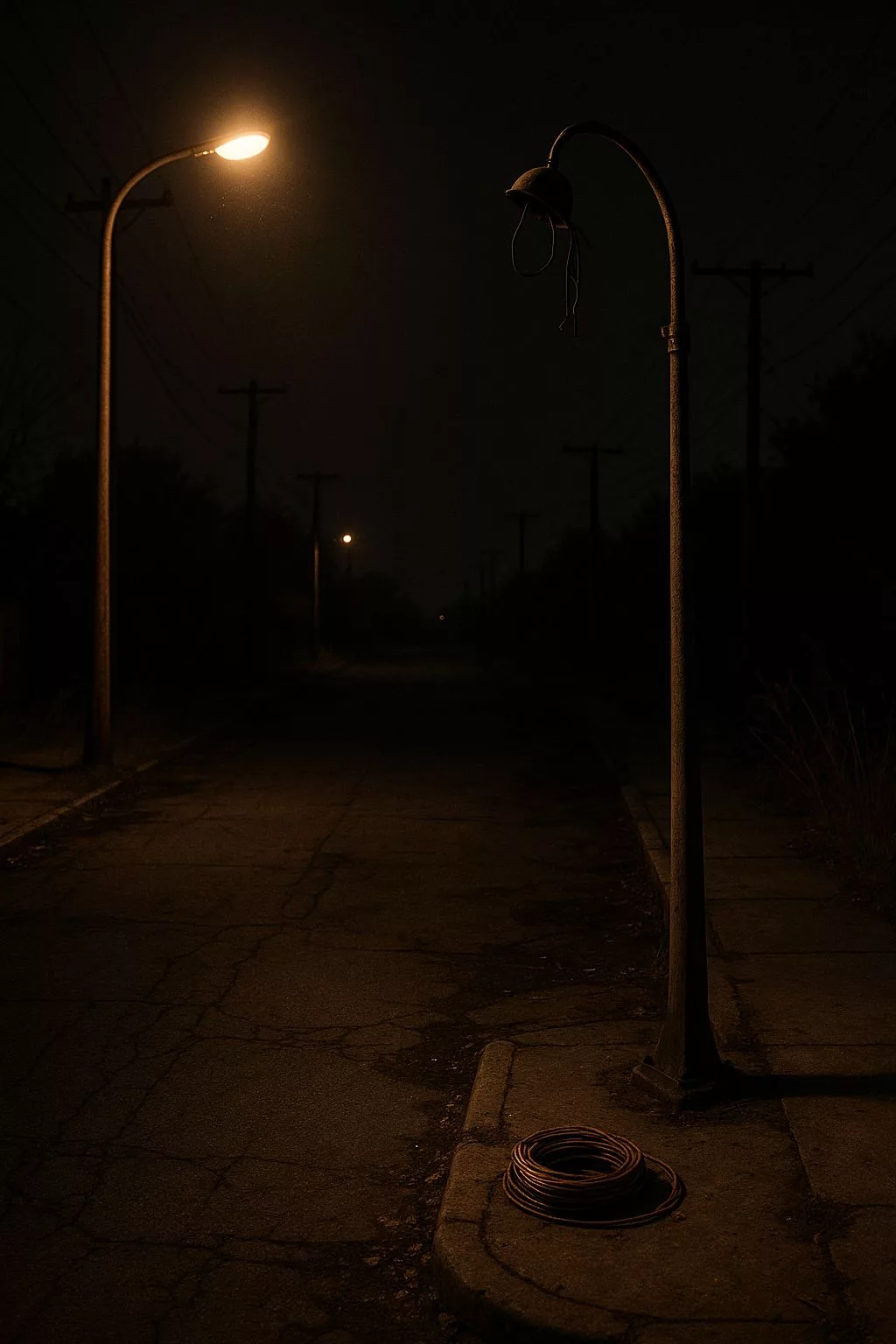
Cape Town is fighting hard to keep the lights on in Delft, a township where darkness invites trouble. Thieves are quick to steal copper from streetlights, plunging streets into danger and costing the city millions. But Cape Town is fighting back with smart tools like special cables that can be traced, drones watching from above, and tough new lights that are hard to break. They’re also getting the community involved, with residents and even kids helping to report problems. It’s a big fight, blending new tech with local heroes to keep Delft’s streets safe and bright after sunset.
How is Cape Town combating streetlight vandalism in Delft?
Cape Town is fighting streetlight vandalism in Delft through multi-faceted strategies including: using micro-polymer dots and laser etching on cables for traceability, deploying drones for surveillance, implementing tamper-proof LED designs, trialling aluminum conductors, and fostering community involvement with initiatives like “light rangers” and local vigilance.
1. A Township That Loses Its Light at Seven O’Clock
Thirty kilometres east of Table Mountain, the neat grid of Delft was drawn on apartheid drafting tables in the late-1980s to absorb families the Group Areas Act had pushed out of the city. Today the rows of single-storey brick boxes, 40-metre street intervals and 8-metre concrete masts still mirror that blueprint. At full strength the suburb’s 3 100 lamps burn overlapping pools of white onto the asphalt, letting worshippers reach night-time sermons and night-shift workers meet their taxis without glancing over their shoulders.
When a lamp dies, the mood flips within two days: muggings rise, burglaries climb and the 12 km² area sinks into a checkerboard of black. Energy Department spreadsheets reveal that Delft logs faults 3.4 times faster than the metro norm. The worst pockets – Leiden’s rent-to-buy flats and the tin-roof temporary camp nicknamed Blikkiesdorp – lose fittings faster than maintenance vans can restock.
2. Seven Minutes of Destruction, Fourteen Nights of Black
Criminals have reduced the art of killing a streetlight to a four-minute dance. A braided rope harness flings a climber upward, a lookout whistles twice, a panel van idles half a soccer-field away. The cast-aluminium hatch at the mast-top is popped with a flat bar, the 0.8 kg brass-threaded photocell is ripped free and pocketed for R120 of scrap change.
Next comes the copper vein: a snip at the bracket, a tug, and 10 kg of 4 mm² phase conductor coils into a sack that will fetch R560 a kilogram. The bulb itself ends in a shower of glass so the sodium-mercury mix can never be traced. City finance tables count the damage at R3 400 a pop – cable, photocell, labour, traffic permits – while residents count 14 moonless nights until new stock arrives.
3. A Shadow Budget the Size of Every Library in Town
Unplanned spending devours the future. In 2024/25 the Energy Directorate quietly moved R62 million from its capital chest into an “emergency” bucket labelled street-light upkeep. That figure mirrors the entire annual operating budget for Cape Town’s 104 libraries; it could also buy 7 000 efficient LED lanterns for poorer wards.
Instead, 82 % of the money paid for fresh copper conductors, 11 % rebuilt smashed mini-substations and 7 % welded angle-grinder wounds on masts. Because the item is booked as unplanned opex, it competes with everyday jobs such as pruning trees or swapping meters. Analysts inside the metro calculate that every rand consumed by vandals pushes the suburb-wide LED roll-out 0.6 m further away; the 19 km of stolen copper since January has already deferred full conversion by 14 months and will keep 1.3 GWh burning unnecessarily – enough to power 280 modest homes for a year.
4. When Houses Swallow the Sidewalk
Building inspectors walking Symphony and Crescendo Roads in October counted 137 boundary walls or backyard shacks squeezed to within 30 cm of lamp columns, brazenly inside the 1 m electrical servitude that wiring code SANS 10142-1 demands. Most extensions are born of overcrowding, not malice, yet they choke maintenance.
Aerial-lift trucks need 3 m of outrigger room; where that space is now a spaza shop, technicians must dead-lift 25 kg cable drums over walls, tripling repair time. One pole has been bricked into a two-metre enclosure and struck off the job roster forever, leaving 120 m of road in permanent dusk. Twenty-three demolition orders sit at the housing tribunal; resolution is two years away.
5. An Aluminium Gambit and the Copper-to-LED Arms Race
LED lanterns were supposed to end the copper chase – until crooks learned the aluminium heat-sink still weighs 1.2 kg and can be sold as “mixed scrap”. Engineers countered with “lumen-side” gear: the driver electronics now hide in a tamper-proof vault under the pole, leaving only a 24 V LED array aloft – worthless to metal thieves.
Pilot zones in Delft East logged 68 % fewer attacks, yet each fitting costs R5 800, twice the normal price and funding is secured for only 400 units, shielding main roads while 2 700 side-street lamps remain trophies. Meanwhile a parallel experiment is under way: 35 mm² hard-drawn aluminium conductor that fetches one-eighth of copper’s price. Its conductivity is lower, joints need special bi-metal lugs, and contractors moan it cracks if bent too sharp; 12 km will be rolled out in March 2026 if salt-mist torture tests at Brackenfell depot pass.
6. From Invisible Ink to WhatsApp War Rooms
Microscopic polymer dots carrying unique DNA-style codes are now baked into UV varnish on every new cable. Scrap-yard scanners can verify origin instantly, turning possession of un-tagged copper into courtroom poison. An 808 nm infrared laser also etches a City coat-of-arms every metre; invisible at noon, it glows under inspection flashlights and shreds the “I didn’t know” excuse.
Operational brains sit inside a WhatsApp group named “Delft Light Rapid Response”. Within half an hour of a fault call, technicians, police, neighbourhood-watch leaders and two scrap-compliance officers receive a GPS pin, a daylight photo and a 1-to-5 risk score. SAPS ghost-squads camp the first three nights, the period that sees 60 % of repeat strikes. Since September the gap between sabotage events has widened from 9 to 21 days, still short of the 90-day dream but enough to trim total faults by 14 %.
7. Café Tables, Kid Rangers and a Ledger No One Can Cook
At the foot of one working mast on Symphony Way, 63-year-old Aunty Pat balances vetkoek and black coffee on paint drums, paying an unofficial R120 a month for 2 A tapped from the photocell compartment. Her snack stall doubles as natural surveillance; engineers credit the “social-glue” effect – zero vandalism within a 100 m radius since August.
A children’s NGO, Molo Songololo, has enlisted 120 primary-school “light rangers” who patrol with crayon maps and log dead lamps directly to customer care. Since July they have filed 142 verified faults, 96 % fixed inside the 14-day promise; each ranger earns a solar reading lamp, tethering homework hopes to public infrastructure.
To keep municipal fingers honest, Supply Chain is trialling a blockchain ledger for every cable reel. NFC chips store unique hashes on a private Ethereum node; if a tagged coil surfaces in a Phillipi night yard, investigators can pinpoint its last legitimate scan within seconds. Two reels signed out for Sea Point were traced to a scrap yard in minutes, triggering internal disciplinary steps.
- Drones, Dimmers and an Economy That Refuses to Sleep
Two DJI Matrice 300 drones cruise 60 m above the feeders between 20:00 and 04:00, their thermal cameras hunting for the 30–40 W heat bloom of illicit extension cords. Ground crews remove the taps and fit tamper-proof ferrules; transformer trips have fallen 22 %. The drones’ flashing nav-lights are mistaken for police helicopters, scattering would-be cutters before a tool touches the wire.
Economists at the University of the Western Cape calculate that every blackout hour bleeds R28 000 from Delft’s informal night economy – spaza shops, hair salons, 24-hour creches – killing 76 neighbourhood jobs in aggregate. Yet the same bright light helps burglars spot palisade fences to cut. The proposed compromise: dimmable LEDs throttled to 30 % between 01:00 and 04:00, releasing 0.9 MWh a month to floodlight the local soccer pitch and attract night tournaments that hire 15 part-time security guards.
Civil-asset forfeiture is the latest legal spear. Using the Prevention of Organised Crime Act, the City recently seized 4.2 t of questionable copper from a Bellmore dealer – R378 000 worth – forcing owners to prove legitimacy. The shockwave pushed scrap-yard licence applications up 30 % as owners scramble to stay on the right side of the ledger.
From aluminium cores to blockchain hashes, from Aunty Pat’s café table to children who trade homework light for civic vigilance, Cape Town is learning that technology alone will not keep Delft lit. The fight for street-level safety is as much about social glue, civic pride and courtroom creativity as it is about cable specs and drone eyes. Until the courts move faster than angle-grinders and communities feel co-ownership in every watt, the battle for Delft’s night will stay a meter-by-meter, lumen-by-lumen campaign against darkness.
[{“question”: “What are the main reasons for streetlight vandalism in Delft?”, “answer”: “Streetlight vandalism in Delft is primarily driven by the theft of copper cables and other valuable components for scrap. Criminals can strip a streetlight of its crucial parts, like the brass-threaded photocell and copper phase conductor, in a matter of minutes, selling the materials for a significant profit in the scrap market. The damage incurred by the city for each incident is substantial, and the stolen copper also includes the aluminum heat-sink from LED lights, further incentivizing theft.”}, {“question”: “How much does streetlight vandalism cost Cape Town annually?”, “answer”: “The financial impact of streetlight vandalism on Cape Town is significant. In the 2024/25 fiscal year, the Energy Directorate reallocated R62 million from its capital budget to an ’emergency’ fund specifically for streetlight upkeep. This amount is equivalent to the entire annual operating budget for Cape Town’s 104 libraries or enough to purchase 7,000 efficient LED lanterns for poorer wards. A large portion of this budget, 82%, goes towards replacing stolen copper conductors, with additional costs for repairing damaged substations and masts.”}, {“question”: “What technological solutions is Cape Town implementing to combat theft and vandalism?”, “answer”: “Cape Town is deploying several advanced technological solutions. These include using micro-polymer dots and laser etching on cables for unique traceability, making it harder for thieves to sell stolen materials. Drones are used for aerial surveillance to detect illicit activities, and tamper-proof LED designs are being introduced, where driver electronics are hidden in secure vaults at the base of the pole. They are also trialing aluminum conductors, which are less valuable than copper, and using blockchain ledgers with NFC chips to track cable reels and prevent internal theft.”}, {“question”: “How is the community involved in the fight against streetlight vandalism?”, “answer”: “Community involvement is a crucial aspect of Cape Town’s strategy. Residents like ‘Aunty Pat,’ whose snack stall near a working mast discourages vandalism, demonstrate the ‘social-glue’ effect. A children’s NGO has enlisted ‘light rangers’ who are primary school children that report dead lamps directly to customer care, earning solar reading lamps for their efforts. There’s also a ‘Delft Light Rapid Response’ WhatsApp group that includes technicians, police, and community watch leaders to quickly address faults and coordinate responses.”}, {“question”: “What challenges does the city face in maintaining and repairing streetlights?”, “answer”: “Beyond vandalism, Cape Town faces challenges such as illegal structural encroachments. Many boundary walls and backyard shacks are built too close to lamp columns, violating electrical servitude regulations. This obstructs maintenance efforts, as aerial-lift trucks require significant space, tripling repair times where access is limited. Some poles have even been permanently bricked into structures, leaving sections of road in darkness. The legal process to resolve these encroachments is slow, with demolition orders taking years to resolve.”}, {“question”: “What long-term vision does Cape Town have for lighting Delft?”, “answer”: “Cape Town’s long-term vision includes a full rollout of efficient LED lanterns across Delft, although this is being delayed by ongoing vandalism. They are also experimenting with dimmable LEDs that can be throttled during off-peak hours, saving energy and redirecting it to light public spaces like soccer pitches for community activities. The city is also using legal tools like civil-asset forfeiture under the Prevention of Organised Crime Act to seize questionable copper from dealers, aiming to disrupt the scrap market and create a deterrent for thieves. The overarching goal is to blend technological innovation with strong community engagement and legal enforcement to ensure a safe and bright Delft.”, “keywords”: [“streetlight vandalism”, “Cape Town”, “Delft”, “copper theft”, “community involvement”, “technological solutions”, “LED lighting”, “urban development”]}]