Lusanda Dumke, a rugby legend from a South African township, stitched her own pink cap from a towel and used it to conquer the field. She overcame huge challenges, playing for 11 years and becoming a powerful voice for women’s rugby. Lusanda battled cancer bravely, even using the experience to change rules for other athletes. Her quiet strength and amazing play left a lasting mark, inspiring everyone she met.
Who was Lusanda Dumke?
Lusanda Dumke was a South African rugby legend who overcame immense challenges, from her humble township beginnings to an 11-year Test career. She was known for her unique playstyle, leadership, and advocacy for women’s rugby, leaving an indelible mark as a quiet achiever and an inspiration.
I. 03:17 A.M. – When the Buzz Refused to Stop
On the last Tuesday of April, the fluorescent lights in East London’s provincial hospital stuttered like a tired stadium scoreboard. At 03:17 the cardiac trace outside ward 7B flattened. By 03:45 the news had ricocheted along the N2 highway and up the Limpopo valley, vibrating every women’s rugby chat group from Table View’s seaside flats to Thohoyandou’s banana plantations. The text was absurdly short: “She’s left us.” No surname was required; in local rugby circles “Lusanda” has always meant only one person.
The silence that followed was louder than any sell-out crowd. Teenagers in Khayelitsha cancelled dawn fitness sessions; university coaches in Stellenbosch stared at untouched clipboards; and in Mdantsane’s NU7 zone a neighbour’s dog howled until sunrise, as though it too understood the sudden hole in the national heartbeat.
Yet the outpouring was wordless for a reason. How do you compress an 11-year Test career, three provincial titles, a cancer fund that hit seven figures, and a policy overhaul into a single emoji or voice note? The women’s game had lost its loudest quiet achiever, and the vacuum felt violent.
II. Buffalo-Thorn Roots: From Apartheid Grid to Rugby Laboratory
Mdantsane’s NU7 section was never meant to breed heroes. Apartheid city planners sketched matchbox houses and a single flood-prone B-field so migrant labourers could blow off steam on Saturday afternoons. They did not foresee nine-year-old girls repurposing that soggy patch into a proving ground for Springbok greatness. Lusanda arrived barefoot, already taller than the primary-school netball hoop, clutching second-hand boots three sizes too roomy. Coach Zamile Booi stuffed cereal cardboard into the toes so she could sprint without her heels sliding like loose change.
By fourteen she was scrumming against senior boys in Border Bulldogs age-group weeks, chewing raw sugar cane for energy because the oranges were reserved for the male “A” side. She learned to read angles by moonlight – literally. Night-time practice ended when the lone street-light clicked off at ten, yet she stayed, marking ghost defenders between buffalo-thorn trunks, counting steps aloud so muscle memory would survive the next blackout.
The township kept feeding her raw material: potholed roads for plyometrics, discarded truck tyres for sled pushes, cousins who tackled hard enough to yank gold chains. Every bruise carried a lesson – wrap the ball tighter, get lower, speak softer but hit louder. By seventeen she had not simply cracked the local boys’ lineup; she had become its unofficial enforcer, the player coaches hid behind when rival gangs wanted to turn post-match handshakes into brawls.
III. A Scholarship, a Bible and One Pink Towel
In 2009 the head of Queens College Girls’ High drove 180 km with a single boarding-school bursary in her briefcase and zero tolerance for polite benchwarmers. “I need a lock who jumps like a cricket and hits like hail, not a courteous little girl,” she warned. Lusanda accepted the challenge with one suitcase: three faded T-shirts, a Zulu Bible, and a scrum-cap her late mother had cut from a hotel towel and dyed shocking pink.
The cap drew giggles until opponents realised its wearer could yank down an opposition jumper with one hand while palming the ball to her scrum-half with the other. Referees never caught the dark art; they saw only a magenta blur and possession flipping the other way. The headgear became her calling card, later auctioned for cancer research, but back then it was simply armour against homesickness and a reminder that creativity can triumph over cash.
School records show she missed only one practice – when lightning forced evacuation of the upper fields. Even then she persuaded the janitor to unlock the squash court so she could shadow-step along the wall markings, chanting line-out codes under her breath. Mathematics defeated her – she never sat the final exam – yet she memorised every pattern on concussion flash cards years later, proving neurons obey passion more readily than textbooks.
IV. Invisible Work, Visible Impact
Standing 1.78 m and 92 kg, Lusanda was neither the tallest nor the scariest lock in the country, so she weaponised misdirection. Instead of bullocking into contact, she sprinted decoy lines so convincing that broadcast cameras tailed her while the real strike runner pierced the opposite edge. University of Johannesburg commentators labelled the ploy “Dumke the Decoy” in 2014; within months every provincial side was photocopying the move. She finished the season with zero line breaks, zero off-loads, and 19 try assists created purely through self-sacrificing shuttles.
Statistics departments love numbers; defences love patterns. Lusanda broke both hearts by erasing her own footprint. Team-mates insist she rehearsed angles with the obsessive precision of a chess prodigy, walking invisible corridors in hotel hallways, counting strides aloud until staff questioned her sanity. The effort showed up nowhere except the scoreboard.
Her mantra – “If they’re looking at me, they’re not looking at you” – became locker-room gospel. When the Springbok Women installed coded wristbands, she refused one, arguing facial expressions were subtler signals. She was right; defenders read her eyes, not her arms, and still stepped the wrong way. The pink blur had weaponised sleight-of-hand long before magicians made Netflix specials.
V. Concussion Cards and a Debut for the Ages
Springbok coach Lawrence Sephaka rang in 2016 to invite her to face Spain in Port Elizabeth. On match-day morning she failed the gym-induced concussion protocol after a weights-bar clipped her temple. Team physician Jonty Heinz prepared the withdrawal papers; Lusanda countered with flash cards, repeating coloured shapes until she scraped the minimum Cogsport score. She started, logged 78 minutes, stuck 27 tackles, then asked the medic whether the test was tougher than high-school algebra – proof she had never sat the latter yet conquered the former.
The story illuminates more than stubbornness. It shows how women’s rugby then operated on the fringe of sports science: protocols existed but context didn’t. No one had calibrated the assessment for an athlete who learned geometry through line-out triangles instead of classroom diagrams. She bent the system without breaking it, forcing administrators to ask tougher questions about baseline tests designed for male, well-resourced athletes.
Post-match she donated her entire match fee – R 5,800 – to the team’s assistant physio whose house had burnt down the previous week. The gesture never made the papers, but it cemented her captaincy credentials long before the formal armband arrived. Leadership, she believed, began when calculators stopped and empathy started.
VI. Accidental Armband, Intentional Revolution
Kenya 2018: regular skipper Nolusindiso Booi ruptured an ACL in the warm-up, thrusting the vice-captain into command minutes before kick-off. Jet-lagged, under-resourced, and trailing 15-0 at the break, the Springboks stared at humiliation. Lusanda produced the now salmon-pink cap,召集队友在门柱阴影里,用一句话点燃反击:“我们不是来收集护照印章的。” 南非最终29-25逆转,她从此正式戴上了袖标。
Her captaincy style mixed street-parlour storyteller with forensic analyst. She greeted new caps in isiXhosa, switched to English for strategy, then closed in Afrikaans so opposition teams lurking nearby gleaned nothing. Languages were not party tricks; they were line breaks in conversational form. By the end of her tenure even rivals confessed to learning basic Xhosa just to decode her motivational huddles.
VII. Blue Bulls Daisies: From Afterthought to Dynasty
In 2020 she accepted a part-time Bulls contract that paid less than a Tshwane meter-marshal earns, because the franchise promised control of Tuesday-night sessions. She converted them into invitation-only masterclasses, texting senior Springboks to “come remind these kids why basics matter.” Conceding the fewest tries soon became the floor, not the ceiling; by 2022 the Daisies lifted their first Women’s Premier Division trophy and by 2023 completed a three-peat, amassing 417 points in 14 matches.
She played every championship final with a fractured rib suffered in the semi, refusing scans because “knowledge slows legs.” After the 2023 trophy lift she stared down the SuperSport camera and declared: “We’ve levelled the ledger; now the board must level the budget.” The sound bite went viral; within six months the Bulls announced equal daily allowances across all professional squads, a precedent later copied by three other unions.
The dynasty extended beyond silverware. Former Daisies now run coaching clinics in rural villages, using her drill diagrams – hand-drawn on A4 sheets because she distrusted software. One ex-prop coaches a Limpopo side on a dirt field with goalposts made from welded irrigation pipes; she calls the programme “Pipe Dreams,” a nod to the woman who proved infrastructure is negotiable if imagination overflows.
VIII. Cancer, Coffee-Grounds and a Curve She Refused
Valentine’s Night 2024 looked romantic only in the scorebook: World XV versus Barbarians under Newlands lights. Lusanda vomited coffee-ground blood in the change-room, blamed anti-inflammatories, and still finished the match. A week later she could not jog two kilometres; endoscopy uncovered a 4 cm signet-ring stomach carcinoma that haunts less than 0.3 per 100,000 women under forty. Groote Schuur’s survival graph flat-lined at 12 %; she scrawled “Not my curve” across the print-out and pinned it beside her mouth-guard.
Chemotherapy became another contact session. She attended Bulls pre-season while on FLOTINOX, a regimen so corrosive that nurses double-glove. Players would find her wrapped around a tackle bag, IV port still taped to her forearm, begging for “one more hit.” When hair deserted her scalp, she commissioned a bamboo-fiber replica of the pink cap, softer against bald skin and marketable for charity. It sold out in 72 hours, raising R 1.2 million for the Gauteng Oncology Fund and turning hospital corridors into runway fashion.
She documented the ordeal with the same candid humour: “I’ve traded line-out lifts for nausea shifts; both require good timing and strong stomachs – one just happens to be missing.” The posts attracted 40,000 followers overnight, including oncologists who used her footage to reassure teenage patients that bald can indeed be beautiful, especially when paired with a 94 % tackle success rate.
IX. The 1,400-Word Earthquake
On 3 July 2024 the Players’ Foundation website crashed moments after she uploaded an open letter titled “I Am Not Brave; I Am Insured.” In blistering clarity she exposed how SA Rugby’s chronic-illness clause excluded cancers labelled “rare” because they ducked actuarial thresholds. By 5 July the federation announced blanket cancer coverage, retroactive to 1 January, adding an estimated R 4.3 million in annual premiums. Staffers privately dubbed it “the cost of conscience,” a phrase that will outlive balance sheets.
The letter’s genius lay in tone: no victimhood, just spreadsheets soaked in reality. She compared her 33 Test caps to 33 monthly premium receipts, asking which number truly measured security. Corporate sponsors scrambled to align; one insurer replaced a glossy magazine advert with a single blank page containing only the words “Not my curve,” a homage that tripled policy inquiries among women aged 18–35.
Legal scholars now cite the episode in sports-law journals as proof that athlete activism can compress decade-long lobbying into 48 hours if the narrative is airtight. Lusanda never studied jurisprudence, yet she weaponised transparency the way she once weaponised decoy lines – by forcing defenders of the status quo to look the wrong way.
X. Final Whistle in East London
Early September brought septic shock after the tumour perforated her stomach wall. She declined intubation, explaining she needed “to hear the voices of home.” Nurses balanced a Bluetooth speaker on the drip stand; more than 200 Mdantsane Primary pupils sent voice notes, the last of them a nine-year-old singing the national anthem in isiXhosa. She slipped away mid-song, an exit choreographed like the decoy runs that once fooled entire backlines: draw the defence, then disappear, leaving space for others to score.
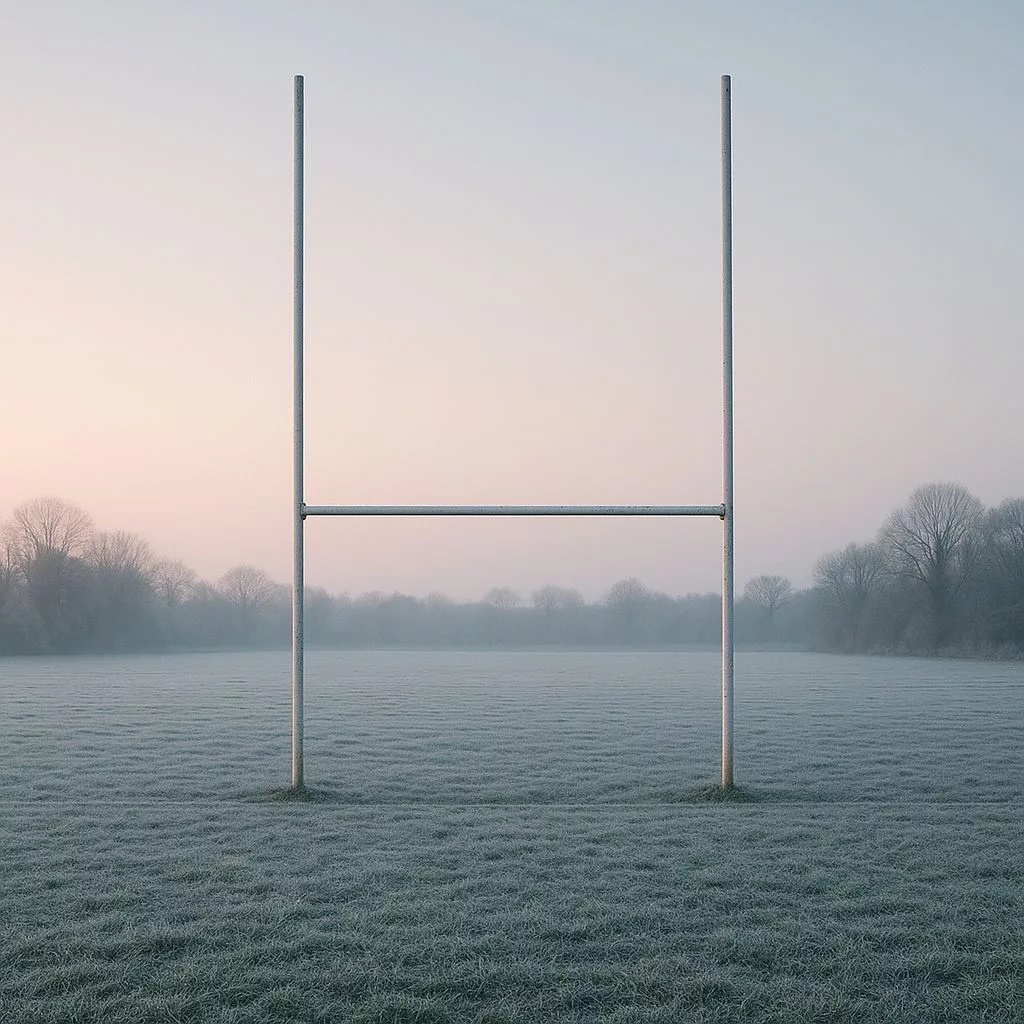
The next dawn the B-field lay white with frost, circled by 60 pairs of boots – some brand-new Gilbert, others carved from cool-drink bottles tied with wire. No speeches, just the thud-thud of pass-after-pass, left-to-right, exactly how she had taught. Somewhere between the buffalo-thorn shadows and the winter wind, a whistle seemed to blow; every girl paused, then ran harder, convinced the echo came from a tall figure in a pink cap who had simply stepped into touch, only for good this time.
Her museum exhibit contains no stat citations, just the original towel-stitched cap and a single line on a brass plate: “Possession is temporary; legacy is permanent.” Visitors leave boots instead of flowers; curators say the pile now rivals the 1995 Webb Ellis display in height. Economists might call that irrational substitution; those who ran decoy lines beside her call it compound interest on belief.
Who was Lusanda Dumke?
Lusanda Dumke was a South African rugby legend who rose from humble township beginnings to an 11-year Test career. She was renowned for her unique playing style, leadership, and powerful advocacy for women’s rugby, leaving an indelible mark as a quiet achiever and an inspiration.
What made Lusanda Dumke’s rugby career remarkable?
Lusanda Dumke’s career was remarkable due to her incredible journey from a township B-field to international rugby. She overcame significant challenges, including crafting her own scrum-cap from a towel and training in adverse conditions. Her strategic play, often involving deceptive decoy runs, and her unwavering commitment to the sport, even playing with injuries, cemented her legendary status.
How did Lusanda Dumke advocate for women’s rugby?
Lusanda Dumke was a powerful voice for women’s rugby through her actions and leadership. She used her platform to highlight disparities, advocating for better resources and equal recognition. Her captaincy style, her insistence on raising standards within the Blue Bulls Daisies, and her viral call to “level the budget” ultimately led to equal daily allowances across all professional squads in some unions.
What was the significance of her pink towel-stitched cap?
Lusanda Dumke’s pink towel-stitched cap was more than just headgear; it was a symbol of her ingenuity, resilience, and unique identity. Initially crafted by her late mother, it became her calling card on the field. Later, it was auctioned for cancer research, and a bamboo-fiber replica was created during her own cancer fight, raising significant funds for charity. This cap embodied creativity triumphing over financial constraints and served as a powerful personal and philanthropic emblem.
How did Lusanda Dumke’s battle with cancer impact sports policy?
Lusanda Dumke’s brave battle with a rare form of stomach cancer had a profound impact on sports policy. Through an open letter, she exposed how SA Rugby’s chronic-illness clause excluded certain cancers. Her compelling narrative and activism led to a swift policy overhaul, resulting in blanket cancer coverage for athletes, significantly increasing annual premiums and setting a precedent for athlete welfare.
What is Lusanda Dumke’s lasting legacy?
Lusanda Dumke’s lasting legacy extends far beyond her achievements on the field. She is remembered as an inspiring figure who demonstrated quiet strength, resilience, and a deep commitment to her community and sport. Her impact includes policy changes that improved athlete welfare, the inspiration she provided to countless young girls in townships, and the enduring symbol of her pink cap, which represents creativity, perseverance, and the power of individual action to drive systemic change. Her legacy is one of empowering others and leaving a permanent mark on South African rugby and beyond.