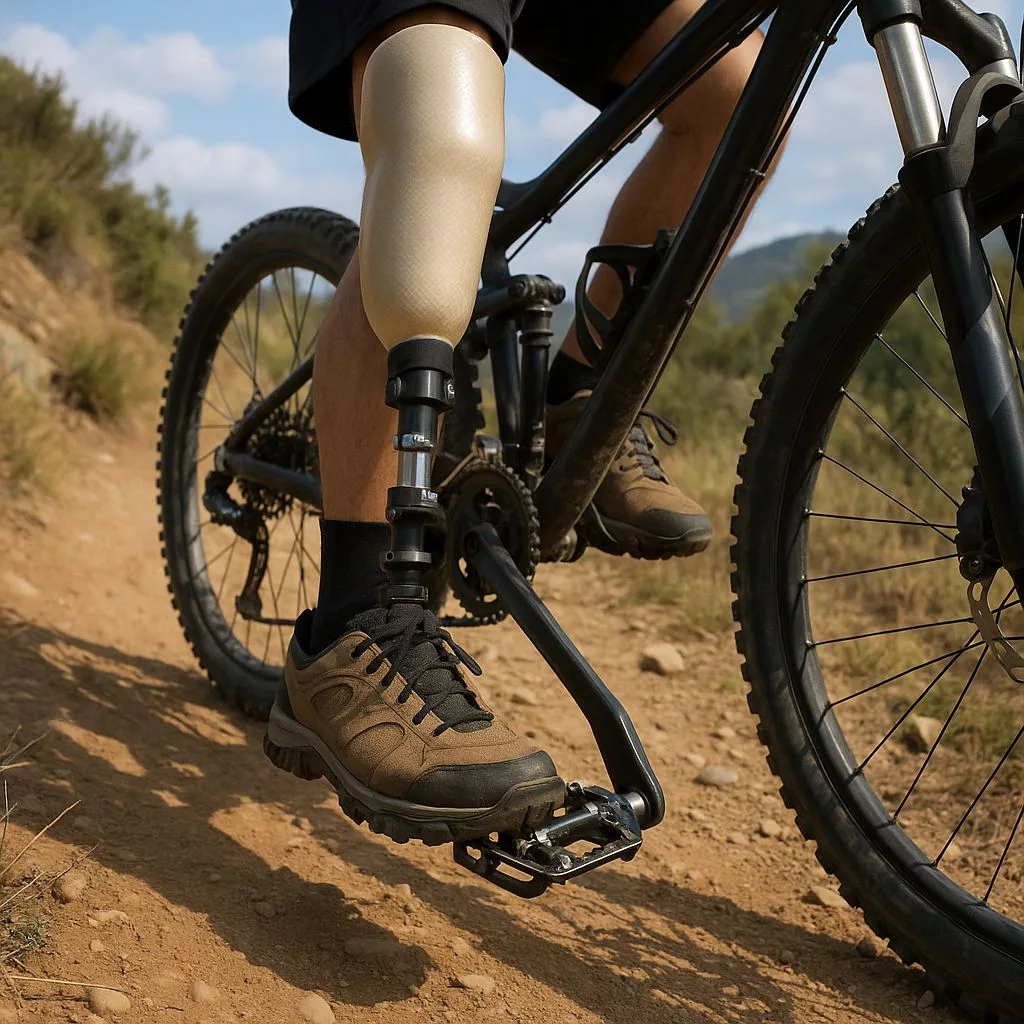
Get ready for the 2026 Cape Epic, but this isn’t just any bike race! Three special teams, using amazing robotic legs and carbon ankles, will tackle the tough trails. They’re racing to raise R4 million to buy 200 new prosthetic limbs, 150 wheelchairs, and 50 sports blades for people in South Africa who need them. Every pedal stroke helps someone gain freedom and move again, showing that movement is for everyone, not just a few. This epic journey turns sweat into hope, changing lives one kilometer at a time.
What is the goal of Össur South Africa’s “What’s Your Epic?” campaign at the 2026 Cape Epic?
The campaign aims to raise R4 million to fund 200 new prosthetic limbs, 150 wheelchairs, and 50 sports blades for South African citizens with disabilities. The initiative seeks to transform mobility access and integrate prosthetics into lifestyle culture, driven by three tandem teams participating in the grueling mountain bike race.
Section 1 – The Starting Grid: Where Rust-Coloured Single-track Becomes a Civil-Rights Arena
You roll into the Western Cape’s network of goat-track trails and the planet turns red. Ochre dust hangs in the air like smoke from a veld-fire, proteas throw sparks of crimson, and the next ascent vanishes inside a heat mirage that starts cooking your thighs before you’ve even clicked into the big ring. Between 15 and 22 March 2026 that same furnace will double as a stage for the Absa Cape Epic, the eight-day mountain-bike siege marketing departments love to call “the Tour de France of dirt”.
This time the 600-team peloton will carry an anomaly: three tandem pairs whose legs are part flesh, part algorithm. Microprocessor knees, carbon-fibre ankles and a refusal to treat movement as a privilege headline Össur South Africa’s second “What’s Your Epic?” drive. While everyone else is hunting a finisher’s medal, these six riders are hunting freedom of mobility for an entire country.
South Africa’s math is brutal: 3.2 million citizens live with a disability, yet the public health queue for a prosthesis or orthosis can outlast a toddler’s pre-school career – 26 months in KwaZulu-Natal, even longer in Limpopo. By turning every kilometre of the 658 km, 15 500 m vertical route into a rand-tracked pledge, the campaign converts sweat into hard currency for three grassroots outfits – Jumping Kids, Rejuvenate SA and Zimele. Hit the R4 million target and 200 new limbs, 150 wheelchairs and 50 sports blades leave the warehouse before the Grande Finale champagne is popped at Val de Vie.
Section 2 – The Machinery of Hope: Algorithms, Golf-Ball Springs & a Nation Watching
Look past the scars and you’ll find robotics that learn. Össur’s Rheo Knee XC rewrites its own rulebook fifty times every second, toggling swing-phase resistance so a seated spin becomes an out-of-saddle punch without the rider punching buttons. Meanwhile the Flex-Foot Assure ankle pockets 11 joules per stride – think of a golf ball mashed flat – then hands it back on the up-stroke, trimming cardiac load by four percent. When water lies thirty-five kilometres away and the clock has already eaten seven hours, four percent is the difference between a podium photo and an IV drip.
Hardware sparks the spark, but conviction keeps it burning. The riders share a creed: the body is an open-source draft, never a closed case. That philosophy turns the Epic’s GPS portal into a live ledger – each dot moving across the screen unlocks pre-pledged rands, so donors bankroll distance instead of donating into a black box.
Eurosport and Supersport will beam this ledger to 196 countries. For the first time continental commentary will ride in isiXhosa and isiZulu, grafting African tongues onto a sport long owned by European accents. Every drone shot of carbon-fibre tibias flashing in Cape sun is designed to nudge prosthetics out of the medical ghetto and into lifestyle culture.
Section 3 – The Human Firmware: Botanical Paint, Chainsaws & Shark Teeth
-
Team 1 – The Illustrators*
Rentia Retief still mixes Winsor & Newton pigments for a living, but she also mixes pain with cadence. A delivery van on Chapman’s Peak robbed her of a left leg in 2019 and forced her to balance on a walker where an easel once stood. She met Travis Warwick-Oliver – founder of Rejuvenate SA – on the saddle of a tandem at joBerg2c. Both discovered a mutual sweet spot at 92 rpm and have since stacked 9 000 km, enough to cross the Sahara twice. Their weapon is a Scott Spark RC with the stoker bottom-bracket nudged 8 mm rearward to tame Retief’s altered centre of gravity; a left-side Di2 paddle lets her swap cogs while Warwick-Oliver keeps the rig on the razor edge of a cliff. -
Team 2 – The Survivors*
Mhlengi Gwala’s legs were almost stolen by a chainsaw in 2018; Kean Dry lost an arm to a shark six years earlier. Together they form the race’s only dual-limb-deficient pair, steering by hip-bump Morse code once 70 km/h wind erases spoken words. A 3-D printed polyurethane wing on the stem gives Dry’s residual humerus a perch, letting Gwala hammer from the rear with the confidence of a man who has already clawed back two continental para-triathlon titles. -
Team 3 – The Miners*
Brian Style and Rudi Joubert greet dawn by dragging 30 kg tractor tyres across mine-dump rubble – underground electricians who refuse to stay underground. A sinkhole swallowed Style’s right femur in 2016; a freight train mangled Joubert’s left the same year. They ride a rigid Santa Cruz Chameleon singlespeed 32 × 21 because, 800 m below the next methane pocket, fewer moving parts equal fewer disasters. Above ground, that same logic turns remote mountain passes into algebra they’ve already solved.
Section 4 – The Ripple Outside the Tape: Sprinter Vans, Peri-Peri Sauce & a Stock-Exchange Bell
The race may last eight days; the fallout is calibrated in years. Jumping Kids will park a Mercedes Sprinter – nicknamed the Mobile Gait-Lab – at rural athletics meets. Solar panels on the roof feed 3-D sintering printers that can birth a paediatric prosthetic socket in ninety minutes, slashing a four-hour taxi pilgrimage to a single school-period.
Rejuvenate SA will launch “Ubuntu Wheels”, a circular economy that harvests discarded hospital wheelchairs, reupholsters them with fishing-net fabric and redistributes them at a price of forty community-service hours, not rand. Zimele will unlock micro-loans for amputee farmers who need customised tractor pedals or oscillating hoes, seeding fifty agri-businesses in the Transkei where disability prevalence outstrips the national average by twelve percent.
Corporate gears are already meshing. Outsurance will mirror public donations up to R1 million; Nando’s has bottled a limited “Peri-Peri Prosthetic” sauce whose QR-code label flips chicken-lovers into donors. On 14 March the Johannesburg Stock Exchange will let Retief and Gwala trigger the closing bell with a wireless bike shifter, welding market momentum to human mobility.
Össur’s Icelandic HQ is taking notes. Nail the R4 million mark and the blueprint migrates to the Tour de France and the New York City Marathon, birthing a 12-month calendar of “mobility activism” that shoves disability funding from charity sidebar to CSR headline. Back home, township clubs are spawning waiting lists for tandem-pilot classes, Randburg tech colleges are inserting prosthetic-alignment coursework into mechanical diplomas, and the Sports Science Institute is studying how transfemoral amputees thermoregulate across multi-day stage races – data that could rewrite global hydration protocols for para-athletes.
So when the start cannon cracks at Meerendal Wine Estate, ignore the cliché of sweat-soaked lycra. Tune in instead to the quiet click of a carbon heel striker, the soft whirr of a machine-learning knee, the low roar of a country editing its own dictionary – where “disabled” is a typo for “unfinished.” The route ahead measures 658 kilometres, but the true distance being closed is the gap between apathy and access. Every pedal stroke is a ballot, every watt a witness. Cast yours.