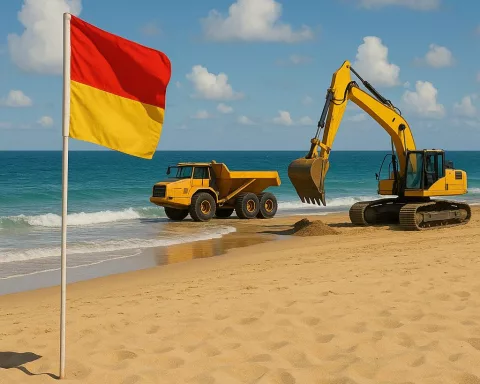
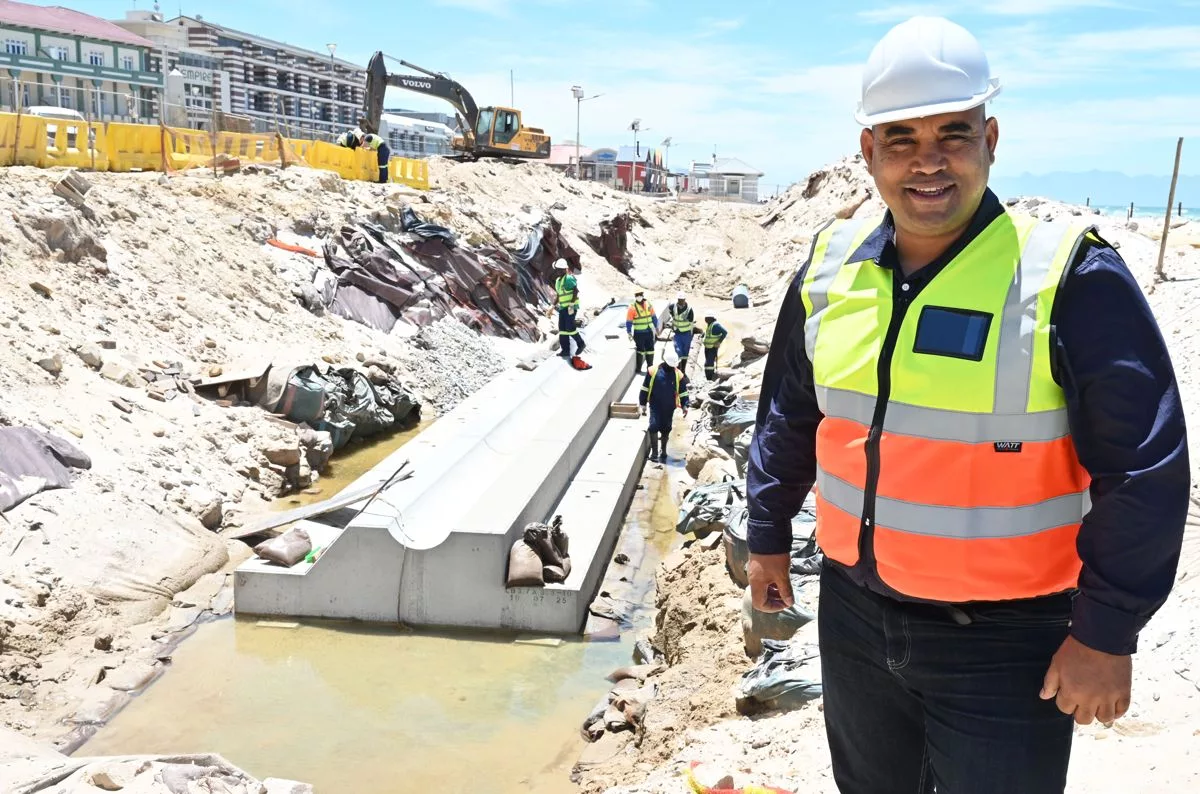
Muizenberg Beach is like a big outdoor workshop right now, with cranes and building everywhere. But don’t worry, they’re making sure you can still get to the beach and have fun. They even stop building for a few weeks in December and January so everyone can enjoy the sand and waves. So, it’s a bit messy, but still a great place to play!
What is the current status of Muizenberg Beach’s renovations?
Muizenberg Beach is currently undergoing significant renovations, transforming it into an “open-air workshop” with cranes and construction. While the beach is a building site, efforts are made to maintain accessibility and amenities, with a temporary truce on construction from December 20 to January 11 to allow for public enjoyment.
- A field-guide to the beach while it rebuilds itself*
1. The Beach Is a Building Site – And Still a Cathedral
Walk the crescent at dawn and you’ll see two oceans: one liquid, one made of cranes.
Between the railway and the surf, ten months of drill-thunder and coral-coloured dust have turned South Africa’s most forgiving break into an open-air workshop. Yet the Edwardian spirit that once wheeled bathing machines across the sand has not been bulldozed; it has simply changed costume. Gents in straw boaters have become toddlers in shark-print onesies, and the new “board-walk” is a haul road of crushed ferricrete, but the liturgy is unchanged – towels unfurl like prayer rugs, sunscreen lingers in the air, wet sand sighs under bare feet.
The city calls the operation a “managed retreat with hard adaptation.” Surfers call it “the big dig.” Both labels are correct: 20-tonne concrete slabs are flying in where Victorian ladies once tiptoed, and the 1938 seawall that replaced the original wooden pavilion is itself being replaced. The difference is that this time the audience stays. Sunbathers now tan a metre from caution tape, and the metallic kiss of angle-grinders has become the back-beat to a thousand Instagram reels. The choreography of summer adapts: same dance, new soundtrack.
What keeps the mood reverent is the temporary truce. From 20 December to 11 January the hammers fall silent, fences bow, and the construction zone becomes a stage. A gravel tongue – still raw sub-base – accepts 120 cars at daybreak, marshalled by men who once lifeguarded the same stretch. The St James tidal-pool catwalk re-opens via a detour so new it still smells of sap; a 40 m wedding-carpet of yellow rubber gives prams and wheelchairs a runway to the sea. The message is clear: play here, but play kindly. The bulldozers are sleeping, not gone.
2. Micro-City in a Sand Box – How the Amenities Survive
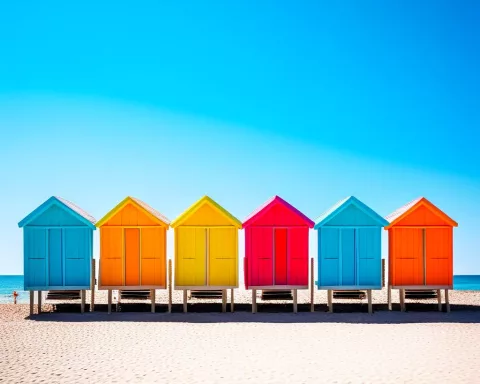
Muizenberg has always worked like a toy metropolis: 225 lockable cubes, one mint-green ablution block, a flag that tells you if you might get eaten. The upgrade has not demolished this model; it has franchised it. The ablution block – dolphin mosaics still sweating chlorine – was due for demolition but won a reprieve and an extra pallet of toilet paper. Its roof now hosts the Shark Spotters hut, the binocular ritual unchanged since 2004: scan, log, raise orange flag, repeat. Below, pastel bathing boxes have been re-keyed with brass padlocks so shiny they look like jewellery on driftwood. Owners perform the same dawn choreography – unlock, fold, drag striped chair, stand barefoot with coffee – owning 1.8 m² of ocean view rather than the ocean itself.
Food has migrated into shipping containers on solar stilts. Batteries hum like beehives, powering gelato spun with fynbos honey, calamari blackened in charcoal smoke, and a “Berg Bowl” that costs more than an hour’s CBD parking. Cash is banned; sea air eats tills alive. QR codes flash, and the transaction is done before the gull lands. Brick-and-mortar cafés – Kauai, Knead, Empire – still trade, but the choreography gravitates to the trucks because they can move when the tide of bureaucracy shifts.
For gear, the rental trailer run by a former Springbok lifesaver is a museum of serial numbers. He remembers every wetsuit he has lent since 1998 and will recite them while fitting your zipper. Umbrellas: R40 plus R20 deposit. Bodyboards: R60. Wetsuits: R100. The prices look quaint against the gourmet bowls, but the value lies in continuity: the same man who saved your aunt in ’94 now hands your child a soft-top, muttering, “This one used to be Jordy Smith’s first board – well, almost.”
3. Zones, Launch Corridors and Secret Waves – How to Navigate the New Topography
The sand has been colour-coded like a mountain trail. Lime green invites volleyball spikes; chevron blue launches kites; magenta tolerates French bulldogs chasing gulls. Ignore your pigment and 300 reclining bodies will swivel in unison, a single organism adjusting its skin. The system is cheaper than bylaws and more effective than security.
Surfers care less about colour than drop-height. The new revetment has created a 1.2 m step to the water; at low tide it’s a toddler moat, at high tide a shore-break cannon. A yellow “launch corridor” is painted on the bottom step – ignore it and the lifeguard’s whistle will treat you like a misbehaving retriever. Meanwhile, 50 m west, surplus dolosse have formed a sneaky left-hander that did not exist last summer. It’s already on WhatsApp with the hush of contraband; paddle out on a long-period south-west swell and you’ll share a grin with strangers who speak only in stoke.
For those who prefer land, the night offers its own map. The western prom stays dark – power cable rerouted – so crowds drift east to the civic-centre amphitheatre. Twenty-four smart bollards throb ultraviolet, invisible to humans but lethal to mozzies. The result is an outdoor lounge: gin-rummy grandparents, TikTok teens projecting onto lifeguard walls, buskers swapping didgeridoo for cello depending on the lunar phase. Security guards orbit, body-cams blinking like small lighthouses. Bring a blanket and red-espresso flask; the only entry fee is the story you trade with strangers.
4. Parking, Weather and Time-Travel – The Survival Manual
Practicalities are tidal. The eastern lot is free for three hours, then coins only – R10 per 30 min – because 4G can’t punch through sea-spray. Full by 9:30 a.m.; after that you circle like a kelp gull until someone buckles a toddler into a car seat. Failing that, pay the informal marshal R50 and receive a hand-drawn receipt plus a promise that your windscreen will remain un-smashed. The transaction is pure Cape Town: half insurance, half street theatre.
Wind is the real currency. The Cape Doctor clocks in at 11 a.m., buckshotting sand across volleyball courts. Arrive at sunrise, stake your towel, retreat for coffee by 10:30 and watch your footprints vanish grain by grain. If the Berg Wind arrives instead – hot, north, sneaky – sunscreen surrenders; only a long-sleeved rash vest will save you from the asymmetrical burn that brands you a tourist for weeks. Before every swim, glance at the shark flag: green equals gift, black equals stay dry, red equals philosophical debate about probability.
History lies under your flip-flops. The new seawall sits atop the 1937 version, which itself buried a 1902 wooden pier whose iron tusks still pierce spring-tide sand. Contractors uncover green ginger-beer bottles faster than they can bag them; a crate of pre-war Kodak negatives has apparently been sighted, men in plus-fours tipping hats to the lens. Officially these fragments are trucked to Philippi; unofficially they wash back as salt-glazed sherds among cigarette butts, a picnic of centuries.
If curiosity pulls you toward the hoarding, resist. The gap between fence and high-water narrows faster than the tide retreats; a crane can swing a slab while you frame the perfect shot. Instead, chalk your climate fears on the plywood gallery – orange suns in gas masks, whales wearing city crowns. Security guards will pretend not to see; the panels will be planed into the boardwalk you will walk next year. Your haiku will become infrastructure.
Epilogue: A Five-Year Forecast Written in Foam
Phase 2 arrives in 2026: a floating kayak pontoon, a tide-fed rock pool cloned from St James, bronze plaques QR-linked to archival footage of the same spot in 1920, 1976 and now. By 2027 Muizenberg hopes to host the World Adaptive Surfing Championships; the revetment steps double as wheelchair ramps, and the dolosse left-handers will be mapped for para-surf lines. In five years today’s gravel tongue will be promenade; in fifty it will be another layer for future gulls to pick through.
Until then the routine is blessedly small: arrive early, choose your colour, respect the flag, tip the guard. When the noon gun fires from Signal Hill, wade waist-deep into the lukewarm Atlantic. Float on your back, toes to the horizon, and watch the cranes stand motionless like giraffes at a waterhole, their necks bowed while the city remembers how to play.
[{“question”: “
What is the current status of Muizenberg Beach’s renovations?
“, “answer”: “Muizenberg Beach is currently undergoing significant renovations, transforming it into an \”open-air workshop\” with cranes and construction. While the beach is a building site, efforts are made to maintain accessibility and amenities, with a temporary truce on construction from December 20 to January 11 to allow for public enjoyment. This \”managed retreat with hard adaptation\” involves replacing the 1938 seawall with 20-tonne concrete slabs.”}, {“question”: “
How are amenities and services being maintained during the renovation?
“, “answer”: “Despite the construction, Muizenberg’s existing amenities have adapted. The ablution block, though old, received a reprieve and now hosts the Shark Spotters hut. Pastel bathing boxes are still in use, and food vendors operate from shipping containers on solar power, accepting QR code payments. Gear rentals, including wetsuits and bodyboards, are available from a long-standing local operator, ensuring continuity of services.”}, {“question”: “
How can visitors navigate the beach with the new topography?
“, “answer”: “The sand is color-coded for different activities: lime green for volleyball, chevron blue for kites, and magenta for dogs. Surfers should be aware of the new 1.2-meter step to the water and use the yellow \”launch corridor.\” A new, unofficial left-hand wave has also formed due to surplus dolosse. For evenings, the eastern side near the civic-centre amphitheater offers an outdoor lounge area with smart bollards for lighting and mosquito control, as the western prom is dark.”}, {“question”: “
What are the practical tips for parking, weather, and historical exploration at Muizenberg?
“, “answer”: “The eastern parking lot is free for three hours, then R10 per 30 minutes, and fills up by 9:30 AM. Informal marshals offer parking for R50. Visitors should be mindful of the \”Cape Doctor\” wind, which starts around 11 AM, and the \”Berg Wind\” for its heat. Always check the shark flag (green for safe, black for caution, red for danger). Construction frequently uncovers historical artifacts like old bottles and negatives, offering glimpses into Muizenberg’s past.”}, {“question”: “
Are there any specific dates or periods when construction is paused?
“, “answer”: “Yes, construction activities at Muizenberg Beach are temporarily halted for several weeks during the peak holiday season. The hammers fall silent, and fences are removed from December 20th to January 11th, allowing the public full access to the beach and amenities without construction interference.”}, {“question”: “
What are the future plans for Muizenberg Beach after the current renovation phase?
“, “answer”: “Phase 2, expected in 2026, includes a floating kayak pontoon, a tide-fed rock pool, and bronze plaques with QR codes linking to historical footage. By 2027, Muizenberg aims to host the World Adaptive Surfing Championships, with the new revetment steps designed as wheelchair ramps. The current gravel areas are planned to become a full promenade in five years. The long-term vision is to create a multi-layered, accessible, and historically rich coastal environment.”}]