
Art pathways open for Cape Town youth
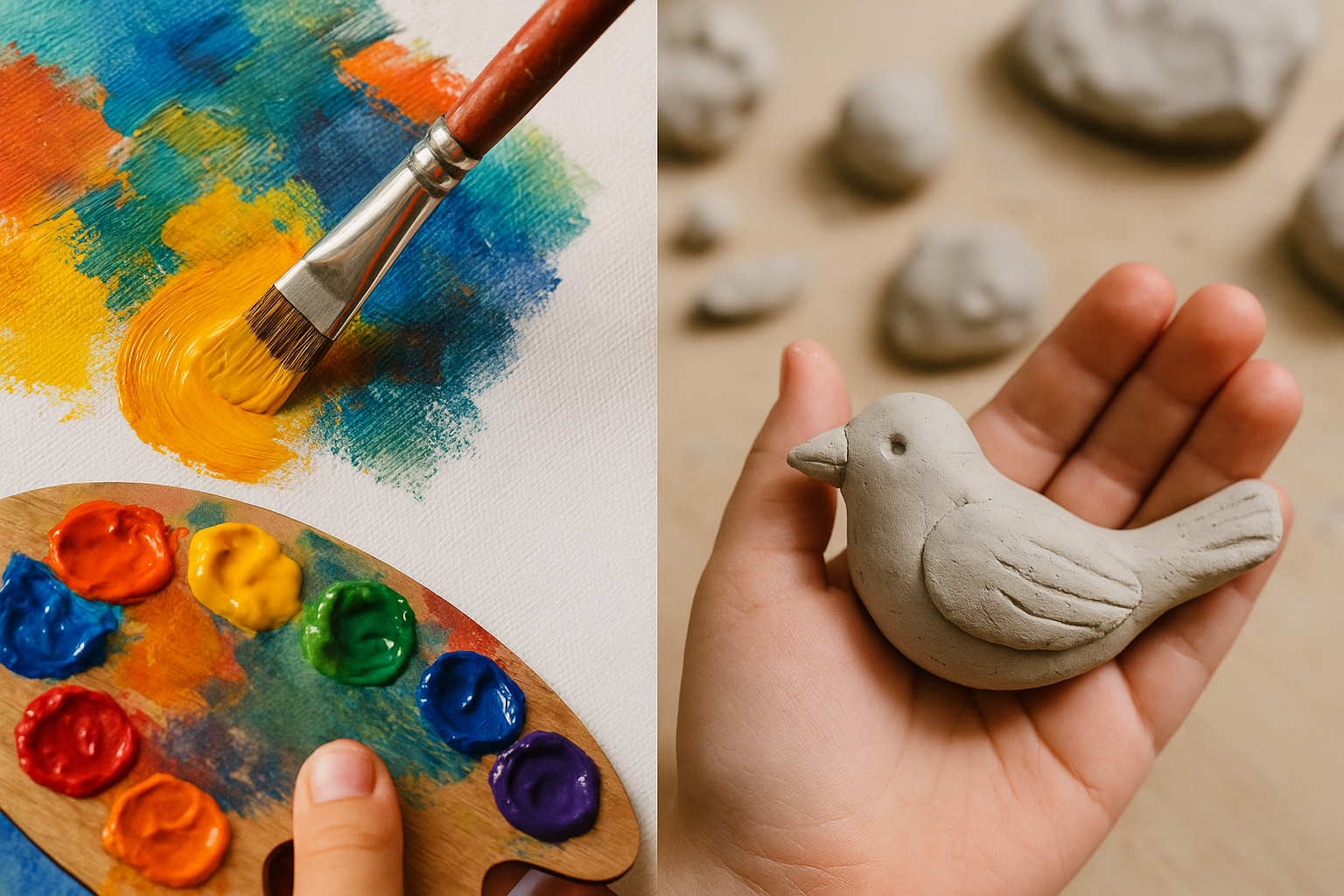
Cape Town fosters young artists through two city programs, nurturing talent from childhood to professional careers, boosting local art economy.
Cape Town has awesome programs to help artists grow! The "Emerging Artists Programme" is like a super tough art school for young adults, teaching them how to sell their art. Then there's "Arts Aweh!", a free after-school club where kids get to play with art supplies and make cool stuff. Together, these programs help artists from childhood doodles all the way to selling their amazing creations in big galleries.
What initiatives does Cape Town have to support emerging artists?
Cape Town supports emerging artists through two main programs: the Emerging Artists Programme and Arts Aweh! The Emerging Artists Programme is a pressure-cooker residency for young adults, focusing on market-readiness and mentorship. Arts Aweh! is a free after-school program for children, fostering creativity from a young age.
Get Cape Town news in your inbox
Stay updated with the latest stories from the Mother City.
Section 1 – Two Doors Swing Open
Cape Town just flung open a pair of gates that matter to anyone who draws, dances, raps or renders.
Gate One is the 2026 Emerging Artists Programme: 25 seats, 400-plus hopefuls, zero consolation prizes.
Gate Two is Arts Aweh!, the free after-school artillery against boredom that has already enrolled 2 000 kids who arrive armed with nothing more than curiosity and the urge to make something out of clay, cardboard or a cracked smartphone.
Between them the City has built a conveyor belt that picks a child up at age eight and, if the hunger survives puberty, drops a market-ready artist into the commercial circuit before the thirtieth birthday cake is cut.
The formula is blunt: catch them, keep them, catapult them.
No other metro on the continent funnels primary-school doodles into Investec Art Fair sell-outs with this degree of premeditation.
Section 2 – The 25 Who Make It
The Emerging Artists Programme is not a pampered residency; it is a pressure cooker that runs on Saturdays and runs you into the ground.
Since 2021 almost 1 000 twenty-somethings have survived legal clinics, grant-writing boot-camps and the Royal-College-style “hot-seat” critique where every brushstroke is interrogated.
Outcome: 38 % of alumni now earn most of their living from art, compared with the national under-35 average of 11 %.
Four of the 2025 intake emptied their booths at the Investec Cape Town Art Fair in seventy-two hours; security had to throttle the aisles.
Collage prodigy Lihle Mgxekwa, 24, walked away with enough cash to rent a studio in Woodstock’s Buchanan Square, the same postcode galleries scout as aggressively as Sand Hill Road scouts unicorns.
What shocks first-timers is the “exhibition readiness” module.
Before you sniff the wine at the May group show you must price, insure, frame and pitch a coherent body of work.
Marketing heavies from WHATIFTHEWORLD and the Association of Arts Pretoria stage fake walk-throughs, demanding to know why an A2 digital print retails for R8 500 when the paper cost R18.
By opening night each artist carries a stock sheet, a card machine and a thirty-second elevator pitch honed in a mirror plastered with fluorescent Post-its.
Mentorship is medieval: one master, one apprentice, one shared wall.
The 2026 line-up pairs applicants with Igshaan Adams, whose tapestries breach R400 000 on the secondary market, and Zanele Muholi, who gives mentees ten days to draft a full exhibition proposal.
Ayesha Price, class of 2022, abandoned kitchen-table politeness and welded 300 kg of reclaimed harbour chain into suspended body casts for her show “Soft Armour”; the Norval Foundation commission cleared her student debt in a single EFT.
Section 3 – The 2 000 Who Start Young
Arts Aweh! operates in the lethal 14:00–17:00 window when parents are still shackled in traffic and the streets market other pastimes.
Venues are chosen like crime-scene tape: a library wedged between two gang territories in Hanover Park, a church hall in Mfuleni opposite a shebeen, a converted bait container in Pelican Park.
Each site swallows R25 000 worth of Daler-Rowney paper, Staedtler pens, non-toxic glaze and DSLR cameras older than the kids wielding them.
The timetable reads like a mixtape: Monday blind-contour boot-camp, Tuesday stop-motion on recycled phones, Wednesday Grade-7s choreograph music videos with under-13 dance crews, Thursday clay day, Friday pop-up gallery where 200 fresh works wallpaper the corridor.
Facilitators - 36 young adults on the Expanded Public Works Programme - earn R4 200 a month plus data, but the real loot is a digital vault of lesson plans and Red Bull royalty-free loops that 14 of them have already leveraged into teaching degrees at CPUT.
The maths is irresistible: R12 per child per day, cheaper than the R18 subsidy for a municipal swimming pool and a fraction of what the state spends on remedial policing.
When eight-year-old Aaliyah Davids describes her cardboard “House with Wings” as armour against the wind and a roof that lifts so Ouma can flee the shooting, the clip is flagged by in-house psychologists and the art class quietly doubles as trauma triage.
Section 4 – Where the Two Rivers Meet
Every Arts Aweh! hall reserves one wall for “alumni spotlights”, glossy prints of Emerging Artists graduates whose surnames are local and whose invoice totals are not.
Kids read those plaques like comics; the subliminal memo is that the cracked linoleum beneath their shoes can lead to Berlin, Basel or the Norval Foundation.
Conversely, any applicant to the senior programme who once wore a blue Arts Aweh! sticker receives an automatic 5 % bump on the final rubric, a policy that has already birthed three inter-generational murals, one of them a 28 m stretch at Mfuleni taxi rank paid for by the drivers’ Christmas fund.
Digital infrastructure keeps widening the pipe.
In 2025 teens minted NFTs on the Celo blockchain - thirty editions of a protea water-colour by a 12-year-old sold at R250 each, proceeds split 70/20/10 artist/community/platform.
The stunt bankrolled an extra semester and drew scolding headlines about “township JPEGs”, but the kids just call it grocery money.
Meanwhile the senior cohort experiments with Geenee AR: point a phone at a canvas and a hologram of the artist explains glaze chemistry in a floating bubble.
Sanlam’s private-client division is already sniffing around wine-cellAR installations for high-net-worth collectors who want a story with every sip.
Logistics remain a contact sport.
A clay shipment hijacked in Bellville resurfaced in Philippi as 200 tourist chameleons; GPS trackers are now baked into every pallet.
Load-shedding murders kilns, so a retired Green Point yachtie donated a bank of second-hand Tesla batteries nicknamed “Area 51” that keeps two kilns at 1 200 °C for three hours - long enough to save a bisque and a livelihood.
International institutions have stopped watching and started shipping.
The Goethe-Institut flew twelve facilitators to Berlin to co-design a fold-out solar container that will dock in Coffee Bay by December 2026, part PA system, part projection wall, full-time cultural Trojan horse.
The Danish Embassy has already booked a 2027 Investec booth where ten-year-olds will share carpet space with twenty-somethings, a soft-power chess move that treats crayon drawings as foreign currency.
Back in Mfuleni the queue outside the library still bends around the corner on registration day.
Numbered stickers - blue for juniors, red for seniors - turn admin into a collector’s quest.
One ten-year-old slides her blue stub beside sketches of mermaids in Springbok jerseys; she is exactly the age at which previous cohorts began to dream - first in graphite, later in exhibition-grade ink - of the morning their own surnames appear on the Emerging Artists wall.
[{"question": "What are the main programs Cape Town offers to support artists?", "answer": "Cape Town offers two primary programs: the \"Emerging Artists Programme\" for young adults and \"Arts Aweh!\" for children. These programs work together to nurture artistic talent from childhood through to professional careers."}, {"question": "What is the \"Emerging Artists Programme\"?", "answer": "The Emerging Artists Programme is a rigorous residency designed for young adults, accepting around 25 participants from hundreds of applicants. It focuses on developing market-ready artists through legal clinics, grant-writing bootcamps, 'hot-seat' critiques, and an 'exhibition readiness' module that teaches pricing, framing, pitching, and marketing. It also includes mentorship with established artists like Igshaan Adams and Zanele Muholi."}, {"question": "How successful is the \"Emerging Artists Programme\" in helping artists earn a living?", "answer": "The program has a significant impact on its alumni's livelihoods. Since 2021, 38% of graduates now earn most of their income from art, which is substantially higher than the national average of 11% for those under 35. Many alumni have achieved notable commercial success, including selling out at art fairs and securing studio spaces."}, {"question": "What is \"Arts Aweh!\"?", "answer": "Arts Aweh! is a free after-school program for children, aimed at fostering creativity from a young age. It operates in various community locations, providing art supplies and diverse activities like blind-contour drawing, stop-motion animation, choreography, and pottery. The program also serves as a form of trauma support, with in-house psychologists flagging concerning artistic expressions."}, {"question": "How do the two programs, \"Emerging Artists Programme\" and \"Arts Aweh!\", connect and support each other?", "answer": "These programs form a 'conveyor belt' for artist development. Arts Aweh! alumni receive a 5% bump on their final rubric if they apply to the Emerging Artists Programme, encouraging continuity. Additionally, Arts Aweh! venues display 'alumni spotlights' of successful Emerging Artists graduates, inspiring younger participants and demonstrating the potential career path."}, {"question": "What innovative approaches does Cape Town use to support artists financially and logistically?", "answer": "Cape Town embraces innovation, such as minting NFTs on the Celo blockchain for young artists to sell their work, providing 'grocery money'. The senior cohort experiments with augmented reality (Geenee AR) for interactive art experiences. Logistically, they've implemented GPS trackers for art supply shipments and use repurposed Tesla batteries ('Area 51') to power kilns during load-shedding, ensuring continuous production. International collaborations, like with the Goethe-Institut and Danish Embassy, also provide global exposure and resources."}]
Sarah Kendricks is a Cape Town journalist who covers the city’s vibrant food scene, from township kitchens reinventing heritage dishes to sustainable fine-dining at the foot of Table Mountain. Raised between Bo-Kaap spice stalls and her grandmother’s kitchen in Khayelitsha, she brings a lived intimacy to every story, tracing how a plate of food carries the politics, migrations and memories of the Cape.
View all articles →