
WHY CHILDREN NEED THIS JOURNEY
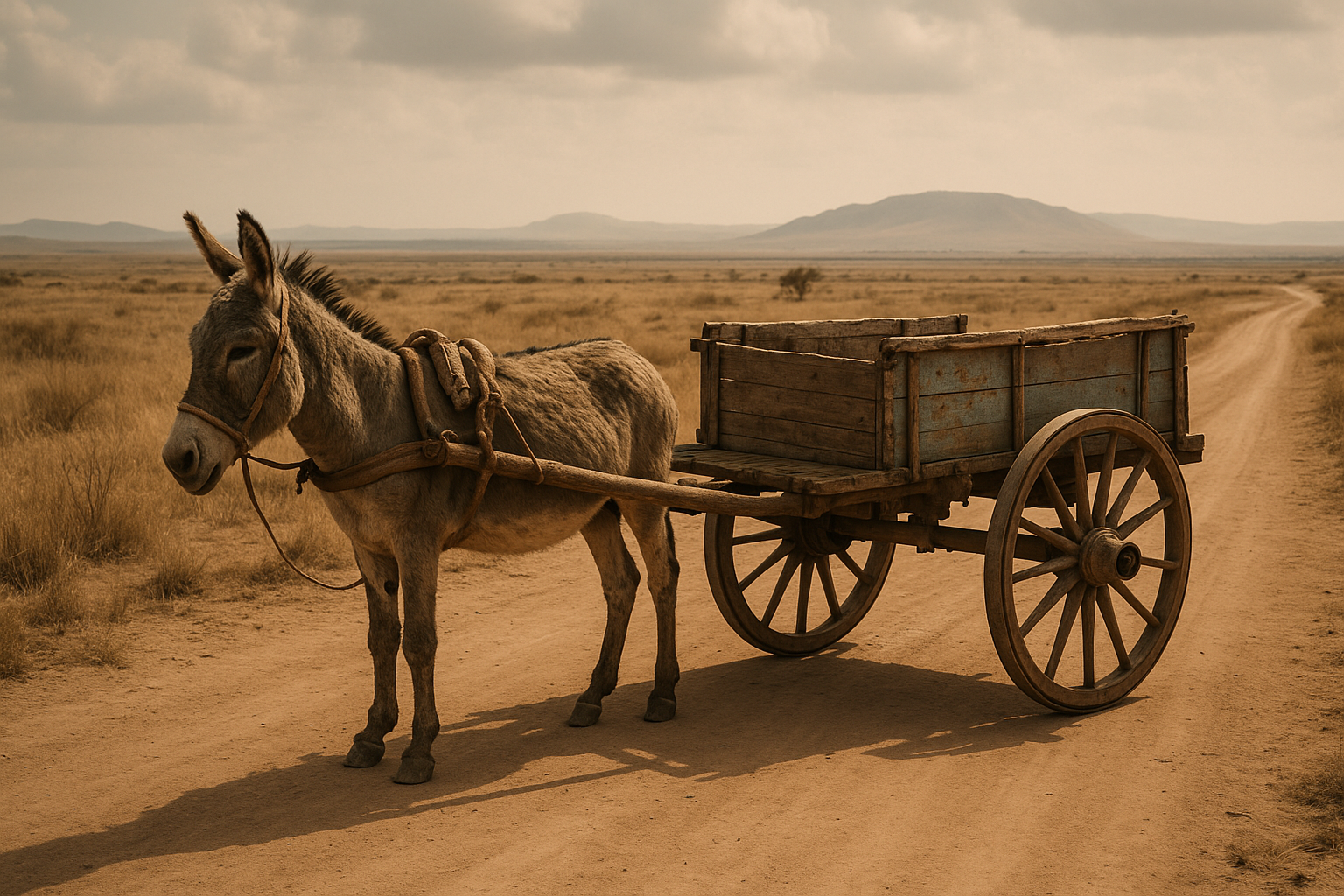
A retired neurosurgeon uses a donkey cart to bring paediatric care to remote South African communities, redefining rural healthcare.
Dr. André Hattingh, a retired brain surgeon, created "Donkeys at Dawn" to bring healthcare to kids in far-off South African villages. He built a special donkey cart, slow but steady, that goes where cars can't. This amazing mobile clinic gives children check-ups and treatment, showing that being there for them is more important than being fast. It's a heartwarming story of compassion, using old ways for new solutions to help little ones.
What is the "Donkeys at Dawn" initiative?
André Hattingh's "Donkeys at Dawn" initiative uses a specially re-engineered donkey cart to bring paediatric healthcare to remote rural children in South Africa. This mobile clinic overcomes geographical barriers, providing essential screenings, diagnoses, and treatments, proving that presence and accessibility are more vital than speed in underserved areas.
Get Cape Town news in your inbox
Stay updated with the latest stories from the Mother City.
Storms, Silence and the Six-Wheel Prescription
Lightning still rips across the Highveld maize belt and the Karoo keeps its ancient hush, but geography no longer decides who gets help first. Paediatric sub-specialists huddle in Gauteng, the Western Cape and KwaZulu-Natal, while one-doctor clinics dot the interior like scattered marbles that disappear at sunset. Between those marble-dots and the city triangles stretches a slow-motion emergency: children whose coughs, fevers or club-foot will out-run any ambulance dispatched after dusk. Enter a grey-haired neurosurgeon who swapped rotor blades for hoof beats and freeways for wagon ruts.
André Hattingh retired from the theatre lights in 2015, but retirement lasted one thunderstorm. Watching a lightning map crawl across the TV weather forecast, he calculated that a helicopter would never beat the storm front to a toddler seizing in a mountain hamlet. A car would bog down on the same wet gravel. What travels 3–4 km per hour, carries half a tonne, and arrives alive every time? A donkey cart, the same technology that hauled wool to Cape Town harbours in 1890. Hattingh phoned Afrikaner wheel-wrights, bought a 1952 chassis for the price of a good dinner, and told them he wanted “space for a stethoscope and a sack of carrots.”
The rebuild took eight months. Six rescued donkeys - Rooibok, Saracen, Tikka, Doppie, Vlooi and Lady - learned to tolerate the hiss of a portable nebuliser and the beep of a pulse-oximeter. A Cape Town sail-maker stitched a canvas roof, then let hospital paediatric nurses splatter it with teddy-bear stencils and X-ray films so that children recognised the rig before they recognised the doctor. Every bolt, cooler and cable was weighed against the 750-kg legal limit on district roads; nothing could snap a donkey’s back or a municipal bylaw. The finished contraption is the continent’s slowest, best-equipped child-health module: a moving argument that velocity is less valuable than visibility.
Pop-Up Lungs, Library Rooms and the R87 Cure
Word of the cart’s schedule travels on WhatsApp groups with names like “Boere Krisis” and on the crackle of farm co-op CB radios long before the first hoof strikes town gravel. A Land Cruiser shadows two kilometres behind, carrying water, wheels and veterinary kits, but the convoy’s real power is sociological: 3.7 km per hour gives principals, pastors and shepherds time to round up every under-fifteen for the moment the canvas flaps open. Two inflatable tents clip to the cart like bright orange dinghies; in thirty minutes a gravel parking lot becomes a paediatric day clinic complete with solar roof, fold-out couch and a tablet linked to WhatsApp Radiology.
In Williston a boy arrives clutching eleven months of clinic cards: asthma, then TB, then “it’s in his head.” Hattingh maps the cough on the back of an immunisation register and notices it spikes every fourteen days - exactly when the family sleeps in a stone kraal thick with donkey hair. A finger-prick IgE test whirs in a shoe-box centrifuge; levels scream five times normal. Allergic bronchopulmonary aspergillosis, not resistant TB. Oral steroids, a spacer hacked from a 500 ml Fanta bottle, and a R4 shade-cloth liner for the kraal cost R87 in total. The mother bursts into tears; she had already spent R1 400 on taxis to hospitals where the queue ate her grant money and her hope.
Forty-eight hours later the Williston council unlocks an empty library storeroom, the co-op donates a 2 kW inverter, and the primary school budget sprouts a new line for monthly medication delivery. Multiply the sequence - sixteen stops, 1 912 screenings, 184 surgical referrals, 47 hearing aids calibrated on a tailgate - and the cart becomes a stone dropped in a dam whose rings refuse to flatten. Outreach clubs keep meeting even when hooves are far away, proving that momentum can be left behind like a scent.
Hoof Heartbeats, Polyurethane Shoes and the R55 000 Rap Track
Rooibok’s cardiac scare arrived disguised as a Karoo sandstorm. The lead donkey wobbled; a Fitbit taped to his girth showed ectopic beats. The same paediatric cardiologist who had travelled to scan children slathered ultrasound gel on a shaved equine chest and diagnosed dehydration-induced electrolyte drift. Two litres of Ringer’s later, both Rooibok and the six-year-old girl awaiting an echo were stable - one health system, one literal heartbeat. The animals wear 3-D-printed polyurethane shoes cast from recycled Coke bottles; the honeycomb sole spreads weight so efficiently that 35 km of tar a day leaves no heat swelling, a distance Victorian transport riders would have called witchcraft.
Funding streams read like a census of modern South Africa. A Stellenbosch estate bottled a single pinotage barrel labelled “Karoo Miles, Children’s Smiles” and auctioned it for R380 000. A Grade-4 class in Lichtenburg dragged 1.2 million five-cent pieces to school in six wheelbarrows after their teacher turned the collection into a maths lesson on mass and volume. Die Kaapse Klonkies sampled Rooibok’s actual bray into an Afrikaans rap track whose streaming royalties have already topped R55 000. Even a highway fast-food store joined in: the “Hattingh Combo” thick-shake donates a percentage nationwide, a campaign that could out-fund the original journey if TikTok views convert to milk-shake sales.
Tokyo Ultrasounds, Matched Grants and Cobalt-Blue Calm
The night before departure, Hattingh e-mailed every district mayor a six-page memorandum quoting Treasury’s clause that lets NGO cash unlock matched public funds within ninety days. By journey’s end, municipal pens had freed R2.4 million for Oudtshoorn Hospital alone: a new humidicrib, piped oxygen to every cot, and a sensory-integration courtyard designed by students who watched the cart work. A Cape Town start-up slid a LoRaWAN tracker under the bench; each wheel revolution now feeds an open-source map proving that where population density drops below 18 people per square kilometre, the cart model breaks even at 1.6 consultations per kilometre - already surpassed by real data.
International ears pricked up faster than policy could. A BBC podcast titled “The Man Who Walked at 3 km/h to Save Children” triggered donations from thirty-one countries; a Japanese engineer air-freighted a 4 kg handheld ultrasound after remembering her own rural childhood. The University of Toronto wants to twin final-year residents for three-month electives, teaching high-level diagnostics without backup - a skill set as useful in the Arctic as in a Karoo dust storm. Back home, builders have broken ground on a 24-bed paediatric wing whose windows stop at donkey-eye height and whose cobalt-blue corridor rails replicate the canopy colour psychologists noticed calming toddlers. Fragments of the original tarp are melted into the floor vinyl, sealing every kilometre into the building’s DNA.
The cart now rests in the hospital forecourt, tyres cool for the first time in months. Children who were too small to walk the route press palms against hail dents and camp-stove scorch marks, inventing the next chapter: Wi-Fi antennae on the canopy for tele-medicine, an axle dynamo that powers a water-purifier, a science-fair booking that turns the rig into a travelling laboratory. No closing ceremony is required; momentum, like the Karoo wind, keeps moving across the plains, proving that speed is a number while presence is a strategy - and a donkey’s ears can out-listen a siren any day.
What is "Donkeys at Dawn"?
André Hattingh's "Donkeys at Dawn" is an initiative that utilizes a specially re-engineered donkey cart to deliver pediatric healthcare to children in remote rural areas of South Africa. This mobile clinic was created to overcome geographical barriers, providing essential screenings, diagnoses, and treatments to underserved communities.
Who founded "Donkeys at Dawn" and why?
"Donkeys at Dawn" was founded by Dr. André Hattingh, a retired brain surgeon. He was inspired to create this initiative after realizing that traditional emergency services and vehicles couldn't reach children in remote mountain hamlets during adverse weather conditions. Witnessing a lightning storm, he concluded that a slow, steady donkey cart would be more reliable and accessible than helicopters or cars in such challenging terrains.
How was the donkey cart clinic developed?
Dr. Hattingh acquired a 1952 chassis and worked with Afrikaner wheel-wrights for eight months to re-engineer it. The cart was designed to be robust yet lightweight enough for donkeys, adhering to a 750-kg legal limit. It was equipped with medical necessities and a canvas roof, decorated with child-friendly stencils by hospital pediatric nurses, to make it welcoming for children. Six rescued donkeys were trained to pull the cart.
What services does the "Donkeys at Dawn" cart provide?
The mobile clinic offers a range of pediatric healthcare services, including screenings, diagnoses, and treatments. It can transform a gravel parking lot into a day clinic with inflatable tents, a solar roof, a fold-out couch, and a tablet for tele-radiology. Examples of its impact include diagnosing and treating conditions like allergic bronchopulmonary aspergillosis, calibrating hearing aids, and making surgical referrals. A Land Cruiser follows with additional supplies and veterinary kits.
How is "Donkeys at Dawn" funded?
Funding for "Donkeys at Dawn" comes from a diverse array of sources. These include unique initiatives like the auction of a special wine barrel ("Karoo Miles, Children's Smiles") for R380,000, school children collecting five-cent pieces, and royalties from an Afrikaans rap track featuring a donkey's bray (over R55,000). A highway fast-food chain also contributes through a "Hattingh Combo" thick-shake campaign. Additionally, the initiative has successfully leveraged NGO cash to unlock matched public funds from municipalities, leading to significant investments in local healthcare infrastructure.
What has been the broader impact and recognition of the initiative?
"Donkeys at Dawn" has had a profound impact. It has facilitated significant infrastructure improvements in local hospitals, such as new humidicribs and piped oxygen, by unlocking R2.4 million from municipal funds. The cart's movements are tracked via LoRaWAN, demonstrating its effectiveness in low-density areas. It has gained international recognition through a BBC podcast, donations from 31 countries, and the receipt of specialized medical equipment like a handheld ultrasound from Japan. The University of Toronto is even considering twinning residents for electives. The initiative's success has led to the construction of a 24-bed pediatric wing designed with children's comfort in mind, embodying the cart's spirit of accessible care.

Liam Fortuin is a Cape Town journalist whose reporting on the city’s evolving food culture—from township kitchens to wine-land farms—captures the flavours and stories of South Africa’s many kitchens. Raised in Bo-Kaap, he still starts Saturday mornings hunting koesisters at family stalls on Wale Street, a ritual that feeds both his palate and his notebook.
View all articles →