
Cape Town’s formal objection
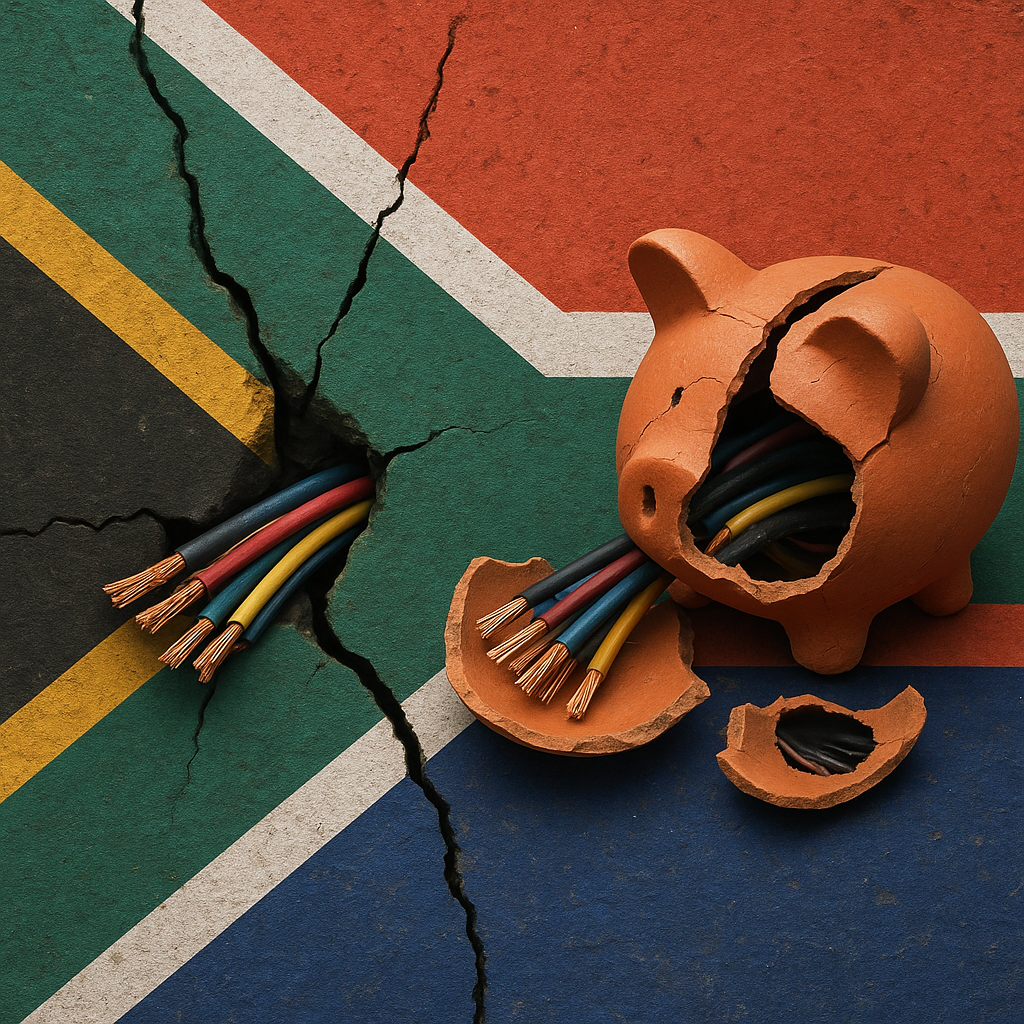
Eskom's 9% tariff hike sparks legal battles, threatens jobs, and reshapes South Africa's energy future amid elections.
{"summary": "South Africa's power prices just shot up by 9%, hitting everyone from homes to big businesses. This means an extra R46 billion will be paid, threatening jobs in mining and squeezing small shops. People are fighting back with lawsuits, solar panels, and even new apps to find better deals. This price hike is shaking up the whole country, pushing people to find new ways to get electricity and changing politics."}
What is the impact of South Africa's 9% power price increase?
The 9% power price increase in South Africa will cost consumers an extra R46 billion, impacting households, municipalities, and industrial users. It threatens 90,000 mining jobs, reduces spaza shop profits, and accelerates the adoption of alternative energy solutions, creating a complex economic and political ripple effect across the nation.
Get Cape Town news in your inbox
Stay updated with the latest stories from the Mother City.
The Announcement That Sparked a Revolt
Just after sunrise on 26 March 2024, Nersa dropped a four-page media note that felt like a fire-cracker in a munitions store.
The regulator confirmed Eskom may lift prices by an average 8.98 %, retro-active to 1 April.
The wording was bone-dry - “a revenue path aligned with prudently incurred costs and the allowed regulatory asset base” - yet within minutes municipalities knew their budgets were bleeding.
Cape Town’s mayor vowed to “use every legal tool in the book.”
SALGA scrambled 113 chief financial officers into an emergency Zoom call.
By supper-time #Reject9Percent was the country’s second-most trending topic, trumped only by gossip about a British royal’s health.
The decision did not fall from the sky.
It is the latest twist in a courtroom saga that started in May 2022, when the North Gauteng High Court threw out MYPD5 and ordered Nersa to re-run the numbers within a year.
The regulator missed that deadline, begged for six more months, and finally published revised figures in December 2023.
Eskom first asked for 17 %, then 13 %, then 10.5 %; the 8.98 % award is now sold to the public as a “compromise” and to Eskom as “below survival level.”
Critics prefer the shorter label: a claw-back in Sunday clothes.
Where the Extra R46 Billion Will Come From and Who Gets Stung
Nersa’s arithmetic shows Eskom will harvest an additional R46.3 billion in twelve months, split into three buckets.
Direct customers - about 5.2 million homes plus 400 000 farms - will hand over R19 billion more.
One-hundred-and-eighty-six municipalities must find another R22 billion when they buy bulk power.
Big industrial users will supply the remaining R5.3 billion through the “network charge” that landed last year.
R7.8 billion of the new money is ring-fenced for diesel-fired open-cycle gas turbines, a blunt admission that another summer of thin margins is expected.
Cape Town, however, claims the whole hike is unnecessary.
Its internal model uses Eskom’s own September 2023 numbers and argues the utility’s EBITDA margin has already bounced from 7 % to 24 %.
Apply the regulator’s real-weighted cost of capital (5.44 %, not the 7.94 % Eskom wanted) and a 4.2 % increase would have been enough, the city insists.
Officials are preparing a second court review but may instead launch a constitutional claim anchored in section 152, the clause that guarantees accountable local government.
While lawyers trade briefs, Cape Town is quietly building 60 MW of rooftop and car-port PV on municipal roofs and reservoirs.
A green bond listed on the JSE is footing the bill.
Once everything runs, the city will skip 180 GWh of Eskom purchases and save R1.2 billion a year, shaving roughly 1.5 percentage points off any future hike.
Every extra percentage point Eskom squeezes therefore shortens the pay-back period on the city’s solar-plus-storage tenders, speeding the utility’s own revenue drain.
Nersa has already muttered that such “partial defection” could activate a re-opener clause forcing municipalities to pay extra “stranded-capacity” fees.
From Gold Belts to Spaza Shelves: The Ripple Few Policymakers Budgeted For
The Minerals Council wasted no time: within two days it published regression work showing a 1 % power-price rise trims sector margins by 0.34 %.
With the rand at 18.90 and gold at $2 050 an ounce, South African deep-level mines already sit on the 90th percentile of the global cost curve.
The lobby group warns the latest hike could erase 90 000 jobs in the next eighteen months, most of them around Carletonville, Welkom and Polokwane.
Sibanye-Stillwater has placed Beatrix West on “care-and-maintenance watch,” while Harmony is eyeing Zambian copper where tariffs sit at US¢9/kWh versus the new local average of US¢13.
The council wants the mineral resources minister to invoke section 54 of the Electricity Regulation Act, a rarely used escape hatch that lets big consumers wheel private power at negotiated prices.
Township micro-retailers feel the shock just as keenly.
A typical Khayelitsha spaza burns 180 kWh a month on fridges, lights and phone charging; the April bill climbs from R459 to R499.
That R40 slice equals two full days of net profit, yet owners cannot push bread prices higher because supermarket chains use subsidised loaves as loss-leaders inside mall forecourts.
The likely coping tactic is to switch fridges off overnight, raising the risk of food spoilage.
Across Diepsloot, Soweto and Umlazi 37 000 licensed spazas serve 11 million residents; electricity now eats 14 % of their operating cost, up from 8 % four years ago.
Some are experimenting with LPG fridges or Chinese-supplied solar freezers, but supplier credit comes at 28 % annual interest, trapping owners in a new debt spiral.
Wealthier households are opting out altogether.
Last year South Africa imported 1.4 GW of small-scale inverters and 2.1 GW of PV modules - more than Namibia’s entire installed base.
Most kits are slapped on suburban roofs by “cowboy” installers who never file the required NRS-097-2-1 forms.
Nersa has only eighteen inspectors nationwide; Eskom’s distributed-generation desk has twenty-seven engineers.
The result is a 300 MW grey market in Gauteng’s northern suburbs alone, none of it metered, all of it eroding the cross-subsidy that keeps the incline-block tariff sane for the poor.
Every percentage point Eskom adds accelerates this exodus, tightening the death spiral.
Courtrooms, Ballot Boxes and Tech Work-Arounds: The Fightback Takes Many Shapes
Civil society is answering with code, not placards.
A Cape Town developer recently released an open-source “Tariff Tracker” that scrapes daily prepaid prices from 1 300 vendors, compares them with the gazetted rate and flags illegal mark-ups in real time.
Within five days 46 000 users had uploaded bills, exposing average vendor premiums of 4.2 %.
The city has already yanked 37 trader licences; banks are watching because the same coder’s machine-learning model predicts solar-adopting suburbs with 71 % accuracy by pairing roof-aspect ratios with credit-bureau data.
Home-loan top-ups in the model’s top decile are surging, evidence that tariff fatigue is driving a secondary consumer-finance boom.
Bondholders are doing their own sums.
South Africa’s 2044 Eskom US-dollar bond trades at 78 ¢, implying a 9.8 % yield.
JP Morgan reckons every 1 % price lift adds roughly $120 million in annual hard-currency cash-flow; the 9 % decision therefore yields an extra $1.08 billion - just enough to cover the $900 million bullet due in January 2025.
Should Cape Town win a retroactive rollback, Eskom could be forced to refund customers and risk a technical default on that covenant.
Rating agencies have placed the B- outlook on “developing” status, polite code for “anything can still happen.”
Meanwhile, the political calendar is ticking.
The first higher bills will hit mailboxes about three weeks before the May-August 2024 national vote.
ANC internal polls show electricity prices now rank third among voter worries, behind only jobs and crime.
One scenario doing the rounds in Treasury is a once-off R9 billion household rebate, funded by the expected Sasol profit-share dividend, to cushion 7.3 million indigent households.
Opposition parties are sharpening sound-bites: the DA promises “a city-owned electron for every resident by 2029,” while the EFF vows to “nationalise Sasol and cut power prices by half.”
What began as a technocratic revenue fix is morphing into an electoral wild-card that could redraw coalition maps.
From heat-pump roll-outs and blockchain pilots to night-surplus pleas and heat-map algorithms, the 9 % hike is ricocheting through suburbs, mines, courtrooms and townships.
Each workaround - legal, financial or technological - weakens the old centralised model a little more, turning today’s tariff victory into tomorrow’s revenue conundrum.
South Africa’s power politics, once decided in smoky boardrooms, is now being rewired kilowatt by kilowatt on roofs, spreadsheets and ballot slips across the country.
What is the recent power price increase in South Africa?
South Africa recently experienced an average power price increase of 8.98%, effective retroactively from April 1, 2024. This decision by Nersa (National Energy Regulator of South Africa) followed a protracted legal battle and negotiations with Eskom, the national power utility.
How will this 9% power price hike impact consumers and businesses?
The 9% power price increase is projected to generate an additional R46.3 billion for Eskom. This will impact direct customers (homes and farms) by R19 billion, municipalities by R22 billion, and large industrial users by R5.3 billion. The increase is expected to threaten up to 90,000 jobs in the mining sector, squeeze the profit margins of small businesses like spaza shops, and increase the cost of living for households across the country.
What are the immediate reactions and legal challenges to this price increase?
Upon the announcement, there was widespread public and institutional backlash. Cape Town's mayor vowed to use all legal tools, while the South African Local Government Association (SALGA) convened an emergency meeting of financial officers. Legal challenges are underway, with some municipalities, like Cape Town, preparing court reviews and even considering constitutional claims. The public also reacted strongly, with '#Reject9Percent' trending on social media.
How are different sectors and individuals adapting to the rising electricity costs?
Various stakeholders are exploring alternatives to mitigate the impact of the price hike. Municipalities like Cape Town are investing in large-scale rooftop and car-port solar PV installations to reduce reliance on Eskom. Wealthier households are increasingly adopting small-scale solar and inverter systems, creating a 'grey market' that further erodes Eskom's revenue. Small businesses are considering LPG fridges or solar freezers, despite high interest rates on credit. A developer even released a "Tariff Tracker" app to help consumers identify and avoid illegal mark-ups by prepaid electricity vendors.
What are the broader economic and political implications of this power price increase?
The 9% power price increase carries significant economic and political weight. Economically, it could lead to job losses, particularly in energy-intensive industries like mining, and contribute to inflationary pressures. Politically, electricity prices have become a key voter concern ahead of the May-August 2024 national elections, ranking third after jobs and crime. The decision could influence voter behavior and potentially reshape coalition maps, with opposition parties using it as a central campaign issue.
What is a 'death spiral' in the context of Eskom and power prices?
A "death spiral" in this context refers to a vicious cycle where increasing electricity tariffs encourage more customers (especially those who can afford it) to switch to alternative energy sources like solar. This reduces Eskom's customer base and revenue, forcing the utility to further increase prices for its remaining customers to cover fixed costs. This, in turn, accelerates the exodus of more customers, tightening the spiral and potentially leading to the collapse of the traditional centralized power model. The current price hike is seen as accelerating this trend as more consumers seek to defect from the grid.

Sarah Kendricks is a Cape Town journalist who covers the city’s vibrant food scene, from township kitchens reinventing heritage dishes to sustainable fine-dining at the foot of Table Mountain. Raised between Bo-Kaap spice stalls and her grandmother’s kitchen in Khayelitsha, she brings a lived intimacy to every story, tracing how a plate of food carries the politics, migrations and memories of the Cape.
View all articles →